New Semester
Started
Get
50% OFF
Study Help!
--h --m --s
Claim Now
Question Answers
Textbooks
Find textbooks, questions and answers
Oops, something went wrong!
Change your search query and then try again
S
Books
FREE
Study Help
Expert Questions
Accounting
General Management
Mathematics
Finance
Organizational Behaviour
Law
Physics
Operating System
Management Leadership
Sociology
Programming
Marketing
Database
Computer Network
Economics
Textbooks Solutions
Accounting
Managerial Accounting
Management Leadership
Cost Accounting
Statistics
Business Law
Corporate Finance
Finance
Economics
Auditing
Tutors
Online Tutors
Find a Tutor
Hire a Tutor
Become a Tutor
AI Tutor
AI Study Planner
NEW
Sell Books
Search
Search
Sign In
Register
study help
business
business statistics
The Bayesian Way Introductory Statistics For Economists And Engineers 1st Edition Svein Olav Nyberg - Solutions
You have studied the brightness of a certain type of star, and are interested in the variation. The brightness follows a Normal distribution \(\phi_{(\mu, \sigma)}(x)\), so you study the variance by means of \(\tau\). Your investigations have concluded that \(\tau \sim \gamma_{(101.5,15)}(t)\).(a)
Find \(t_{4,0.1}\).
In the following problems, the probability distributions for the parameter \(p\) of a Bernoulli process are given. Find the probability of event \(H\).(a) \(p \sim \beta_{(12,17)}(p) . H=\mathrm{T}\).(b) \(p \sim \beta_{(12,17)}(p) . H=\perp\).(c) \(p \sim \beta_{(12,17)}(p) . H=\perp
Let \(X\) be the proportion of \(40 \mathrm{~W}\) light bulbs that break when dropped onto a carpet from a height of \(1 \mathrm{~m}\). You have tried it out, and your probability distribution for \(X\) is now \(X \sim \beta_{(23,48)}\).(a) What is the expected proportion of light bulbs \(\mu_{X}\)
It is election time, and you are fact checking candidate April Weatherstone's factual claims. Let \(Y\) be the proportion of errors in Weatherstone's factual claims. Your estimate of \(Y\), after studying two months of election campaigns, is \(\beta_{(17,64)}\). What is the probability that 2 or
T ∼ weib(5,4). What are μT, σ2T, and P(T ≤ 4)?
When Jack goes into the Canadian wilderness, he looks most forward to seeing reindeer. Let \(T\) be the time (in hours) that it takes before he sees a reindeer. \(T \sim\) weib \(_{(2,2)}\).(a) What is expected waiting time \(\mu_{T}\) for Jack to see a reindeer?(b) What is the probability that
It is given that \(T\), the time (in seconds) it takes Santa's engineer elves to make a remote controlled car, is Weibull distributed with parameters \(\lambda=2.5\) and \(k=1\).(a) What is the expected time for the engineering elves to make a car?(b) What is the standard deviation for the time for
The longevity of Solan's motorized vehicles (in years), is \(T \sim f(x)=\) weib \(_{(1,0.5)}(x)\).(a) What are \(\mu_{T}\) and \(\sigma_{T}^{2}\) ?(b) What is the probability that a given motorized vehicle lasts for more than one year?(c) Write down \(f(x)\) as simplified as possible. You will
X follows a continuous uniform probability distribution over the interval \(I=(a, b)\) if \(P(X=x)=1 /(b-a)\) whenever \(x \in I\), and 0 otherwise. Use the rules from sections 7.3, 7.5 and 7.6 to solve the problems below:(a) Find \(\mu_{X}\).(b) Find \(\sigma_{X}^{2}\).(c) Graph the probability
X is (continuously) uniformly distributed over an interval \([a, b]\), and \(M \subset[a, b]\) is a disjoint union of intervals whose widths sum up to \(w\). What is \(P(X \in M)\) ?
Bayesian/frequentist(a) Who makes their estimates of the model parameters from the data alone?(b) Who speaks of \(P\) (observation | model )?(c) Who speaks of \(P\) (model | observation \()\) ?(d) Who presupposes randomness for their methods?(e) Who does all their inference through a probability
What are the two main purposes of statistical inference mentioned by Bard and Frederick? What is the difference between these two purposes, and how are the purposes related?
Your company has acquired the Chuck Wood's lumber mill. Along with the mill itself, they also got the mill's inventory. Your job is to estimate the humidity of the lumber by measuring 100 units. Discuss in groups which factors may bias the selection and sampling of units.
Discuss strengths and weaknesses in Bard's and Frederick's estimates of the proportion of hugs Mina will give to each of them. May one of the ways of analysing fit better in one context, and the other better in another context? If so: which kind of analysis fits which kind of context best?
Santa's workshop makes 10 different types of sack for Santa and his elves, types \(A_{1}, A_{2}, \ldots, A_{10}\). The number of \(A_{x}\) type sacks made are \(17 \times x\). In other words, there exist \(17 A_{1}\) sacks, \(34 A_{2}\) sacks, etc. The proportion of soft gifts depends on the type
You have \(100 A_{k}\), numbered from 1 to 100 , and \(f_{\text {pre }}(k)=k^{2} / 338350\). You make observation \(B_{1}\), and see that \(g(k)=P\left(B_{1} \mid A_{k}ight)=1 / k\). What are the posterior probabilities \(P_{\text {post }}\left(A_{k}ight)\) ?
You participate in a chocolate lottery, where every participant gets a bag. Your Christmas elf has filled the bags like this: he puts a dark chocolate into the bag. Then he tosses a coin. If the coin lands heads, he adds a milk chocolate, and tosses the coin again, and repeats the process. The
You have found a magic lamp on the beach. The genie in the lamp is a mathematician, and she has decided to fill a bag with rocks in the following way: she tossed a fair coin repeatedly until she got tails. She then counted the total number of tosses, \(X\), and filled the bag with \(2^{X}\) rocks.
Bernoulli trials- The alternatives are indexed by an \(x\) running from 1 through 15 .- The prior probability in choosing among the 15 alternatives is uniform.- For alternative \(x\), we have \(P(\mathrm{~T})=x / 15\) whereas \(P(\perp)=1-P(\mathrm{~T})\).- You perform two trials, "with
Sacks with handles; the contents are white (W) and black (B) balls.- You have seven sacks with an index \(x\) running from 1 through 7.- Sack \(x\) has \(x\) handles, and in a random pick, each handle has equal probability of being picked.- All the sacks are filled with white (W) and black (B)
Nuts come in two different chiralities (threadings); left-handed (L) and right-handed (R). Oleson's hardware store sells packs containing both kinds in one pack.- Oleson sells 5 types of nut pack. The types are enumerated by an \(x\) running from 1 through 5.- All packs contain 100 nuts. A pack of
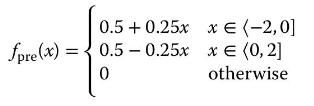
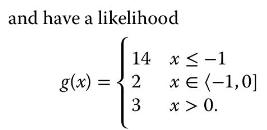
You are updating a prior probabilityFind the posterior probability distribution \(f_{\text {post }}(x)\). fpre (x)= 0.5 +0.25x x = (-2,0] - 0.5 0.25x x = (0,2] 0 otherwise
Make a die or any other physical object that may serve as your "random generator". Divide the possible outcomes into two roughly equal sets. If, for instance, you have made a 6-sided die, you may divide it into \(A\) : "low numbers" \((1,2,3)\) and \(B\) : "high numbers" \((4,5,6)\). Your task is
Prove the formula for the probability distribution of \(X_{+}\)in Section 13.1.1. Use that \(\mu\) and \(\left(X_{+}-\muight) \sim \phi_{(0, \sigma)}\) are independent.
Capacitors: You have measured the capacitance of FR Electronics's smallest capacitors. From a sample of 25 measurements, you got an average of \(\bar{c}=49.19 \mu \mathrm{F}\), and a sample standard deviation of \(s_{c}=2.15 \mu \mathrm{F}\). Assume the capacitance of this kind of capacitor follows
The tensile strength of cables of the same type and thickness typically follows some Normal distribution \(\phi_{(\mu, \sigma)}\), where \(\mu\) and \(\sigma\) depend only on type and thickness. A colleague of yours has pulled apart wires of a certain type and thickness to find their tensile
You are given the prior hyperparameters of a binomial process, observation data, and a value \(p\). Find the posterior distribution for \(\pi\) and its Normal approximation. Further, calculate the probability \(P(\pi \leq p)\) both by exact calculation on \(\beta\), and by using the Normal
You are given the posterior for the Bernoulli parameter \(\pi\), and numbers \(m, s, k\), and \(l\). Find the predictive distributions for \(K_{+m}\) and \(L_{+s}\), and calculate the probabilities \(P\left(K_{+m} \leq kight)\) and \(P\left(L_{+s}
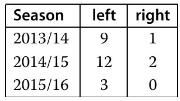
The Bayern Munich player Arjen Robben scores most of his goals with the left foot. The statistics of the goals he has scored by foot are as follows:Let \(\pi\) be the proportion of Robben's foot scorings that he does with his left. Find the probability distribution of \(\pi\) when...(a) you use
Bard has given you a biased coin, and you wonder what the probability \(\pi\) of heads is. He replies that he doesn't quite know, but that his friend Sam, who gave it to him, once estimated the probability of heads to be \(\frac{3}{7}\), and that Sam was as certain of that as if he had flipped the
You are looking at the proportion \(\pi\) of consumers who prefer MegaCola to its competitors. You use Jeffreys' prior hyperparameters, \(a_{0}=b_{0}=0.5\).(a) You arrange blind tastings of MegaCola and and its competitors, and then ask the participants to indicate which one they preferred. After
You are estimating the proportion of Macintoshes among the laptops of a rather large company. Your prior hyperparameters are \(a_{0}=7\) and \(b_{0}=3\). You ask 10 laptop-using colleagues; 8 of them are on a Macintosh. What are now your posterior hyperparameters for the proportion of MacBooks?
You are looking into the quality of the diamonds of the diamond mines in a new area. You have a special interest in "Fancy diamonds" 5 of quality IF and VVS, and you are estimating \(\pi\), the proportion of diamonds from the new mines that fit one of these descriptions. After having evaluated 172
In the two-player board game Go, black and white take turns putting a stone on the board, with black having the first move. Sondre Glimsdal, the \(O g\) Go club chairman, wonders what percentage of the games is won by each color. He believes it is fairly even, so his prior for the proportion of
You are given prior hyperparameters for a Poisson process, and observational data. Find the posterior distribution for the rate parameter \(\lambda\).(a) Prior: \(\kappa_{0}=0, \tau_{0}=0\). Observed: \(n=7\) occurrences during \(t=5\) units.(b) Prior: \(\kappa_{0}=5, \tau_{0}=10\). Observed:
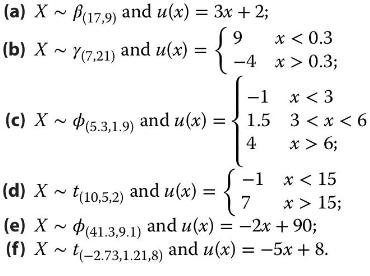
In the problems below, you are given the probability distribution of a stochastic variable \(X\) and a utility function \(u(x)\). Find the expected utility \(U\). (a) X ~ B(17.9) and u(x) = 3x + 2; (b) X ~ Y(7.21) and u(x) = { 9 x < 0.3 -4 x > 0.3; -1 x 15; (e) X ~ (41.3.9.1) and u(x) = -2x + 90;
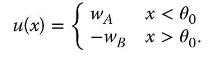
You are going to decide whether \(A\) : \(\Theta\theta_{0}\). The gain in utility of choosing \(A\) instead of \(B\) isIn the first three subproblems below, you are given \(\theta_{0}, w_{A}\), and \(w_{B}\). Formulate the decision problem as a hypothesis test by indicating significance level
You are given the posterior distribution \(\theta \sim f(x)\), the significance \(\alpha\), and alternative hypothesis \(H_{1}\). Test, and decide between the competing hypotheses.(a) \(\theta \sim \phi_{(7,2)}, \alpha=0.05\), and \(H_{1}: \theta>3\).(b) \(\theta \sim \phi_{(9,2)}, \alpha=0.05\),
You have a job controlling how well pubs fill pint servings. More precisely, you sample to evaluate if the mean servings \(\mu\) are at least 1.0 pint. For your job, you use a neutral prior. At one particular pub one evening, you have sampled 10 pints, and measured:
Measuring 25 of FR Electronics's smallest capacitors, you got \(\bar{c}=49.19 \mu \mathrm{F}\) and sample standard deviation \(s_{c}=2.15 \mu \mathrm{F}\). Assume the capacitances follow a Normal distribution \(\phi_{(\mu, \sigma)}\), and determine, with significance \(\alpha=0.02\) and neutral
You are given a (posterior) distribution for \(\pi \sim \beta_{(a, b)}\), a significance \(\alpha\), and \(H_{1}\). Test the following competing hypotheses, to decide between them, both by direct calculation and by Normal approximation.(a) Posterior: \(\pi \sim \beta_{(35,24)}, \alpha=0.1\), and
You are estimating \(\pi\), the proportion who prefer MegaCola to its competitors, and your posterior hyperparameters for \(\pi\) are \(a_{1}=41.5\) and \(b_{1}=9.5\). If the proportion who prefer MegaCola is more than 75\%, MegaCola will launch a costly campaign. A consideration of the utilities
Your are estimating \(\pi\), the proportion of "Fancy diamonds" of quality IF and VVS, in a diamond mining project where they are considering buying new and expensive mining equipment if this proportion exceeds 0.1 . Owing to the high costs, they will be determining whether \(H_{1}: \pi>0.1\) with
You are given a probability distribution for \(\tau \sim \gamma_{(k, \lambda)}\), a significance \(\alpha\), and \(H_{1}\). Determine the hypothesis test, both by direct calculation and by using the Normal approximation.(a) Posterior: \(\tau \sim \gamma_{(6,3)}, \alpha=0.04\), and \(H_{1}:
The brothers Odd and Kjell Aukrust lie home in bed with whooping cough, and as Kjell rattles off a particularly long-lasting cough, Odd exclaims: That one lasted for rather a long time, but not as long as mine do! Kjell disagrees, so they decide to measure coughing times (in seconds):- Odd: 22, 20,
Nicholas believes that the tomcat Baggins purrs for longer than the female cat Perry, but Caroline, who is a student keenly interested in statistics, asks him to back up his claim by hypothesis testing it with significance \(\alpha=0.1\).Nicholas then times how long each cat purrs after one single
Your are comparing two \(\gamma\) distributed variables \(\Theta \sim \gamma_{(k, l)}\) and \(\Psi \sim \gamma_{(m, n)}\) to decide between hypotheses \(H_{1}\) (as specified below) and \(H_{0}\), with significance \(\alpha\).(a) \(\Theta \sim \gamma_{(7,70)}\), and \(\Psi \sim \gamma_{(4,80)}\).
You are comparing two \(\beta\) distributed variables \(\psi \sim \beta_{(k, l)}\) and \(\pi \sim \beta_{(m, n)}\) to determine the hypothesis \(H_{1}\) (which is either \(\psi>\pi\), or \(\psi\pi\).(d) Let the parameters of the Problem 16.c be 10 times as large. This corresponds to ten times as
Your company has for a long time used Imperial Deliveries for freight. Lately, however, a promising new competitor has surfaced: Centurium Falcon Freight. You decide to test the rate of delivery errors to compare the two. Let \(\pi_{I D}\) be the proportion of erroneous deliveries at Imperial
From distribution to interval.(a) \(\mu \sim \phi_{(14,3)}\). Find \(I_{0.025, l}^{\mu}\) and \(I_{0.025, r}^{\mu}\) and \(I_{0.05}^{\mu}\).(b) \(\mu \sim \phi_{(-4.3,7.2)}\). Find \(I_{0.005, l}^{\mu}\) and \(I_{0.005, r}^{\mu}\) and \(I_{0.01}^{\mu}\).(c) \(\mu \sim \phi_{(48, \sqrt{19})}\). Find
From data + prior to interval. Find \(I_{2 \alpha}^{\mu}\) and \(I_{2 \alpha}^{+}\).(a) Data: \(\{0,1,2,3,4,5,6,7,8,9,10\}\), neutral prior, known \(\sigma=2.3 ; 2 \alpha=\) 0.05 .(b) Prior: \(\kappa_{0}=7, \Sigma_{0}=1253, s_{0}=15.2 \alpha=0.1\). We have 23 observations with
Sample size:(a) Given known \(\sigma=5\), and prior hyperparameter \(\kappa_{0}=0\), how many observations \(n\) do you have to make to ensure \(I_{0.01}^{\mu}\) is narrower than 0.5 ?(b) With known \(\sigma=0.42\), and prior hyperparameter \(\kappa_{0}=8\) how many observations \(n\) do you have
You have tried weighing your dog, knowing well that it is unable to stand still on the scales. You have done this four times, and based on the wobbling of the weight dial, you assume the weighings correspond to \(\sigma=0.4 \mathrm{~kg}\); the mean weight was \(\bar{y}=17.5 \mathrm{~kg}\). Using a
Your son is doing athletics, and his performance varies from day to day. He wants to compete, and has asked you to help him by assessing his high jumps. His coach is also a gymnastics and mathematics teacher, and tells you that jump heights of each athlete follows a Normal distribution
From distribution to interval.(a) \(\mu \sim t_{(68.1,11.9,17)}\). Find \(I_{0.001}^{\mu}\).(b) \(\mu \sim t_{(68.1,11.9,4)}\). Find \(I_{0.001}^{\mu}\) and \(I_{0.1}^{\mu}\).(c) \(X_{+} \sim t_{(5,1.2,7)}\). Find \(I_{0.02}^{+}\).
From data + prior to interval. Find \(I_{2 \alpha}^{\mu}\) and \(I_{2 \alpha}^{+}\). In addition, find \(I_{2 \alpha}^{\tau}\) and \(I_{2 \alpha}^{\sigma}\). (a) Data: \(\{0.896,0.279,0.865,0.955,0.936,-0.046\}\); use a neutral prior. \(2 \alpha=0.05\).(b) Prior: \(\kappa_{0}=6, m_{0}=150, v_{0}=5,
Sample size:(a) Using prior hyperparameters \(\kappa_{0}=7, v_{0}=6\), and \(S S_{0}=17\), how many observations \(n\) do you need to make in order for \(P\left(\mu \in H_{1.3}^{\mu}ight) \geq 0.9\) ?(b) Using prior hyperparameters \(\kappa_{0}=5, v_{0}=4\), and \(S S_{0}=50\), how many
A standard European football goal is \(732 \mathrm{~cm}\) wide and \(244 \mathrm{~cm}\) high, so if the goalkeeper is standing in the middle of the goal, he needs to be able to throw himself far enough to the sides that his hands are \(366 \mathrm{~cm}\) away from the middle, if he wants to cover
You are out diving with five friends, and stop to admire a school of goldfish. At that point, you are all at the same depth. Your ACME depth gauges respectively 33.1, 28.3, 29.0, 29.7, 33.2, and 30.9 meters. Find a \(90 \%\) credible interval for your actual depth. Use a neutral prior.
You are following the band Pünk Flöyd, and just attended a concert with a rather permeating smell of sweet smoke. The police had conducted random checks of 10 audience members, and had in total impounded 54.4 grams of hashish. The individual weights were as follows: 5.8, 6.0, 1.8, 3.4,
In the Norwegian box office hit film Il Tempo Gigante, it was said that on Reodor Felgen's first run of his racing car Il Tempo Gigante, the seismograph in Bergen registered it as an earthquake in Flåklypa of magnitude 7.8 on the Richter scale. For extra observations, the seismograph in Reykjavik
From distribution to interval.(a) \(\lambda \sim \gamma_{(4,17)}\). Find \(I_{0.05}^{\lambda}\).(b) \(\lambda \sim \gamma_{(7,128)}\). Find \(I_{0.001}^{\lambda}\).(c) \(\lambda \sim \gamma_{(2,8)}\). Find \(I_{0.1}^{\lambda}\).
From data + prior to interval. Find \(I_{2 \alpha}^{\mu}\) and \(I_{2 \alpha}^{+}\).(a) Prior: \(\kappa_{0}=3, \tau_{0}=5\). Observed: \(n=13\) occurrences during \(t=20\) units. \(2 \alpha=0.02\).(b) Prior: \(\kappa_{0}=4, \tau_{0}=8\). Observed: \(n=48\) occurrences during \(t=100\) units. \(2
Your prior hyperparameter is \(\kappa_{0}=5\). How many observations do you need to make for the relative interval width \(r\) for a \(80 \%\) credible interval to be less than 0.2 ?
The daily catch for grouse hunters in an area is considered to be Poisson distributed with rate \(\lambda\). One day, you talked to 23 hunters from a certain part of the Lowlands, and their total catch was 111 grouse. Use a neutral prior, and find an \(85 \%\) credible interval for \(\lambda\).
The number of plumbing gaskets that need changing every week in an apartment complex is assumed to follow a Poisson process with rate \(\lambda\). You are estimating this need for an apartment complex with 70 flats, and have looked into the documentation for the last semester (26 weeks), and find
The number of cracks in the tarmac per kilometer of road is assumed to follow a Poisson process with rate \(\lambda\). Your job is to find this rate for a lesser highway, and you have found 13 cracks in \(10 \mathrm{~km}\). Use a neutral prior, and calculate a \(92 \%\) credible interval for
How many four-leaf clovers are there per square meter in a field of leaf clovers? Assume that the occurrence follows a Poisson process with rate \(\lambda\). You look at three independent leaf clover fields. The first field is \(t_{1}=1.9 \mathrm{~m}^{2}\) in area, and has \(n_{1}=0\) fourleaf
The number of bacterial colonies per cubic centimeter in a certain polluted lake is assumed to be Poisson distributed with parameter \(\lambda\). You sample 1 deciliter, and find 157 bacterial colonies. Use a neutral prior, and calculate a 95\% credible interval for \(\lambda\).
From distribution to interval.(a) \(\pi \sim \beta_{(43,96)}\). Find \(I_{0.1}^{\pi}\), both by exact calculation of \(\beta\), and by using Normal approximation.(b) \(\pi \sim \beta_{(7,128)}\). Find \(I_{0.001}^{\pi}\), both by exact calculation of \(\beta\), and by using Normal approximation.(c)
From data + prior to interval. Find \(I_{2 \alpha}^{\pi}\).(a) \(2 \alpha=0.07\). Prior: \(a_{0}=3, b_{0}=5\).Observed: \(k=13\) positives and \(l=20\) negatives.(b) \(2 \alpha=0.1\). Prior: \(a_{0}=0, b_{0}=0\) (Novick and Hall).Observed: \(k=4\) positives and \(l=9\) negatives.(c) \(2
Sample size: \(\pi\) has prior hyperparameters \(a_{0}=12\) and \(b_{0}=31\). How many new observations do you need to make to ensure that \(I_{0.2}^{\pi}\) is narrower than 0.05 ?
You are studying Bard's biased coin. Your prior hyperparameters for \(\pi\), the probability of heads, is \(a_{0}=9\) and \(b_{0}=12\). Find the \(90 \%\) symmetric credible interval for \(\pi\) after each update.(a) You flip 23 heads and 18 tails.(b) You flip again, and get 458 heads and 366
Sondre Glimsdal wants to estimate \(\pi\), the proportion of \(G o^{1}\) games won by white. His prior is \(\pi \sim \beta_{(7,7)}\). Sondre updates his estimate by observing new games. Find the \(80 \%\) symmetric credible interval for \(\pi\) after each update.(a) 1st observation: white wins 13
Find the \(P \%=(1-\alpha) 100 \%\) interval estimates \(\widehat{I_{\alpha}^{\mu}}\) and \(\widehat{I_{\alpha}^{+}} ; \sigma\) is known. (a) \(\sigma_{0}=2\). Data: \(\{5.9,5.8,4.8,4.7,1.6,2.8,2.6,5.8,5.1,4.1\} . P \%=90 \%\).(b) \(\sigma_{0}=\) 12.1. \(\alpha=0.05\). We have 47 observations with
Find the \(P \%=(1-\alpha) 100 \%\) interval estimates \(\widehat{I_{\alpha}^{\mu}}, \widehat{I_{\alpha}^{\sigma}}\) (use that \(\sigma=1 / \sqrt{\tau}\) ) and \(\widehat{I_{\alpha}^{+}} ; \sigma\) is unknown.(a) \(\alpha=0.1\). We have 29 observations with average \(\bar{x}=8.2069\) and sample
Find the \((1-\alpha) 100 \%\) confidence interval \(\hat{I_{\alpha}^{p}}\).(a) \(k=17\) positive and \(l=25\) negative. \(\alpha=0.05\).(b) You have heard that Coca and Pepsi have an equal share in the Cola market at your university, and decide to investigate if this is true. Your investigations
Determine the hypothesis test outcome about the parameter \(\pi\) for a Bernoulli process; significance \(\alpha\).(a) \(H_{1}: \pi>0.5 . \alpha=0.05\). Observations: \(k=8\) positive and \(l=6\) negative.(b) \(H_{1}: \pi
Determine the hypothesis test outcome about the mean \(\mu\) for a Gaussian process; significance \(\alpha\).(a) \(H_{1}: \quad \mu eq 25 . \quad \alpha=0.05\). Statistics: \(n=27, S_{x}=715.333 . \quad \sigma_{0}=3.73\) (known).(b) \(H_{1}: \mu>80 . \alpha=0.01\). We have 200 observations with
It is claimed that the mean compression strength for a certain kind of steel beam exceeds 60000 psi, and you have decided to determine the test outcome of this alternative hypothesis with \(\alpha=0.1\). Your observations are \(\{60060,59580,60498,60071,60593,60384,60013,60491,60321,60626\),
Determine the hypothesis test outcome concerning the variance \(\sigma^{2}\) of a Gaussian process; significance \(\alpha\).(a) \(H_{1}: \sigma^{2}25 . \alpha=0.02\). We have 100 observations with sample standard deviation \(s_{x}=6.41236\).
We look at the steel beams in again. This time, we are testing the variance, and the alternative hypothesis is \(H_{1}: \sigma eq 666\). Determine the hypothesis test outcome with \(\alpha=0.1\).
In the problems below, you are given observational data \(\left\{\left(x_{i}, y_{i}ight)ight\}\), and information about \(\sigma\). Find the ...- posterior distribution of \(\tau\).- posterior distribution of \(y(x)\).- posterior predictive distribution of \(Y_{+}(x)\).- \(P
In the problems below, you are given observational data \(\left\{\left(x_{i}, y_{i}ight)ight\}\), and information about \(\sigma\). Find the ...- posterior distribution of \(\tau\).- posterior distribution of \(y(x)\).- posterior predictive distribution of \(Y_{+}(x)\).(a) Data:
In the problems below, you are given observational data \(\left\{\left(x_{i}, y_{i}ight)ight\}\), and information about \(\sigma\). Find the ...- \(P \%=\left(1-\alpha_{1}ight) 100 \%\) credible interval \(I_{\alpha_{1}}\) for the regressions line \(y(x)\).- \(Q \%=\left(1-\alpha_{2}ight) 100 \%\)
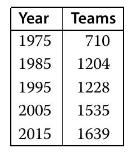
The Norway Cup is a European football youth cup and training camp that has arranged at Ekebergsletta in Oslo every year since 1972 (except for in 1976, when the organizers, Bækkelagets Sportsklub, arranged the Oslo Handball Cup instead). We are going to look at the trend in the number of
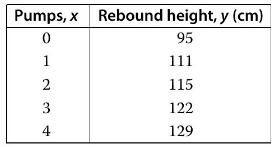
In American football, there was a scandal where the New England Patriots had inflated their balls rather poorly ahead of a decisive game against the Indianapolis Colts. Our local football coach informs us that balls behave differently when they are flaccid than when they are hard, and he wants to
The spectral slope is an important characteristic of voices and musical instruments. The spectral slope is the slope \(b\) of the regression line between \(\ln x\) and \(y\), where \(x\) is the frequency (measured in hertz), and \(y\) is the amplitude (measured in decibels). You have made such
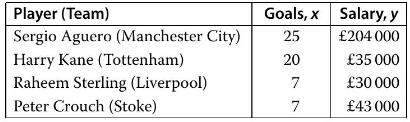
Investigate whether there is a (linear) relation between the weekly salaries of the best UK football strikers and the number of goals they score, with significance \(\alpha=0.2\). We will be using data from 2015 . Player (Team) Sergio Aguero (Manchester City) Goals, x Salary, y Harry Kane
You are investigating the solubility of xylose in water inside a pumping system. The water is pressurized, so you get temperatures well in excess of \(200^{\circ} \mathrm{C}\). The variables are temperature \((x)\) and (maximum) grams of xylose per liter \((y)\). Your measurements arePresent your
The position number ω(letter) tells us where in the alphabet the given letter is located. For instance: ω(“b”) = 2. Find the mean, median and population standard deviation for the vowel position numbers in the English alphabet.
For the functions f (x) above that are continuous probability distributions:let X ∼ f (x), and find Mx, x, and P(X 5).
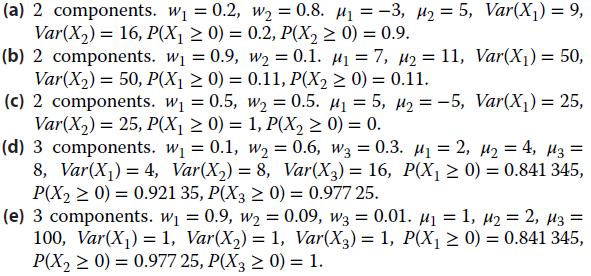
In the subproblems below, X is a mixed distribution with k components Xk, with respective weights wk. For each subproblem, find μX, Var(X), and P(X ≥ 0). (a) 2 components. W = 0.2, w = 0.8. = -3, = 5, Var(X) = 9, Var(X2)=16, P(X 0) = 0.2, P(X 0) = 0.9. (b) 2 components. W = 0.9, Var(X2)=50,
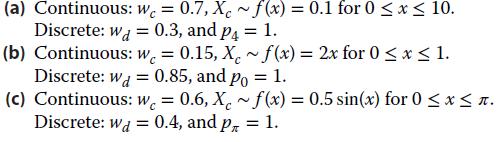
In the subproblems below, there is one discontinuity. Graph Fc, Fd, and FX, and find μX and Var(X). ~ (a) Continuous: wc = 0.7, X f(x) = 0.1 for 0 x 10. Discrete: wd = 0.3, and p4 = 1. 2 (b) Continuous: w = 0.15, X f(x) = 2x for 0 x 1. Discrete: wd = 0.85, and po = 1. (c) Continuous: w = 0.6, X
We have a mixed distribution with two discontinuities. The continous part is given by wc = 0.2, and Xc ∼ f (x) = 0.1 for 0 ≤ x ≤ 10. The discrete part is given by wd = 0.8, and the two discontinuities are p3 = 0.375 and p9 = 0.625.Graph Fc, Fd, and F, and find μX and Var(X).
The artist Sandra has insured her concert tour. Insurance agents Beowulf have calculated with a 12% probability that the tour will be in the red, and that, in such a case, the loss will be distributed g(x) = 5 × 10⁻⁷e−5×10⁻⁷x. The insurance covers the entire loss. Let X be the payment from
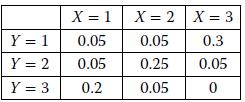
For Z = (X, Y) given by following table, find the marginal probabilities, P(X + Y = 4), and the correlation ρxy: X=1 X 2 X=3 - = Y = 1 0.05 0.05 0.3 Y = 2 0.05 0.25 0.05 Y = 3 0.2 0.05 0
Z = (X, Y) ∼ fZ(x, y) = 4/5 ( 2 − x − y3) for ∫x, y ∈ [0, 1]. Find the marginal probabilities fx and fy, the covariance σxy, and determine whether X and Y are independent.
Z = (X, Y) ∼ fZ(x, y), which is 1/π inside the circle x2 + y2 = 1, and 0 otherwise(where π = 3.141 59…).(a) Find the marginal probability distributions fx and fy.(b) Are X and Y independent?(c) Find the conditional probability distributions f|Y=y(x) and f|X=x(y).
Showing 8200 - 8300
of 8575
First
72
73
74
75
76
77
78
79
80
81
82
83
84
85
86
Step by Step Answers

 Get 50% OFF
Claim Now
Get 50% OFF
Claim Now