New Semester
Started
Get
50% OFF
Study Help!
--h --m --s
Claim Now
Question Answers
Textbooks
Find textbooks, questions and answers
Oops, something went wrong!
Change your search query and then try again
S
Books
FREE
Study Help
Expert Questions
Accounting
General Management
Mathematics
Finance
Organizational Behaviour
Law
Physics
Operating System
Management Leadership
Sociology
Programming
Marketing
Database
Computer Network
Economics
Textbooks Solutions
Accounting
Managerial Accounting
Management Leadership
Cost Accounting
Statistics
Business Law
Corporate Finance
Finance
Economics
Auditing
Tutors
Online Tutors
Find a Tutor
Hire a Tutor
Become a Tutor
AI Tutor
AI Study Planner
NEW
Sell Books
Search
Search
Sign In
Register
study help
business
computer communications
Data And Computer Communications 10th Edition William Stallings - Solutions
Some researchers argue that the optimal placement of the center of the shared tree(i.e., the rendezvous point in PIM) is crucial for achieving good delay characteristics for the multicast traffic. Argue for or against this statement.
“In sparse-mode PIM, for the route between a given source and a given destination, the RP-based tree may be replaced with a path that is the shortest unicast path from source to destination.” This is not quite accurate. What is wrong with the statement?
Most multicast routing protocols, such as MOSPF, minimize the path cost to each group member, but they do not necessarily optimize the use of the Internet as a whole. This problem demonstrates this fact.a. Sum the hop costs incurred by each packet involved in a multicast transmission of a source
With multicasting, packets are delivered to multiple destinations. Thus, in case of errors (such as routing failures), one IP packet might trigger multiple ICMP error packets, leading to a packet storm. How is this potential problem avoided? Hint: consult RFC 1122.
Multicast applications commonly use UDP or RTP (Real-Time Transport Protocol)as their transport protocol. Multicast applications do not use TCP as its transport protocol. What’s the problem with TCP?
Multicast applications call an API function on their sockets in order to ask the IP layer to enable or disable reception of packets sent from some specific IP address(es)to a specific multicast address.For each of these sockets, the system records the desired multicast reception state. In addition
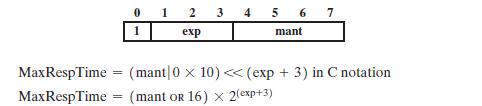
IGMP membership queries include a “Max Resp Code” field that specifies the maximum time allowed before sending a responding report. The actual time allowed, called the Max Resp Time, is represented in units of 0.1 s and is derived from the Max Resp Code as follows:If MaxRespCode 6 128,
In IGMPv1 and IGMPv2, a host will cancel sending a pending membership report if it hears another host claiming membership in that group, in order to control the generation of IGMP traffic. However, IGMPv3 removes this suppression of host membership reports. Analyze the reasons behind this design
IGMP specifies that query messages are sent in IP datagrams that have the Time to Live field set to 1. Why?
In a manner similar to Figure 21.3, show the spanning tree from router B to the multicast group.
and comment on the results.
In the discussion of Figure 21.1, three alternatives for transmitting a packet to a multicast address were discussed: broadcast, multiple unicast, and true multicast. Yet another alternative is flooding. The source transmits one packet to each neighboring router. Each router, when it receives a
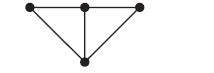
A connected graph may have more than one spanning tree. Find all spanning trees of this graph:
Most operating systems include a tool named “traceroute” (or “tracert”) that can be used to determine the path packets follow to reach a specified host from the system the tool is being run on. A number of sites provide web access to the “traceroute”tool, for
Under what circumstances would a mobile node choose to use each of the types of address referred to in the preceding question?
What are the two different types of destination addresses that can be assigned to a mobile node while it is attached to a foreign network?
What is the relationship between Mobile IP discovery and ICMP?
List and briefly define the capabilities provided by Mobile IP.
What is Openflow?
What is an SDN domain?
What network requirements led to the development of SDN?
What operations are performed by IGMP?
List and briefly explain the functions that are required for multicasting.
Summarize the differences among unicast, multicast, and broadcast addresses.
List some practical applications of multicasting.
A TCP entity opens a connection and uses slow start. Approximately how many round-trip times are required before TCP can send N segments?
In Equation (20.5), rewrite the definition of SRTT(K + 1) so that it is a function of SERR(K+1). Interpret the result.
Derive Equation (20.2) from Equation (20.1).
One difficulty with the original TCP SRTT estimator is the choice of an initial value.In the absence of any special knowledge of network conditions, the typical approach is to pick an arbitrary value, such as 3 s, and hope that this will converge quickly to an accurate value. If this estimate is
Jacobson’s congestion control algorithm assumes most packet losses are caused by routers dropping packets due to network congestion. However, packets may be also dropped if they are corrupted in their path to destination. Analyze the performance of TCP in such a lossy environment, due to
Analyze the advantages and disadvantages of performing congestion control at the transport layer, rather than at the network layer.
A source generates data in terms of bursts: 3 MB bursts lasting 2 msec once every 100 msec. The network offers a bandwidth of 60 MB/sec.a. The source passes through a leaky bucket with a capacity of 4 MB. How does the output look like?b. What should be the capacity of the leaky bucket to avoid loss?
Consider a token bucket with a capacity of 1 Mb, a token replenishment rate of 2 Mbps, and an outgoing network link of capacity 10 Mbps. Suppose that an application produces 0.5-Mb burst every 250 ms for 3 seconds and that initially the bucket is full of tokens.a. Initially, what is the output rate
The token bucket scheme places a limit on the length of time at which traffic can depart at the maximum data rate. Let the token bucket be defined by a bucket size B octets and a token arrival rate of R octets/second, and let the maximum output data rate be M octets/s.a. Derive a formula for S,
For a frame relay network to be able to detect and then signal congestion, it is necessary for each frame handler to monitor its queueing behavior. If queue lengths begin to grow to a dangerous level, then either forward or backward explicit notification or a combination should be set to try to
Consider the packet-switching network depicted in Figure 20.14. C is the capacity of a link in frames per second. Node A presents a constant load of 0.8 frames per second destined for A’. Node B presents a load λ destined for B’. Node S has a common pool of buffers that it uses for traffic
A congestion control scheme used with ATM (Available Bit Rate) is to decrease the allowable data rate in response to congestion with the following equation.Ratenew = Rateold - Rateold * RDF where RDF is the rate decrease factor.a. Discuss how fast/slow does the sender respond to congestion for the
When the sustained traffic through a packet-switching node exceeds the node’s capacity, the node must discard packets. Buffers only defer the congestion problem;they do not solve it. Consider the packet-switching network in Figure 20.13. Five stations attach to one of the network’s nodes. The
A proposed congestion control technique is known as isarithmic control. In this method, the total number of frames in transit is fixed by inserting a fixed number of permits into the network. These permits circulate at random through the frame relay network. Whenever a frame handler wants to relay
Distinguish among TCP, UDP, and DCCP.
How can TCP be used to deal with network or internet congestion?
What are the differences between token bucket and leaky bucket?
Briefly explain the three general approaches to explicit congestion signaling.
What is the difference between backward and forward explicit congestion signaling?
Give a brief explanation of each of the congestion control techniques illustrated in Figure 20.5.
Why is it that when the load exceeds the network capacity, delay tends to infinity?
When a node experiences saturation with respect to incoming packets, what general strategies may be used?
BGP provides a list of autonomous systems on the path to the destination. However, this information cannot be considered a distance metric. Why?
BGP’s AS_PATH attribute identifies the autonomous systems through which routing information has passed. How can the AS_PATH attribute be used to detect routing information loops?
Consider a system using flooding with a hop counter. Suppose that the hop counter is originally set to the “diameter” of the network. When the hop count reaches zero, the packet is discarded except at its destination. Does this always ensure that a packet will reach its destination if there
Build a centralized routing directory for the networks of Figure 19.16.
Another adaptive routing scheme is known as backward learning. As a packet is routed through the network, it carries not only the destination address but also the source address plus a running hop count that is incremented for each hop. Each node builds a routing table that gives the next node and
With random routing, only one copy of the packet is in existence at a time.Nevertheless, it would be wise to utilize a hop count field. Why?
It was shown that flooding can be used to determine the minimum-hop route. Can it be used to determine the minimum delay route?
In Figure 19.3, node 1 sends a packet to node 6 using flooding. Counting the transmission of one packet across one link as a load of one, what is the total load generated if:a. Each node discards duplicate incoming packets?b. A hop count field is used and is initially set to 5, and no duplicate is
Both Dijkstra’s algorithm and the Bellman–Ford algorithm find the least-cost paths from one node to all other nodes. The Floyd–Warshall algorithm finds the least-cost paths between all pairs of nodes together. Define:N = set of nodes in the network w(i, j) = link cost from node i to node j;
Will Dijkstra’s algorithm and the Bellman–Ford algorithm always yield the same solutions? Why or why not?
Repeat Problem 19.9 using the Bellman–Ford algorithm.
Apply Dijkstra’s routing algorithm to the networks in Figure 19.16. Provide a table similar to Table 19.4a and a figure similar to Figure 19.14.
Repeat Problem 19.7 using the Bellman–Ford algorithm.
Using Dijkstra’s algorithm, generate a least-cost route to all other nodes for nodes 2 through 6 of Figure 19.1. Display the results as in Table 19.4a.
In step 3 of Dijkstra’s algorithm, the least-cost path values are only updated for nodes not yet in T. Is it possible that a lower-cost path could be found to a node already in T? If so, demonstrate by example. If not, provide reasoning as to why not.
In the discussion of the Bellman–Ford algorithm, it is asserted that at the iteration for which h = K, if any path of length K+1 is defined, the first K hops of that path form a path defined in the previous iteration. Demonstrate that this is true.
In the discussion of Dijkstra’s algorithm in Section 19.4, it is asserted that at each iteration, a new node is added to T and that the least-cost path for that new node passes only through nodes already in T. Demonstrate that this is true. Hint: Begin at the beginning. Show that the first node
Dijkstra’s algorithm, for finding the least-cost path from a specified node s to a specified node t, can be expressed in the following program:for n := 1 to N do begin L[n] := ∞; final[n] := false; {all nodes are temporarily labeled with ∞}pred[n] := 1 end;L[s] := 0; final[s] := true; {node s
Consider a binary tree topology for a packet-switching network. The root node connects to two other nodes. All intermediate nodes connect to one node in the direction toward the root, and two in the direction away from the root. At the bottom are nodes with just one link back toward the root. If
Compare the three main approaches to routing.
What is the difference between an interior router protocol and an exterior router protocol?
What is the essential difference between Dijkstra’s algorithm and the Bellman–Ford algorithm?
What is a least-cost algorithm?
What are the advantages and disadvantages of adaptive routing?
What is flooding?
What is fixed routing?
What are the key requirements for a routing function for a packet-switching network?
The token bucket scheme places a limit on the length of time at which traffic can depart at the maximum data rate. Let the token bucket be defined by a bucket size B octets and a token arrival rate of R octets/second, and let the maximum output data rate be M octets/s.a. Derive a formula for S,
The CVSD scheme is described in Section 18.5. Assume that the current value of x(k)is 1000, the current value of xn1k - 12 is 990, and the current value of δ(k - 1) is 30.a. Assume that the last 4 output bits are the same. Calculate the next value of xn1k - 12.b. Repeat part (a) when the last 4
that illustrate the use of multislot packets. For the first diagram, assume that the station begins with a threeslot packet followed by two 1-slot packets. For the second diagram, assume that the station begins with a five-slot packet followed by a 1-slot packet. Ignore TDD and just show the
Draw two time sequence diagrams similar to Figure
In Figure 18.6, the DL subframe contains both DL-MAP and UL-MAP. Why not make UL-MAP a preamble in the UL subframe?
What is a flow specification?
List and briefly define Bluetooth baseband logical channels.
How is it possible to combine frequency hopping and time division duplex?
What is the relationship between master and slave in a piconet?
List and briefly describe the three IEEE 802.16 physical layer options.
List and briefly define IEEE 802.16 service classes.
Define fixed broadband wireless access.
Consider a CDMA system in which users A and B have the Walsh codes (−1 1 −1 1 −1 1 −1 1) and (−1 −1 1 1 −1 −1 1 1), respectively.a. Show the output at the receiver if A transmits a data bit 1 and B does not transmit.b. Show the output at the receiver if A transmits a data bit 0 and
Demonstrate that the codes in an 8 * 8 Walsh matrix are orthogonal to each other by showing that multiplying any code by any other code produces a result of zero.
Walsh codes are the most common orthogonal codes used in CDMA applications. A set of Walsh codes of length n consists of the n rows of an n * n Walsh matrix. That is, there are n codes, each of length n. The matrix is defined recursively as follows:W1 = (0) W2n = a Wn Wn Wn Wn bwhere n is the
In any use of pseudorandom numbers, whether for encryption, simulation, or statistical design, it is dangerous to trust blindly the random number generator that happens to be available in your computer’s system library. [PARK88] found that many contemporary textbooks and programming packages make
We would like m to be very large so that there is the potential for producing a long series of distinct random numbers. A common criterion is that m be nearly equal to the maximum representable nonnegative integer for a given computer. Thus, a value of m near to or equal to 231 is typically chosen.
By far, the most widely used technique for pseudorandom number generation is the linear congruential method. The algorithm is parameterized with four numbers, as follows:m the modulus m 7 0 a the multiplier 0 … a 6 m c the increment 0 … c 6 m X0 the starting value, or seed 0 … X0 6 m The
Figure 17.15 depicts a simplified scheme for CDMA encoding and decoding. There are seven logical channels, all using DSSS with a spreading code of 7 bits. Assume that all sources are synchronized. If all seven sources transmit a data bit, in the form of a 7-bit sequence, the signals from all
Assume we wish to transmit a 56-kbps data stream using spread spectrum.a. Find the channel bandwidth required to achieve a 56-kbps channel capacity when SNR = 0.1, 0.01, and 0.001.b. In an ordinary (not spread spectrum) system, a reasonable goal for bandwidth efficiency might be 1 bps/Hz. That is,
What is CDMA?
What is the relationship between the bit rate of a signal before and after it has been encoded using DSSS?
What is direct sequence spread spectrum?
List three benefits of spread spectrum.
What is the relationship between the bandwidth of a signal before and after it has been encoded using spread spectrum?
Briefly define OFDM, OFDMA, and SC-FDMA
Showing 500 - 600
of 975
1
2
3
4
5
6
7
8
9
10
Step by Step Answers

 Get 50% OFF
Claim Now
Get 50% OFF
Claim Now