New Semester
Started
Get
50% OFF
Study Help!
--h --m --s
Claim Now
Question Answers
Textbooks
Find textbooks, questions and answers
Oops, something went wrong!
Change your search query and then try again
S
Books
FREE
Study Help
Expert Questions
Accounting
General Management
Mathematics
Finance
Organizational Behaviour
Law
Physics
Operating System
Management Leadership
Sociology
Programming
Marketing
Database
Computer Network
Economics
Textbooks Solutions
Accounting
Managerial Accounting
Management Leadership
Cost Accounting
Statistics
Business Law
Corporate Finance
Finance
Economics
Auditing
Tutors
Online Tutors
Find a Tutor
Hire a Tutor
Become a Tutor
AI Tutor
AI Study Planner
NEW
Sell Books
Search
Search
Sign In
Register
study help
business
computer communications
Data And Computer Communications 10th Edition William Stallings - Solutions
With 8B6T coding, the effective data rate on a single channel is 33 Mbps with a signaling rate of 25 Mbaud. If a pure ternary scheme were used, what is the effective data rate for a signaling rate of 25 Mbaud?
Analyze the advantages of having the FCS field of IEEE 802.3 frames in the trailer of the frame rather than in the header of the frame.
Describe the signal pattern produced on the medium by the Manchester-encoded preamble of the IEEE 802.3 MAC frame.
The binary exponential backoff algorithm is defined by IEEE 802 as follows:The delay is an integral multiple of slot time. The number of slot times to delay before the nth retransmission attempt is chosen as a uniformly distributed random integer r in the range 0 … r 6 2K, where K =
For p-persistent CSMA, consider the following situation. A station is ready to transmit and is listening to the current transmission. No other station is ready to transmit, and there will be no other transmission for an indefinite period. If the time unit used in the protocol is T, show that the
A disadvantage of the contention approach for LANs, such as CSMA/CD, is the capacity wasted due to multiple stations attempting to access the channel at the same time. Suppose that time is divided into discrete slots, with each of N stations attempting to transmit with probability p during each
In the context of Ethernet, what is full-duplex operation?
How does Fast Ethernet differ from 10BASE-T, other than the data rate?
What are the transmission medium options for Fast Ethernet?
Explain binary exponential backoff.
What is CSMA/CD?
Explain the three persistence protocols that can be used with CSMA.
A station on a LAN that includes an attached bridge sends out a frame to a device that is not present on any of the segments of the total network. What does the bridge do with this frame?
Develop a spanning tree for the configuration of Figure 11.15.
For the configuration of Figure 11.8, show the central routing matrix and the routing tables at each bridge.
for a configuration in whicha. Two LANs are connected via two bridges that are connected by a point-to-point link.b. Two LANs are connected via two bridges that are connected by an ATM packetswitching network.
Draw figures similar to Figure
Repeat Problem 15.4 for a data rate of 100 Mbps.
Consider a baseband bus with a number of equally spaced stations with a data rate of 10 Mbps and a bus length of 1 km.a. What is the mean time to send a frame of 1000 bits to another station, measured from the beginning of transmission to the end of reception? Assume a propagation speed of 200
Consider the transfer of a file containing one million 8-bit characters from one station to another. What is the total elapsed time and effective throughput for the following cases:a. A circuit-switched, star-topology local network. Call setup time is negligible and the data rate on the medium is
An asynchronous device, such as a teletype, transmits characters one at a time with unpredictable delays between characters. What problems, if any, do you foresee if such a device is connected to a LAN and allowed to transmit at will (subject to gaining access to the medium)? How might such
Instead of LLC, could HDLC be used as a data link control protocol for a LAN? If not, what is lacking?
What is the difference between a hub and a layer 2 switch?
What is a spanning tree?
Why are there multiple LAN standards?
What is the purpose of the IEEE 802 committee?
List four common LAN topologies and briefly describe their methods of operation.
What is network topology?
What is the difference between fast and slow fading?
What is the difference between diffraction and scattering?
What is fading?
Explain the paging function of a cellular system.
List five ways of increasing the capacity of a cellular system.
What is the principle of frequency reuse in the context of a cellular network?
What geometric shape is used in cellular system design?
In order to support IP service over an ATM network, IP datagrams must first be segmented into a number of ATM cells before sending them over the ATM network. As ATM does not provide cell loss recovery, the loss of any of these cells will result in the loss of the entire IP packet. Given:PC = cell
when we look at a switch it is busy. Suppose that if there is a cell being transmitted by a switch, the average delay spent waiting for a cell to finish transmission is one-half a cell transmission time. What is the average time from the input of the first switch to clearing the fifth?d. However,
Consider compressed video transmission in an ATM network. Suppose standard ATM cells must be transmitted through 5 switches. The data rate is 43 Mbps.a. What is the transmission time for one cell through one switch?b. Each switch may be transmitting a cell from other traffic all of which we assume
Another key design decision for ATM is the size of the data field for fixed-size cells.Let us consider this decision from the point of view of efficiency and delay.a. Assume that an extended transmission takes place, so that all cells are completely filled. Derive an expression for the efficiency N
One key design decision for ATM was whether to use fixed- or variable-length cells.Let us consider this decision from the point of view of efficiency. We can define transmission efficiency as N =Number of information octets Number of information octets + Number of overhead octetsa. Consider the use
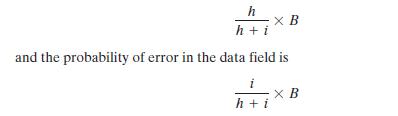
Although ATM does not include any end-to-end error detection and control functions on the user data, it is provided with a HEC field to detect and correct header errors. Let us consider the value of this feature. Suppose that the bit error rate of the transmission system is B. If errors are
Assuming no malfunction in any of the stations or nodes of a network, is it possible for a packet to be delivered to the wrong destination?
What value of P, as a function of N, L, and H, results in minimum end-to-end delay on a datagram network? Assume that L is much larger than P, and D is zero.
Define the following parameters for a switching network:N = number of hops between two given end systems L = message length in bits B = data rate, in bits per second (bps), on all links P = fixed packet size, in bits H = overhead (header) bits per packet S = call setup time (circuit switching or
Explain the flaw in the following reasoning: Packet switching requires control and address bits to be added to each packet. This introduces considerable overhead in packet switching. In circuit switching, a transparent circuit is established. No extra bits are needed. Therefore, there is no
Consider a TDM system with 8 I/O lines, and connections 1-2, 3-7, and 5-8. Draw several frames of the input to the TSI unit and output from the TSI unit, indicating the movement of data from input time slots to output time slots.
Consider a TSI system with a TDM input of 8000 frames per second. The TSI requires one memory read and one memory write operation per slot. What is the maximum number of slots per frame that can be handled, as a function of the memory cycle time?
Consider a three-stage switch such as in Figure 9.6. Assume that there are a total of N input lines and N output lines for the overall three-stage switch. If n is the number of input lines to a stage 1 crossbar and the number of output lines to a stage 3 crossbar, then there are N/n stage 1
a. If a crossbar matrix has n input lines and m output lines, how many crosspoints are required?b. How many crosspoints would be required if there were no distinction between input and output lines (i.e., if any line could be interconnected to any other line serviced by the crossbar)?c. Show the
Consider a simple telephone network consisting of two end offices and one intermediate switch with a 1-MHz full-duplex trunk between each end office and the intermediate switch. Assume a 4-kHz channel for each voice call. The average telephone is used to make four calls per 8-hour workday, with a
List and briefly explain the fields in an ATM cell.
What are the characteristics of a virtual path connection?
What are the characteristics of a virtual channel connection?
What types of delay are significant in assessing the performance of a packet-switching network?
What is the significance of packet size in a packet-switching network?
What are the advantages of packet switching compared to circuit switching?
What is the principal application that has driven the design of circuit-switching networks?
Why is it useful to have more than one possible path through a network for each pair of stations?
In statistical TDM, there may be a length field. What alternative could there be to the inclusion of a length field? What problem might this solution cause and how could it be solved?
For a statistical time-division multiplexer, define the following parameters:F = frame length, bits OH = overhead in a frame, bits L = load of data in the frame, bps C = capacity of link, bpsa. Express F as a function of the other parameters. Explain why F can be viewed as a variable rather than a
Assume that you are to design a TDM carrier, say DS-489, to support 30 voice channels using 6-bit samples and a structure similar to DS-1. Determine the required bit rate.
In synchronous TDM, the I/O lines serviced by the two multiplexers may be either synchronous or asynchronous although the channel between the two multiplexers must be synchronous. Is there any inconsistency in this? Why or why not?
A company has two locations: a headquarters and a factory about 25 km away. The factory has four 300-bps terminals that communicate with the central computer facilities over leased voice-grade lines. The company is considering installing TDM equipment so that only one line will be needed. What cost
kbps input may be treated as two 4.8-kbps inputs).b. What is the percentage overhead in the multiplexed bit stream?c. What is the multiplexed output bit rate?d. What is the minimum reframe time? What is the maximum reframe time?What is the average reframe time?
A synchronous nonstatistical TDM is to be used to combine four 4.8-kbps and one 9.6-kbps signals for transmission over a single leased line. For framing, a block of 7 bits (pattern 1011101) is inserted for each 48 data bits. The reframing algorithm (at the receiving demultiplex)is as follows:1.
Ten 9600-bps lines are to be multiplexed using TDM. Ignoring overhead bits in the TDM frame, what is the total capacity required for synchronous TDM? Assuming that we wish to limit average TDM link utilization to 0.8, and assuming that each TDM link is busy 50% of the time, what is the capacity
Find the number of the following devices that could be accommodated by a T1-type TDM line if 1% of the T1 line capacity is reserved for synchronization purposes.a. 110-bps teleprinter terminalsb. 300-bps computer terminalsc. 1200-bps computer terminalsd. 9600-bps computer output portse. 64-kbps PCM
A character-interleaved time-division multiplexer is used to combine the data streams of a number of 110-bps asynchronous terminals for data transmission over a 2400-bps digital line. Each terminal sends asynchronous characters consisting of 7 data bits, 1 parity bit, 1 start bit, and 2 stop bits.
for a TDM PCM system that will accommodate four 300-bps, synchronous, digital inputs and one analog input with a bandwidth of 500 Hz. Assume that the analog samples will be encoded into 4-bit PCM words.
Draw a block diagram similar to Figure
Twenty-four voice signals are to be multiplexed and transmitted over twisted pair.What is the bandwidth required for FDM? Assuming a bandwidth efficiency (ratio of data rate to transmission bandwidth, as explained in Chapter 5) of 1 bps/Hz, what is the bandwidth required for TDM using PCM?
In the DS-1 format, what is the control signal data rate for each voice channel?
One of the 193 bits in the DS-1 transmission format is used for frame synchronization.Explain its use.
Explain in terms of data link control and physical layer concepts how error and flow control are accomplished in synchronous time-division multiplexing.
Why is it that the start and stop bits can be eliminated when character interleaving is used in synchronous TDM?
In synchronous TDM, it is possible to interleave bits, one bit from each channel participating in a cycle. If the channel is using a self-clocking code to assist synchronization, might this bit interleaving introduce problems because there is not a continuous stream of bits from one source?
Consider a transmission system using frequency-division multiplexing. What cost factors are involved in adding one more pair of stations to the system?
and relate the preceding to the figure.
To paraphrase Lincoln: “. . . all of the channel some of the time, some of the channel all of the time. . . .” Refer to Figure
The information in four analog signals is to be multiplexed and transmitted over a telephone channel that has a 400- to 3100-Hz bandpass. Each of the analog baseband signals is bandlimited to 500 Hz. Design a communication system (block diagram)that will allow the transmission of these four sources
as a guide, indicate the major difference between North American and international TDM carrier standards.
Using Table
Why is a statistical time-division multiplexer more efficient than a synchronous timedivision multiplexer?
Explain how synchronous time-division multiplexing (TDM) works.
Define upstream and downstream with respect to subscriber lines.
What is echo cancellation?
How is interference avoided by using frequency-division multiplexing?
Why is multiplexing so cost-effective?
A World Wide Web server is usually set up to receive relatively small messages from its clients but to transmit potentially very large messages to them. Explain, then, which type of ARQ protocol (selective reject, go-back-N) would provide less of a burden to a particularly popular WWW server.
Consider that several physical links connect two stations. We would like to use a“multilink HDLC” that makes efficient use of these links by sending frames on a FIFO basis on the next available link. What enhancements to HDLC are needed?
Assume that the primary HDLC station in NRM has sent six I-frames to a secondary.The primary’s N(S) count was three (011 binary) prior to sending the six frames. If the poll bit is on in the sixth frame, what will be the N(R) count back from the secondary after the last frame? Assume error-free
Using the example bit string of Figure 7.8, show the signal pattern on the line using NRZ-L coding. Does this suggest a side benefit of bit stuffing?
Suggest improvements to the bit stuffing-algorithm to overcome the problems of single-bit errors described in the preceding problem.
Because of the provision that a single flag can be used as both an ending and a starting flag, a single-bit error can cause problems.a. Explain how a single-bit error can merge two frames into one.b. Explain how a single-bit error can split a single frame into two frames.
It is clear that bit stuffing is needed for the address, data, and FCS fields of an HDLC frame. Is it needed for the control field?
Two stations communicate via a 1-Mbps satellite link with a propagation delay of 270 ms. The satellite serves merely to retransmit data received from one station to another, with negligible switching delay. Using HDLC frames of 1024 bits with 3-bit sequence numbers, what is the maximum possible
The ISO standard for HDLC procedures (ISO 4335) includes the following definitions:(1) an REJ condition is considered cleared upon the receipt of an incoming I-frame with an N(S) equal to the N(R) of the outgoing REJ frame; and (2) a SREJ condition is considered cleared upon the receipt of an
Out-of-sequence acknowledgment cannot be used for selective-reject ARQ. That is, if frame i is rejected by station X, all subsequent I-frames and RR frames sent by X must have N1R2 = i until frame i is successfully received, even if other frames with N1S2 7 i are successfully received in the
Two neighboring nodes (A and B) use a sliding-window protocol with a 3-bit sequence number. As the ARQ mechanism, go-back-N is used with a window size of 4. Assuming A is transmitting and B is receiving, show the window positions for the following succession of events:a. Before A sends any framesb.
Suppose that a selective-reject ARQ is used where W = 4. Show, by example, that a 3-bit sequence number is needed.
Showing 700 - 800
of 975
1
2
3
4
5
6
7
8
9
10
Step by Step Answers

 Get 50% OFF
Claim Now
Get 50% OFF
Claim Now