New Semester
Started
Get
50% OFF
Study Help!
--h --m --s
Claim Now
Question Answers
Textbooks
Find textbooks, questions and answers
Oops, something went wrong!
Change your search query and then try again
S
Books
FREE
Study Help
Expert Questions
Accounting
General Management
Mathematics
Finance
Organizational Behaviour
Law
Physics
Operating System
Management Leadership
Sociology
Programming
Marketing
Database
Computer Network
Economics
Textbooks Solutions
Accounting
Managerial Accounting
Management Leadership
Cost Accounting
Statistics
Business Law
Corporate Finance
Finance
Economics
Auditing
Tutors
Online Tutors
Find a Tutor
Hire a Tutor
Become a Tutor
AI Tutor
AI Study Planner
NEW
Sell Books
Search
Search
Sign In
Register
study help
business
construction project management
Project Management Case Studies 4th Edition Harold R. Kerzner - Solutions
How might the Army have responded if it were presented with a risk management plan early during the R&D activities?
Should the customer be allowed to participate in or assist the contractor in developing a risk management plan?
How effective will the risk management plan be if developed by the project manager in seclusion?
Would Altex have been more interested in developing a risk management plan if the project were funded entirely from within?
Does the customer have the right to expect the contractor to perform risk analysis and develop a risk management plan if it is not called out as part of the contractual statement of work?
Should risk management planning be performed in the proposal stage or after contract award, assuming that it must be done?
Why was a risk management plan considered unnecessary?
Would you side with marketing or engineering? What should Luxor do at this point?
The seven items in the list provided by engineering are all ways of mitigating certain risk events. If the company follows these suggestions, is it adopting a risk response mode of avoidance, assumption, reduction, or deflection?
How does one assign probabilities to the marketing list?
Does the list provided by marketing demonstrate the likelihood of a risk event or the impact of a risk event?
Can the impact of one specific risk event, such as a technical risk event, create additional risks, which may or may not be technical risks? Can risk events be interrelated?
Can employees begin using a risk management template without some form of specialized training?
Should a risk management template be forward looking?
How do you validate a risk management template?
Can probability distributions be transferred from one company to another? If not, then how do we develop a probability distribution?
Can templates be transferred from one company to another, or should tailoring be mandatory?
If you were on a jury attempting to place liability, whom would you say was responsible for the Challenger disaster?
How should we handle situations where people in authority believe that the potential rewards justify what they believe to be relatively minor risks?
What level of risk should have been acceptable for launch?
Because of the ice problem, Rockwell could not guarantee the shuttle’s safety, but did nothing to veto the launch. Is there a better way for situations as this to be handled in the future?
How could the chains of communication and responsibility for the Space Shuttle Program have been made to function better?
How might an engineer deal with pressure from above to follow a course of action that the engineer knows to be wrong?
Should someone have stopped the Challenger launch and, if so, how could this have been accomplished without risking one’s job and career?
How might Thiokol engineers have convinced both their own management and NASA to postpone the launch?
Risk management includes the documentation of lessons-learned. In the case study, was there an audit trail of lessons learned or was that audit trail simply protection memos?
How much documentation should be necessary for the tracking of a risk management plan? Can this documentation become overexcessive and create decision-making problems?
When NASA discounted the effects of the weather, did NASA’s risk response mechanism violate their responsibility to ensure crew safety?
When NASA pressed its contractors to recommend a launch, did NASA’s risk response mechanism violate their responsibility to ensure crew safety?
Did the engineers at Thiokol and NASA do all they could to convince their own management that the wrong risk response mechanism was about to be taken?
What risk response mechanism were managers at Thiokol and NASA using when they ignored the recommendations of their engineers?
Did the need to maintain a flight schedule compromise the risk response mechanism that would otherwise have been taken?
Are waivers a type of risk response mechanism?
What risk response mechanism did NASA administrators use when they issued waivers for the Launch Commit Criteria?
Why weren’t the astronauts involved in the launch decision (i.e., the acceptance of the risk)? Should they have been involved?
What should be the determining factors in deciding which risks are brought upstairs to the executive levels for review before selecting the appropriate risk response mechanism?
How should an organization decide whether or not to accept a risk and launch if the risks cannot be quantified?
Did it appear that the risk response method selected was dependent on the risk or on other factors?
What methods of risk response were used at NASA?
Who should have final say in deciding upon the appropriate response mechanism for a risk?
How does an organization decide what is or is not an acceptable risk?
Were probabilities assigned to any of the risks? Why or why not?
How were the identified risks quantified at NASA? Is the quantification system truly quantitative or is it a qualitative system?
If a critical risk is discovered, what is the proper way for the project manager to present to senior management the impact of the risk? How do you as a project manager make sure that senior management understand the ramifications?
How should risk quantification problems be resolved if there exist differences of opinion between the customer and the contractors?
How does one quantify the dangers associated with the ice problem?
Given the complexity of the Space Shuttle Program, is it feasible and/or practical to develop a methodology for quantifying risks, or should each situation be addressed individually? Can we have both a quantitative and qualitative risk evaluation system in place at the same time?
Suppose that a risk identification plan had been established at the beginning of the space program when the shuttle was still considered an experimental design. If the shuttle is now considered as an operational vehicle rather than as an experimental design, could that affect the way that risks
How should one identify or classify the risks associated with pressure resulting from making promises that may be hard to keep?
How should one identify or classify trade-off risks such as trading off safety for political acceptability?
How should one identify or classify the risks associated with using solid rocket boosters on manned spacecraft rather than the conventional liquid fuel boosters?
Should senior management or sponsors be informed about all risks identified or just the overall “aggregate” risk?
How should problems with risk identification be resolved if there exist differences of opinion between the customer and the contractors?
Does there appear to have been a structured process in place for risk identification at either NASA or Thiokol?
What is the difference between a risk and an anomaly? Who determines the difference?
Would there have been a better way to handle risk management planning at NASA assuming sixteen flights per year, twenty-five flights per year, or as originally planned, sixty flights per year? Why is the number of flights per year critical in designing a formalized risk management plan?
Is there a difference between a risk management plan, a quality assurance plan, and a safety plan, or are they the same?
If such a plan did exist, then why wasn’t it followed—or was it followed?
Does it appear, from the data provided in the case, that a risk management plan was in existence?
What are the risks assuming these two metrics can be created?
Can a metric for predicting capacity needs be developed?
Can a metric for predicting success be developed?
Can the exit champion use a different criterion such as looking only at return on investment?
Which approach would you pick?
What are the advantages and disadvantages of each approach?
Under what conditions would a project still be allowed to continue even if it falls below the acceptable value threshold limit?
At what value contribution level would a project definitely be canceled?
Can the value component change over the life-cycle phases and, if so, under what circumstances?
If these innovation projects were for external rather than internal clients, who should have more of an influence in the selection of the value components:the customers or the contractor doing the work?
What factors would make this process more subjective than objective?
How many of the metrics in Exhibit II are now considered as KPIs?
Using the KPI selection criteria in Exhibit I, complete Exhibit II.
What factors determine how many KPIs should be reported?
Is there a simple way to differentiate between a metric and a KPI?
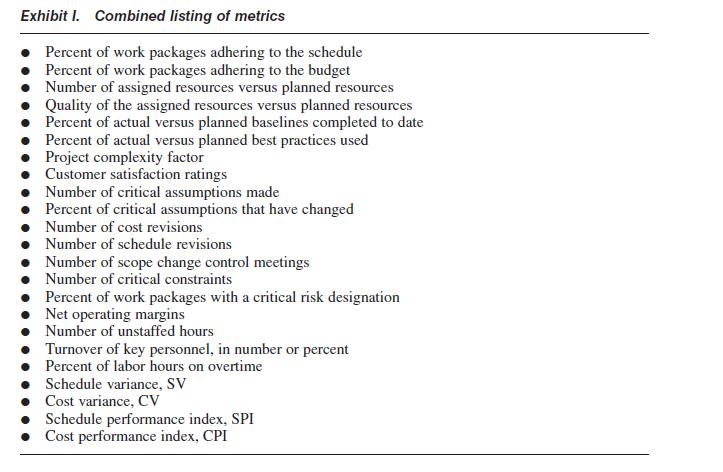
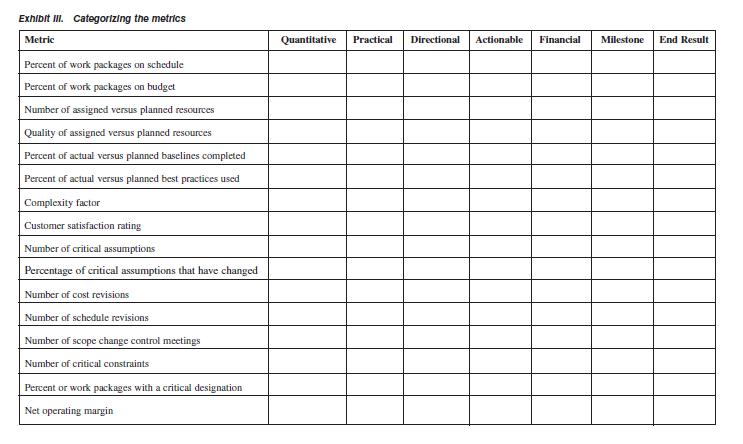
Using Exhibit III, categorize the metrics in Exhibit I. Exhibit I. Combined listing of metrics Percent of work packages adhering to the schedule Percent of work packages adhering to the budget Number of assigned resources versus planned resources Quality of the assigned resources versus planned
What are the risks of reporting on too few metrics?
What are the risks of reporting on too many metrics?
What metrics would you include in the list that may be appropriate for innovation projects?
Are the four questions posed by John correct?
Does it seem reasonable that some people might feel that metrics can be a spying machine?
Is the makeup of the team correct? Should someone from senior management also have been part of the team?
Is there a relationship between the capturing of best practices and the development of new metrics?
Are a few days enough time for the follow-on meeting and should the executives attend?
Should the PMO take the lead in the establishment of the metrics?
Would you agree with Al Grey that the real cause of the failures appears to be a lack of good metrics? If this is the cause, then how do you justify that other projects were successful?
Is Ann Hawthorne’s description of engineers realistic?
Who, if anyone, should be blamed for the failure of the projects in this case study?
Is it inherently dangerous to encourage a project manager to recommend that his or her project be terminated during early life-cycle phases?
Can a PMO prevent failure?
Is it good or bad to have five R&D projects out of twelve completed successfully?
Is it possible that highly talented resources can overthink an R&D project to the point where they look for the most complicated solution rather than the simplest solution?
What information is lacking in Exhibit I?
What information is found in Exhibit I?
When project work goes bad and failures occur, is it common practice for finger-pointing and the laying of blame to occur, even at the executive levels?
Can the failure of R&D actually be this devastating to a company?
Who got promoted and who got fired? In other words, how did the executives save face?
Is it customary for companies to allow executives to have pet or secret projects that do not follow the normal project approval process?
How do you prevent this situation from recurring on all yearly follow-on contracts?
Would your previous answer change if the program had the money available as a result of an underrun?
If you were the customer of this cost-plus program, what would your response be for additional funds for the bathtub period, assuming cost overrun?
Showing 2200 - 2300
of 6659
First
16
17
18
19
20
21
22
23
24
25
26
27
28
29
30
Last
Step by Step Answers

 Get 50% OFF
Claim Now
Get 50% OFF
Claim Now