New Semester
Started
Get
50% OFF
Study Help!
--h --m --s
Claim Now
Question Answers
Textbooks
Find textbooks, questions and answers
Oops, something went wrong!
Change your search query and then try again
S
Books
FREE
Study Help
Expert Questions
Accounting
General Management
Mathematics
Finance
Organizational Behaviour
Law
Physics
Operating System
Management Leadership
Sociology
Programming
Marketing
Database
Computer Network
Economics
Textbooks Solutions
Accounting
Managerial Accounting
Management Leadership
Cost Accounting
Statistics
Business Law
Corporate Finance
Finance
Economics
Auditing
Tutors
Online Tutors
Find a Tutor
Hire a Tutor
Become a Tutor
AI Tutor
AI Study Planner
NEW
Sell Books
Search
Search
Sign In
Register
study help
business
cost accounting
Cost Accounting 4th Edition Michael W. Maher, Edward B. Deakin - Solutions
(Weighted average) You have just been hired as the cost accountant for California Micro, a producer of personal computer cases. This position has been vacant for one month. John Friend, manager of the firm’s tax department, has performed some computations for last month’s information; however,
(FIFO cost per EUP) The following information has been gathered from the records of Snack-On Foods for July 1997. The firm makes a variety of snacks; the information presented here is for a peanut and pretzel mix. Materials are added at the beginning of processing; overhead is applied on a direct
(Cost assignment; FIFO) Biltmore Manufacturing is a contract manufacturer for Zesty Dressing. Biltmore uses a FIFO process costing system to account for the production of its salad dressing. All ingredients are added at the start of the process. Zesty provides reusable vats to Biltmore for the
(Weighted average & FIFO) In a single-process production system, the Gayden Corporation produces fingernails. For August 1997, the company’s accounting records reflected the following:a. For August, prepare a cost of production report assuming the company uses the weighted average method.b.
(FIFO; second department) Ottawa Ltd. manufactures porcelain kitchen sinks in a process requiring operations in three separate departments: Molding, Curing, and Finishing. Materials are first introduced in the molding operation and ad¬ ditional material is added during the curing process. The
(Two departments; weighted average) The Holiday Spirits Corporation manufac¬ tures plastic Christmas trees in two departments: Cutting and Boxing. In the Cutting Department, wire wrapped with green “needles” is placed into produc¬ tion at the beginning of the process and is cut to various
(Cost flows, multiple departments) Smyrna Corporation produces accent stripes for automobiles in 50-inch rolls. Each roll passes through three departments (strip¬ ping, adhesion, and packaging) before it is ready for shipment to automobile dealers and detailing shops. Product costs are tracked by
(Comprehensive; two departments) Pet Pens Inc. makes a backyard fencing system for pet owners in a two-stage production system. In Process One, wood is cut and assembled into 6-foot fence sections. In Process Two, the sections are pres¬ sure treated to resist the effects of weather and then coated
(Standard process costing) Eye-Guard is a manufacturer of high-quality lenses for sunglasses and ski goggles. Eye-Guard uses a standard process costing system and carries inventories at standard. In July 1997, the following data were available:a. Prepare an equivalent units of production
(Multiproduct; hybrid costing) Lilliput Industries manufactures a series of three models of molded plastic chairs: Standard (can be stacked), Deluxe (with arms), and Executive (with arms and padding); all are variations of the same design. The company uses batch manufacturing and has a hybrid
(IVA and FIFO) Whitehall Company makes quality paint sold at premium prices in one production department. Production begins with the blending of various chemicals, which are added at the beginning of the process, and ends with the canning of the paint. Canning occurs when the mixture reaches the 90
Pharmaceutical companies make most drugs in mass-production processes after the products are cleared for sale by the Food and Drug Administration. Addi¬ tionally, they spend huge amounts of money on research and development; the estimated cost of bringing a drug to market is almost $200 million.
Quantex makes high-quality steel for specialized applications like ball bearings, camshafts, and tank treads. Most of the armor of Desert Storm rode to victory on Quantex steel.The company keeps almost no inventory—a lesson learned from the days when steel produced for the oil patch rusted on its
As labor markets and product markets become ever more competitive, govern¬ ment programs involving affirmative action and set-asides have increasingly been attacked. U.S. Representative Jan Meyers has led the charge to eliminate the set-aside programs for minority businesses, which are
In 1996, one of the more hotly contested political issues in the United States was whether the minimum wage should be increased. Proponents of an increase in the minimum wage argue that such an increase is necessary for low-paid employees to maintain a decent standard of living. Opponents of an
Every week, hundreds of beer aficionados tour the tiny, run-down brewery of Boston Beer Co., purveyor of the fashionable Samuel Adams beers.But all this is just for show. The real stuff is brewing 750 miles away, in the sprawling Cincinnati plant of Hudepohl-Schoenling Brewing Co. Beer-buffs who
Find the home page for Deloitte & Touche Consulting Group. From there, find the page discussing developments in the Pharmaceutical/Medical Devices In- INTERNET ACTIVITIES dustry. Read the materials on that page about evolving practices in the industry to improve cost effectiveness of operations.
Find the web page for the “Agile Manufacturing Project at MIT.” Discuss the nature of this research project and how the research might affect cost accounting practices in industries that manufacture complex products.LO1
Why do lost units occur in manufacturing processes?LO1
How do normal and abnormal loss of units differ and how is each treated in an EUP schedule?LO1
How are the costs of each type of loss assigned?LO1
How does accretion of units affect the EUP schedule and costs per unit?LO1
How are rework costs of defective units treated?LO1
What is the cost of quality products?LO1
Differentiate among shrinkage, spoilage, and defects.LO1
What are some reasons a company would set a “tolerated1 2 3 4 5 6 7 8 9 10 11 12' loss level? such a level be set?LO1
List five examples (similar to the steak illustration in the text) in which a unit would be considered (a) defective and (b) spoiled.LO1
What is the difference between a normal and an abnormal loss?LO1
Why would abnormal losses be more likely to be preventable than some types of normal losses?LO1
How does a continuous loss differ from a discrete loss?LO1
When does a discrete loss actually occur? When is it assumed to occur for accounting purposes? Why are these not necessarily at the same point?LO1
Why is the cost of an abnormal loss considered a period cost? How is its cost removed from Work in Process Inventory?LO1
What is meant by the term method of neglect? When is this method used?LO1
How does using the method of neglect affect the cost of good production in a period?LO1
In a job order costing system, spoilage may be incurred in general for all jobs or it may be related to a specific job. What differences do these circumstances make in the treatment of spoilage?LO1
In a production process what is accretion? How does it affect the cost of the units transferred in from a predecessor department?LO1
The Mixing Department of Leeward Company transferred 100,000 gallons of material to the Baking Department during July. The cost per gallon transferred out shown on Mixing’s cost of production report was $2.50. On Baking’s cost of production report for the same period, the cost per gallon for
How are costs of reworking defective units treated if the defects are considered normal? Abnormal?LO1
A company has an AQL for defects of 5 percent of units started during the period. Current period loss was 3 percent. Why should management attempt to measure the cost of this loss rather than simply include it as part of the cost of good production?LO1
How do statistical process control techniques contribute to the control of spoil¬ age costs?LO1
(Terminology) Match the following lettered terms on the left with the appropriate numbered definition on the right.LO1 a. Spoiled unit b. Normal loss c. Economically reworked d. Abnormal loss e. Defective unit f. Method of neglect g. Accretion 1. Allowing the production of unacceptable units to
(Cost-benefit analysis) Jim Logan, plant manager at UNO Manufacturing, is in¬ vestigating spoilage created by a machine that prints packing boxes for computers and other large, fragile items. At the beginning of each production run, fifty boxes are misprinted either because of miscoloration or
(Normal vs. abnormal spoilage; WA) Albuquerque Electronics uses a weighted av- erage process costing system for its production process in which all material is added at the beginning of production. Company management has specified that the normal loss cannot exceed 7 percent of the units started in
(EUP computations; normal and abnormal loss) The Bangor factory of New England Chemical produces environmental chemicals in processes in which spoilage takes place on a continual basis. Management considers normal spoilage to be 0.5 per¬ cent or less of gallons of material placed into production.
(EUP computation; normal and abnormal loss; FIFO) Southern Foods manufactures corn meal in a continuous, mass-production process. Corn is added at the be¬ ginning of the process. Fosses are few and occur only when foreign materials are found in the corn meal. Inspection occurs at the 95 percent
(EUP computation; normal and abnormal loss; cost per EUP; FIFO) Luminations uses a FIFO process costing system to account for its candle production process. Wax occasionally forms imperfectly in molds and, thus, spoilage is viewed as continuous. The accepted quality level is 92 percent of the
(Cost assignment; WA) Zero-Bounce manufactures automobile springs. Its pro¬ duction equipment is fairly old, and one bad unit is typically produced for every 20 good units. The bad units cannot be reworked and must be discarded. Spoil¬ age is determined at an end-of-process inspection point.
(Rework) Slick Shine Inc. manufactures two-gallon tubs of car wax for body shops. The company uses an actual cost, process costing system. All material is added at the beginning of production; labor and overhead are incurred evenly through the process. Defective units are identified through
(Controlling losses) For each of the following types of production losses or poor service, indicate whether prevention (P) or appraisal (A) techniques would pro¬ vide the most effective control mechanism. Explain why you made your choice.a. Putting pages in upside down in a book.b. Bolting the
(Process improvement) Use library, Internet, or personal resources to find three companies (such as Delta Wire) that instituted workforce education programs and, thereby, reduced the number of lost units. Prepare a 5- to 7-minute oral presentation about your companies’ programs and their
(Requirements; team activity) Every job has certain requirements, and quality is defined by meeting those requirements. In some cases, however, people make decisions to override requirements. In a team of three or four, choose four re¬ quirements for your class (or for a job held by one of you).
(Normal discrete spoilage, weighted average) The Potato Division of Global Foods Company processes potatoes. In the process, raw potatoes are sequentially cleaned, skinned, cooked, and canned. Spoilage amounting to less than 12 per¬ cent of the total pounds of potatoes that are introduced to the
(Shrinkage; WA) Department 1 of Tastee Patties cooks ground beef for ham¬ burger patties. The patties are then transferred to Department 2 where they are placed on buns, boxed, and frozen. The accepted level of shrinkage in Depart¬ ment 1 is 10 percent of the pounds started. Tastee Patties uses a
(Discrete spoilage; WA) Sara Fims Inc. makes stuffed angels in a mass-production process. Parachute cloth and stuffing are added at the beginning of the produc¬ tion process; the angels are packaged in sky-blue boxes at the end of production. Conversion costs for the highly automated process are
(Normal and abnormal discrete spoilage; WA) Payne Tools manufactures one of its products in a two-department process. A separate work in process account is maintained for each department, and Payne Tools uses a weighted average pro¬ cess costing system. The first department is Forming; the second
(Normal and abnormal spoilage; WA) Ozark Furniture produces coffee tables in a two-department process: Cutting/Assembly and Lamination. Varnish is added in the Lamination Department when the goods are 60 percent complete as to over¬ head. Spoiled units are found on inspection at the end of
(Normal and abnormal discrete spoilage; FIFO method) Use the Ozark Furniture information from problem 32. Determine the proper disposition of the Septem¬ ber costs of the Lamination Department using the FIFO method; include journal entries.LO1
(Normal and abnormal discrete spoilage; FIFO) Hinkley Company produces hinges. Completed hinges are inspected at the end of production. Any spoilage in excess of 2 percent of the completed units is considered abnormal. Material is added at the start of production. Labor and overhead are incurred
(Noinnal and abnonnal discrete spoilage; WA) Use the Hinkley Company data as given in problem 34. Prepare a July 1997 cost of production report using the weighted average method.LO1
(Cost assignment) Data below summarize operations for Lawn Gro Company. The company makes five-gallon containers of herbicide. All material is added at the beginning of the process.Spoilage is detected at inspection when the units are 60 percent complete.a. Prepare an EUP schedule using the
(Cost assignment) Tons of Shade employs a weighted average process costing system for its products. One product passes through three departments (Mold¬ ing, Assembly, and Finishing) during production. The following activity took place in the Finishing Department during March 1997:Raw material is
(Comprehensive; weighted average) Caunitz Company produces mops. Department 1 winds and cuts cotton into mop heads and transfers these to Department 2 where the mop head is twisted and attached to a handle. Cotton is added at the beginning of the first process, and the handle is added at the end of
(Comprehensive; FIFO method) Use the information for Caunitz Company from problem 38 to prepare a FIFO cost of production report for each department for January 1997.LO1
(Comprehensive; weighted average and FIFO) Kansas Company mines salt in central Kansas. Approximately 30 percent of the mined salt is processed into table salt. Kansas Company uses a process costing system for the table salt operation. Pro¬ cessing takes place in two departments. Department 1 uses
(Defective units and rework) Terrell Corporation produces plastic pipe and ac¬ counts for its production process using weighted average process costing. Ma¬ terial is added at the beginning of production. The company applies overhead to products using machine hours. Terrell Corporation used the
(Job order costing; rework) Michaels Rigging manufactures pulley systems to cus¬ tomer specifications and uses a job order system. A recent order from Barnett Company was for 10,000 pulleys, and the job was assigned number BA468. The job cost sheet for #BA468 revealed the following:Final
(Normal and abnormal spoilage; WA method) APCO Company manufactures var¬ ious lines of bicycles. Because of the high volume of each type of product, the company employs a process cost system using the weighted average method to determine unit costs. Bicycle parts are manufactured in the Molding
FulRange Inc. produces complex printed circuits for stereo amplifiers. The cir¬ cuits are sold primarily to major component manufacturers, and any production overruns are sold to small manufacturers at a substantial discount. The small manufacturer segment appears to be very profitable because the
Read the News Note on page 573 Joseph Pereira and Joseph Rebello in Chapter 13. The company states that only 4 lots (118,000 vials) were sold that were contaminated with relatively benign bacteria. However, in January 1995, Copley informed the court that it is possible that there may be over 10,000
The IRS collects and accounts for over $1 trillion in revenue each year. Yet it is estimated another $100 billion of tax owed each year is not collected. In addition, millions of unnecessary taxpayer contacts are made annually requiring countless hours of taxpayers' time.Taxpayer service also
Find the home page for Interkinetics Corporation. Identify and discuss the ser¬ vices offered by this firm to manufacturers that might be useful to improve the quality of production processes, improve the yield of processes, and reduce waste and defective products.LO1
Find the home page for Precision Machined Products Association. From there, find in the reports issued by the association a discussion of “Screw Machining Skill Standards Update.” Discuss the purposes of the associations’s skills stan¬ dards initiative and how such industry-level initiatives
Search the Internet for information regarding the PCS Software Package which was developed under the auspices of the Canadian government. The software was designed for sewing factories. Discuss the capabilities of the software and how it could be utilized by a small firm to monitor quality and
At what point in a joint process are joint products identifiable?LO1
What management decisions must be made before a joint process is begun?LO1
How are joint costs allocated to products?LO1
How are by-products treated in job order costing?LO1
Why are equivalent units computed for process costing?
Management of a company that manufactures cereal is trying to decide whether to install a job or process costing system. The manufacturing vice president has stated that job costing gives them the best control because it is possible to assign costs to specific lots of goods. The controller,
Farleigh O. Tuvit is a new member of the controller's staff in the same company as you. Farleigh has just completed a report that urges the company to adopt the Last-in, First-out (LIFO) method for inventory accounting. The controller is concerned about the recommendation because the cost records
Assume the number of units transferred out of a department is unknown.Using the basic cost flow model, write a formula to solve for units transferred out.
Refer to the Real World Application on page 117. Describe the materials and the conversion process at each stage of production for canning such soft drinks.
Select the best answer:Under which of the following conditions will the first-in, first-out method of process costing produce the same cost of goods manufactured as the weighted-average method?(1) When goods produced are homogeneous.(2) When there is no beginning inventory.(3) When there is no
Select the best answer:An error was made in the computation of the percentage of completion of the current year's ending work in process inventory. The error resulted in assigning a lower percentage of completion to each component of the inventory than actually was the case. Assume there was no
Select the best answer:In computing the cost per equivalent unit, the weighted-average method considers:(1) Current costs only.(2) Current costs plus costs in beginning work in process inventory.(3) Current costs plus cost of ending work in process inventory.(4) Current costs less costs in
Select the best answer:When using the FIFO method of process costing, total equivalent units produced for a given period are equal to the number of units:(1) Started and completed during the period, plus the number of units in beginning WIP, plus the number of units in ending WIP.(2) In beginning
A company's records show the following information concerning the work in process in a chemical plant:1. Beginning inventory—7,000 partially complete units.2. Transferred out—18,000 units.3. Ending inventory—(materials are 10 percent complete; conversion costs are 15 percent complete).4.
Refer to the data in exercise 4-14. Assume beginning inventory is 20 percent complete with respect to materials and 15 percent complete with respect to conversion costs.a. Compute the equivalent units for materials using FIFO.b. Compute the equivalent units for conversion costs using FIFO.
Mesozoic Company shows the following information concerning the work in process at an assembly plant:1. Beginning inventory was partially complete.2. Transferred out—30,000 units.3. Ending inventory—10,000 units (materials are 50 percent complete; conversion costs are 30 percent complete).4.
Refer to the data in exercise 4-16. Assume beginning inventory is 45 percent complete with respect to materials and 60 percent complete with respect to conversion costs.a. Compute the equivalent units for materials using FIFO.b. Compute the equivalent units for conversion costs using FIFO.
Refer to the data in exercise 4-22. Compute the cost of goods transferred out and the ending inventory, using the weighted-average method.
Using the data in exercise 4-22, compute the cost per equivalent unit for direct materials and for conversion costs using the FIFO method. Assume that beginning inventory is 60 percent complete with respect to materials and 30 percent complete with respect to conversion costs.
Refer to the data in exercise 4-22 and 4-24. Compute the cost of goods transferred out and the ending inventory using the FIFO method.
The beginning work in process inventory showed a balance of $62,080. Of this amount, $25,410 is the cost of direct materials, and $36,670 are conversion costs.There were 8,000 units in the beginning inventory that were 30 percent complete with respect to both direct materials and conversion
Refer to the data in exercise 4-26. Compute the costs of goods transferred out and the ending inventory using the weighted-average method.
Refer to the data in exercise 4-26. Compute the cost per equivalent unit for direct materials and for conversion costs using the FIFO method. Are these unit costs higher or lower under weighted-average compared to FIFO? Why?
Refer to the data in exercise 4-26. Compute the cost of goods transferred out and the cost of ending inventory using the FIFO method. Is the ending inventory higher or lower under weighted-average compared to FIFO? Why?
Refer to the information in exercise 4-30.a. Prepare a production cost report using the weighted-average method.b. Is the ending inventory higher using FIFO or weighted-average? Why?
Refer to the facts in problem 4-34. Prepare a production cost report, using FIFO.
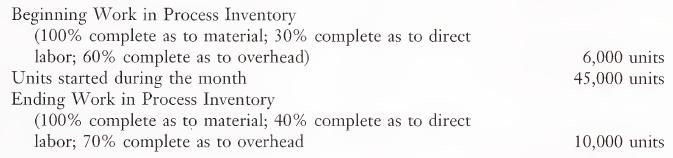
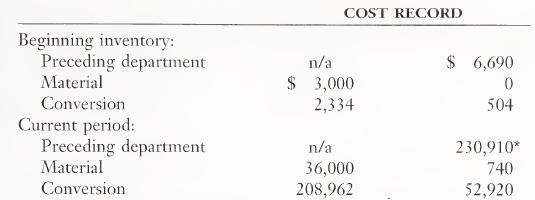
Mercantile Recovery Corporation has devised a process for converting garbage into liquid fuel. While the direct materials costs are zero, the operation requires the use of direct labor and overhead. The company uses a process costing system and keeps track of the production and costs of each
Showing 2600 - 2700
of 6579
First
20
21
22
23
24
25
26
27
28
29
30
31
32
33
34
Last
Step by Step Answers

 Get 50% OFF
Claim Now
Get 50% OFF
Claim Now