New Semester
Started
Get
50% OFF
Study Help!
--h --m --s
Claim Now
Question Answers
Textbooks
Find textbooks, questions and answers
Oops, something went wrong!
Change your search query and then try again
S
Books
FREE
Study Help
Expert Questions
Accounting
General Management
Mathematics
Finance
Organizational Behaviour
Law
Physics
Operating System
Management Leadership
Sociology
Programming
Marketing
Database
Computer Network
Economics
Textbooks Solutions
Accounting
Managerial Accounting
Management Leadership
Cost Accounting
Statistics
Business Law
Corporate Finance
Finance
Economics
Auditing
Tutors
Online Tutors
Find a Tutor
Hire a Tutor
Become a Tutor
AI Tutor
AI Study Planner
NEW
Sell Books
Search
Search
Sign In
Register
study help
business
cost accounting
Cost Accounting 4th Edition Jawahar Lal, Seema Srivastava - Solutions
Describe the following methods of valuing materials issued to production and discuss the advantage and disadvantage of each?(i) First-in, First-out;(ii) Weighted Average;(iii) Replacement Price.
Alpha company has been using LIFO method of materials pricing for 15 years. Its 2008 closing inventory was Rs. 15,000 but it would have been Rs. 26,000 if FIFO had been used. Thus, if FIFO had been used, this company's net income before taxes would have been(a) Rs. 11,000 less over 15-year
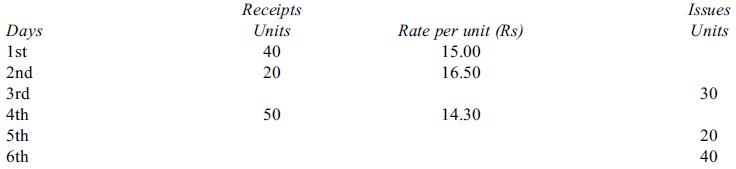
You are presented with the following information by Sphix Engineering Co. relating to the first week of September, 2008.Materials - The transactions in connection with the materials are as follows:Calculate the cost of materials issued under FIFO method and Weighted Average Method of issue of
From the following particulars workout the issue rate per 1000 each of first class and second class bricks.(a) Paid for supply at the kiln site for 30 lakh first class bricks @ Rs. 30 per 1,000.(b) Paid for supply at the kiln site for 60 lakh second class bricks @ Rs. 25 per 1,000.(c) Paid carriage
Explain the FIFO methods of valuation of materials issues. Discuss the effects of rising prices and falling prices on these two methods of pricing of materials issues.
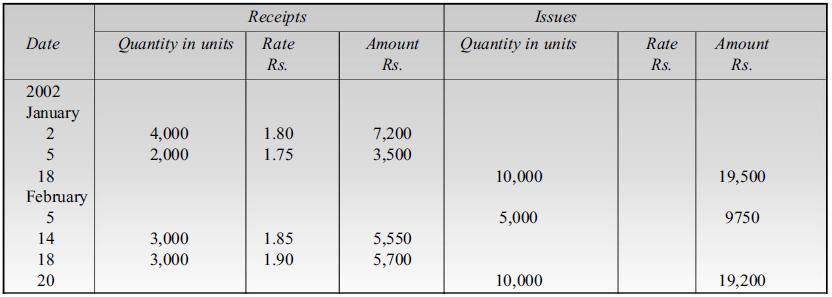
The stores ledger of a manufacturing Company reveals the following entries of a particular material.Opening stock as on 1.1.2002 was 20,000 units valued at Rs. 40,000, Closing stock as per physical verification on 28.2.2002 was 6,950 units.Work out the method of pricing the issue which you consider
What factors have to be considered for adopting a method for the pricing of materials? In the light of these and relevant factors, give a comparative description of LIFO and FIFO.
Modern Manufacturing Company purchased a material of 20 tonnes from a mining company. The following data is available for the lot of material purchased:(a) Invoice price of material @ Rs. 2,000 per tonne(b) Trade discount @ 20% on invoice price(c) Excise duty @ 10% on invoice price(d) Sales tax @
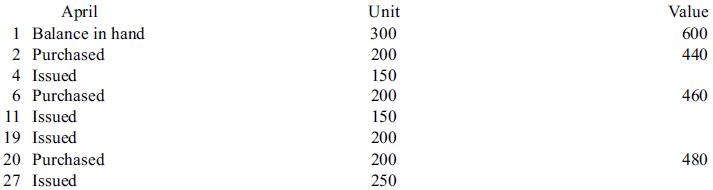
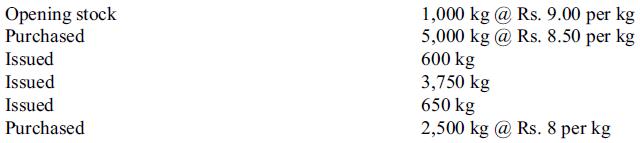
Show the stores ledger entries as they would appear when using(a) The weighted average method(b) The LIFO method of pricing issues, in connection with the following transactions:In a period of rising prices such as above what are the effects of each method? April 1 Balance in hand 2 Purchased 4
What are the conditions that favour the adoption of the Last-in, First-out system of materials pricing ? Explain its working and indicate its advantages and limitations.
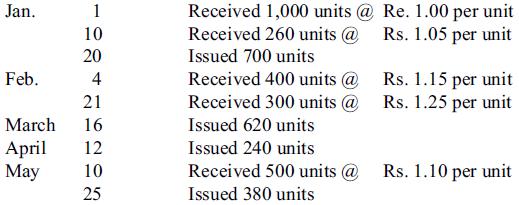
Prepare a stores ledger account from the following transactions under the LIFO method. 1 10 20 4 21 March 16 April 12 May 10 25 Jan. Feb. Received 1,000 units @ Received 260 units @ Issued 700 units Received 400 units @ Received 300 units @ Issued 620 units Issued 240 units Received 500 units
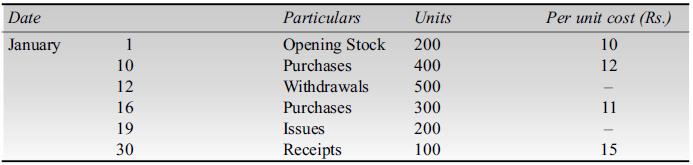
The following is a summary of the receipts and issue of materials in a factory during January. January1 Opening balance 500 units @ Rs. 25 per unit3 Issue 70 units4 Issue 100 units8 Issue 80 units13 Received from supplier 200 units @ Rs. 24.50 per unit14 Returned to store 15 units @ Rs. 24 per
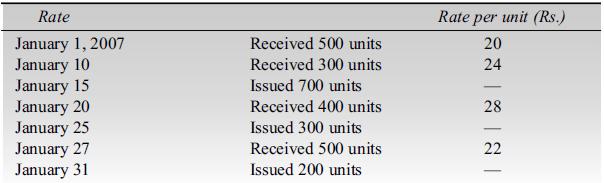
From the following information prepare a stores ledger account assuming 100 units as base stock following the FIFO method: Rate January 1, 2007 January 10 January 15 January 20 January 25 January 27 January 31 Received 500 units Received 300 units Issued 700 units Received 400 units Issued 300
Give the advantages and disadvantages of the actual cost basis of pricing of material issues.
A consignment consisted of two chemicals A and B. The invoices gave the following data:A shortage of 200 lb in A and 128 lb in B was noticed due to breakage. What stock rate would you adopt for pricing issues assuming a provision of 5% towards further deterioration? Chemical 4-4,000 lb @ Rs. 2.50
Explain FIFO and LIFO methods of pricing of material issues. Which of these should be preferred in rising and falling prices and why?
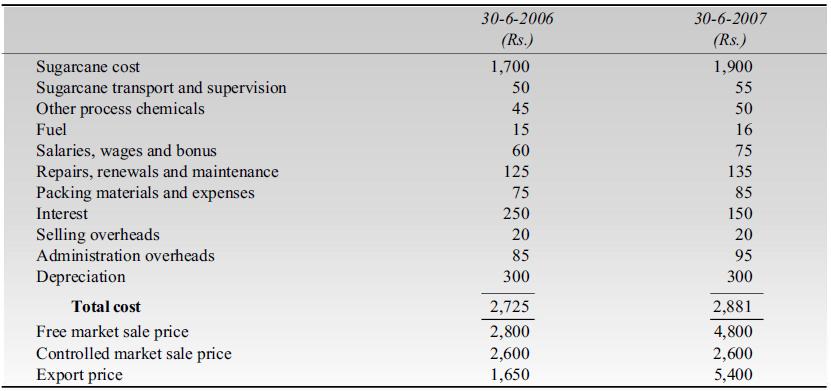
You are the Chief Accountant of a sugar factory, whose cost of production per tonne of sugar is given below:Salaries, wage and bonus include administration salaries Rs. 20.You have been valuing the closing stock of sugar consistently at cost or market price whichever is lower. For the purpose of
Under conditions of rising prices, which of the following two methods of pricing material issues would you recommend and why?(i) FIFO(ii) LIFO
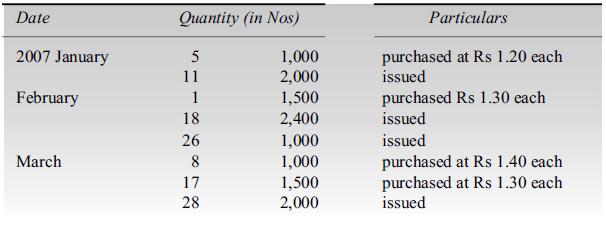
The following are the transactions in respect of purchase and issue of components forming part of an assembly of a product manufactured by a firm which requires to update its cost of production, very often for bidding tenders and finalising cost plus contracts.The stock on January 1, 2007 was 5,000
From the records of an oil distributing company, the following summarised information is available for the month of March 2005.Sales of the month: Rs. 19,25,000Opening Stock as on 1.3.2005: 1.25,000 litres @ Rs. 6.50 per litrePurchases (including freight and insurance):Closing stock as on
Briefly contrast the effects of using first-in, first-out with the last-in, first-out methods of pricing material issues from stores.
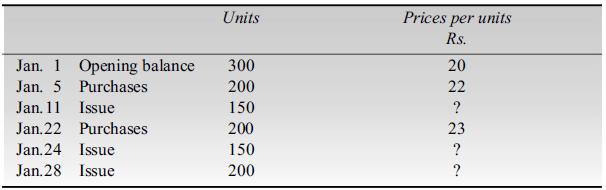
Show how the items given ahead relating to purchases and issue of raw material item will appear in the stores ledger card, using weighted average method for issue pricing: Jan. 1 Opening balance Jan. 5 Purchases Jan. 11 Issue Purchases Issue Issue Jan. 22 Jan. 24 Jan.
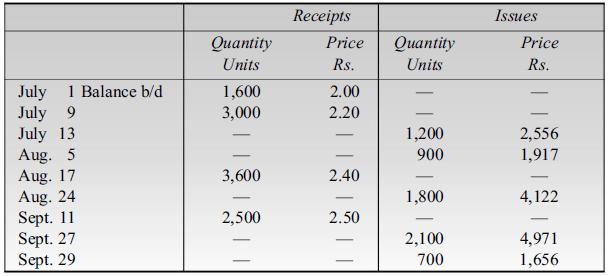
The Stock Ledger Account for Material X in a manufacturing concern reveals the following data for the quarter ended Sept. 30, 2002.Physical verification on Sept. 30, 2002 revealed an actual stock of 3,800 units. You are required to:(a) Indicate the method of pricing employed above.(b) Complete the
Write short notes on:(i) LIFO vs FIFO(ii) Bill of Materials(iii) Prepetual Inventory System.
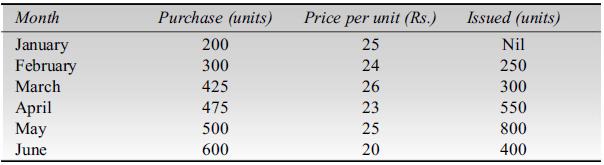
The following transactions in respect of material Y occurred during the six months ended 30th June, 2005.Required:The chief accountant argues that the value of closing stock remains the same, no matter which method of pricing of material issues is used. Do you agree? Why or why not? Detailed stores
ABC Limited provides you the following information. Calculate the cost of goods sold and ending inventory, applying the LIFO method of pricing raw materials under the Perpetual and Periodical Inventory Control Systems.Also explain in brief the reasons for a difference in profit, if any.
Oil India is a bulk distributor of oil. A periodic inventory of oil on hand is taken when the books are closed at the end of each month. The following summary of information is available for the month of December.Sales Rs. 9,45,000General Administrative Cost Rs. 25,000Opening Stock 1,00,000 litres
The following are the particulars regarding receipts and issues of certain material:The credit balance of price variance account, before transfer to costing profit and loss account, was Rs. 500.Calculate the standard rate at which the above issues should be made, and determine the value of closing
The annual accounts of a trading company are to be made up to December 31 but it was not possible to carry out a stock-taking until January 5 at which date the stock was valued at cost at Rs. 68,567.The following transactions took place between 1st and 5th January:Prepare a statement to show the
Describe the various methods of recording time.
The standard hours of job X is 100 hours. The job has been completed by Amar in 60 hours, Akbar in 70 hours and Anthony in 95 hours. The bonus system applicable to the job is as follows:The rate of pay is Rs. 10 per hour. Calculate the total earnings of each worker and also the rate of earnings per
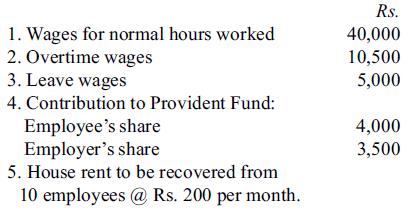
From the following particulars, find the amount of cash required for payment of wages in a factory for a particular month: 1. Wages for normal hours worked 2. Overtime wages 3. Leave wages 4. Contribution to Provident Fund: Employee's share Employer's share 5. House rent to be recovered from 10
There are two piece-workers, Rakhal and Upendra, who are paid Rs. 5 for each piece work executed, which costs Rs. 15 per piece in materials.In a working day of 8 hours, Rakhal can complete 4 pieces and Upendra only 3. If the overhead charges be Rs. 1.50 per hour show which of the two piece workers
What are the merits and demerits of time rate and piece-rate systems of wage payment? State the situations in which each system is effective and useful.
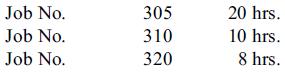
A worker is paid Rs. 50 per hour and the 5 days working week contains 42 hours. The daily allowance for approved absence from his place of work, maintenance of machine etc. is 12 minutes and his job card shows that his time chargeable during the week to various jobs is as follows:The unaccounted
What are the reasons for booking workers on idle time in a factory? How is idle time controlled and treated in cost accounts?
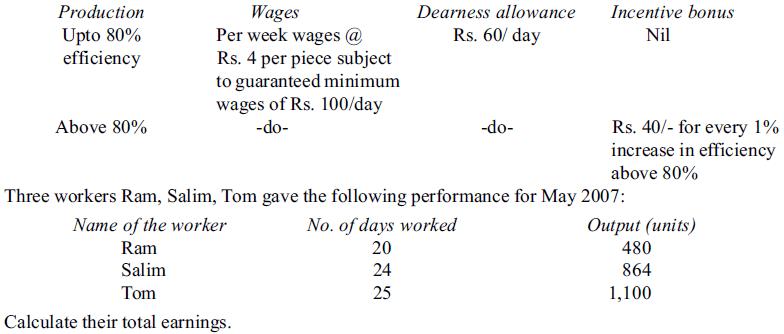
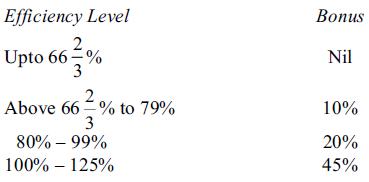
A factory has a piece-work scheme for mass production of a certain component for a T.V. manufacturer. The standard production fixed for a day of 8 hours is 40 units. The piece work rate is Rs. 4 per piece. The details of remuneration payable to the workers are as follows: Production Upto
Calculate total monthly remuneration of three workers A, B and C from the following data:(a) Standard production per month per worker - 1,000 units. Actual production during month A - 850 units, B - 750 units, C-950 units.(b) Piecework rate Rs. 10 per unit (actual production).(c) Additional
The standard labour time requierd for the production of a certain component has been fixed as 4 hours. An incentive scheme was introduced recently to raise labour productivity. The relevant details of the scheme are as follows:Four workers A, B, C and D produced 16, 12, 14 and 10 units respectively
Discuss individual bonus systems, group bonus systems and bonus systems for indirect workers.
List the characteristics desirable in any Incentive Wages Plan.
A worker produced 200 units in a week's time. The guaranteed weekly wage payment for 45 hours is Rs. 81. The expected time to produce one unit is 15 minutes which is raised further by 20% under the incentive scheme. What will be the earnings per hour of that worker under Halsey (50% sharing) and
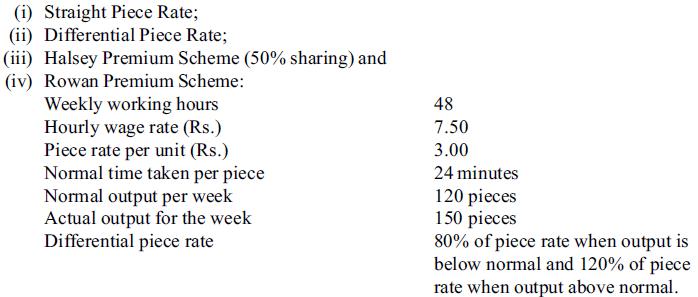
From the following particulars, you are required to work out the earnings of a worker for a week under (i) Straight Piece Rate; (ii) Differential Piece Rate; (iii) Halsey Premium Scheme (50% sharing) and (iv) Rowan Premium Scheme: Weekly working hours Hourly wage rate (Rs.) Piece rate per unit
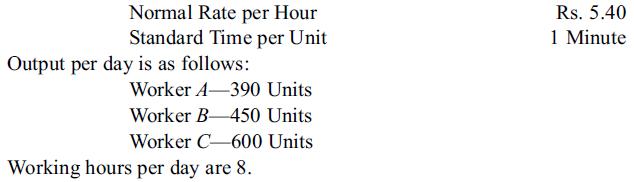
Calculate the earnings of workers A, B and C under Straight Piece Rate System and Merrick's Multiple Piece Rate System from the following particulars: Normal Rate per Hour Standard Time per Unit Output per day is as follows: Worker A-390 Units Worker B450 Units Worker C 600 Units Working hours per
Distinguish between systems of wage payments known as Taylor's Differential Piece-Rate and Emerson's Efficiency system.
A worker, whose day-work wages are Rs. 25 per hour, received production bonus under the Rowan Scheme. He carried out the following work in a 48-hour week:Job No. 2 was carried out on a machine running at 90 per cent efficiency and an extra allowance of 1/9th of actual time was given to compensate
What is labour turnover? How will you measure it? What are its causes and effects on labour costs?
Following particulars have been extracted from the books of Supreme Engineers Limited:(a) You are required to compute the quantum of wages under Halsey Scheme and Rowan Schemes. Which of these schemes would you like to introduce in this company if the time taken to complete the job is likely to
In a manufacturing unit, a multiple piece rate plan is operated as under:(i) Basic piece rate up to 85% efficiency;(ii) 115% basic piece rate between 90% and 100% efficiency;(iii) 125% basic piece rate above 100% efficiency.The workers are eligible for a Guaranteed Day Rate which is equal to
What is idle time? Indicate the different categories into which idle time can be classified and state which of them can be effectively controlled and how?
A worker produced 200 units in a week's time. The guaranteed weekly wage payment for 45 hours is Rs. 81. The expected time to produced one unit is 15 minutes which is raised further by 20% under the incentive scheme. What will be the earnings per hour of that worker under Halsey (50% sharing) and
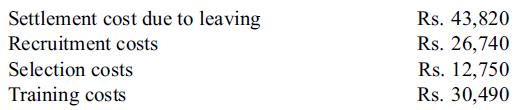
The management of Bina and Rina Ltd. is worried about its increasing labour turnover in the factory and before analysing the causes and taking remedial steps it wants to have an idea of the profit foregone as a result of labour turnover in the last year.Last year sales amounted to Rs. 83,03,300 and
A company is considering installing a workers' profit sharing scheme in lieu of an individual bonus scheme. You are required to specify the disadvantages of the former.
Three workers Govind, Ram and Shyam respectively produced 80, 100 and 120 pieces of product X on a particular day in May 2007 in a factory. The time allowed for 10 units of product X is 1 hour and their hourly rate is Rs. 4. Calculate for each of these three workers the following:(i) Earnings for
The following particulars for the first week of September 2003 relate to X and Y, two workers employed in a factory.The normal working hours per week are fixed at 42 hours. Bonus is paid @ 2/3 of basic wage rate for gross time worked and gross output produced without deduction of rejected output.
(a) Describe the treatment of payments to labour for overtime work and in respect of holiday with pay in cost accounts.(b) Distinguish between Taylor's differential piece-rate and the Emerson Efficiency Plan system of incentive wage payments.
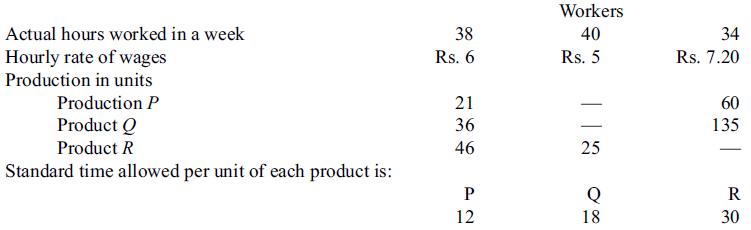
A company is undecided as to what kind of wage scheme should be introduced. The following particulars have been compiled in respect of three systems, which are under consideration of the management.MinutesFor the purpose of piece rate, each minute is valued at Re. 0.10You are required to calculate
For each of the pay roll costs given below, state the accounting treatment that you would recommend, giving your reason:(a) Idle time in the finishing department because the assembly department delayed its production.(b) Overtime resulting from a customer saying ''I want this job done in a week,
Discuss labour turnover and different methods of measuring it.
The finishing shop of a company employs 60 direct workers. Each worker is paid Rs. 400 as wages per weak of 40 hours. When necessary, overtime is worked upto a maximum of 15 hours per weak per worker at time rate plus one-half as premium. The current output on an average is 6 units per man hour
Both direct and indirect labour of a department in a factory are entitled to production bonus in accordance with a group incentive scheme, the outline of which is as follows:(a) For any production in excess of the standard rate fixed at 10,000 units per month (of 25 days) a general incentive of Rs.
ZED Limited employing 50 skilled workers is considering the introduction of incentive scheme-either Halsey scheme (with 50% bonus) or Rowan scheme of wage payment for increasing the labour productivity to cope up the increasing demand for the product by 40%. It is believed that proposed incentive
What do you mean by labour turnover? What are the costs associated with it? How would you treat these costs in cost accounting?
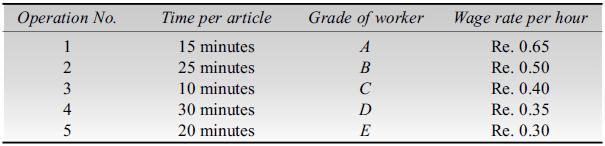
An article passes through five hand operations as follows:The factory works 40 hours a week and the production target is 600 dozens per week. Prepare a statement showing for each operation and in total the number of operators required, the labour cost per dozen and the total labour cost per week to
Discuss the effect of overtime payment on productivity.
The time taken for a particular operation for Operator X in the process division of a manufacturing concern on three different counts was 24,22 and 27 minutes while that of Operator Y was 20, 23 and 26 minutes. It has been ascertained that the rating of X is 70/60 and that of Y is 55/60. Allowances
Explain the purpose of time keeping and time booking and state what detailed records are normally maintained under each. Do you feel any need for reconciliation of these two? What is the benefit you expect if such reconciliation is carried out?
Following are the particulars for April, 2002 relating to four employees working in Department M of a factory, exclusively for Job. No. 120.The normal working hours per week of six days are 48, or 8 hours per day. Sundays are paid holidays.(There were no other holidays during the
Write a short essay on ''Time and Motion Study'', stating the benefits to be derived by management from such study.
How are payments to workers in respect of overtime work and set-up time treated in cost accounts?
Explain the nature and significance of 'Labour Turnover'.
Under the Rowan Premium Bonus system, a less efficient worker can obtain same bonus as a highly efficient worker. Discuss with suitable example.
A company has its factories at two locations. Rowan plan is in use at location A and Halsey plan at location B. Standard time and basic rate of wages are same for a job which is similar and is carried out on similar machinery. Time allowed is 60 hours.Job at location A is completed in 36 hours
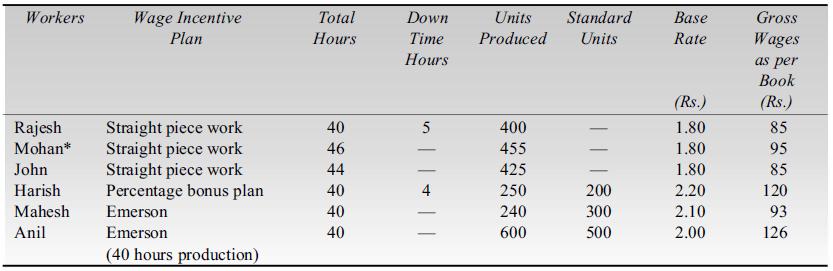
During audit of accounts of G. Company, your assistant found errors in the calculation of the wages of factory workers and he wants you to verify his work.He has extracted the following information:(i) The contract provides that the minimum wage for a worker is his base rate. It is also paid for
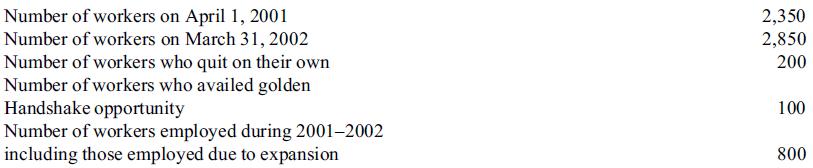
The following information relates to work force in a factory during the year 2001 - 02:Calculate annual labour turnover rate and equivalent monthly turnover rate under different methods. Number of workers on April 1, 2001 Number of workers on March 31, 2002 Number of workers who quit on their
The Cost Accountant of Tirupati Electronics Ltd. has computed labour turnover rates for the quarter ending 31st March, 1998 as 10%, 5% and 3% respectively under 'Flux Method', Replacement Method', and 'Separation Method'. If the number of workers replaced during that quarter is 30, find out the
What are the effects of labour turnover on cost of production?
Enumerate the causes of labour turnover. What is the impact of high labour turnover on the cost of production?
''High wages do not necessarily mean high labour cost''. Elucidate.
Showing 6500 - 6600
of 6579
First
52
53
54
55
56
57
58
59
60
61
62
63
64
65
66
Step by Step Answers

 Get 50% OFF
Claim Now
Get 50% OFF
Claim Now