New Semester
Started
Get
50% OFF
Study Help!
--h --m --s
Claim Now
Question Answers
Textbooks
Find textbooks, questions and answers
Oops, something went wrong!
Change your search query and then try again
S
Books
FREE
Study Help
Expert Questions
Accounting
General Management
Mathematics
Finance
Organizational Behaviour
Law
Physics
Operating System
Management Leadership
Sociology
Programming
Marketing
Database
Computer Network
Economics
Textbooks Solutions
Accounting
Managerial Accounting
Management Leadership
Cost Accounting
Statistics
Business Law
Corporate Finance
Finance
Economics
Auditing
Tutors
Online Tutors
Find a Tutor
Hire a Tutor
Become a Tutor
AI Tutor
AI Study Planner
NEW
Sell Books
Search
Search
Sign In
Register
study help
business
database management systems
Modern Database Management 10th Edition Heikki Topi, Jeffrey A Hoffer, Ramesh Venkataraman - Solutions
Find the information that is needed in order to give each faculty member a list of students who take at least one of their courses during the current semester.
Find the titles and numbers of all 300-level IS courses that are offered in Spring 2010.
Assume that a course number consists of a two-letter designator (such as IS) and a three-digit number. Find the titles and numbers of all 300-level IS courses.
Create a relational schema that is compatible with the domain model specified in Problem and Exercise 7 and a set of .hbm.xml files that map between the domain model and the relational schema.
Create a domain model (using the UML class diagram notation) corresponding to the EER model in Figure 4-36.
Create a relational schema that is compatible with the domain model specified in Problem and Exercise 5 and a set of .hbm.xml files that map between the domain model and the relational schema.
Create a domain model (using the UML class diagram notation) corresponding to the EER model in Figure 4-38.
Create a relational schema that is compatible with the domain model specified in Problem and Exercise 3 and a set of .hbm.xml files that map between the domain model and the relational schema.
Create a domain model (using the UML class diagram notation) corresponding to the EER model in Figure 4-33.
Create a domain model (expressed in the UML class diagram notation) corresponding to the .hbm.xml files you created in Problem and Exercise 1.
Create a set of .hbm.xml files that would generate a database schema presented in Figure 4-5.
Analyze the queries that include explicit joins in the HQL queries and their SQL counterparts. What is the main difference between these two query types?
What is an implicit association join?
When is the select keyword necessary in HQL?
Explain the importance of well-designed fetching strategies.
What is the practical impact of specifying an association as composition from the perspective of object-relational mapping?
Explain why it makes sense to differentiate between manyto-one and one-to-many associations in the object-oriented world.
Briefly describe the four different ways in which an inheritance structure can be mapped to a relational schema.
Explain the importance of pooling database connections.
Referring to the SQL code in Figure 14-7, explain why Student_T, Faculty_T, and Registration_T do not have autogenerated primary keys.
What is the purpose of the SchemaExport tool in Hibernate?
Explain how primary keys of the database tables are specified within the Hibernate environment.
What is the purpose of the tag in the Hibernate configuration files?
How are attributes specified in the Hibernate configuration files?
How is Hibernate configured for a specific database management system environment?
What is the purpose of the .hbm.xml files in Hibernate?
What is the relationship between Hibernate and JPA?
Some developers are concerned about the overhead that SQL query mapping frameworks and ORM frameworks add to call-level APIs. Why?
Why is transparent persistence so important from the perspective of application developers?
Explain the criteria that you might use to select between iBATIS and Hibernate.
Explain the main conceptual difference between iBATIS and Hibernate.
Why can the link between object-oriented applications and relational databases not be built simply by using JDBC or some other call-level application programming interface?
Why is it essential that relational databases be effectively used to provide persistence for objects in applications developed using the object-oriented paradigm?
What is the key difference in how entity instance identities are defined in the object-oriented and relational worlds?
Explain how the object-oriented and relational approaches to accessing data differ from each other.
Briefly describe the factors that contribute to the object-relational impedance mismatch.
Explain the reasons object-oriented database management systems never became very popular.
Compare and contrast the following terms:a. object identity; primary key value of a row in a database tableb. entity class; value typec. OODBMS; RDBMSd. many-to-one association; one-to-many associatione. lazy loading; eager loadingf. JPA; Hibernate
Define each of the following terms:a. object-relational impedance mismatchb. object-relational mappingc. persistenced. call-level application programming interfacee. transparent persistencef. JDBC g. iBATIS h. Hibernate i. N+1 selects problem
Interview a systems analyst in a local company who uses object-oriented programming and systems development tools. Ask to see any analysis and design diagrams the analyst has drawn of the database and applications. Compare these diagrams to the ones in this chapter. What differences do you see?
Ask a database administrator or database or systems analyst in a local company to show you an EER (or E-R) diagram for one of the organization’s primary databases.Translate this diagram into a class diagram.
Visit two local small businesses, one in the service sector and one in manufacturing. Interview employees from these organizations to obtain examples of both superclass/subclass relationships and operational business rules (such as “A customer can return merchandise only if the customer has a
Interview a friend or family member to elicit from them common examples of superclass/subclass relationships. You will have to explain the meaning of this term and provide a common example, such as PROPERTY: RESIDENTIAL, COMMERCIAL; or BONDS: CORPORATE, MUNICIPAL.Use the information your
In the Pine Valley Furniture class diagram, is there a need to add any derived associations or derived relationships? If so, please redraw the diagram to represent this.
Pine Valley Furniture Company has implemented electronic payment methods for some customers. These customers will no longer require an invoice. The sendInvoice and receivePayment methods will still be used for those customers who always pay by cash or check. However, a new method is needed to
Assume that at Pine Valley Furniture Company each product (described by product number, description, and cost)comprises at least three components (described by component number, description, and unit of measure), and components are used to make one or many products. In addition, assume that
Draw a class diagram for the following situation (state any assumptions you believe you have to make in order to develop a complete diagram):A facilities management unit on a corporate campus is responsible for a number of tasks associated with the maintenance of the physical facilities of the
In Chapter 9, we presented a case study for the Fitchwood Insurance Agency. As you may recall, we developed the ER diagram shown in Figure 13-25 for this agency. Convert this E-R diagram into a class diagram. State any assumptions that you make.
Draw a class diagram, showing the relevant classes, attributes, operations, and relationships for the following situation: An international school of technology has hired you to create a database management system in order to assist in scheduling classes. After several interviews with the
Our friend Wally Los Gatos (see Problem and Exercise 18), realizing that his wallcoverings business had a few wrinkles in it, decided to pursue a law degree at night. Since graduating, he has teamed up with Lyla El Pàjaro to form Peck and Paw, Attorneys at Law. Wally and Lyla have hired you to
Draw a class diagram, showing the relevant classes, attributes, operations, and relationships for the following situation:Wally Los Gatos, owner of Wally’s Wonderful World of Wallcoverings, has hired you as a consultant to design a database management system for his chain of three stores that
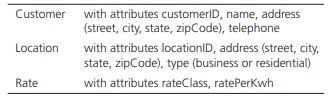
Draw a class diagram, showing the relevant classes, attributes, operations, and relationships for the following situation:Emerging Electric wishes to create a database with the following classes and attributes:After interviews with the owners, you have come up with the following business rules:•
An organization has been entrusted with developing a registration and title system that maintains information about all vehicles registered in a particular state. For each vehicle that is registered with the office, the system has to store the name, address, and telephone number of the owner, the
Refer to the class diagram for hospital relationships (Figure 13-9b). Add notation to express the following business rule:A resident patient can be assigned a bed only if that patient has been assigned a physician who will assume responsibility for the patient’s care.
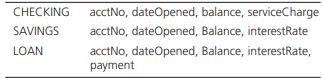
A bank has three types of accounts: checking, savings, and loan. Following are the attributes for each type of account:Assume that each bank account must be a member of exactly one of these subtypes. At the end of each month, the bank computes the balance in each account and mails a statement to
Draw a class diagram for the following situation (state any assumptions you believe you have to make in order to develop a complete diagram):SeeALeopard (SAL) is a company that organizes tours in the Kruger National Park in South Africa. These tours last several hours and sometimes an entire day.
Draw a class diagram for the following situation (state any assumptions you believe you have to make in order to develop a complete diagram):A consulting firm is organized as a partnership with five different types of employees: senior partners, junior partners, senior associates, associates, and
Draw a class diagram for the following situation (state any assumptions you believe you have to make in order to develop a complete diagram):A nonprofit organization depends on a number of different types of persons for its successful operation. The organization is interested in the following
Draw a class diagram for the following situation (state any assumptions you believe you have to make in order to develop a complete diagram):A library has a large number of items that customers can borrow. In addition to books, the collection includes audio products (audio CDs, books on CD, and
Imagine two different types of airline frequent flyer programs: one that awards points based on flown miles and gives free trips based on accumulated mileage according to a predefined awards schedule (e.g., domestic roundtrip in economy requires 25,000 miles, a roundtrip between North America and
Draw a class diagram for the following situation (state any assumptions you believe you have to make in order to develop a complete diagram):A company bottles and distributes bottled water to both private consumers and organizations. The firm wants to develop an application to support the delivery
Draw a class diagram for the following situation (state any assumptions you believe you have to make in order to develop a complete diagram):Stillwater Antiques buys and sells one-of-a-kind antiques of all kinds (e.g., furniture, jewelry, china, and clothing).Each item is uniquely identified by an
Prepare a class diagram for a real estate firm that lists property for sale. This organization is described as follows:• The firm has a number of sales offices in several states;location is an attribute of sales office.• Each sales office is assigned one or more employees.Attributes of employee
Each semester, each student must be assigned an adviser who counsels students about degree requirements and helps students register for classes. Each student must register for classes with the help of an adviser, but if a student’s assigned adviser is not available, the student may register with
Draw a class diagram, showing the relevant classes, attributes, operations, and relationships for each of the following situations (if you believe that you need to make additional assumptions, clearly state them for each situation):a. A company has a number of employees. The attributes of Employee
Refer to Figure 4-36 (originally presented in the context of Problem and Exercise 4-19), which uses an E-R diagram to describe the essential business constructs of a middle-sized software vendor.a. Present the same situation with a class diagram.b. Based on what you have learned about class
A student, whose attributes include studentName, address, phone, and age, may engage in multiple campus-based activities. The university keeps track of the number of years a given student has participated in a specific activity and, at the end of each academic year, mails an activity report to the
Draw a class diagram for some organization that you are familiar with—Boy Scouts/Girl Scouts, a sports team, and so on. In your diagram, indicate names for at least four association roles.
The class diagram shown in Figure 13-24 is an example of. Is the relationship between faculty and their department represented properly in this diagram? Why or why not?
The class diagram shown in Figure 13-23 is an example of.
In the class diagram shown in Figure 13-22, checkFee and monthlyFee are examples of attributes. What type of an operation is calcFee?
In the class diagram shown in Figure 13-21, what do we call/availBalance? What do we call/purchases? Why are these used in this diagram?
When would a unary relationship need to be represented as an association class?
In the diagram shown in Figure 13-20, what do we call the Assignment class?
Why does UML specify several different types of diagrams?
Given the class diagram shown in Figure 13-19, can we have an instance of Vehicle? Why or why not?
What makes the object-oriented modeling approach a powerful tool for developing complex systems?
Give an example of aggregation. Your example should include at least one aggregate object and three component objects. Specify the multiplicities at each end of all of the aggregation relationships.
Using (and, if necessary, extending) the diagram from your solution to Review Question 11, give an example of polymorphism.
If the diagram you developed for Review Question 11 does not contain an abstract class, extend the diagram by adding an abstract class that contains at least one abstract operation. Also, indicate which features of a class other classes inherit.
Give an example of generalization. Your example should include at least one superclass and three subclasses and a minimum of one attribute and one operation for each of the classes. Indicate the discriminator and specify the semantic constraints among the subclasses. What is the purpose of the
Add operations to some of the classes you identified in Review Question 7.
Add role names to the association relationships you identified in Review Question 7.
Explain the difference between the name of the association relationship and the role names linked to an association.
Using a class diagram, give an example for each of the following types of relationships: unary, binary, and ternary.Specify the multiplicities for all the relationships.
State the conditions under which a designer should model an association relationship as an association class. In what way is the expressive power of an association class stronger than that of an ordinary association relationship?
Compare the object-oriented model with the EER model.
State the activities involved in each of the following phases of the object-oriented development life cycle: object-oriented analysis, object-oriented design, and object-oriented implementation.
Contrast the following terms:a. class; objectb. attribute; operationc. state; behaviord. operation; methode. query operation; update operationf. abstract class; concrete class g. class diagram; object diagram h. association; aggregation i. generalization; aggregation j. aggregation; composition k.
Define each of the following terms:a. classb. statec. behaviord. encapsulatione. operationf. method g. constructor operation h. query operation i. update operation j. abstract class k. concrete class l. abstract operation m. multiplicity n. class-scope attribute o. association class p. polymorphism
Find examples of cases in which the emergence of fast Internet-based virtual private networks has changed the context for designing data distribution strategies.
Visit an organization that uses a large-scale enterprise system (such as an ERP, SCM, or CRM) from multiple locations.Find out what type of a database distribution approach the organization has chosen to adopt.
Visit an organization that has installed a client/server database environment. Explore the following questions:a. What distributed database features do the client/server DBMSs in use offer?b. Is the organization attempting to achieve the same benefits from a client/server environment as are
Investigate the latest distributed database product offerings from the DBMS vendors mentioned in this chapter. Update the description of the features for one of the distributed DBMS products listed. Search for distributed DBMS products from other vendors and include information about these products
Visit an organization that has installed a distributed database management system. Explore the following questions:a. Does the organization have a truly distributed database? If so, how are the data distributed: via replication, horizontal partitioning, or vertical partitioning?b. What commercial
Assume that an organization operates using a model in which most of its employees are either telecommuting from home or working from client sites all the time. What type of impact would this model operation have on the selection of your data distribution strategies?
How would your database distribution strategy planning process change if you could assume that you have unlimited, error-free bandwidth between all the locations from which the data have to be accessed?
Assume that PVFC has expanded its operations significantly and added sales offices in both Stuttgart, Germany, and Moscow, Russia. Each of these sales offices has about 10 staff members, and their primary role is to manage the collaboration between PVFC and its regional distributors in their
Management has decided to add an additional warehouse for customers west of the Mississippi. Items that are not custom built are shipped from this warehouse.Custom-built and specialty items are shipped from the manufacturing facility. What additional tables and changes in distribution strategy, if
Certain items are available to only international customers and customers on the East Coast. How would this change your distribution strategy?
Showing 1600 - 1700
of 3225
First
10
11
12
13
14
15
16
17
18
19
20
21
22
23
24
Last
Step by Step Answers

 Get 50% OFF
Claim Now
Get 50% OFF
Claim Now