New Semester
Started
Get
50% OFF
Study Help!
--h --m --s
Claim Now
Question Answers
Textbooks
Find textbooks, questions and answers
Oops, something went wrong!
Change your search query and then try again
S
Books
FREE
Study Help
Expert Questions
Accounting
General Management
Mathematics
Finance
Organizational Behaviour
Law
Physics
Operating System
Management Leadership
Sociology
Programming
Marketing
Database
Computer Network
Economics
Textbooks Solutions
Accounting
Managerial Accounting
Management Leadership
Cost Accounting
Statistics
Business Law
Corporate Finance
Finance
Economics
Auditing
Tutors
Online Tutors
Find a Tutor
Hire a Tutor
Become a Tutor
AI Tutor
AI Study Planner
NEW
Sell Books
Search
Search
Sign In
Register
study help
business
database management systems
Modern Database Management 12th Global Edition Topi Hoffer, Venkataraman - Solutions
Observe the kind of people who work in your university/college. Then interview DB administrator/ system analyst or a concerned official who collects data on these people.Ask about the attributes on which data is collected. Is it possible in this scenario that there exists supertype/subtype
Add the following to Figure 3-16: An EMPLOYMENT party relationship is further explained by the positions and assignments to positions during the time a person is employed. A position is defined by an organization unit, and a unit may define many positions over time.Over time, positions are assigned
Develop an EER model for the following situation using the traditional EER notation, the Visio notation or the subtypes inside supertypes notation, as specified by your instructor:TomKat Entertainment is a chain of theaters owned by former husband and wife actors/entertainers who, for some reason,
Refer to your answer to Problem and Exercise 2-51 in Chapter 2.The description for DocIT explained that there were to be data in the database about people who are not patients but are related to patients. Also, it is possible for some staff members to be patients or to be related to patients. And,
Based on the EER diagram constructed for Problem and Exercise 3-34, develop a sample definition for each entity type, attribute, and relationship in the diagram.
Develop an EER model for the following situation using the traditional EER notation, the Visio notation, or the subtypes inside supertypes notation, as specified by your instructor:Wally Los Gatos and his partner Henry Chordate have formed a new limited partnership, Fin and Finicky Security
Develop an EER model for the following situation using the traditional EER notation, the Visio notation, or the subtypes inside supertypes notation, as specified by your instructor:An international school of technology has hired you to create a database management system to assist in scheduling
Applying generalization and specialization, a data modeler has split supertype entity Students’of a university into the following subtypes: Professionals taking up professional courses at the university, Arts and Humanities, Sciences, and Doctoral Student. Depict this situation in the form of an
Develop an EER model for the following situation, using the traditional EER notation, the Visio notation, or the subtypes inside supertypes notation, as specified by your instructor:A technology company provides offerings to its customers. Offerings are of two separate types: products and services.
Add a subtype discriminator (named Paticipant Type) to the diagram you created in Problem and Exercise 2-29.
Draw an EER diagram for the following problem using EER notation, the Visio notation, or the subtypes inside supertypes notation, as specified by your instructor.A nonprofit organization depends on a number of different types of persons for its successful operation. The organization is interested
Refer to your answer to Problem and Exercise 3-24.Develop entity clusters for this E-R diagram and redraw the diagram using the entity clusters. Explain why you chose the entity clusters you used.
Refer to your answer to Problem and Exercise 2-44 in Chapter 2.Develop entity clusters for this E-R diagram and redraw the diagram using the entity clusters. Explain why you chose the entity clusters you used.
An institute facilitates its students to participate in three types of sports events: Long Jump, Discus Throw and 100-Meter race. The following attributes are recorded for each event:Long Jump: Student Roll Number, Name, House, Age, Recorded Jump Discus Throw: Student Roll Number, Name, House, Age,
An electronics goods store has electronic devices, such as mobile phones, laptops, televisions, and refrigerators for sale.a. Is it possible to apply supertype/subtype hierarchy to the above situation?How?b. Construct an EER diagram. Which specialization rule(completeness constraint) does it
Refer to Problem and Exercise 2-44 in Chapter 2, Part f.Redraw the ERD for your answer to this exercise using appropriate supertypes and subtypes.
Figure 3-13 shows the development of entity clusters for the Pine Valley Furniture E-R diagram. In Figure 3-13b, explain the following:a. Why is the minimum cardinality next to the DOES BUSINESS IN associative entity coming from CUSTOMER zero?b. What would be the attributes of ITEM (refer to Figure
Refer to the EER diagram for patients in Figure 3-3.Make any assumptions you believe are necessary. Develop sample definitions for each entity type, attribute, and relationship in the diagram.
Refer to the employee EER diagram in Figure 3-2.Make any assumptions that you believe are necessary. Develop a sample definition for each entity type, attribute, and relationship in the diagram.
For simplicity, subtype discriminators were left off many figures in this chapter. Add subtype discriminator notation in each figure listed below. If necessary, create a new attribute for the discriminator.a. Figure 3-2b. Figure 3-3c. Figure 3-4bd. Figure 3-7ae. Figure 3-7b
Add a subtype discriminator for each of the supertypes shown in Figure 3-10.Show the discriminator values that assign instances to each subtype. Use the following subtype discriminator names and values:a. PERSON: Person Type (Employee? Alumnus?Student?)b. EMPLOYEE: Employee Type (Faculty, Staff)c.
Examine the hierarchy for the university EER diagram(Figure 3-10). As a student, you are an instance of one of the subtypes: either UNDERGRAD STUDENT or GRADUATE STUDENT. List the names of all the attributes that apply to you. For each attribute, record the data value that applies to you.
When is a member of a supertype always a member of at least one subtype?
What are the benefits of utilizing a universal data model?
Discuss how it is decided which subtype will be inserted with a new instance of supertype.
Does a data modeling project using a packaged data model require less or greater skill than a project not using a packaged data model? Why or why not?
Purchasing a packaged data model involves mapping.What is mapping? What are the points you need to consider about it?
In what ways is starting a data modeling project with a packaged data model different from starting a data modeling project with a clean sheet of paper?
How are the attributes assigned in supertype/subtype hierarchy?
Give an example of generalization not discussed in the text.
What types of business rules are normally captured in an EER diagram?
Give an example of each of the following:a. a supertype/subtype relationship where the disjoint rule appliesb. a supertype/subtype relationship where the overlap rule applies
What is attribute inheritance? Why is it important?
Give an example (other than those discussed in the chapter)of a supertype/subtype relationship.
State the need for EER modeling.
Discuss the notations used to represent EER models.Which notation is the most widely used?
Contrast the following terms:a. supertype; subtypeb. generalization; specializationc. disjoint rule; overlap ruled. total specialization rule; partial specialization rulee. PARTY; PARTY ROLEf. entity; entity cluster
Define each of the following terms:a. supertypeb. subtypec. specializationd. entity clustere. completeness constraintf. enhanced entity-relationship (EER) model g. subtype discriminator h. total specialization rule i. generalization j. disjoint rule k. overlap rule l. partial specialization rule m.
Describe the special features of a data modeling project when using a packaged data model.
Explain the major features and data modeling structures of a universal (packaged)data model.
Develop an entity cluster to simplify presentation of an E-R diagram.
Develop a supertype/subtype hierarchy for a realistic business situation.
Specify both completeness constraints and disjointness constraints in modeling supertype/subtype relationships.
Use both specialization and generalization as techniques for defining supertype/subtype relationships.
Prepare a list of questions that you have as a result of your E-R modeling efforts, and that need to be answered to clarify your understanding of FAME’s business rules and data requirements.
Use the narratives in Chapter 1 and above to identify the typical outputs (reports and displays) the various stakeholders might want to retrieve from your database.Now, revisit the E-R diagram you created in 2-60 to ensure that your model has captured the information necessary to generate the
Create an E-R diagram for FAME based on the enterprise data model you developed in 1-52.Clearly state any assumptions you made in developing the diagram.
Redo the enterprise data model you created in Chapter 1 to accommodate the information gleaned from Alex Martin, Dale Dylan, and Sandy Wallis’ e-mails.
Research various graphics and drawing packages (e.g., Microsoft Office, SmartDraw) and compare the E-R diagramming capabilities of each. Is each package capable of using the notation found in this text? Is it possible to draw a ternary or higher-order relationship with each package?
Visit a local branch of any bank and a fast food chain outlet.Interview employees from the organization to elicit if they use time dependent data. How do they model such data? Is time stamping or some other means is used? Is it necessary to use and model time dependent data? If history of
Ask a database or systems analyst in a local company to show you an E-R diagram for one of the organization’s primary databases. Ask questions to be sure you understand what each entity, attribute, and relationship means.Does this organization use the same E-R notation used in this text? If not,
Ask a database or systems analyst to give you examples of unary, binary, and ternary relationships that the analyst has dealt with personally at his or her company. Ask which is most common and why.
Interview a database analyst or a system analyst. How do they extract business rules for ER modeling? Ask for specific sources. Are they all listed in the text? Did they purchase an ER model and customize it or design it on their own? How did they decide on naming entity types?Ask the analyst or
Interview a database analyst or systems analyst and document how he or she decides on names for data objects in data models. Does the organization in which this person works have naming guidelines? If so, describe the pattern used. If there are no guidelines, ask whether your contact has ever had
Review your answer to Problem and Exercise 2-49; if necessary, change the names of the entities, attributes, and relationships to conform to the naming guidelines presented in this chapter. Then, using the definition guidelines, write a definition for each entity, attribute, and relationship. If
Draw an ERD for the following situation. (State any assumptions you believe you have to make in order to develop a complete diagram.) Also, draw a data model for this situation using the tool you have been told to use in your course: The A. M. Honka School of Business operates international
Draw an ERD for the following situation. (State any assumptions you believe you have to make in order to develop a complete diagram.) Also, draw a data model for this situation using the tool you have been told to use in your course: Stillwater Antiques buys and sells one-of-akind antiques of all
Draw an ERD for the following situation (Batra et al., 1988). Also, develop the list of words for qualifiers and classes that you use to form attribute names. Explain why you chose the words on your list. Also, draw a data model for this situation using the tool you have been told to use in your
Obtain several common user views such as a credit card receipt, credit card statement, and annual summary or some other common document from one organization with which you interact.a. Prepare an ERD for one of these documents. Also prepare a data model for this document, using the tool you have
After completing a course in database management, you are asked to develop a preliminary ERD for a gym database. You discover the entity types that should be included as shown in the provided figure.During further discussions you discover the following:• The employees can be staff or trainers.
In the chapter, when describing Figure 2-4a, it was argued that the Received and Summarizes relationships and TREASURER entity were not necessary. Within the context of this explanation, this is true. Now, consider a slightly different situation. Suppose it is necessary, for compliance purposes
An IT multinational organization has launched a connecting program across 250 campuses around the world to train faculty members from each campus in both current and new technology. Each year, at least 5 faculty members from each campus need to register for this program.We need to track the faculty
Management department at Scholars University holds workshops annually in collaboration with two other universities. The department wishes to create a database with the following entities and attributes:• Faculty delivering workshop – FacultyID, Name, Email, Address (street, city, state, zip
Assume that at Pine Valley Furniture, each product (described by product number, description, and cost) is composed of three components (described by component number, description, and unit of measure), and components are used to make one or many products. In addition, assume that components are
Review Figure 2-8 and Figure 2-22.a. Identify any attributes in Figure 2-22 that might be composite attributes but are not shown that way.Justify your suggestions. Redraw the ERD to reflect any changes you suggest.b. Identify any attributes in Figure 2-22 that might be multivalued attributes but
Modify Figure 2-11a to model the following additional information requirements: The training director decides for each employee who completes each class who (what employees) should be notified of the course completion. The training director needs to keep track of which employees are notified about
Figure 2-28 shows two diagrams (A and B), both of which are legitimate ways to represent that a stock has a history of many prices. Which of the two diagrams do you consider a better way to model this situation and why?
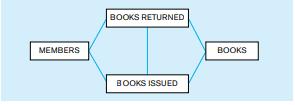
Consider the figure provided which represents a situation of members of a library who get books issued and return to the libraryThe members can be students, staff or faculty and their details are stored in Member entity. A member can issue no more than 10 books. All the books details are stored in
The Is Married To relationship in Figure 2-12a would seem to have an obvious answer in Problem and Exercise 2-33d—that is, until time plays a role in modeling data.Draw a data model for the PERSON entity type and the Is Married To relationship for each of the following variations by showing the
Add minimum and maximum cardinality notation to each of the following figures, as appropriate:a. Figure 2-5b. Figure 2-10ac. Figure 2-11bd. Figure 2-12 (all parts)e. Figure 2-13cf. Figure 2-14
Figure 2-26 shows a grade report that is mailed to students at the end of each semester. Prepare an ERD reflecting the data contained in the grade report. Assume that each course is taught by one instructor. Also, draw this data model using the tool you have been told to use in the course. Explain
Because Visio does not explicitly show associative entities, it is not clear in Figure 2-22 which entity types are associative. List the associative entities in this figure. Why are there so many associative entities in Figure 2-22?
Consider the situation: Faculty at a university (FACULTY entity) can also be part of Board of Studies (BOARD entity). Is there a weak entity here? How?
The entity type TEACHER has the following attributes:Teacher Name, Email, Phone, Age, Trainer, and Training Count. Trainer represents some workshop organized by the teacher, and Training Count represents the number of times teacher has organized such workshops. This implies a teacher may organize
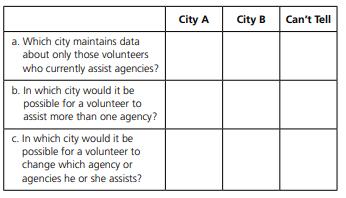
Consider the two E-R diagrams in Figure 2-25, which represent a database of community service agencies and volunteers in two different cities (A and B). For each of the following three questions, place a check mark under City A, City B, or Can’t Tell for the choice that is the best answer. a.
You may have been assigned a CASE or a drawing tool to develop conceptual data models. Using this tool, attempt to redraw all the E-R diagrams in this chapter. What difficulties did you encounter? What E-R notations did not translate well to your tool? How did you incorporate the E-R notation that
There is a bulleted list associated with Figure 2-22 that describes the entities and their relationships in Pine Valley Furniture. For each of the 10 points in the list, identify the subset of Figure 2-22 described by that point.
Answer the following questions concerning Figure 2-22:a. Where is a unary relationship, what does it mean, and for what reasons might the cardinalities on it be different in other organizations?b. Why is Includes a one-to many relationship, and why might this ever be different in some other
For each of the descriptions below, perform the following tasks:i. Identify the degree and cardinalities of the relationship.ii. Express the relationships in each description graphically with an E-R diagram.a. A book is identified by its ISBN number, and it has a title, a price, and a date of
A cellular operator needs a database to keep track of its customers, their subscription plans, and the handsets (mobile phones) that they are using. The E-R diagram in Figure 2-24 illustrates the key entities of interest to the operator and the relationships between them. Based on the figure,
Why is it recommended to define and name the data before using it in a data model?
Explain the distinction between entity type and entity instance.
For the Manages relationship in Figure 2-12a, describe one or more situations that would result in different cardinalities on the two ends of this unary relationship.Based on your description for this example, do you think it is always clear simply from an E-R diagram what the business rule is that
Discuss why data modeling is considered more important than process modeling.
What are the special guidelines for naming relationships?
State a rule that says when to extract an attribute from one entity type and place it in a linked entity type.
Discuss why ER model is a popular modeling tool.
Provide examples (other than those described in this chapter) of multiple relationships, and explain why these examples best represent this type of relationship. Discuss the role of identifiers in modeling this relationship.
Give an example (other than those described in this chapter) for each of the following, and justify your answer:a. derived attributeb. multivalued attributec. atomic attributed. composite attributee. composite identifier attributef. optional attribute
State the guidelines for naming entity types.Discuss why organizations customize a purchased data model.
Give an example, other than those described in this chapter, of a weak entity type. Why is it necessary to indicate an identifying relationship?
When should an attribute be linked to an entity via a relationship?
State three conditions that suggest the designer should model a relationship as an associative entity type.
What is the need of time stamping to model time-dependent data?
State the differences between a term and a fact.
State six general guidelines for naming data objects in a data model.
What are the characteristics of good business rules?
Give four reasons why a business rules approach is advocated as a new paradigm for specifying information systems requirements.
Give four reasons why many system designers believe that data modeling is important and arguably the most important part of the systems development process.
Contrast the following terms:a. stored attribute; derived attributeb. simple attribute; composite attributec. entity type; relationship typed. strong entity type; weak entity typee. degree; cardinalityf. required attribute; optional attribute g. composite attribute; multivalued attribute h. ternary
Showing 700 - 800
of 3225
1
2
3
4
5
6
7
8
9
10
11
12
13
14
15
Last
Step by Step Answers

 Get 50% OFF
Claim Now
Get 50% OFF
Claim Now