New Semester
Started
Get
50% OFF
Study Help!
--h --m --s
Claim Now
Question Answers
Textbooks
Find textbooks, questions and answers
Oops, something went wrong!
Change your search query and then try again
S
Books
FREE
Study Help
Expert Questions
Accounting
General Management
Mathematics
Finance
Organizational Behaviour
Law
Physics
Operating System
Management Leadership
Sociology
Programming
Marketing
Database
Computer Network
Economics
Textbooks Solutions
Accounting
Managerial Accounting
Management Leadership
Cost Accounting
Statistics
Business Law
Corporate Finance
Finance
Economics
Auditing
Tutors
Online Tutors
Find a Tutor
Hire a Tutor
Become a Tutor
AI Tutor
AI Study Planner
NEW
Sell Books
Search
Search
Sign In
Register
study help
business
environmental economics
A Course In Environmental Economics 1st Edition Daniel J Phaneuf, Till Requate - Solutions
What is externality? Provide two examples that are not given in the text? What are the root causes of environmental externality? Be specific. You are encouraged to use demand and supply analysis to answer this question.
Clearly delineate the differences and similarities between public goods and common property resources. You may find it helpful to use concepts, such as rival, non-rival, joint consumption, and non-exclusive, to answer this question.
It has been shown that the consequence of environmental externality is a divergence between social and private costs. Explain the differences between social and private cost and explain how the difference in these two concepts causes market failure. What exactly is meant by market failure? Be
In some instances, consideration of ‘transaction costs’ alone could make internalizing an externality (positive or negative) economically indefensible. Can you provide three concrete examples of this nature? In answering this question, make sure to provide a clear definition of transaction cost.
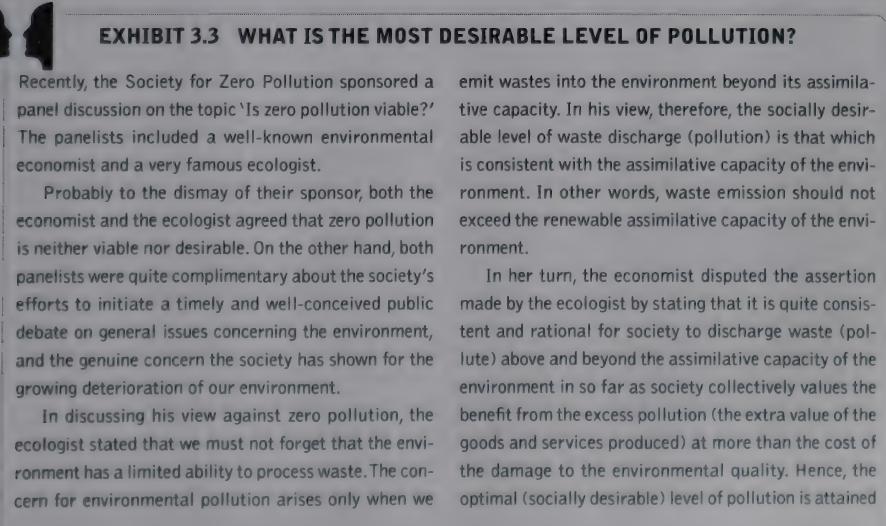
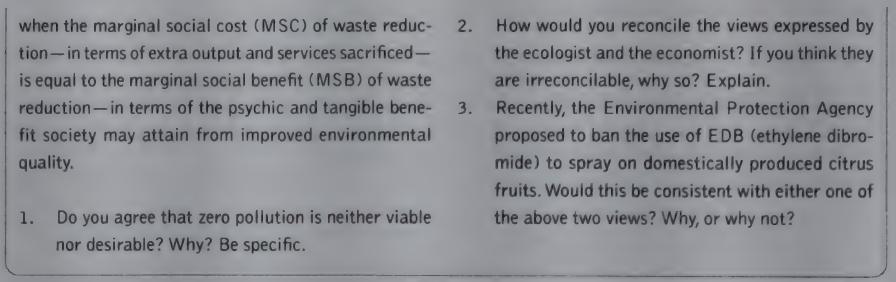
Questions for discussion: read the material in Exhibit 3.3 below and answer the three questions presented at the end of the exhibit. EXHIBIT 3.3 WHAT IS THE MOST DESIRABLE LEVEL OF POLLUTION? Recently, the Society for Zero Pollution sponsored a panel discussion on the topic 'Is zero pollution
Briefly identify the following concepts: pollution-control technology, pollution-control cost, pollution-damage cost, cost-effective, eutrophication, pollution prevention.
Read the following statements. Respond ‘True’, ‘False’ or ‘Uncertain’ and explain why:(a) Improvement in pollution-control technology reduces pollution while at the same time allowing society to realize savings in its expenditure for waste control. A ‘win-win’ situation, indeed!
Fundamentally, the economics of pollution-control attempts to balance the cost of pollution cleanup with the damage cost to the environment at the margin. With this in mind, explain what happens under each one of the following situations:(a) MCC > MDC(b) MCC
Examine the following two statements. Are they equivalent? Why or why not?(a) Pollution-damage costs are externalities.(b) Not all aspects of pollution-damage costs can be evaluated in monetary terms.
Evaluate the relative merit of each of the following environmental-management strategies. Identify a real-world case under which one of these strategies is more appropriate than the others.(a) Pollution should be ‘controlled’ up to a point where the total social cost for disposing of it is
Quickly review the following concepts: the polluter-pays principle, regulatory capture, emission standards, effluent charge, and the double-dividend feature of pollution tax.
Read the following statements. In response, state ‘True’, ‘False’ or ‘Uncertain’ and explain why:(a) Public intervention is both a necessary and sufficient condition for internalizing environmental externality.(b) Environmental advocacy groups generally favor the command-and-control
Provide four reasons why economists generally don’t favor a policy that is based on a command-and-control approach to environmental regulation.
To say that an effluent charge is cost-effective does not necessarily mean that it is socially optimal. Discuss.
The core problem of a command-and-control approach to environmental policy is its inherent bias or tendency to standard-setting practice that is uniformly applicable to all situations. For example, the ambient-air-quality standards in the United States are basically nationalT.hi s may have serious
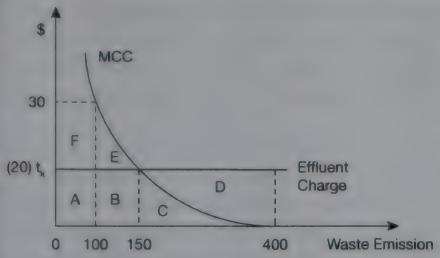
Refer back to Figure 5.3. Let tk now represent, not effluent tax, but subsidies. In other words, the firm will be paid by the regulators t, (i.e., $20) for each unit of waste cleaned up.(a) Demonstrate that the final outcome will be the same (cleanup 250 units of waste or control 150 units of
It is often argued that effluent charge (not subsidy) may have a regressive effect on income distribution (i.e., lower-income households may end up paying more tax relative to their income). However, some economists have argued that effluent charge should not be dismissed on the basis of
Briefly describe the following concepts: emission credits, the grandfathering principle, the emissions bubble policy, the emissions offsets policy, the emissions banking policy, pollution havens, hot-spots, the jobs—environment tradeoff myth, the Porter Hypothesis.
As you have read in this chapter, since the mid-1980s the Environmental Protection Agency (EPA) in the United States has seemingly come to increasingly rely on transferable emissions control (TEC) as an instrument to regulate pollution.(a) Do you support this fundamental shift in policy from the
Environmental organizations have opposed market-based pollution-control policies out of a fear that permit levels and tax rates, once implemented, would be more difficult to tighten over time than command-and-control standards. Is this fear justifiable? Why, or why not?
Which of the environmental policy options discussed in this and previous chapters would you recommend if a hypothetical society were facing the following environmental problems? In each case, briefly explain the justification(s) for your choice.(a) Pollution of an estuary from multiple source
Are the following three statements reconcilable? Give reasons for your answers.(a) Uncertainty arising from environmental regulation is crippling job creation.(b) Environmental regulations enhance innovation and competitiveness.(c) Market-based approaches to pollution control provide incentives for
Environmental regulation creates more jobs that it destroys. Do you agree? Discuss.
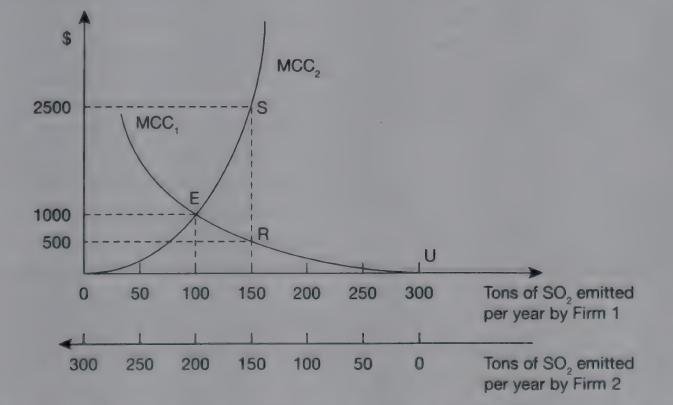
As discussed in this chapter, by all accounts the US acid-rain program has been hailed a success at reducing emissions of SO, and NO, from power plants. The reason for its success is largely attributed for its use of market based instruments; namely, the emissions trading scheme. Furthermore, the
Briefly explain the following concepts: consumers’ surplus, revealed preference valuation methods, stated preference valuation methods, conjoint rating analysis, statistical life, aversive expenditure, use values, option values, bequest values, existence value, total value, commodification of
Read the following statements. In response, state ‘True’, ‘False’ or ‘Uncertain’ and explain why:(a) To describe an environmental asset as ‘priceless’ does not mean that it has an infinite value.(b) Economists do not attempt to measure the value of the environment. What they attempt
On April 20 2010, an oil rig leased by oil giant BP exploded in the Gulf of Mexico, killing 11 workers and releasing approximately 200 million gallons of oil, tens of millions of gallons of natural gas and 1.8 million gallons of chemicals The ecological, economic and human impacts of this oil spill
With respect to the contingent valuation method, explain why is hypothetical bias a more serious problem than strategic bias?
Are the two comments below equivalent? Do you agree with the ideas conveyed by these comments? Explain.(a) Putting real economic value on components of nature will help protect the environment and promote biodiversity. (Hint: notice the emphasis on components. )(b) The reason we are losing natural
How would you respond to a skeptic who asked the following question: Should we put a dollar value on nature?
Carefully explain the differences and similarities between the following pairs of concepts as environmental valuation methods:(a) Aversive expenditure versus travel-cost.(b) Conjoint analysis versus choice-modeling.(c) Contingent valuation versus choice-modeling.(d) Contingent valuation versus
In this chapter we discussed five commonly used techniques for measuring the monetary values of avoided environmental damages (benefits): market pricing; replacement cost; hedonic price; household production function (which includes the travel-cost and aversive expenditures); and contingent
A colleague said to me,I have my own personal doubts about contingent valuation when respondents are ethically committed to environmental preservation. If they are asked a willingness-to-accept question, then they may respond with an infinite or very large price. In essence, they see the resource
Economists are difficult to understand. They claim that they can put a monetary value on premature death, but not on human life. They also claim that they can value ecosystem services (such as a wetland area)in a certain locality, but not the value of the world’s ecosystem services. How could
Briefly identify the following concepts: ‘actual’ Pareto improvement, ‘potential’ Pareto improvement, capital budgeting, double counting, net present value, private discount rates, social discount rates, the discount factor, positive time preference, the precautionary principle,
Read the following statements. In response, state ‘True’, ‘False’ or ‘Uncertain’ and explain why.(a) Double counting is a potentially serious problem often encountered in assessing both social and private projects.(b) Addressing the concern for intergenerational fairness need not
Carefully explain the differences and/or similarities between the following pairs of concepts:(a) Capital budgeting and cost-benefit analysis.(b) Net present value criterion and potential Pareto improvement.(c) Private and social discount rates.
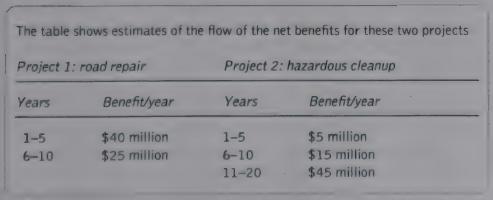
A hypothetical country has a surplus of $200 million in its budget for the fiscal year just ended. Several proposals have been examined for the use of this money, two of which are emerging as leading candidates for serious consideration. One of the favored projects is to use the entire surplus
The Stern Review on the Economics of Climate Change (to be discussed in the next chapter), a report commissioned by the British government in 2005, argued for zero discounting of future generationWsh.at could be the rationale for this? Speculate.
Imagine that an environmental regulatory body is in the process of attempting to decide on the level of a toxic substance that can be safely released into an estuary that provides shelter and food for a variety of birds, fish and other animals. This estuary is also located in a very close proximity
If acompany locates a plastic recycling facility in a predominantly poor neighborhood of a city, would this be sufficient to place the action in the realm of environmental justice? Discuss.
Howwould you reconcile the two observations below regarding the precautionary approach as a decision-making framework (Russell 2005):(a) Making the precautionary principle the norm would encourage scientific responsibility in developing new technologies, rather than encouraging the economic
Briefly explain the meaning of the following concepts and terms: greenhouse gases (GHGs), the IPCC, the ‘little ice age’, the Keeling graph, telekinetic property of the atmosphere, global ‘weirding’, greenhouse-damage costs, greenhouse-abatement costs, clean development mechanism (CDM), and
Read the following statements. In response, state ‘True’, ‘False’ or ‘Uncertain’ and explain why.(a) Climate change and GW are two perfectly interchangeable terms.(b) It is more effective to control global carbon emissions using a carbon tax than tradable emissions permits.(c) The
Explain how the combined effects of clouds, aerosols, forest ecosystems and ocean currents contribute to the difficulty of estimating future GW trends.
Do you agree with the distinguished British economist Sir Nicholas Stern’s claim that climate change confronts economists with ‘the biggest case of market failure’? Explain.
Suppose you are someone who really feels that something serious has to be done to slow the GW trend.(a) Would you support the ‘gradualist’ or the ‘precautionary’ approach? Explain.(b) If you are not convinced by either of these approaches, is there a different approach that you would
It is very dangerous to put too much faith in agreements reached through international conventions to address a problem like GW. Look how insignificant the accomplishments of the Kyoto Protocol have been after 15 years of its existence and only a few years left before its mandate officially
To safeguard the interest of future generations, studies done by the proponents of ‘the precautionary approach to GW (such as, Cline and the Stern Report) strongly advocate the use of a discount rate that is very close to zero.However, a very highly regarded British economist, Sir Partha
1 percent) discount rate carries its own risk. This is because of the possibility that a discount rate close to zero may hinder important technological advances in the near-term. The adverse effects on technological advances will not only be limited to present but also future generations. In this
Carefully review the following key concepts discussed in this chapter: ESS, biodiversity conservation, species richness, critical thresholds for species extinction, debt-for-nature swaps, protected areas, and the insurance value of biodiversity.
Provide the ecological argument for why increases in species diversity would lead to increases in ecosystem productivity, and hence an increase in the production of ESS.
Do you think it is reasonable to assume that the production of ESS follows the law of diminishing marginal product? Explain.
In your own words, explain the arguments given in this chapter regarding why the demand for ESS should be separated into two distinct segments.
Provide three economic reasons why, from a global perspective, there appears to be underinvestment in projects that would lead to the reversal of the current trends in biodiversity loss.
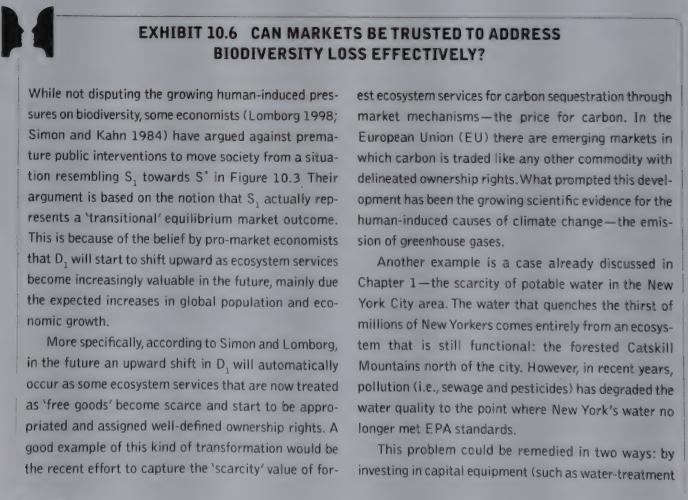
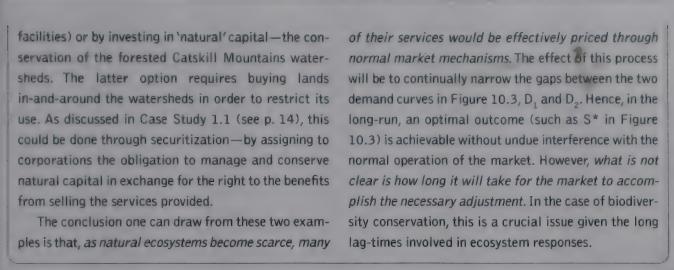
Read Exhibit 10.6 carefully and answer the following question: Can a free-market system be trusted to effectively address the global concern in biodiversity loss? Why or why not?Exhibit 10.6 EXHIBIT 10.6 CAN MARKETS BE TRUSTED TO ADDRESS BIODIVERSITY LOSS EFFECTIVELY? While not disputing the
Read the following statements. In response, state ‘True’, ‘False’ or ‘Uncertain’ and explain why:(a) Biological diversity contributes to an increase in the stability of the supply of ecosystems services.(b) Human population growth, economic growth and increased use of technology
Provide brief but critical comments on the following major UN biodiversity related treaties and policy guidelines:(a) The 1973 Convention on International Trade in Endangered Species of Wild Fauna and Flora, CITES (and the subsequent amendments).(b) The 1992 Convention on Biological Diversity, CBD
Briefly identify the following concepts: preventive and positive checks to population growth, exponential growth, the Malthusian trap, Ricardian rent, neo-Malthusian, real per capita output, throughput, the spaceship economy, and ecological resilience.
Read the following statements. In response, state ‘True’, ‘False’ or ‘Uncertain’ and explain why.(a) The connection between population growth and environmental damage is undeniable. More people cause increasing damage to the environment.(b) It is inadequate to identify the ‘optimal’
More than any other factor, as human population increases it causes a rise in the demand for food and other extractive resources. It is the gradual decline in the quality of arable land and the difficulty of mining increasingly poor-quality mineral deposits that eventually halt human material
Ill-conceived technology, not population growth or affluence, has been primarily responsible for today’s global population problems. Critically comment. Support your comments with specific examples.
The isolated and sporadic instances of hunger that we continue to witness in parts of our contemporary world do not support the Malthusian theory as some would like to claim. These events are caused not by population pressure but by the poor global distribution of resources. Do you agree? Why, or
Garrett Hardin (1993: 94) wrote:Ceven though] John Maynard Keynes had the highest opinion of his contributions to economics, Malthus continues to be bad-mouthed by many of today’s sociologists and economists. The passion displayed by some of his detractors is grossly disproportionate to the
Davidson (2000) suggested that Malthusians’ repeated predictions about the inevitability of impending economic and ecological catastrophe are ultimately damaging to the cause of environmental protection. How could this be? Explain.
Identify what you consider to be the three most important features of the ecological economics perspective about biophysical limits. How are these different from the Malthusian perspective about limits?
It is argued that all transformations require energy, that energy flow is unidirectional and that there is no substitute for energy. It therefore makes sense to use energy as a numeraire—a denominator by which the value of all resources can be weighed. That is, energy is the ultimate resource.
Compare and contrast the neo-Malthusian and the ecological economic perspectives of the biophysical limits to growth.
Briefly review the following concepts: persistent pollutants, assimilative capacity of the environment, common property resources, transaction cost, joint consumption, social cost, private cost, externality, market failure, the polluter-pays principle, Coase theorem, internalization of externality.
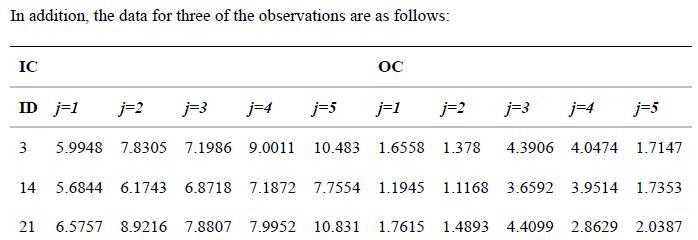
Consider a risk averse firm with utility function U(z)=z1-g/(1-g) Further assume that D=5, y=10, and g=0.5. Calculate the care level chosen by the firm under the strict liability rule for the two probability functions in exercise 10.1. Compare the levels to the socially optimal care levels.Data
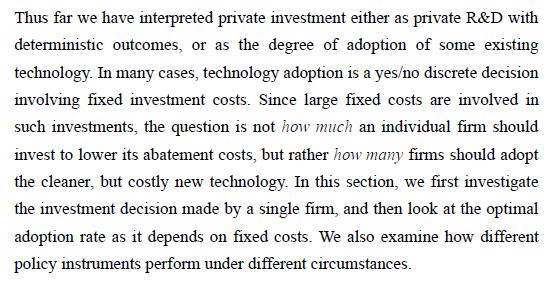
Consider the model from section 11.3. Assume now that the cost of new technology is C'(e, v) with Cl v (e, v)> 0 Cl vv (e, v) > 0 and -Cl ev (e, v) > 0, where v is a technology parameter impacting the variable abatement cost function. Assume further that [eº(t)-ev, (T)] is decreasing in
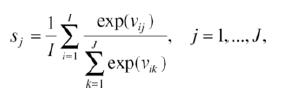
For the specification in exercise 16.1, derive expressions for the elasticities of the probability of alternative j with respect to a change in Xij and a change in Xik, for k not equal to j.The following exercises are based on data describing the choice of residential home heating systems in newly
Suppose you have estimated a model that includes only the installation and operating cost variables. The results are:(a) The negative of the coefficient on ocij can be interpreted as the marginal utility of a dollar of annual income. Given this, interpret the ratio of the coefficient on icij over
Van Houtven et al. (2014) use these data as part of an analysis linking stated preference with expert elicitation to value water quality. Their Table 7 presents estimates from several models and several configurations of the data, including a continuous version of the water quality indicator.
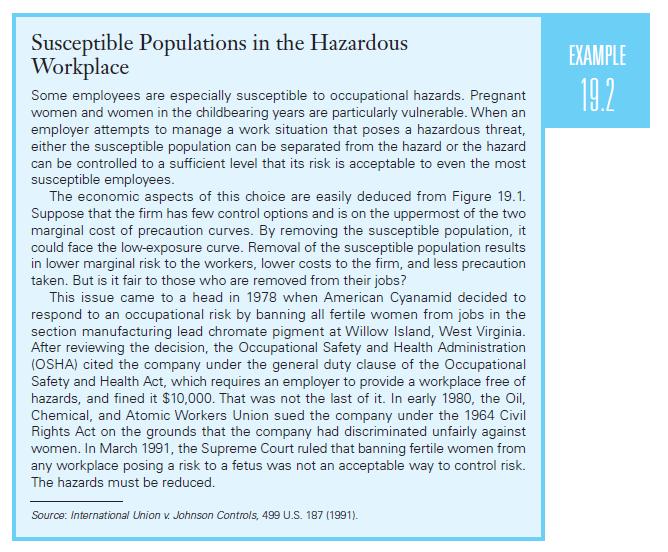
Did the courts resolve the dilemma posed in Example 19. 2 correctly in your opinion? Why or why not?Data from example 19. 2 Susceptible Populations in the Hazardous Workplace Some employees are especially susceptible to occupational hazards. Pregnant women and women in the childbearing years are
What is the difference in practice between an approach relying on performance bonds and one imposing strict liability for cleanup costs on any firm for a toxic substance spill?
Assume the demand and marginal cost conditions given in the second self-test exercise in Chapter 2. In addition, assume that the government imposes a price control at P = $80/3.(a) Find the consumer and producer surplus associated with the resulting allocation.(b) Compare this price control
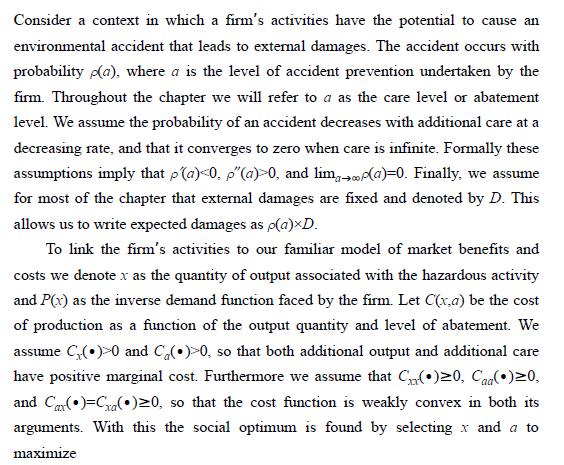
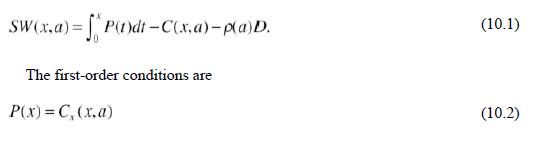
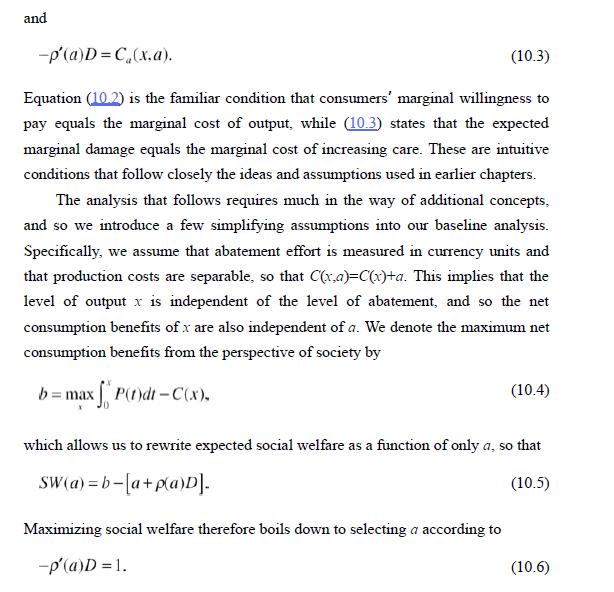
Consider the probability functions p(a)= min{1/a,1} and p(a)=1+a(a-2). Calculate the socially optimal levels of care for thesimple model outlined in section 10.1.Data from section 10.1] Consider a context in which a firm's activities have the potential to cause an environmental accident that leads
Consider a risk averse firm that is regulated by the strict liability rule. Set up the first-order condition for the firm’s optimal care level. Show that our assumptions guarantee that the second-order condition is also satisfied.
Consider a competitive firm engaging in risky activity, where damage is a function of output level x. The cost of production is C(x), which is increasing and convex in x. The damage function is D(x) and the cost of care is simply a, as before.(a) Determine the socially optimal levels of output and
Assume now that production and care cost are not separable but are instead represented by a joint cost function C(x,a). What assumptions should be imposed on C(x,a)? Determine the socially optimal levels of output and care as well as the competitive and solvent firm’s choice of output and level
Consider the model as in exercise 10.4, but assume the polluting firm has monopoly power on the output market. For this we assume the monopolist faces a downward sloping inverse demand function P(x), resulting in a concave revenue function. Show that the monopolist chooses a sub-optimal level of
Consider the case of limited liability, where the firm becomes bankrupt in case of an accident. Show that the second-order condition for the firm’s first-order condition is guaranteed by our assumptions.
Assume a polluting firm is risk averse and sufficiently wealthy such that bankruptcy is not an issue (i.e. y−a*−D>>0). (a) Show by examples that under strict liability a polluter may choose too small or too large a level of care, depending on the curvature properties of the utility and
Assume a polluting firm is risk averse and not sufficiently wealthy to cover the damage in case of an accident (i.e. y−a*−D
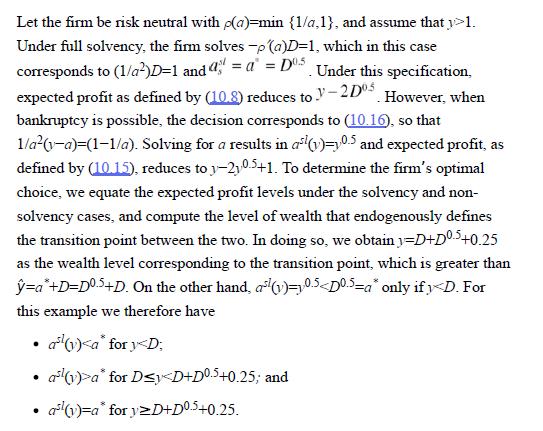
Assume that the strict liability rule holds and a potentially polluting firm is risk averse. Define ŷ implicitly by ŷ= asl s (ŷ) + D, where asl s (ŷ) is the solution to the solvent firm’s problem and ŷ divides wealth into (privately) optimal solvent and insolvent regimes. Characterize the
Assume the negligence rule holds and the owner of the potentially polluting firm is risk averse. Assume that the regulator sets the due care level equal to the socially optimal level, so that ā=a*. Let y1
Assume the negligence rule holds. Show that the second-best optimal due care level anr(y) is given by:(a) anr(y)=a* for y≥y̆(b) anr(y)=ā(y) for y [1-p(as (y))]U (y-a" (y)) = U (y (y))
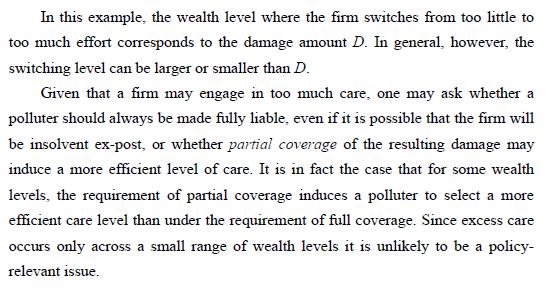
Draw on example 10.1 to show that for y=30, partial coverage (denoted by c) induces a higher level of welfare than full coverage.Determine the second-best optimal level of partial coverage. Which incentive condition must this level satisfy? Show that for y=25, partial coverage does not induce a
Consider an abatement cost function C(e,κ)=(a−be−κ)2/2b, where κ is the amount of private investment to reduce abatement costs.There are J identical firms. The social damage function is D(E)=d·E2/2.(a) Determine the socially optimal allocation, including the level of investment for each
Assume there is a single firm producing the output with a general cost function C(x,e,κ).(a) Set up some reasonable assumptions on C(x,e,κ).(b) Determine the socially optimal allocation, given a convex (linear) damage function.(c) What instrument(s) does the regulator need to induce the
Consider an abatement cost function of the typewhere 0(a) Determine the socially optimal allocation.(b) Determine the socially optimal policy mix, including optimal levels.(c) Now assume the regulator may only use a single instrument.Determine the second-best optimal tax rate and the second-best
Consider abatement cost curves of the type C0(e)= (a0−b0e)2/2b0 and CI(e)=(aI−bIe)2/2bI with a0>aI and a0/b0>aI/bI. The social damage function is D(E)=d·E2/2 and the adoption cost for technology I is denoted byF. The total number of firms is J, while JIdenotes the number of firms
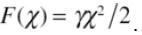
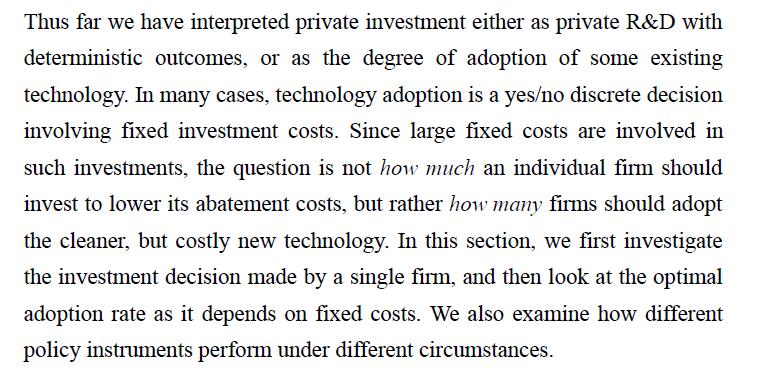
Now consider the continuum-of-firms model as suggested in section 11.3. The conventional and new technologies are again given by C0(e)=(a0−b0e)2/2b0 and CI(e)=(aI−bIe)2/2bI with a0>aI and a0/b0>aI/bI. The fixed cost is given by:(a) Determine the socially optimal allocation, including
Consider a firm whose cost function is given by c(x)=c·x2/2.The output price is fixed and denoted by p. Emissions are proportional to output according to e=α0·x. The firm is subject to an emission tax τ.(a) Calculate the optimal output and determine the firm’s profit function.(b) Determine
Consider a firm that produces output at constant marginal cost c>0, and emissions are proportional to output so that e=αx, where x is output, and e is emissions. The output price is normalized to 1. Assume that the firm has a technology with emission coefficient α0 and that a new technology is
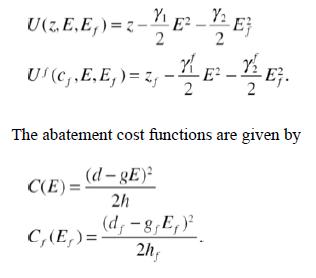
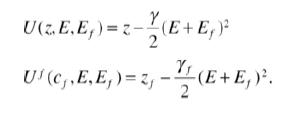
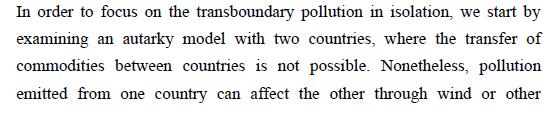
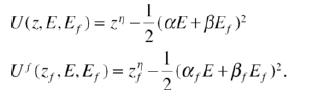
Consider the model from section 12.1, where the countries’ utility functions are:(a) Determine the efficient allocations.(b) Determine the unilateral optimal emission choices (i.e. the emissions Nash equilibrium).(c) Assume goods transfer is possible. Under what circumstances does one country
Repeat exercise 12.1, but now usefor the domestic utility function, and a corresponding expression for the foreign utility function.(a) What are the maximum consumption levels for z and zf?(b) Assume now that pollution is proportional to consumption so that e=φz and ef=φ fzf. Repeat
Consider utility functions:with α, β > 0 and 0 x with 0 f = Exf f with 0 f Repeat exercise 12.1Consider the model from section 12.1, where the countries’ utility functions are:(a) Determine the efficient allocations.(b) Determine the unilateral optimal emission choices (i.e. the
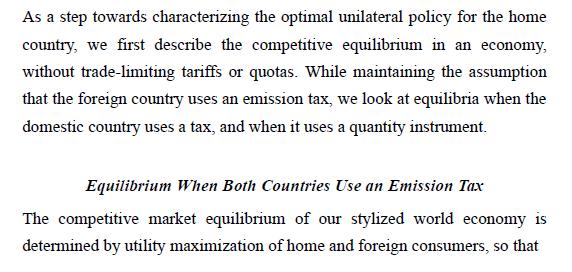
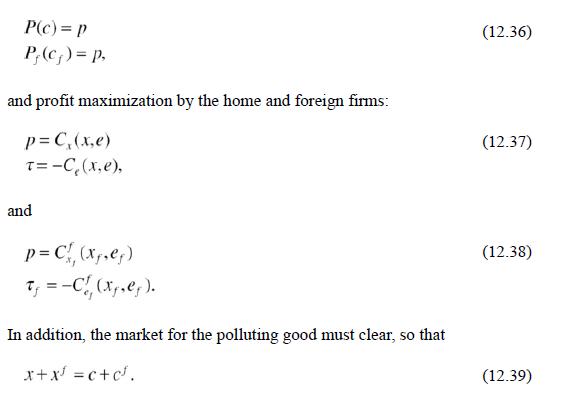
Consider the model of section 12.4.1. Show that if the foreign country maintains its emission tax, domestically emission taxes and tradable permits are equivalent.Data from section 12.4.1 As a step towards characterizing the optimal unilateral policy for the home country, we first describe the
Showing 1400 - 1500
of 2027
First
7
8
9
10
11
12
13
14
15
16
17
18
19
20
21
Step by Step Answers

 Get 50% OFF
Claim Now
Get 50% OFF
Claim Now