New Semester
Started
Get
50% OFF
Study Help!
--h --m --s
Claim Now
Question Answers
Textbooks
Find textbooks, questions and answers
Oops, something went wrong!
Change your search query and then try again
S
Books
FREE
Study Help
Expert Questions
Accounting
General Management
Mathematics
Finance
Organizational Behaviour
Law
Physics
Operating System
Management Leadership
Sociology
Programming
Marketing
Database
Computer Network
Economics
Textbooks Solutions
Accounting
Managerial Accounting
Management Leadership
Cost Accounting
Statistics
Business Law
Corporate Finance
Finance
Economics
Auditing
Tutors
Online Tutors
Find a Tutor
Hire a Tutor
Become a Tutor
AI Tutor
AI Study Planner
NEW
Sell Books
Search
Search
Sign In
Register
study help
business
environmental economics
A Course In Environmental Economics 1st Edition Daniel J Phaneuf, Till Requate - Solutions
Should U.S. national forests become “privatized” (sold to private owners)? Why or why not?
In his book, The Federal Land Revisited, Marion Clawson proposed what he called the “pullback concept”: Under the pullback concept any person or group could apply, under applicable law, for a tract of federal land, for any use they chose; but any other person or group would have a limited time
Suppose there are two identical forest plots except that one will be harvested and left as is while the second will be cleared after the harvest and turned into a housing development. In terms of efficiency, which one should have the oldest harvest age? Why?
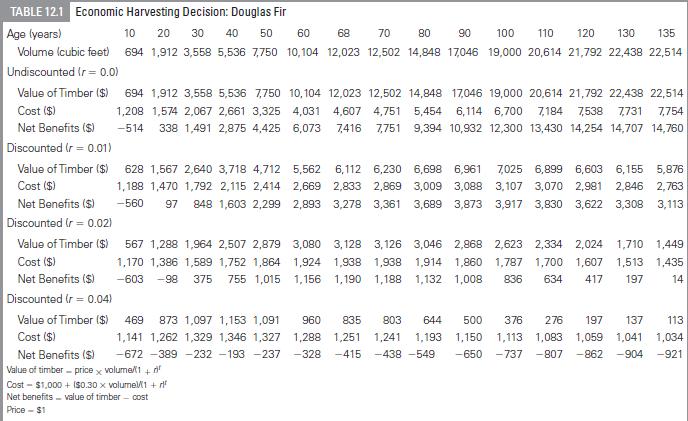
In Table 12. 1, when r = 0. 02, the present value of the cost rises for 68 years and then subsequently declines. Why?Table 12. 1 TABLE 12.1 Economic Harvesting Decision: Douglas Fir 10 20 30 40 50 Age (years) Volume (cubic feet) Undiscounted (r= 0.0) 60 68 70 80 90 100 110 120 130 135 694 1,912
As our energy structure transitions toward renewable fuels, forest-based biomass fuels benefit from this transition. What are the likely effects of this transition on consumers, producers, and the states that host these resources?
This chapter contains two views of the future. Since the validity of these views cannot be completely tested until the time period covered by the forecast has passed (so that predictions can be matched against actual events), how can we ever hope to establish in advance whether one is a better view
Positive and negative feedback loops lie at the core of systematic thinking about the future. As you examine the key forces shaping the future, what examples of positive and negative feedback loops can you uncover?
Which point of view in Debate 1.2 do you find most compelling? Why? What logic or evidence do you find most supportive of that position?Debate 1. 2 DEBATE 1.2 What Does the Future Hold? Is the economy on a collision course with the environment? Or has the process of reconciliation begun? One group,
In a well-known legal case, Miller v. Schoene (287 U.S. 272), a classic conflict of property rights was featured. Red cedar trees, used only for ornamental purposes, carried a disease that could destroy apple orchards within a radius of two miles. There was no known way of curing the disease except
In primitive societies, the entitlements to use land were frequently possessory rights rather than ownership rights. Those on the land could use it as they wished, but they could not transfer it to anyone else. One could acquire a new plot by simply occupying and using it, leaving the old plot
Suppose the state is trying to decide how many miles of a very scenic river it should preserve. There are 100 people in the community, each of whom has an identical inverse demand function given by P = 10 – 1. 0q, where q is the number of miles preserved and P is the per-mile price he or she is
Suppose the market demand function (expressed in dollars) for a normal product is P = 80 – q, and the marginal cost (in dollars) of producing it is MC = 1q, where P is the price of the product and q is the quantity demanded and/or supplied.a. How much would be supplied by a competitive market?b.
Suppose you were asked to comment on a proposed policy to control oil spills. Since the average cost of an oil spill has been computed as $X, the proposed policy would require any firm responsible for a spill immediately to pay the government $X. Is this likely to result in the efficient amount of
Label each of the following propositions as descriptive or normative and defend your choice:a. Energy efficiency programs would create jobs.b. Money spent on protecting endangered species is wasted.c. To survive our fisheries must be privatized.d. Raising transport costs lowers suburban land
Identify whether each of the following resource categories is a public good, a common-pool resource, or neither and defend your answer:a. A pod of whales in the ocean to whale hunters.b. A pod of whales in the ocean to whale watchers.c. The benefits from reductions of greenhouse gas emissions.d.
Over the last several decades in product liability law, there has been a movement in the court system from caveat emptor (“buyer beware”) to caveat venditor (“seller beware”). The liability for using and consuming risky products has been shifted from buyers to sellers. Does this shift
How should the public sector handle a toxic gas, such as radon, that occurs naturally and seeps into some houses through the basement or the water supply? Is this a case of an externality? Does the homeowner have the appropriate incentives to take an efficient level of precaution?
Would the export of hazardous waste to developing countries be efficient? Sometimes? Always? Never? Would it be moral? Sometimes? Always? Never? Make clear the specific reasons for your judgments.
Two legal doctrines used to control contamination from toxic substances are negligence and strict liability. Imagine a situation in which a toxic substance risk can be reduced only by some combination of precautionary measures taken by both the user of the toxic substance and the potential
“With a global economy, the only way to achieve cost-effective control of greenhouse gases is to assure that every country imposes the same universal set of emissions standards.” Discuss.
Consider a possible mechanism for controlling population. According to an idea first put forth by Kenneth Boulding (1964) each individual would be given the right to produce one (and only one!) child. Because this scheme over a generation allows each member of the current population to replace
Is informing the consumer about any toxic substances used in the manufacture of a product sufficient to produce an efficient level of toxic substance use for that product? Why or why not?
“Every molecule of a nonrenewable resource used today precludes its use by future generations. Therefore, the only morally defensible policy for any generation is to use only renewable resources.” Discuss.
“Future generations can cast neither votes in current elections nor dollars in current market decisions. Therefore, it should not come as a surprise to anyone that the interests in future generations are ignored in a market economy.”Discuss.
“Trade simply represents economic imperialism where one country exploits another. The environment is the inevitable victim.” Discuss.
Some education is funded by property taxes, whereas other forms of education are funded by charging tuition. Suppose that within a community, more money is needed for education. Assuming that they raise the same amount of revenue, would the rising cost of education have the same effect on the
Fertility rates vary widely among various ethnic groups in the United States. Black and Spanish-speaking Americans have above-average rates, for example, while Jews have below-average fertility rates. This may be due to different ethnic beliefs, but it may also be due to economic factors. How could
The microeconomic theory of fertility provides an opportunity to determine how public policies that were designed for quite different purposes could affect fertility rates. Identify some public policies (e.g., subsidies to people who own their own home, or subsidized day care) that could have an
“According to the theory of the demographic transition, industrialization lowers population growth.” Discuss.
Label the following as True, False, or Uncertain and explain your choice. (Uncertain means that it can be either true or false depending upon the circumstances).a. Any economy that experiences a total fertility rate equal to the replacement rate would have a stationary population.b. The induced
Are you optimistic or pessimistic about the future? Why?
In thinking about the appropriate balance between the market and the government in achieving sustainability, do you think the government needs to take a stronger role or would you favor reducing government influence over the market? Why?
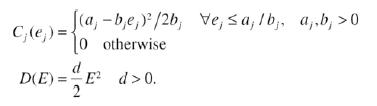
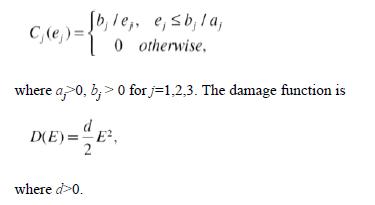
Consider a situation with two countries that have abatement cost functions :for j=L and j=H. The countries have identical damage functions D(E)= d.E. For each country the parameters sj are drawn independently from an identical Bernoulli distribution, with probabilities πL and (1−πL) for high
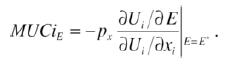
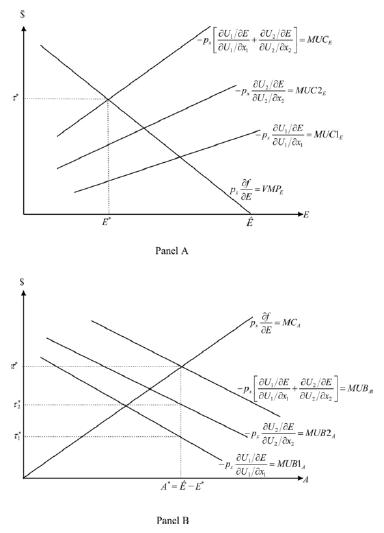
From Figure 1.1 it is clear that the marginal utility cost of pollution for each person at the optimum is:Figure 1.1(a) Consider a proposal to use the revenue from the Pigouvian tax to compensate people for damages. In particular, each person i would receive pe=MUCiE for each unit of E. How does
Show that the allocation which solves the first-order condition from Eq. (3.7) for a social optimum satisfies the second-order conditions.Equation 3.7 -C(e) = D'(E) i=1,.... (3.7)
Consider an industry consisting of two firms (j=1 and 2) that produce a consumer good and pollution. The abatement cost and damage functions are:(a) Determine the firms’ marginal abatement cost curves.(b) Determine the socially optimal allocation and level of pollution. Now let a1=10, b1=1,
In the 1990s, the leader of Germany’s Social Democratic Party, Oscar LaFontaine, suggested a type of environmental regulation combining emission taxes with a minimum allowable emission standard. Specifically, each firm would be allowed to pollute an amount E̅ without paying the tax. All units
Consider the basic model shown in section 3.1 , but assume the social damage function is linear such that D(E)=d×E for d>0.(a) Show that for an efficient amount of pollution, both individual firm and total emissions decrease with an increase in d.(b) Derive the comparative static relationships
Consider the generalized externality problem. Assume the damage and cost functions are given by:(a) Determine the non-regulated level of E if the polluter has the right to pollute.(b) Determine the level of E under the polluter-pays principle.(c) Determine the efficient solution.(d) Determine the
Suppose in a given area there are three power plants, each of which emits SO2 with different intensities. The abatement cost functions for each firm j are:(a) Set up the conditions for the socially optimal allocation. Can you solve it algebraically?(b) Let a1=a2=a3=1, b1=1000, b2=640, b3=360, and
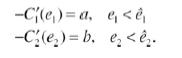
Consider constant marginal abatement cost for two firms:(a) Determine the optimal allocation for both firms when the damage function is convex, and when it is linear.(b) Is it possible to achieve the optimal allocation using economic incentive policy tools in these cases? -C(e)= a, e,
Consider the case of J polluters and with abatement cost functions Cj(ej) and one pollution victim. Abatement costs are ordered from highest to lowest such that C1(e1)>C2(e2)>…>CJ(eJ). Assume the pollution victim approaches the polluters in order to offer compensation for pollution reductions.
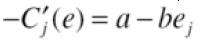
Consider a situation where the true aggregate marginal abatement cost curve is given by: -C'(E)= a-b E, and the marginal damage function by D'(E)=d. E The regulator believes the marginal damage curve to be D'(E)=d̃. E with d̃ ∠ d. (a) Which total emission level will a benevolent but
Consider a situation where the true aggregate marginal abatement cost curve is given by -C'(E)= a-bE, and the marginal damage function by D'(E)= d.E. The regulator believes the true marginal abatement cost curve is -C'(E)= ã -bE with ã < a (alternatively -C'(E)= a - B̃ E with B̃ < B)(a) Which
Our derivation of the Weitzman theorem has proceeded by assuming that the uncertainty in the abatement cost and damage functions (ε and η, respectively) are uncorrelated. If we generalize the problem and allow COV(ε,η)≠0, a slightly different expression for Δ as shown in Eq. (4.17) arises.
Weitzman’s research has motivated several subsequent papers examining how features of policy design in specific contexts interact with benefit or cost uncertainty to alter the original model’s conclusions.Examples include Newell and Pizer (2003), Montero (2002b), and Quirion (2004). Consider
Consider a situation where the marginal damage function is known and equal to D'(E)= d.E. The aggregate marginal abatement cost curve is given by -C'(E)=ã-bE where is ãrandom variable uniformly distributed on the interval The regulator wants to apply the hybrid instrument with a supply of
Consider a situation similar to the previous exercise. According to Roberts and Spence, the regulator can set n different levels of tradable permits L12.....N subsidy rates ζ12 n and tax rates τ1 2 .... n with ζ2 = τ1, ζ3 = τ2 ,..., ζn = τn–1 Assume further that is chosen
Show that Kwerel’s mechanism is not incentive compatible if the regulator allocates the permits for free. Would the firms over- or underreport their marginal abatement costs? Illustrate this graphically.
Consider a situation with two firms that have marginal abatement cost function The marginal damage function is known and given by D'(E)= d.E. Assume the regulator applies Kwerel’s mechanism, but firm 1 reports Knowing this, what would be the optimal response of firm 2? -C(e)= a-be and C () =
Consider a situation with two firms that have marginal abatement cost functions The marginal damage function is again equal to D'(E)=d.E. Assume the regulator applies Montero’s mechanism. Determine the optimal allocation and the optimal refunding shares β1 and β2 -C(e)= a-be and C() = a-be.
Consider a situation with J identical firms that have marginal abatement cost functions for j=1,…,J. The marginal damage function is equal to D'(E)=d.E Determine the optimal allocation and the optimal refunding shares B(J) of the Montero mechanism and the share of total refunding.(a) Show
Consider the Montero mechanism with two (or three) firms.Assume that two firms (or two of the three firms) form a bidding coalition. Show that the bidding coalition can do no better than submitting its joint aggregate marginal abatement cost curve.
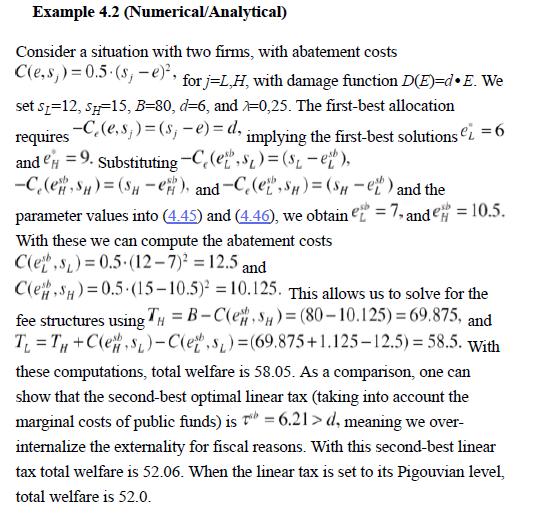
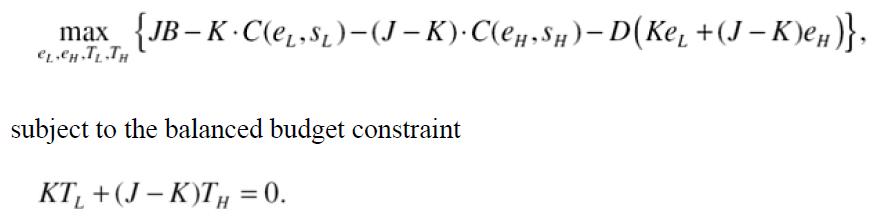
Modify the problem in example 4.2 by considering an increasing marginal damage function of type D(E)= dE2/2(a) Modify the example by assuming that there are K firms of type L and J−K firms of type H.(b) Assume now that there are three types of firm with a number K of type L firms, a number N
Consider a regulator’s objective formulized as:(a) Show that at most one of the four constraints (incentive compatibility and participation) can be binding in this case, that the high cost firm’s fee is always positive, and, therefore, that the low cost firm’s participation constraint is
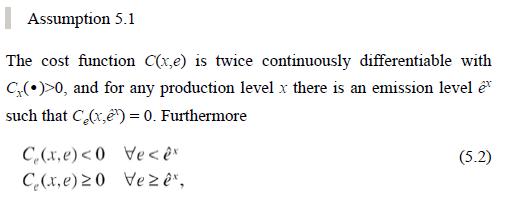
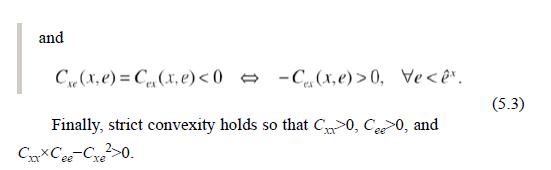
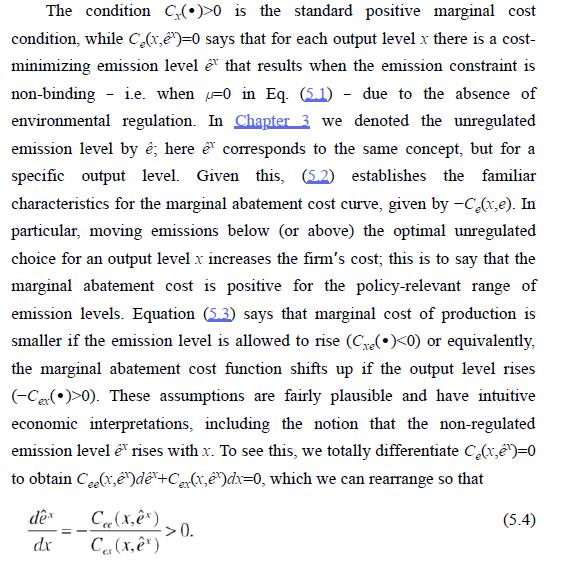
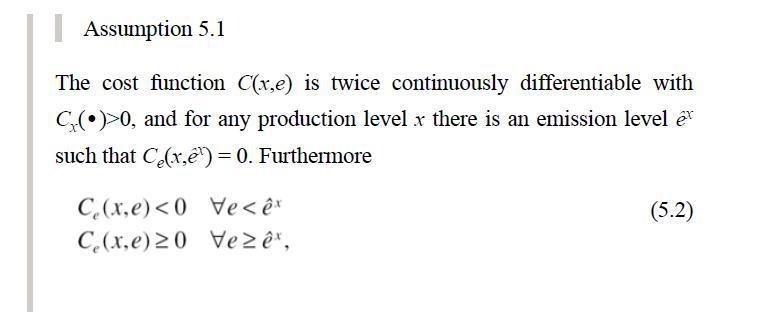
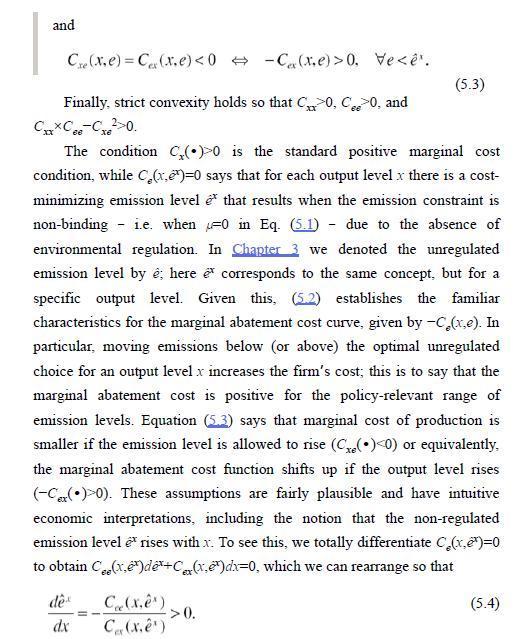
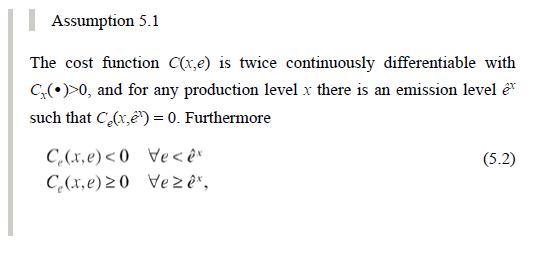
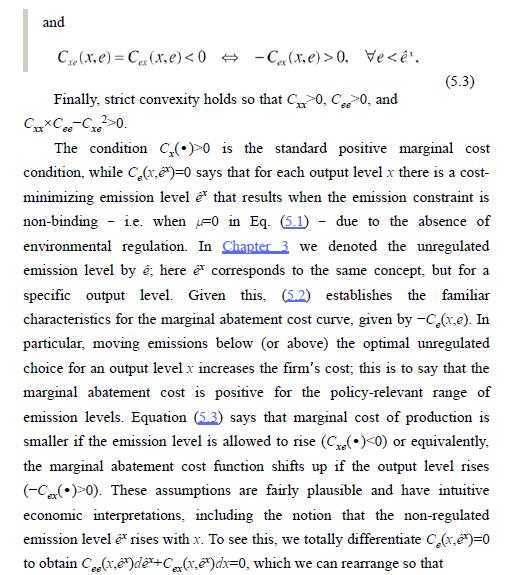
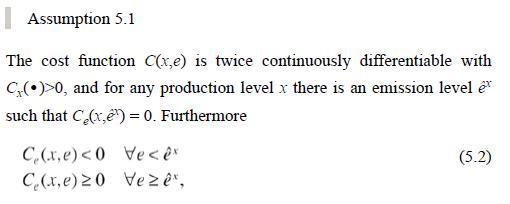
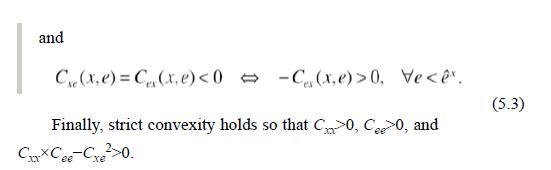
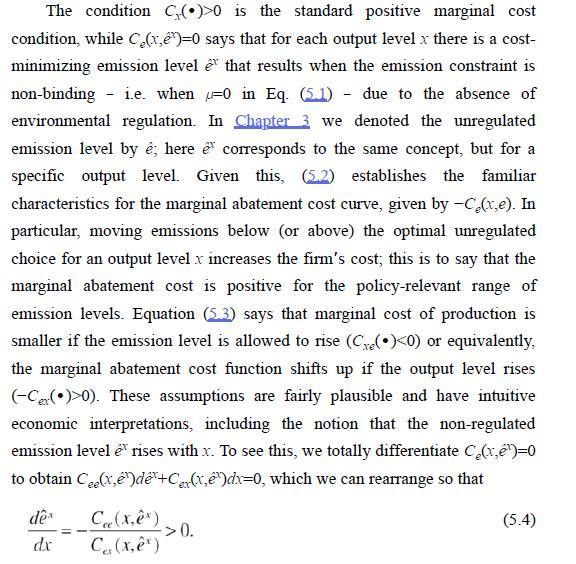
Which of the following costs functions satisfies assumption 5.1?(a) C(x,e)=α(x2/e) +βe(b) C(x,e)=0.5×[αe−βx)] +0.5×γx2(c) C(x,e)=αx2/e(d) C(x,e)=αx2/e+βe2 where α,β,γ>0.Data from assumption 5.1 Assumption 5.1 The cost function C(x,e) is twice continuously differentiable with
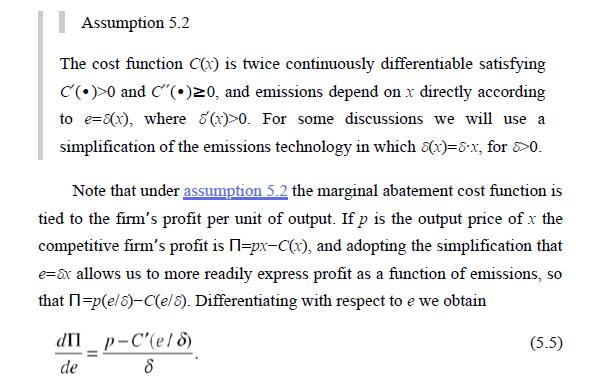
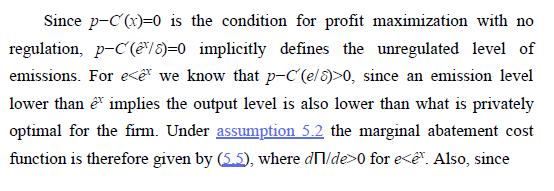
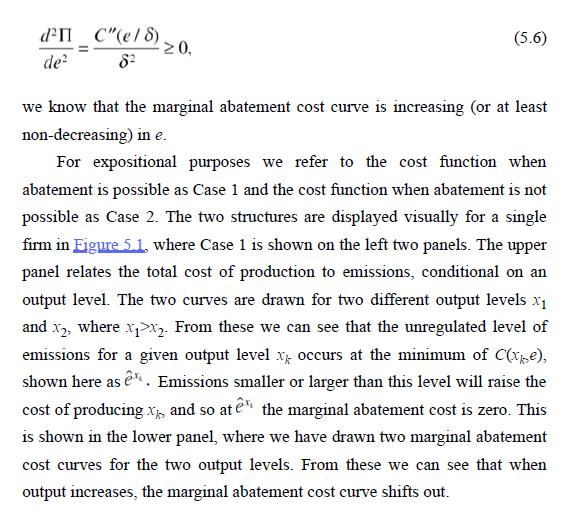
Consider a firm whose technology satisfies assumption 5.2. The cost function is c(x)=c·x2/2. The output price is fixed and denoted by:p. Emissions are proportional to output according to e=α·x. The firm is subject to an emission tax τ.(a) Calculate the optimal output and determine the firm’s
Our model of pollution in this chapter assumed that emissions are a pure private bad, and that people have no ability to protect themselves from the adverse consequences of exposure. In reality, individuals can often take private action to mitigate the effective level of pollution. For example, one
Consider the Cobb-Douglas production function with X=lα1lβ2 where α+β•l1, where d>0. (a) Denoting the input prices by w1 and w2, derive the cost function as it depends on x and e. Show that it satisfies assumption 5.1.(b) What happens when α+β=1?Data from assumption 5.1
Consider a firm with the production function x=f(l)=la, where α
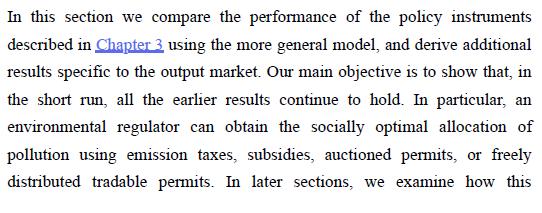
Show using the model from section 5.2 that, for an exogenous number of firms, freely distributed permits or subsidies can be used to implement the social optimum.Data from section 5.2 In this section we compare the performance of the policy instruments described in Chapter 3 using the more general
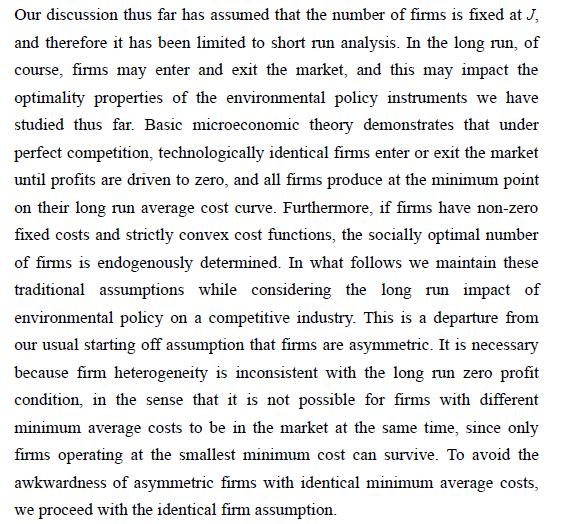
Consider the model from section 5.4, where the number of firms is endogenous. Derive the comparative static results for emission taxes, auctioned permits, and absolute standards. That is, determine the direction of change for x, e, J, p, X, and E when the level of each policy variable is marginally
Consider a Cournot oligopoly facing linear demand P(X)=1−X and constant marginal costs c>0 (and/or increasing marginal cost Cʹ(X)=cX). The social damage function is quadratic of the form D(E)=dE2/2. Emissions are proportional to output, where E=X.(a) Determine the optimal emission tax.(b)
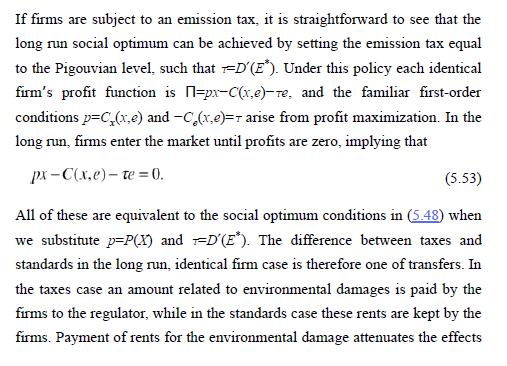
Show that in a symmetric oligopoly with free entry and firms’ technologies satisfying assumption 5.1 the first-best outcome can be achieved by an emission tax, a subsidy on output, and either an entry fee or a quota of auctioned licenses. Determine the optimal levels of those policy
Consider a firm that produces an output using two inputs so that x=f(l1,l2). Pollution is proportional to one of the inputs. The polluting firm has market power in the market for l1. Denote the inverse supply function for l1 by w1(l1). Assume that the polluting firm is subject to an emission
Consider the regulation of J local monopolies for different goods with inverse demand functions Pj(Xj) and cost functions Cj(Xj,ej). Social damage depends on total pollution and is given by a convex damage function D(E).(a) Derive an expression for the second-best tax to jointly regulate the J
Consider the partial model of Chapter 3 with an aggregate abatement cost function C(E satisfying the usual properties. The regulator charges an emission tax. Assume there exists a marginal cost of public funds denoted by λ, and that the regulator’s objective function is SC(E)=C(E)+D(E) −λτE,
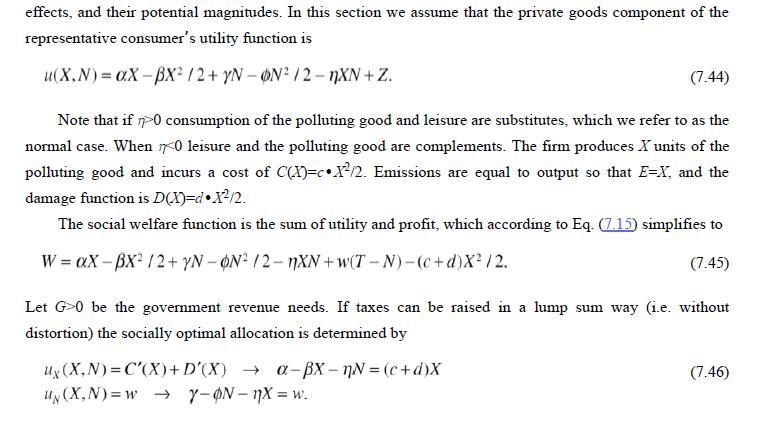
Use a software package such as Matlab or Mathematica to program the example described in section 7.3.(a) Assume the environmental regulator ignores the impact on the labor market and sets an emission standard according to the Pigouvian rule. Determine the second-best optimal labor tax and all
Consider the transaction costs model of section 8.4. Show that a unilateral increase in the seller’s transaction costs (increasing α1) induces the permit price to decrease, while a unilateral increase in the buyer’s transaction costs (increasing α2) induces that price to increase. Show also
Consider J symmetric firms operating in two periods with constant over time cost functions Cj (x j, e j) = (xjbjej)2/2bj, +cjx2j /2 The output prices are exogenous and given by p1 and p2 for the two periods. When relevant, emission caps are denoted by E̅1and E̅2 in periods 1 and 2,
Extend the model of this chapter by assuming that there are several firms with (possibly asymmetric) cost functions with increasing marginal costs. Assume first that emissions are regulated by a cap and trade system with freely allocated emission permits.(a) Write down the equilibrium conditions
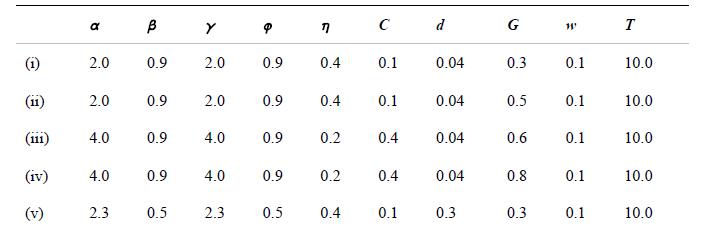
Replicate the calculations of the example in section 7.3 using numerical software such as Mathematica, Mathlab or the like. Do the calculations also for the following parameter sets and interpret your results:Data from section 7.3 (11) (111) (iv) (v) a 2.0 2.0 4.0 4.0 2.3 B 0.9 0.9 0.9 0.9 0.5 Y
Modify the model in this chapter by considering a closed economy with endogenous wage formation. The production sector is now characterized by a decreasing returns to scale production function F(L,E) where E is a polluting input, L is labor, and FLE>0, FEE
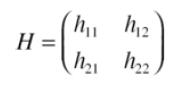
Consider a pollution problem with two sources and two recipient regions. Abatement cost functions are given by Cj(ej)=(aj−bjej)2/2bj for j=1,2. The diffusion matrix is given by:and the damage function for receptor m is Dm (Am)=dmA2m/2.(a) Determine how many permits must be issued for each
Assume now that the consumer consumes a clean and a dirty good, the quantities of which are written as C and D, which generate utility U(C,D). Assume the clean and the dirty good are substitutes. A fixed amount of labor is supplied by the consumer (with elasticity equal zero and no disutility of
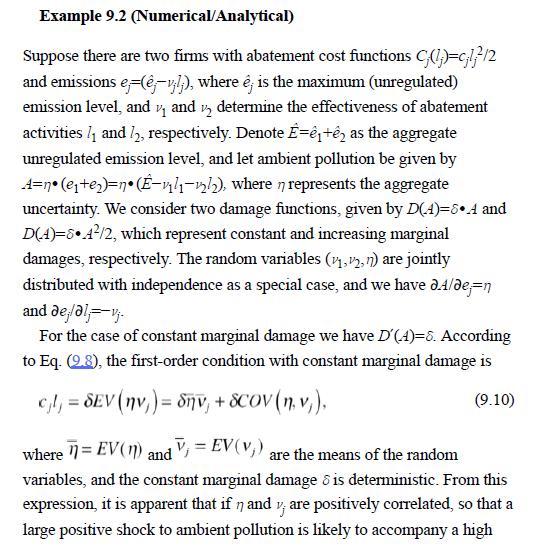
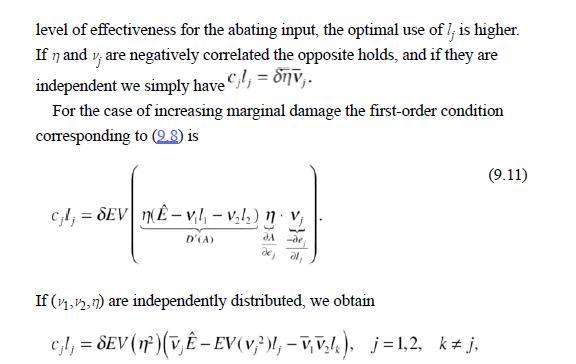
Consider examples 9.2 and 9.3. Assume that social damage is quadratic as in the examples. Following section 9.2.3, assume that the regulator can only set a uniform tax. Determine the formula for the second-best optimal tax rate.Data from example 9.2example 9.3Data from section 9.2 .3 Example 9.2
Consider a spatial pollution problem with J pollution sources and M recipients. The regulator is concerned that M different permit markets will cause transaction costs to be too high. She decides to set up two trading regions, one with J1 sources and the other with J2 sources. Find a rule to
Suppose that firms can invest in abatement technology prior to permit trading. Firms have abatement cost functions Cj (ej,κj), where κj is measured in money and lowers both the abatement and marginal abatement cost functions. More specifically:Consider three periods. In period 0 firms select
Consider a stylized two-period model with banking. The aggregate abatement cost function in period t is given by C(E)= (at−be)2/2b with a1< a2 is D(E)=dE2/2.(a) Determine the optimal emission quantities for both periods without banking.(b) Assume that, starting from these optimal non-banking
Consider J−1 small polluting firms with abatement cost functions Cj(ej)=(aj−bjej)2/2bj and one large firm indexed j=1 with market power and abatement cost function C1(e1)=(a1−b1e1)2/2b1. Let ē2,…,ēJ be the initial permit endowment for the small firms and ē1 be the endowment for the
Consider two polluting firms with marginal production costs c1=0 and c2=0.25. Pollution is proportional to output with emission coefficients d1=1 and d2=0. Inverse market demand is P(X)=1−X.(a) Determine the Cournot-Nash equilibrium in the absence of environmental regulation.(b) Assume each
Consider J=J1+J2 polluting firms, where there are J1 firms of type 1 and J2 firms of type 2. The abatement cost functions are given by Cj(ej)=(aj−bjej)2/2bj for types j=1,2. The damage function is D(E)=dE2/2, where E is total emissions.(a) Determine the socially optimal allocation of
Consider two polluting firms with cost functions Cj(xj,ej). The inverse demand function is P(X). Firms engage in negotiations about the permit allocation and a transfer price in a first stage and engage in Cournot competition in the second stage. Derive a condition describing how the firms will
Consider J local monopolists with cost functions Cj(xj,ej) and facing inverse demand functions Pj(xj). The pollutant is homogeneous and the total supply of tradable permits is L, with each firm holding a permit endowment of ēj.(a) Show that a competitive permit market leads to an efficient
Consider the energy sector consisting of J firms where energy producers are characterized by their cost functions Cj(xj,ej). The firms are subject to an emission trading system with a total emission cap E̅.(a) Assume that an (additional) energy tax on output is introduced. Show that individual
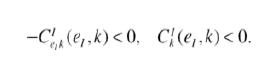
Assume there are two regions with a joint emission trading system. The government of region I can influence its abatement costs by investment. The abatement cost function is written as CI(eI,k)+k where k is measured in monetary units. Assume that:The other region’s abatement cost function is
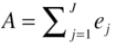
Consider firms’ abatement cost functions Cj(ej)=(aj−bjej)2/2bj and an ambient damage function D(A)=δA2/2, where is the ambient pollution level.(a) Determine the optimal emission level.(b) Determine the optimal ambient tax and the optimal ambient tax/subsidy scheme.(c) Determine an optimal
Assume electricity is generated by three technologies: a base load technology with cost function Cb(xb) and proportional emission coefficient αb; gas turbines with cost function Cg(xg) and emission coefficient αg< αb; and an emission-free renewable energy source with cost function Cr(xr). All
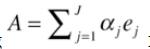
Repeat exercise 9.1 using for αj>0.Data from exercise 9.1 Consider firms’ abatement cost functions Cj(ej)=(aj−bjej)2/2bj and an ambient damage function D(A)=δA2/2, where is the ambient pollution level. _A= ae; A: j=l
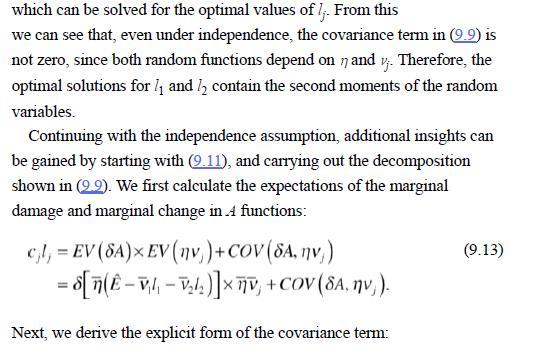
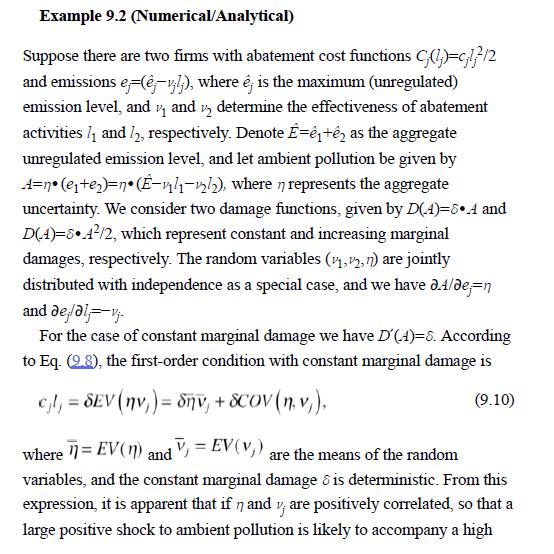
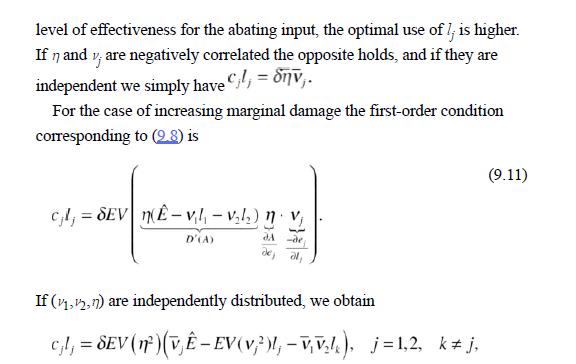
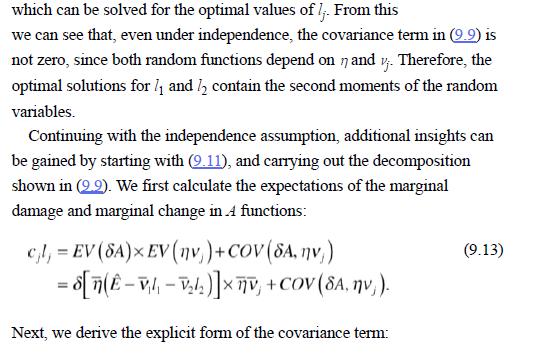
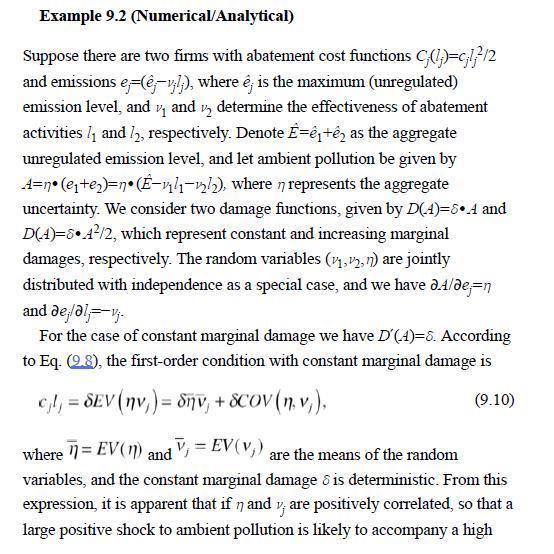
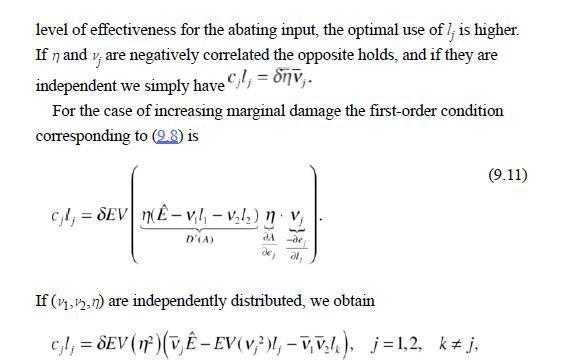
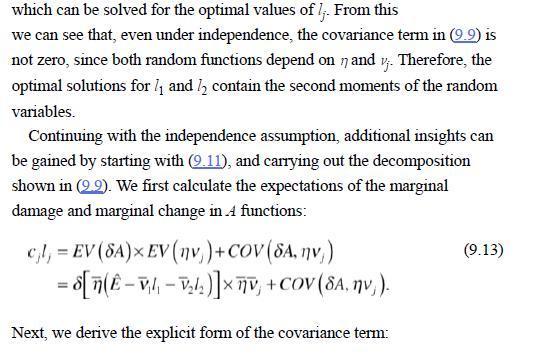
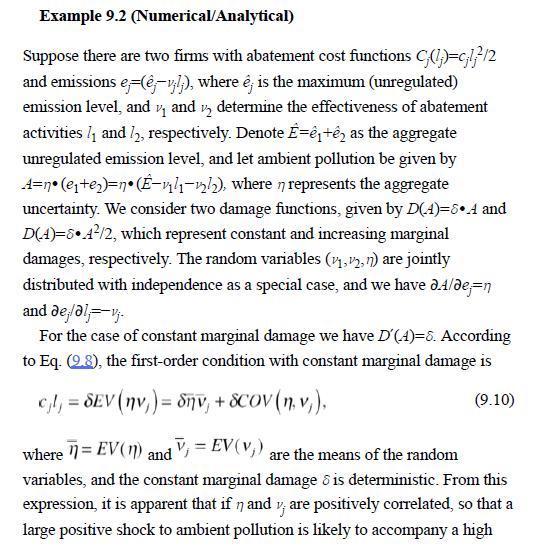
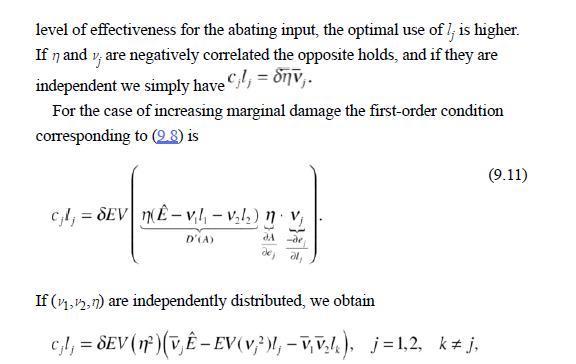
Consider example 9.2. Determine the socially optimal level of abatement input in closed form for the case of independently distributed parameters νj and η.Example 9.2 Example 9.2 (Numerical/Analytical) Suppose there are two firms with abatement cost functions C(1)=cl/2 and emissions e-(e-vlj),
Modify example 9.2 by assuming there is only one firm. Assume that both η and ν1=ν can take two values: νL, νH, and ηL, ηH. Denote pLL=Pr(η=ηL, ν=νL) as the probablity that both parameters take their low values, and similarly define pLH, pHL, and pHH. Define abatement costs by
Show that if in an ambient pollution problem with J polluters each firm pays only 1/J of the damage, there will be too little incentive to abate emissions efficiently.
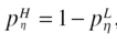
Consider again examples 9.2 and 9.3 , and once again assume that there are two states of the world for each random variable, denoted by VLj , VHj and nL, nH. Denote the probabilities for these by PLv and PHv = 1– PLv and PLn and respectively. Assume the random variables are all
Consider a modified version of the model with uncertainty from section 9.2 . Assume that the firm is characterized by an output production function gj(lj), where lj is now a single productive input, and emissions are given by ej(lj,νj), where now ∂ej(lj,νj)/∂lj>0 (that is, the input is now
Assume now that each firm has two abatement possibilities represented by the abatement vector lj=(lj1, lj2). The abatement cost function is additively separable and given by:and and emissions are determined by:Once again there are two states of the world k=L,H, with probabilities PLv and pHv =
Show that a non-linear tax scheme which reflects total damage from ambient pollution also works to decentralize the first-best allocation if a firm has several choices.
Extend the model of this chapter by assuming that the firm’s cost function has the form C(X,E) satisfying assumption 5.1.(a) Derive the second-best optimal combination of an emission standard (no emission tax revenues) and labor tax.(b) Assume now that an emission tax with revenue recycling is
In contrast to our analysis in Section 5.4.3, Carlton and Loury (1980) suggest that a Pigouvian tax alone will not lead to a long run social optimum for competitive polluting firms. Using their arguments, show that when the damage function is D(E,J), depending on both emissions and the number of
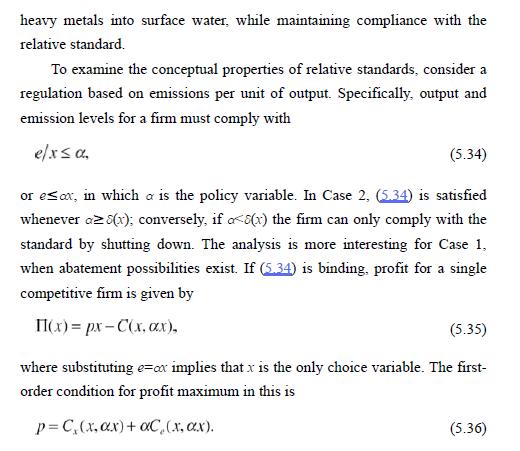
Consider the model in section 5.3. (a) Derive the firm’s first-order conditions for profits maximization when they are subject to the relative standard given by Eq. (5.45).(b) Derive a rule for the second-best optimal standard of the type given by Eq. (5.45).Equation 5.45Data from section 5.3
Show that in the model with an exogenous number of firms, the second-order conditions for profit maximum are satisfied. Show that these cost functions satisfy assumptions 5.1 and 5.2.assumption 5.1assumption 5.2 Assumption 5.1 The cost function C(x,e) is twice continuously differentiable with C)>0,
Showing 1700 - 1800
of 2027
First
7
8
9
10
11
12
13
14
15
16
17
18
19
20
21
Step by Step Answers

 Get 50% OFF
Claim Now
Get 50% OFF
Claim Now