New Semester
Started
Get
50% OFF
Study Help!
--h --m --s
Claim Now
Question Answers
Textbooks
Find textbooks, questions and answers
Oops, something went wrong!
Change your search query and then try again
S
Books
FREE
Study Help
Expert Questions
Accounting
General Management
Mathematics
Finance
Organizational Behaviour
Law
Physics
Operating System
Management Leadership
Sociology
Programming
Marketing
Database
Computer Network
Economics
Textbooks Solutions
Accounting
Managerial Accounting
Management Leadership
Cost Accounting
Statistics
Business Law
Corporate Finance
Finance
Economics
Auditing
Tutors
Online Tutors
Find a Tutor
Hire a Tutor
Become a Tutor
AI Tutor
AI Study Planner
NEW
Sell Books
Search
Search
Sign In
Register
study help
business
financial institutions management
Financial Institutions Management A Risk Management Approach 11th International Edition Anthony Saunders, Marcia Millon Cornett, Otgo Erhemjamts - Solutions
How has the Financial Services Modernization Act of 1999 opened the doors for the establishment of full-service financial institutions in the United States?
How does the range of product activities permitted for U.S. commercial banks compare to that of banks in other major industrialized countries?
How are the product activities of U.S. commercial banks likely to change in the future?
What are some of the issues that tend to arise in response to bank expansion into securities, insurance, and commercial activities?
Describe three ways in which the losses of a securities affiliate in a holding company structure could be transmitted to a bank.
In addition to the six potential conflicts of interest discussed in this section, can you think of any additional possible conflicts that might arise if commercial banks were allowed to expand their investment banking activities?
What are three ways that the failure of a securities affiliate in a holding company organizational form could negatively affect a bank affiliate? How has the Fed attempted to prevent a breakdown of the ring-fences or firewalls between bank and nonbank affiliates in these situations?
In what ways does the current regulatory structure argue against providing additional securities powers to the banking industry? Does this issue just concern banks?
The Justice Department has been asked to review a merger request for a market with the following four FIs:a. What is the HHI for the existing market?b. If Bank A acquires Bank D, what will be the impact on the market’s level of concentration?c. If bank C acquires Bank D, what will be the impact
What are some plausible reasons for the percentage of assets of small- and intermediate-sized banks decreasing and the percentage of assets of large banks increasing since 1984?
What are some of the benefits for banks engaging in domestic geographic expansion?
What is the expected impact of the implementation of the Basel III risk-based capital requirements on the international activities of some major U.S. banks?
What is the European Community (EC) Second Banking Directive? What impact has the Second Banking Directive had on the competitive banking environment in Europe?
Go to the FDIC website at https://www.fdic.gov/bank/statistical. Find the most recent breakdown of bank holding company deposit share for the State of New York using the following steps. Click on “Deposit Market Share Reports.”Under “Report,” click on “State-> County-> City-> Zip.”
What are the major differences between a spot contract and a forward contract?
Explain how a naive hedge works.
What does it mean to say that an FI has immunized its portfolio against a particular risk?
What is the difference between microhedging and macrohedging and between routine hedging and selective hedging?
In Example 23–2, suppose the FI had the reverse duration gap; that is, the duration of its assets was shorter (DA = 3) than the duration of its liabilities (DA = 5). (This might be the case of a bank that borrows with long-term notes or time deposits to finance floating-rate loans.) How should it
In Example 23–3, how many futures contracts should have been sold using the 20-year bond futures contracts if the basis risk measure br = 0.8?
Circle an observation in Figure 23–5 that shows futures price changes exceeding spot price changes.
Suppose that R2 = 0 in a regression of ΔSt on ΔFt. Would you still use futures contracts to hedge? Explain your answer.
In running a regression of ΔSt on ΔFt, the regression equation is ΔSt = 0.51 + 0.95 ΔFt and R2 = 72 percent. What is the hedge ratio? What is the measure of hedging effectiveness?
Suppose an FI purchases a 20-year Treasury bond futures contract at 95.a. What is the FI’s obligation at the time the futures contract is purchased?b. If an FI purchases this contract, in what kind of hedge is it engaged?c. Assume that the Treasury bond futures price falls to 94.What is the loss
In each of the following cases, indicate whether it would be appropriate for an FI to buy or sell a forward contract to hedge the appropriate risk.a. A commercial bank holds three-month CDs in its liability portfolio.b. An insurance company plans to buy bonds in two months.c. A savings bank is
The duration of a 20-year, 8 percent coupon Treasury bond selling at par is 10.292 years. The bond’s interest is paid semiannually and the bond qualifies for delivery against the Treasury bond futures contract.a. What is the impact on the Treasury bond price if market interest rates increase 50
Hedge Row Bank has the following balance sheet (in millions):The duration of the assets is six years and the duration of the liabilities is four years. The interest rate on both the assets and the liabilities is 10 percent. The bank is expecting interest rates to fall from 10 percent to 9 percent
Tree Row Bank has assets of $150 million, liabilities of $135 million, and equity of $15 million. The asset duration is six years and the duration of the liabilities is four years. Market interest rates are 10 percent. Tree Row Bank wishes to hedge the balance sheet with Eurodollar futures
How would your answer for part (b) in problem 16 change if the relationship of the price sensitivity of futures contracts to the price sensitivity of underlying bonds were br = 0.92?
A mutual fund plans to purchase $500,000 of 30-year Treasury bonds in four months. These bonds have a duration of 12 years and are priced at 96.25 (percent of face value). The mutual fund is concerned about interest rates changing over the next four months and is considering a hedge with T-bond
Consider the following balance sheet (in millions) for an FI:a. What is the FI’s duration gap?b. What is the FI’s interest rate risk exposure?c. How can the FI use futures and forward contracts to put on a macrohedge?d. What is the impact on the FI’s equity value if the relative change in
Refer again to problem 21.How does consideration of basis risk change your answers to problem 21?a. Compute the number of futures contracts required to construct a macrohedge if[Δ R f / (1 + R f ) / ΔR / (1 + R)] = br = 0.90b. Explain what is meant by br = 0.90.c. If br = 0.90, what information
An FI has an asset investment in euros. The FI expects the exchange rate of dollars/euro to increase by the maturity of the asset.a. Is the dollar appreciating or depreciating against the euro?b. To fully hedge the investment, should the FI buy or sell euro futures contracts?c. If there is perfect
What is meant by tail the hedge? What factors allow an FI manager to tail the hedge effectively?
What does the hedge ratio measure? Under what conditions is this ratio valuable in determining the number of futures contracts necessary to fully hedge an investment in another currency?
An FI has assets denominated in British pounds of $125 million and pound liabilities of $100 million. The exchange rate of pounds for dollars is currently$1.20/£.a. What is the FI’s net FX exposure?b. Is the FI exposed to a dollar appreciation or depreciation?c. How can the FI use futures or
An FI is planning to hedge its one-year, 100 million Swiss francs (SFr)–denominated loan against exchange rate risk. The current spot rate is $1.10/SFr.A one-year SFr futures contract is currently trading at $1.08/SFr. SFr futures are sold in standardized units of SFr125,000.a. Should the FI be
A U.S. FI has a long position in £75,500,000 assets funded with U.S. dollardenominated liabilities. The FI manager is concerned about the £ appreciating relative to the dollar and is considering a hedge of this FX risk using pound futures contracts. The manager has regressed recent changes in the
An FI has made a loan commitment in Swiss francs (SFr) of SFr10 million that is likely to be taken down in six months. The current spot rate is $1.10/SFr.a. Is the FI exposed to the dollar’s depreciating or appreciating relative to the SFr? Why?b. If the spot rate six months from today is
A U.S. FI has assets denominated in Swiss francs (SFr) of 75 million and liabilities of 125 million. The spot rate is $1.0600/SFr and one-year futures are available for $1.0512/SFr.a. What is the FI’s net exposure?b. Is the FI exposed to dollar appreciation or depreciation relative to the SFr?c.
A property–casualty (PC) insurance company purchased catastrophe futures contracts to hedge against losses during the hurricane season. At the time of purchase, the market expected a loss ratio of 0.75. After processing claims from a severe hurricane, the PC company actually incurred a loss ratio
Go to the Office of the Comptroller of the Currency website at www.occ.treas.gov. Find the most recent levels of futures, forwards, options, swaps, and credit derivatives using the following steps. Click on “Publications & Resources” and then “All Publications.” From there click on
How do interest rate increases affect the payoff from buying a call option on a bond?How do they affect the profit from writing a call option on a bond?
How do interest rate increases affect the payoff from buying a put option on a bond?How do they affect the profit from writing a put option on a bond?
What are some of the economic reasons for an FI not to write options?
What are some regulatory reasons why an FI might choose to buy options rather than write options?
What are two common models used to calculate the fair value of a bond option?Which is preferable, and why?
In the example above, calculate the value of the option if the exercise price(X) = $88. (P = $0.064)
Why are bond or interest rate futures options generally preferred to options on the underlying bond?
If an FI hedges by buying put options on futures and interest rates rise (i.e., bond prices fall), what is the outcome?
If interest rates fall, are you better off purchasing call or put options on T-bonds and why?
In the example above, what number of put options should you purchase if δ = 0.25 and D = 6? (Np = 1,718.213)
What is the difference between options on foreign currency and options on foreign currency futures?
If an FI has to hedge a $5 million liability exposure in Swiss francs (SFr), what options should it purchase to hedge this position? Using Figure 24–13, how many contracts of Swiss franc futures options should it purchase (assuming no basis risk) if it wants to hedge against the SFr falling in
What is the difference between a credit spread call option and a digital default option?
What is the difference between the payoff on the catastrophe call spread option in Figure 24–19 and the payoff of a standard call option on a stock?
In Example 24–4, suppose that in year 3 the highest and lowest rates were 12 percent and 6 percent instead of 11 percent and 7 percent, respectively. Calculate the fair premium on the cap. ($975,515)
Assume two exercise dates at the end of year 2 and the end of year
Suppose that the FI buys a floor of 4 percent at time
The binomial tree suggests that rates at the end of year 2 could be 3 percent (p = 0.5) or 5 percent (p = 0.5) and at the end of year 3 rates could be 2 percent (p = 0.25), 4 percent (p = 0.5), or 6 percent(p = 0.25). Calculate the fair value of the floor premium. Assume that the notional face
What is a put option?
In each of the following cases, identify what risk the manager of an FI faces and whether that risk should be hedged by buying a put or a call option.a. A commercial bank holds three-month CDs in its liability portfolio.b. An insurance company plans to buy bonds in two months.c. A savings bank
What are the regulatory reasons why FIs seldom write options?
A pension fund manager anticipates the purchase of a 20-year, 8 percent coupon Treasury bond at the end of two years. Interest rates are assumed to change only once every year at year-end with an equal probability of a 1 percent increase or a 1 percent decrease. The Treasury bond, when purchased in
Consider Figure 24–13. What are the prices paid for the following futures options?a. May T-bond calls at $156.00.b. April 10-year T-note puts at $127.50.c. June Eurodollar calls at 98.94 percent.
Consider Figure 24–13 again. What happens to the option price of the following?a. A call when the exercise price increases.b. A call when the time until expiration increases.c. A put when the exercise price increases.d. A put when the time to expiration increases.
An FI must make a single payment of 500,000 Swiss francs in six months at the maturity of a CD. The FI’s in-house analyst expects the spot price of the franc to remain stable at the current $1.02/SFr. But as a precaution, the analyst is concerned that it could rise as high as $1.07/SFr or fall as
An American insurance company issued \($10\) million of one-year, zero-coupon GICs (guaranteed investment contracts) denominated in Swiss francs at a rate of 5 percent. The insurance company holds no SFr-denominated assets and has neither bought nor sold francs in the foreign exchange market.a.
An FI has made a loan commitment of SFr10 million that is likely to be taken down in six months. The current spot exchange rate is $1.0210/SFr.a. Is the FI exposed to the dollar depreciating or the dollar appreciating?Why?b. If the FI decides to hedge using SFr futures, should it buy or sell SFr
How do the cash flows to the lender for a credit spread call option hedge differ from the cash flows for a digital default option?
Use the following information to price a three-year collar by purchasing an in-the-money cap and writing an out-of-the-money floor. Assume a binomial options pricing model with an equal probability of interest rates increasing 2 percent or decreasing 2 percent per year. Current rates are 7 percent,
Use the following information to price a three-year collar by purchasing an outof-the-money cap and writing an in-the-money floor. Assume a binomial options pricing model with an equal probability of interest rates increasing 2 percent or decreasing 2 percent per year. Current rates are 4 percent,
Contrast the total cash flows associated with the collar position in question 34 against the collar in question
Do the goals of FIs that utilize the collar in question 34 differ from those that put on the collar in question 35? If so, how?
What credit risk exposure is involved in buying caps, floors, and collars for hedging purposes?
Referring to the fixed-fixed currency swap in Table 25–6, if the net cash flows on the swap are zero, why does either FI enter into the swap agreement?
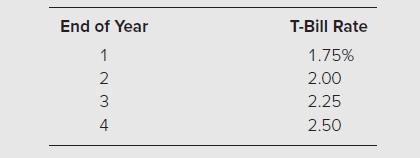
Referring to Table 25–8, suppose that the U.S. FI had agreed to make floating payments of LIBOR + 1 percent instead of LIBOR + 2 percent. What would its net payment have been to the U.K. FI over the four-year swap agreement? (−$1.6 m.)
What is the link between preserving “customer relationships” and credit derivatives such as total return swaps?
Is there any difference between a digital default option (see Chapter 24) and a pure credit swap?
Are swaps as risky as equivalent-sized loans?
An insurance company owns $50 million of floating-rate bonds yielding LIBOR plus 1 percent. These loans are financed with $50 million of fixed-rate guaranteed investment contracts (GICs) costing 10 percent. A bank has $50 million of auto loans with a fixed rate of 14 percent. The loans are financed
A commercial bank has $200 million of four-year maturity floating-rate loans yielding the T-bill rate plus 2 percent. These loans are financed with $200 million of four-year maturity fixed-rate deposits costing 9 percent. The commercial bank can issue four-year variable-rate deposits at the T-bill
Bank 1 can issue five-year CDs at an annual rate of 11 percent fixed or at a variable rate of LIBOR plus 2 percent. Bank 2 can issue five-year CDs at an annual rate of 13 percent fixed or at a variable rate of LIBOR plus 3 percent.a. Is a mutually beneficial swap possible between the two banks?b.
First Bank can issue one-year, floating-rate CDs at prime plus 1 percent or fixedrate CDs at 12.5 percent. Second Bank can issue one-year floating-rate CDs at prime plus 0.5 percent or fixed-rate CDs at 11.0 percent.a. What is a feasible swap with all the benefits going to First Bank?b. What is a
Describe how an inverse floater swap works to the advantage of an investor who receives coupon payments of 10 percent minus LIBOR if LIBOR is currently at 4 percent.When is it a disadvantage to the investor? Does the issuing party bear any risk?
A Swiss bank issues a $100 million, three-year eurodollar CD at a fixed annual rate of 7 percent. The proceeds of the CD are lent to a Swiss company for three years at a fixed rate of 9 percent. The spot exchange rate is SFr1.50/US$.a. Is this expected to be a profitable transaction?b. What are the
Use the following information to construct a swap of asset cash flows for the bank in problem
The bank is a price taker in both the fixed-rate market at 9 percent and the rate-sensitive market at the T-bill rate plus 1.5 percent. A securities dealer has a large portfolio of rate-sensitive assets funded with fixed-rate liabilities. The dealer is a price taker in a fixed-rate market paying
Consider the following currency swap of coupon interest on the following assets:5 percent (annual coupon) fixed-rate US$1 million bond 5 percent (annual coupon) fixed-rate bond denominated in Swiss francs (SFr)Spot exchange rate: SFr1.5/US$.a. What is the face value of the SFr bond if the
Consider the following fixed-floating-rate currency swap of assets: 5 percent(annual coupon) fixed-rate US$1 million bond and floating-rate SFr1.5 million bond set at LIBOR annually. Currently LIBOR is 4 percent. The face value of the swap is SFr1.5 million. The spot exchange rate is SFr1.5/$.a.
What role did the swap market play in the financial crisis of 2008–2009?The following problem refers to material in Appendix 25A.
Which loans should have the highest yields: (a) loans sold with recourse or (b) loans sold without recourse?
Which have higher yields, junk bonds or leveraged loans? Explain your answer.
Describe the two basic types of loan sale contracts by which loans can be transferred between seller and buyer.
Explain the main reason behind the growth in loan sales in the 1980s and the early 2000s.
What institutions are the major buyers in the traditional U.S. domestic loan sales market? What institutions are the major sellers in this market?
What are some of the economic and regulatory reasons why FIs choose to sell loans?
How can an FI use its loans to mitigate a liquidity problem?
What are some of the factors that are likely to deter the growth of the loan sales market in the future?
What are some specific legal concerns that have hampered the growth of the loan sales market?
Showing 4000 - 4100
of 4618
First
33
34
35
36
37
38
39
40
41
42
43
44
45
46
47
Step by Step Answers

 Get 50% OFF
Claim Now
Get 50% OFF
Claim Now