New Semester
Started
Get
50% OFF
Study Help!
--h --m --s
Claim Now
Question Answers
Textbooks
Find textbooks, questions and answers
Oops, something went wrong!
Change your search query and then try again
S
Books
FREE
Study Help
Expert Questions
Accounting
General Management
Mathematics
Finance
Organizational Behaviour
Law
Physics
Operating System
Management Leadership
Sociology
Programming
Marketing
Database
Computer Network
Economics
Textbooks Solutions
Accounting
Managerial Accounting
Management Leadership
Cost Accounting
Statistics
Business Law
Corporate Finance
Finance
Economics
Auditing
Tutors
Online Tutors
Find a Tutor
Hire a Tutor
Become a Tutor
AI Tutor
AI Study Planner
NEW
Sell Books
Search
Search
Sign In
Register
study help
business
foundations macroeconomics
Foundations of Macroeconomics 8th edition Robin Bade, Michael Parkin - Solutions
In which episode, the Great Depression or the 2008–2009 recession, did the banks’ desired reserve ratio and the currency drain ratio increase by the larger amount and the money multiplier fall by the larger amount?
Read Eye on the Fed in a Crisis on p. 434. What are the key differences in monetary policy between the Great Depression and the slow recovery from the 2008–2009 recession?
Premature to rule out an interest rate increase this year Federal Reserve Bank of New York President William Dudley says that in the current state of the economy, it would be worse for the Fed to raise rates too soon than moving slightly too late and adjusting by raising rates more quickly.What are
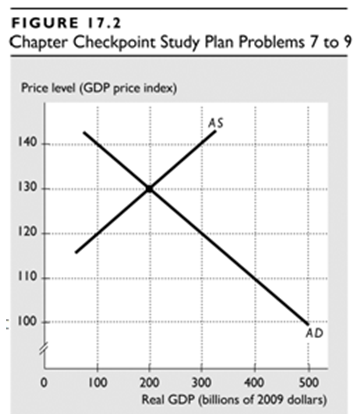
Suppose that a drought decreases potential GDP in Artica to $250 billion. Explain what happens if the central bank lowers the federal funds rate. Do you recommend that the central bank lower the interest rate? Why?
What do you predict will happen if the central bank takes no monetary policy actions? What monetary policy action would you advise the central bank to take and what do you predict will be the effect of that action?
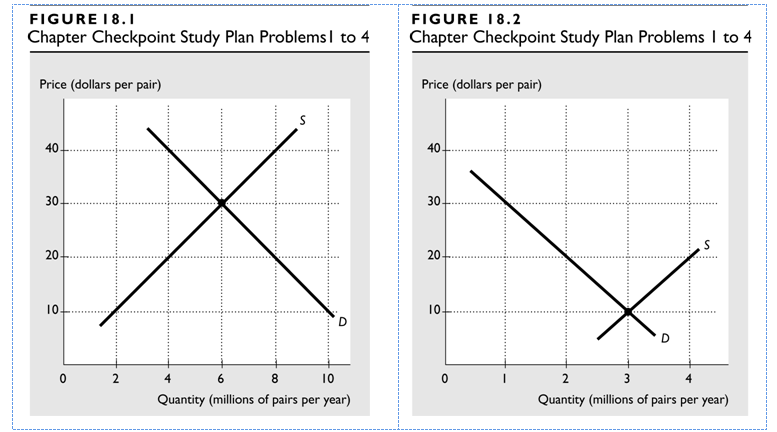
What are the price level and real GDP? Does Artica have an unemployment problem or an inflation problem? Why?Figure 17.2 shows the aggregate demand curve, AD, and the short-run aggregate supply curve, AS, in the economy of Artica. Potential GDP is $300 billion. FIGURE 17.2 Chapter Checkpoint Study
What is financial stability? What actions has the Fed taken since 2007 in pursuit of financial stability? Use a graph to illustrate the effects of the Fed’s actions.
What is the Fed’s “dual mandate” for the conduct of monetary policy? What are the means to achieving the goals of the dual mandate?
Central bankers warn of QE threat to budget discipline, the German and Dutch central bank presidents warn that quantitative easing and low interest rates make discipline in government budgeting more important. Debt and deficits must be cut.How might a government budget deficit and debt threaten
A tax cut increases _______.A. Aggregate demand but has no effect on aggregate supplyB. Aggregate demand because it increases disposable income and increases aggregate supply because it is an incentive to supply more laborC. Aggregate demand because it increases consumption expenditure and
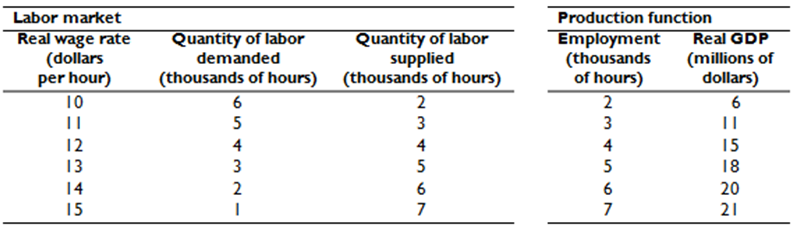
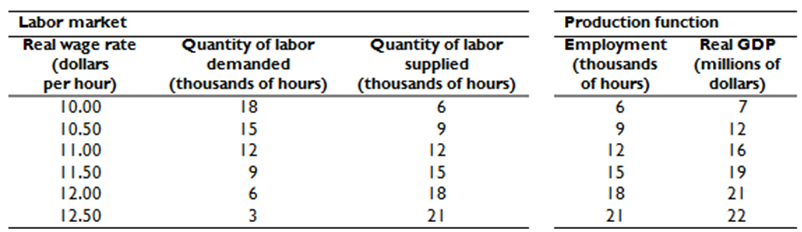
What are the levels of employment and potential GDP in LowTaxLand, what is the real wage rate paid by employers, and what is the after-tax real wage rate received by workers? The first table to the left describes the labor market in LowTaxLand and the second table to the right describes the
Suppose that the U.S. government increases its expenditure on highways and bridges by $100 billion. Explain the effect that this expenditure would have on needs-tested spending and the government’s budget surplus.
The global economy is in bad shape and getting worse, the world economy is growing slowly and productive public investment that boosts both the demand and supply sides of the economy is not being used, either because debts are high or because governments are misguidedly pursuing austerity.Explain
What are the levels of employment and potential GDP in Oil Patch, what is the real wage rate paid by employers, and what is the after-tax real wage rate received by workers? OilPatch is a mineral rich economy in which the government gets most of its tax revenue from oil royalties. But OilPatch
The U.S. economy is in recession and has a large recessionary gap. Describe what automatic fiscal policy might occur. Describe a fiscal stimulus that could be used that would not increase the budget deficit.
Classify the following items as automatic fiscal policy actions, discretionary fiscal policy actions, or neither.An increase in expenditure on homeland securityAn increase in unemployment benefits paid during a recessionDecreased expenditures on national defense during peace timeAn increase in
Suppose that in an economy, investment is $400 billion, saving is $400 billion, tax revenues are $500 billion, exports are $300 billion, and imports are $200 billion. Calculate government expenditure and the government’s budget balance.
Draw two short-run Phillips curves and a long-run Phillips curve for Brazil. On your graph, place two points, one for Brazil in 2014 and one for the central bank’s expectations about the outcome in 2015. Explain any assumptions you make.Use the following information to work Brazilian inflation
According to Okun’s Law, how would you expect Brazil’s fall in real GDP (negative growth rate) to change the unemployment rate?Use the following information to work Brazilian inflation and growth get worse, brazil’s central bank has increased its inflation forecast to 9 percent and cut its
The inflation rate is 6 percent a year, the unemployment rate is 4 percent, and the economy is at full employment. The Fed announces that it intends to slow the money growth rate to keep the inflation rate at 3 percent a year for the foreseeable future. People believe the Fed. Explain how
The inflation rate is 3 percent a year, and the quantity of money is growing at a pace that will maintain the inflation rate at 3 percent a year. The natural unemployment rate is 4 percent, and the current unemployment rate is 3 percent. In what direction will the unemployment rate change? How will
Explain the relationship between the long-run Phillips curve and potential GDP and the short-run Phillips curve and the aggregate supply curve.
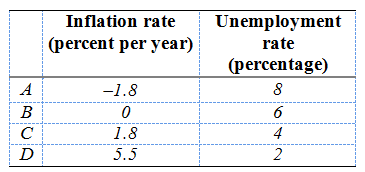
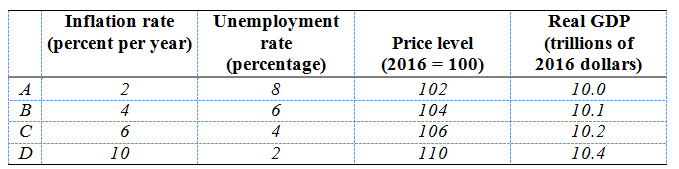
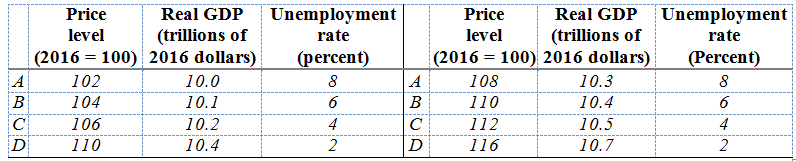
In 2017, the outcome turned out to be row D of the left side table. Plot the short-run Phillips curve for 2018 and mark the points A, B, C, and D that correspond to the data in the right part of the table. Inflation rate Unemployment (percent per year) rate (percentage) -1.8 B 1.8 4 5.5 2
Plot the short-run Phillips curve and aggregate supply curve for 2017 and mark the points A, B, C, and D on each that correspond to the data in the left part of the table.The left part of the table describes four possible situations that might arise in 2017, depending on the level of aggregate
In an economy, the natural unemployment rate is 4 percent and the expected inflation rate is 3 percent a year. Draw a graph of the short-run and long-run Phillips curves that display this information. Label each curve.
Suppose that the U.S. economy fully recovers from the 2008-2009 recession but the natural unemployment rate has risen to 8 percent and the expected inflation rate is zero. How would the short-run and long-run Phillips curves change? Would the trade off be more favorable or less favorable than that
Read Eye on the Tradeoff on p. 391. How can the Phillips curve account for the combination of inflation and unemployment in 2015? Do the data for that year mean that there is no tradeoff?
If the government replaces the central bank governor and pursues faster growth by increasing aggregate demand, how will inflation and unemployment change? How will India’s Phillips curves change?Use the following information to work India seeks more reserved central bank, there is a conflict in
Sketch India’s short-run and long-run Phillips curves if the expected inflation rate rises from 5 percent per year to 7 percent per year and the natural unemployment rate is constant at 8 Percent.Use the following information to work India seeks more reserved central bank, there is a conflict in
From 1991 until 2013, the average inflation rate in Russia was 151.48 percent. Explain how a history of rapid inflation might influence the short-run and long-run Phillips curves in Russia.
The inflation rate is 2 percent a year, and the quantity of money is growing at a pace that will maintain that inflation rate. The natural unemployment rate is 7 percent, and the current unemployment rate is 9 percent. In what direction will the unemployment rate change? How will the short-run
Suppose that the natural unemployment rate is 7 percent and the expected inflation rate in 2017 is 3 percent a year. If the inflation rate is expected to rise to 5 percent a year in 2018, explain how the short-run and the long-run Phillips curves will change.
Suppose that the natural unemployment rate is 7 percent in 2016 and it de-creases to 6 percent in 2017 with no change in expected inflation. Explain how the short-run and long-run tradeoffs change.
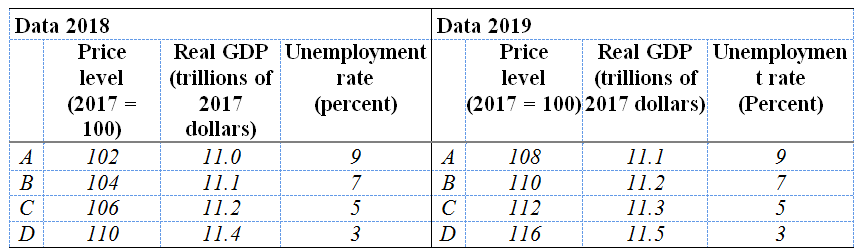
What is Okun€™s Law? If the natural unemployment rate is 6 percent, does this economy behave in accordance with Okun€™s Law? Data 2018 Price level (2017 100) Data 2019 Real GDP Unemployment (trillions of Real GDP Unemploymen Price level (trillions of rate t rate (2017 = 100)
Suppose that the U.S. government puts an import quota on roses. Show on your graph the effect on the quantity bought by U.S. consumers, the quantity produced by U.S. rose growers, and the quantity imported.
Which country has a comparative advantage in producing shoes? With international trade, explain which country would export shoes and how the price of shoes in the importing country and the quantity produced by the importing country would change. Explain which country gains from this trade.Use
What actions might the Fed take in the foreign exchange market? Could these actions persist in the long run? Would the Fed’s actions prevent interest rate parity from being achieved? Why or why not?Suppose that the euro keeps appreciating against the U.S. dollar. The Fed decides to stop the euro
The U.S. dollar depreciates. Explain which of the following events could have caused the depreciation and why. The Fed intervened in the foreign exchange market. Did the Fed buy or sell U.S. dollars?People began to expect that the U.S. dollar would depreciate.The U.S. interest rate
U.S. trade gap widened in June due to import surge, the U.S. trade deficit soared in June to $44.5 billion. Higher oil prices and increased purchases of pharmaceuticals and smart phones swelled imports.Explain how the United States pays for its international trade deficit.
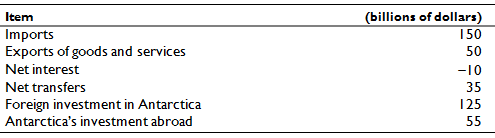
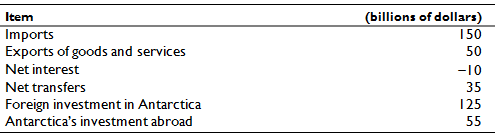
Is Antarctica a debtor nation or a creditor nation? Are its international assets increasing or decreasing? Is Antarctica borrowing to finance investment or consumption? Explain. The table gives some data that describe the economy of Antarctica in 2050: (billions of dollars) Item 150 Exports of
Calculate Antarctica€™s current account balance, capital and financial account balance, and the increase in Antarctica€™s official reserves. The table gives some data that describe the economy of Antarctica in 2050: (billions of dollars) Item 150 Exports of goods and
A monetary policy rule is ______ to discretionary monetary policy because______. A. Superior; discretion limits what the Fed can do in a financial crisis B. Inferior; a rule makes it harder for people to forecast the inflation rate C. Superior; a rule keeps inflation expectations
The Fed’s choice of monetary policy strategy is ______. A. Discretionary monetary policy B. The k-percent rule for money growth C. Adjusting the federal funds rate to best fulfill its dual mandate D. Setting the foreign exchange rate of the dollar
The people who support restricted international trade say that ______.A. Protection saves jobs, in both the U.S. and foreign economiesB. U.S. firms won’t be able to compete with low-wage foreign labor if trade is freeC. Outsourcing sends jobs abroad, which brings diversification and makes our
If Korea imposes an import quota on U.S. oranges, losers include Korean _______ of oranges and U.S. ______ of oranges.A. Consumers; consumersB. Consumers; producersC. Producers; consumersD. Producers; producers
The U.S. tariff on paper ____ the U.S. price of paper, _____ U.S. production of paper and _______the U.S. gains from tradeA. Raises; increases; increasesB. Doesn’t change; increases; increasesC. Doesn’t change; doesn’t change; decreasesD. Raises; increases; decreases
With free trade between China and the United States, the winners are ___________ and the losers are _______.A. U.S. consumers of U.S. imports; U.S. producers of the U.S. import goodB. China’s consumers of China’s imports; China’s producers of its export goodC. U.S. producers of the U.S.
With free trade between the United States and Canada, the United States exports tomatoes and Canada exports maple syrup. U.S. consumers ______A. Of tomatoes gain and Canadian consumers of maple syrup loseB. Of both tomatoes and maple syrup gain more than either producerC. Of maple syrup gain more
A country will export wheat if, with no international trade, ______.A. It produces a surplus of wheatB. Its opportunity cost of producing wheat is below the world priceC. Its domestic price of wheat exceeds the world priceD. Other countries have a shortage of wheat
The fundamental force driving international trade is comparative _______.A. Advantage: a country exports those goods that have high pricesB. Abundance: the country that produces more than it needs exports the goodC. Advantage: the country with the lower opportunity cost of production exports the
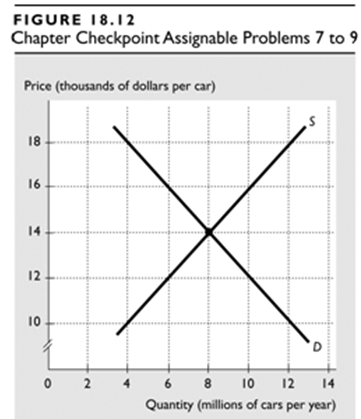
What argument might be used to encourage the government of Mexico to introduce a $2,000 tariff on car imports from the United States? Who will gain and who will lose as a result of Mexico€™s tariff? Figure 18.12 shows the car market in Mexico when Mexico places no restriction on the
If the government of Mexico introduces an import quota of 4 million cars a year, what will be the price of a car in Mexico, the quantity of cars produced in Mexico, and the quantity imported? Figure 18.12 shows the car market in Mexico when Mexico places no restriction on the quantity of cars
If the government of Mexico introduces a $2,000 tariff on car imports, what will be the price of a car in Mexico, the quantity of cars produced in Mexico, the quantity imported into Mexico, and the government€™s tariff revenue?Use Figure 18.12 and the following information to work. Figure
The United States exports services and imports coffee. Why does the United States gain from exporting services and importing coffee? How do economists measure the net gain from this international trade?
Suppose that the world price of sugar is 20 cents a pound, Brazil does not trade internationally, and the equilibrium price of sugar in Brazil is 10 cents a pound. Brazil then begins to trade internationally.How does the price of sugar in Brazil change? Do Brazilians buy more or less sugar? Do
The United States exports wheat. Draw a graph to illustrate the U.S. wheat market if there is free international trade in wheat. On your graph, mark the price of wheat and the quantities bought, produced, and exported by the United States.
Draw a graph of the U.S. market for textiles and show how removing a tariff would change the quantities produced, bought, and imported. Explain why the gains exceed the losses.The future of U.S.–India relations, in May 2009, Secretary of State Hillary Clinton gave a major speech covering all the
Explain who in the United States would gain and who might lose from dismantling trade barriers between the United States and India.The future of U.S.–India relations, in May 2009, Secretary of State Hillary Clinton gave a major speech covering all the issues in U.S.–India relations. On economic
Read Eye on Globalization on p. 461 and draw two graphs to show how U.S. consumers gain from iPads manufactured in China and why Chinese workers also gain.
Explain and illustrate with a graph the effects of the central bank of Brazil trying to lower the inflation rate by unexpectedly slowing the money growth rate. Explain how the unemployment rate will change in the short run and in the long run if the central bank persists with a lower money growth
The short-run Phillips curve shows that, other things remaining the same, ________. A. An increase in expected inflation will lower the unemployment rate B. A fall in unemployment will lower the inflation rate C. The inflation rate rises by 1 percent when unemployment falls by 1
The long-run Phillips curve _______A. Is a horizontal curve at the expected inflation rate B. Is a vertical curve at the natural unemployment rate C. Slopes downward as the inflation rate falls D. Slopes upward as the unemployment rate falls
The short-run Phillips curve intersects the long-run Phillips curve at _______. A. The expected inflation rate and the current unemployment rate B. The current inflation rate and the natural unemployment rate C. The expected inflation rate and the natural unemployment rate D.
An increase in the expected inflation rate, other things remaining the same, ________. A. Shifts the short-run Phillips curve upward B. Creates a movement up along the short-run Phillips curve C. Decreases the natural unemployment rate and shifts the long-run Phillips curve
A decrease in the natural unemployment rate _______A. Shifts both the short-run and the long-run Phillips curves leftward B. Shifts the short-run Phillips curve leftward but the long-run Phillips curve does not change C. Creates a movement along the short-run Phillips curve D.
Suppose that the unemployment rate exceeds the natural unemployment rate and the Fed increases the money growth rate. If the Fed’s action is _______A. Unexpected, the unemployment rate falls but the inflation rate rises B. Unexpected, the inflation rate doesn’t change but the unemployment
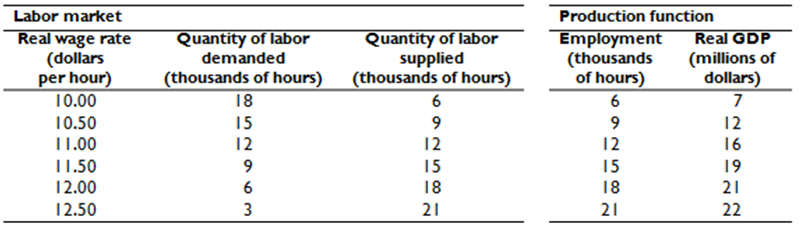
If OilPatch eliminates its income tax, what then are the levels of employment and potential GDP and what is the real wage rate in OilPatch?
If Oil Patch doubles its income tax to $4 an hour, what then are the levels of employment and potential GDP? What is the real wage rate paid by employers and the after-tax real wage rate received by workers?
The income tax rate on all forms of income is 40 percent and there is a tax of 10 percent on all consumption expenditure. The nominal interest rate is 7 percent a year and the inflation rate is 5 percent a year. What is the size of the tax wedge on wages and what is the true tax rate on interest?
The Canadian Prime Minister Stephen Harper warned on November 6, 2008, that if policy makers adopt too strong a fiscal stimulus then long-term growth might be jeopardized. Explain what he meant.
How big was the fiscal stimulus package of 2008–2009, how many jobs was it expected to create, and how large was the multiplier implied by that expectation? Did the stimulus work?
From the peak in 1929 to the Great Depression trough in 1933, government tax revenues fell by 1.9 percent of GDP and government expenditures increased by 0.3 percent. Real GDP fell by 25 percent. Compare and contrast this experience with the fiscal policy that accompanied the 2008-2009 recession.
Suppose that the U.S. government increases its expenditure on highways and bridges by $100 billion. Explain the effect that this expenditure would have on aggregate demand and real GDP.
If Low Tax Land eliminates its income tax, what then are the levels of employment and potential GDP and what is the real wage rate in Low Tax Land? Production function Labor market Real wage rate Real GDP Quantity of labor Quantity of labor Employment (thousands of hours) (millions of (dollars per
If Low Tax Land doubles its income tax to $2 an hour, what then are the levels of employment and potential GDP? What is the real wage rate paid by employers and the after-tax real wage rate received by workers?
Describe the supply-side effects of a fiscal stimulus and explain how a tax cut will influence potential GDP.
Use an aggregate supply–aggregate demand graph to illustrate the effects on real GDP and the price level of a fiscal stimulus when the economy is in recession.
The federal government’s major outlay in its budget is_______ and its major source of revenue is _______.A. Debt interest; sales of government bondsB. Expenditure on goods and services; taxes on goods and servicesC. Social Security and other benefits; personal income taxesD. Subsidies to farmers;
U.S. national debt _______ when the federal government’s _______.A. Increases; outlays exceed tax revenueB. Decreases; outlays exceed tax revenueC. Increases; tax revenue rises faster than outlaysD. Decreases; tax revenue rises faster than outlays
Discretionary fiscal policy to stimulate the economy includes ________.A. Lowering the tax rate paid by households with middle incomesB. Raising the tax on gasolineC. The fall in tax revenue as the economy goes into recessionD. The rise in tax revenue collected from businesses as their profits
Automatic fiscal policy ________A. Requires an action of the government B. Is weak unless the government cuts its outlays to reduce the deficitC. Operates as the economy moves along its business cycleD. Reduces the deficit as the economy goes into recession
Needs-tested spending is _______ fiscal policy because it _______.A. Automatic; increases in recession and decreases in expansionB. Discretionary; increases when tax revenue increasesC. Automatic; increases when the government’s budget deficit fallsD. Discretionary; is determined by economic
A government expenditure multiplier _______A. Equals 1B. Is less than the tax multiplierC. Exceeds 1D. Equals the tax multiplier
When the government lowers the income tax rate, ______A. Employment increases and potential GDP increasesB. Employment does not change but labor productivity fallsC. Labor productivity rises and employment decreasesD. Both labor productivity and potential GDP increase
Will the U.S. dollar appreciate or depreciate against the yen and will purchasing power parity be violated? Why or why not?Suppose that the inflation rate is lower in Japan than it is in the United States, and that the difference in the inflation rates persists for some years.
Will U.S. interest rates be higher or lower than Japanese interest rates and will interest rate parity hold? Why or why not?Suppose that the inflation rate is lower in Japan than it is in the United States, and that the difference in the inflation rates persists for some years.
Explain how the expected future exchange rate will change.Suppose that the inflation rate is lower in Japan than it is in the United States, and that the difference in the inflation rates persists for some years.
Suppose that the U.K. pound is trading at 1.82 U.S. dollars per U.K. pound and at this exchange rate purchasing power parity holds. The U.S. interest rate is 2 percent a year and the U.K. interest rate is 4 percent a year. Calculate the U.S. interest rate differential. What is the U.K. pound
Pound plunges on U.K. vote to leave the European UnionBritain’s vote to leave the European Union lowered the pound from $1.50 to $1.32 in tumultuous hours of foreign exchange trading.Did the vote to leave the European Union make the British pound appreciate of depreciate against the U.S. dollar?
Read Eye on the Dollar on p. 495. When and why did the dollar rise against the euro and when and why did it fall?
If the European Central Bank starts to raise its policy interest rate before the Fed starts to raise the federal funds rate target, what do you predict will happen to the dollar/euro exchange rate? Illustrate your answer with an appropriate graphical analysis.
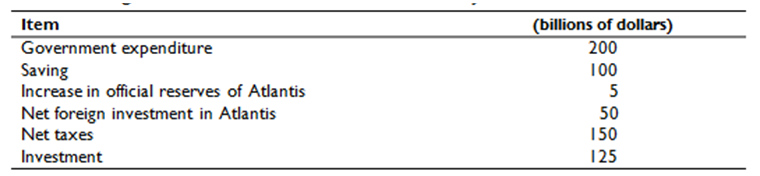
The table gives some data that describe the economy of Atlantis in 2020:Calculate the current account balance, the capital and financial account balance, the government sector balance, and the private sector balance. Item (billions of dollars) 200 Government expenditure 100 Saving Increase in
The U.S. dollar appreciates, and U.S. official reserves increase. Explain which of the following events might have caused these changes to occur and why.The Fed intervened in the foreign exchange market and sold U.S. dollars.The Fed conducted an open market operation and sold U.S. bonds.People
Which of the following events might have caused the euro to appreciate and why? The European Central Bank sold euros in the foreign exchange market.The Fed intervened in the foreign exchange market and bought U.S. dollars.The EU interest rate differential increased.Profits increased in
Are there any other actions that the Fed could take to raise the foreign ex-change value of the dollar? Explain your answer.Suppose that the euro keeps appreciating against the U.S. dollar. The Fed decides to stop the euro from appreciating (stop the U.S. dollar from depreciating) and intervenes in
Does purchasing power parity (PPP) hold between Brazil and the United States? If not, does PPP predict that the real will appreciate or depreciate against the U.S. dollar?In August 2013, the exchange rate between the U.S. dollar and the Brazilian real was 3.125 real per dollar. In the same month,
Does interest rate parity hold between Brazil and the United States? If in-terest rate parity does hold, what is the expected rate of appreciation or depreciation of the Brazilian real against the U.S. dollar? If the Fed raised the interest rate while the Brazilian interest rate remained at 14.25
The current account balance equals ______. A. Exports minus imports plus net interest and net transfers B. Net exports plus net foreign investment in the United States C. Capital and financial account balance minus the official settlements account balance D. Net exports plus the
China’s official reserves have ballooned, fueled by strong foreign in-vestment and large trade surpluses. China is a net ______ and a ______ na-tion. A. Lender; debtor B. Borrower; debtor C. Lender; creditor D. Borrower; creditor
Net exports equal the ______. A. Private sector balance plus the government sector balance B. Private sector balance minus the government sector balance C. Government sector balance minus the private sector balance D. Private sector balance plus the government’s budget deficit
Showing 4500 - 4600
of 5010
First
37
38
39
40
41
42
43
44
45
46
47
48
49
50
51
Step by Step Answers

 Get 50% OFF
Claim Now
Get 50% OFF
Claim Now