New Semester
Started
Get
50% OFF
Study Help!
--h --m --s
Claim Now
Question Answers
Textbooks
Find textbooks, questions and answers
Oops, something went wrong!
Change your search query and then try again
S
Books
FREE
Study Help
Expert Questions
Accounting
General Management
Mathematics
Finance
Organizational Behaviour
Law
Physics
Operating System
Management Leadership
Sociology
Programming
Marketing
Database
Computer Network
Economics
Textbooks Solutions
Accounting
Managerial Accounting
Management Leadership
Cost Accounting
Statistics
Business Law
Corporate Finance
Finance
Economics
Auditing
Tutors
Online Tutors
Find a Tutor
Hire a Tutor
Become a Tutor
AI Tutor
AI Study Planner
NEW
Sell Books
Search
Search
Sign In
Register
study help
business
intermediate microeconomics
Microeconomics 7th Edition Jeffrey M. Perloff - Solutions
6.1 Solved Problem 13.4 shows that a monopolistically competitive firm maximizes its profit where it is operating at less than full capacity. Does this result depend upon whether firms produce identical or differentiated products? Why?
5.8 Two pizza parlors are located within a few feet of each other on the Avenue of the Americas in New York City. Both were selling a slice of pizza for $1(Matt Flegenheimer, “$1 Pizza Slice Is Back After a Sidewalk Showdown Ends Two Parlors’ Price War,” New York Times, September 5, 2012).
5.7 Solve for the Nash-Bertrand equilibrium for the firms described in Question 5.5 if Firm 1’s marginal cost is $30 per unit and Firm 2’s marginal cost is$10 per unit. A
5.6 Solve for the Nash-Bertrand equilibrium for the firms described in Question 5.5 if both firms have a marginal cost of $0 per unit. A
5.5 Suppose that identical duopoly firms have constant marginal costs of $10 per unit. Firm 1 faces a demand function of q1 = 100 - 2p1 + p2, where q1 is Firm 1’s output, p1 is Firm 1’s price, and p2 is Firm 2’s price. Similarly, the demand Firm 2 faces is q2 = 100 - 2p2 + p1. Solve for the
5.4 In the initial Nash-Bertrand equilibrium, two firms with differentiated products charge the same equilibrium prices. A consumer testing agency praises the product of one firm, causing its demand curve to shift to the right as new customers start buying the product. (The demand curve of the
5.3 In the Coke and Pepsi example, what is the effect of a specific tax, t, on the equilibrium prices?(Hint: What does the tax do to the firm’s marginal cost? You do not have to use math to answer this problem.)
5.2 Will the price be lower if duopoly firms set price or if they set quantity? Under what conditions can you give a definitive answer to this question?
5.1 What happens to the homogeneous-good Nash-Bertrand equilibrium price if the number of firms increases? Why?
4.7 Zipcar invented the business of renting cars by the hour and is still the industry leader with half a million U.S. members and 9,000 vehicles. However, Hertz and Enterprise have more recently entered the market. Enterprise claims it has 58,000 carsharing members and the second largest fleet of
4.6 To examine the trade-off between efficiency and market power from a merger, consider a market with two firms that sell identical products. Firm 1 has a constant marginal cost of 1, and Firm 2 has a constant marginal cost of 2. The market demand is Q = 15 - p.a. Solve for the Nash-Cournot
4.5 The market demand function is Q = 1,000 -1,000p. Each firm has a marginal cost of m =0.28 (28¢ per unit). Firm 1, the leader, acts before Firm 2, the follower. Solve for the Nash-Stackelberg equilibrium quantities, prices, and profits. (Hint:See Appendix 13B and Solved Problem 13.3.)Compare
4.4 Your college is considering renting space in the student union to one or two commercial textbook stores. The rent the college can charge per square foot of space depends on the profit (before rent) of the firms and hence on whether the market has a monopoly or a duopoly. Which number of stores
4.3 If two quantity-setting firms act simultaneously, is the Stackelberg outcome likely? Why or why not?
4.2 Determine the Nash-Stackelberg equilibrium with one leader firm and two follower firms if the market demand curve is linear and each firm faces a constant marginal cost, m, and no fixed cost. (Hint:See Appendix 13B for the Stackelberg model with one follower or use calculus.) C
4.1 Duopoly quantity-setting firms face the market demand p = 150 - Q. Each firm has a marginal cost of $60 per unit.a. What is the Nash-Cournot equilibrium?b. What is the Nash-Stackelberg equilibrium when Firm 1 moves first? A
3.14 In a Nash-Cournot equilibrium, does an oligopolistic firm produce at less than full capacity, full capacity, or more than full capacity? Explain.
3.13 Draw a figure to illustrate the Intel-AMD Nash-Cournot equilibrium in Solved Problem 13.2. At what quantities do the best-response functions hit the axes?
3.12 Firms 1 and 2 produce differentiated goods. Firm 1’s inverse demand function is p1 = 260 - 2q1 - q2, while Firm 2’s inverse demand function is p2 = 260 - 2q2 - q1. Each firm has a constant marginal cost of 20. What is the Nash-Cournot equilibrium in this market? (Hint: See Solved Problem
3.11 How would the Intel-AMD equilibrium in Solved Problem 13.2 change if AMD faced the same demand function as Intel, Equation 13.10? A
3.10 Why do prices increase if oligopolistic firms differentiate their products?
3.9 If the inverse market demand function facing a duopoly is p = a - bQ, what are the Nash-Cournot equilibrium quantities if the marginal cost of Firm 1 is m and that of Firm 2 is m + x, where x 7 0? Which firm produces more and which has the higher profit? A
3.8 In 2012, Southwest Airlines reported that its “cost per available seat mile” was 13.0¢ compared to 13.8¢ for United Airlines. Assuming that Southwest and United compete on a single route, use a graph to show that their equilibrium quantities differ.(Hint: See Solved Problem 13.1.)
3.7 How would the airlines’ Nash-Cournot equilibrium(Figure 13.3) change if United’s marginal cost was$100 and American’s was $200? (Hint: See Solved Problem 13.1.) A
3.6 Lee et al. (2010) estimated that a 2009 tax of 10 New Taiwan Dollars ($0.30) per pack of cigarettes reduced Taiwanese cigarette consumption by 13.19%. Assuming that the market consists of two cigarette firms, show how this specific tax affects the Nash-Cournot equilibrium. (Hint: Show how the
3.5 Show how the Nash-Cournot equilibrium for n firms given in Appendix 13A changes if each firm faces a fixed cost of F as well as a constant marginal cost per unit. (Hint: Very little, if any, formal math is needed, though it can be used.) A
3.4 The viatical settlement industry enables terminally ill consumers, typically HIV patients, to borrow against equity in their existing life insurance contracts to finance their consumption and medical expenses. The introduction and dissemination of effective anti-HIV medication in 1996 reduced
3.3 Duopoly quantity-setting firms face the market demand p = 150 - q1 - q2. Each firm has a marginal cost of $60 per unit. What is the Nash-Cournot equilibrium? A
3.2 What is the duopoly Nash-Cournot equilibrium if the market demand function is Q = 1,000 - 1,000p, and each firm’s marginal cost is $0.28 per unit? A
3.1 The state of Connecticut sets a maximum fee that bail-bond businesses can charge for posting a given-size bond (Ayres and Waldfogel, 1994).The bail-bond fee is set at virtually the maximum amount allowed by law in cities with only one active firm (Plainville, 99% of the maximum;Stamford, 99%;
2.9 In 2013, the number two and number three office supply companies, OfficeMax Inc. and Office Depot, Inc., were discussing merging (Anupreeta Das et al., “OfficeMax, Office Depot in Talks to Merge,” Wall Street Journal, February 18, 2013).Office Depot’s market value was $1.3 billion and
2.8 In 2013, a federal judge ruled that Apple colluded with five major U.S. publishers to artificially drive up the prices of e-books (which could be read on Apple’s iPad). Apple collects a 30% commission on the price of a book from the publisher. Why would Apple want to help publishers raise
2.7 A market has an inverse demand curve p = 100 - 2Q and four firms, each of which has a constant marginal cost of MC = 20. If the firms form a profit-maximizing cartel and agree to operate subject to the constraint that each firm will produce the same output level, how much does each firm
2.6 In 2012, the U.S. government sued to block the world’s biggest beer maker, Anheuser-Busch InBev, from buying Mexico’s Grupo Modelo(which manufactures Corona and other beers) for$20 billion (Brent Kendall and Valerie Bauerlein,“U.S. Sues to Block Big Beer Merger,” Wall Street Journal,
2.5 The Federation of Quebec Maple Syrup Producers supplies up to 78% of the world’s maple syrup (Ian Austen, “In $18 Million Theft, Victim Was a Canadian Maple Syrup Cartel,” New York Times, December 19, 2012; www.siropderable.ca/Afficher.aspx?page=3&langue=en). Under government rules, the
2.4 Many retail stores offer to match or beat the price offered by a rival store. Explain why firms that belong to a cartel might make this offer.
2.3 What are the main factors that increase the likelihood of a cartel being successful?
2.2 Holding the number of firms in the market fixed, what happens to the price as the number of noncartel members rises? Why?
1.1 Which market structure best describes (a) airplane manufacturing, (b) electricians in a small town,(c) farms that grow tomatoes, and (d) cable television in a city? Why?
Use algebra to solve for the Nash-Stackelberg equilibrium quantities and market price if American Airlines were a Stackelberg leader and United Airlines were a follower.(Hint: As the graphical analysis shows, American Airlines, the Stackelberg leader, maximizes its profit as though it were a
Derive United Airlines’ best-response function if its marginal cost falls to $99 per unit. Given that American’s marginal cost does not change, what is the new Nash-Cournot equilibrium?
7.5 Use a diagram to illustrate the effect of social media on the demand for Super Bowl commercials. (Hint:See the “Super Bowl Commercials” Application.)
7.4 A monopoly’s inverse demand function is p = 800 - 4Q + 0.2A0.5, where Q is its quantity, p is its price, and A is the level of advertising. Its marginal cost of production is 2, and its cost for a unit of advertising is 1. What are the firm’s profitmaximizing price, quantity, and level of
7.3 O. J. Simpson’s 1995 trial for murder was broadcast by many television and radio stations.Viewership and sales sagged as viewers skipped program-length product pitches to watch trial coverage on weekday mornings. Estimates of average infomercial sales declines due to the Simpson trial ranged
7.2 Various services such as Hulu.com that provide television shows and movies over the Internet subject customers to customized commercials, as the firms learn more about their viewing habits. How does this customization affect the marginal benefit curve for an advertiser, and why?
7.1 Using a graph similar to Figure 12.7, explain why a firm might not want to spend A on advertising, even though it shifts the firm’s demand curve to the right. (Hint: Discuss what happens to the elasticity of demand or the price at the monopoly optimum.)
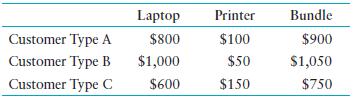
6.4 A computer hardware firm sells both laptop computers and printers. It has a large inventory of laptops and printers that it wants to sell, so it has no variable production cost. Through the magic of focus groups, their pricing team determines that they have an equal number of three types of
6.3 Explain why in Table 12.2 the firm does not use mixed bundling.
6.2 A monopoly sells two products, of which consumers want only one. Assuming that it can prevent resale, can the monopoly increase its profit by bundling them, forcing consumers to buy both goods?
6.1 Why do Honda service departments emphasize to customers the importance of using “genuine Honda parts” when servicing and tuning Honda cars and motorcycles? Is Honda likely to be as successful as Hewlett-Packard in the Application “Ties That Bind”?
5.5 Explain why charging a higher or lower price than p = 10 reduces the monopoly’s profit in Figure 12.5. Show the monopoly’s profit if p = 20 and compare it to its profit if p = 10.
5.4 As described in the Application “iTunes for a Song,” Shiller and Waldfogel (2011) estimated that if iTunes used two-part pricing charging an annual access fee and a low price per song, it would raise its profit by about 30% relative to what it would earn using uniform or variable pricing.
5.3 Joe has just moved to a small town with only one golf course, the Northlands Golf Club. His inverse demand function is p = 120 - 2q, where q is the number of rounds of golf that he plays per year.The manager of the Northlands Club negotiates separately with each person who joins the club and
5.2 Knoebels Amusement Park in Elysburg, Pennsylvania, charges an access fee, A, to enter its Crystal Pool. It also charges p per trip down the pool’s water slides. Suppose that 400 teenagers visit the park, each of whom has a demand function of q1 = 5 - p, and that 400 seniors also visit, each
5.1 Using math, show why two-part pricing causes customers who purchase relatively few units to pay more per unit than customers who buy more units. C
4.3 In our discussion of Figure 12.4, we assumed that the monopoly engaged in block-pricing by setting both block prices so that they were on the demand curve. However, suppose the monopoly sets the first block at 20 units but can choose a first-block price that is greater than $70. It then allows
4.2 The quantity-discriminating monopoly in panel a of Figure 12.4 sets three prices that depend on the quantity a consumer purchases. The firm’s profit isπ = p1Q1 + p2(Q2 - Q1) + p3(Q3 - Q2) - mQ3, where p1 is the high price charged on the first Q1 units (first block), p2 is a lower price
4.1 Are all the customers of a monopoly that engages in nonlinear pricing (quantity discrimination) in panel a of Figure 12.4 worse off than they would be if the firm set a single price (panel b)?
3.15 According to a report from the Foundation for Taxpayer and Consumer Rights, gasoline costs twice as much in Europe as in the United States because taxes are higher in Europe. However, the amount per gallon net of taxes that U.S. consumers pay is higher than that paid by Europeans.The report
3.14 Spenser’s Superior Stoves advertises a one-day sale on electric stoves. The ad specifies that no phone orders are accepted and that the purchaser must transport the stove. Why does the firm include these restrictions?
3.13 How would the analysis in Solved Problem 12.3 change if m = 7 or if m = 4? (Hint: Where m = 4, the marginal cost curve crosses the MR curve three times—if we include the vertical section.The single-price monopoly will choose one of these three points where its profit is maximized.)
3.12 In Solved Problem 12.3, calculate the firm’s profit with and without a ban against shipments between the two countries.
3.11 A monopoly sells its good in the United States, where the elasticity of demand is –2, and in Japan, where the elasticity of demand is –5. Its marginal cost is $10. At what price does the monopoly sell its good in each country if resale is impossible? A
3.10 A monopoly sells in two countries, and resale between the countries is impossible. The demand curves in the two countries are p1 = 100 - Q1 and p2 = 120 - 2Q2. The monopoly’s marginal cost is m = 30. Solve for the equilibrium price in each country. (Hint: See Solved Problem 12.2.) A
3.9 A copyright gave Universal Studios the legal monopoly to produce and sell the Mama Mia! DVD.The DVD sold for $20 in the United States and$36 (£22) in the United Kingdom. I estimate that the inverse demand functions for the United States and the United Kingdom were pA = 39 - 3QA and pB = 71 -
3.8 Warner Home Entertainment sold the Harry Potter and the Prisoner of Azkaban two-DVD movie set in China for about $3, which was only one-fifth the U.S. price, and sold nearly 100,000 units. The price is extremely low in China because Chinese consumers are less wealthy than those in the other
3.7 Warner Home Entertainment sold the Harry Potter and the Prisoner of Azkaban two-DVD movie set around the world. Warner charged 33% more in Canada and 66% more in Japan than in the United States, where it charged $15. Given that Warner’s marginal cost was $1, determine what the elasticities of
3.6 A monopoly sells its good in the U.S. and Japanese markets. The American inverse demand function is pA = 100 - QA, and the Japanese inverse demand function is pJ = 80 - 2QJ, where both prices, pA and pJ, are measured in dollars. The firm’s marginal cost of production is m = 20 in both
3.5 A patent gave Sony a legal monopoly to produce a robot dog called Aibo (“eye-BO”). The Chihuahua-size pooch robot can sit, beg, chase balls, dance, and play an electronic tune. When Sony started selling the toy, it announced that it would sell 3,000 Aibo robots in Japan for about$2,000 each
3.4 Grocery stores often set consumer-specific prices by issuing frequent-buyer cards to willing customers and collecting information on their purchases.Grocery chains can use that data to offer customized discount coupons to individuals.a. Are grocery stores engaging in perfect or group price
3.3 Does a monopoly’s ability to price discriminate between two groups of consumers depend on its marginal cost curve? Why or why not? Consider two cases: (a) the marginal cost is so high that the monopoly is uninterested in selling to one group, and (b) the marginal cost is low enough that the
3.2 A monopoly has a marginal cost of zero and faces two groups of consumers. At first, the monopoly could not prevent resale, so it maximized its profit by charging everyone the same price, p = $5. No one from the first group chose to purchase. Now the monopoly can prevent resale, so it decides to
2.7 To promote her platinum-selling CD Feels Like Home in 2005, singer Norah Jones toured the country for live performances. However, she sold an average of only two-thirds of the tickets available for each show, T* (Robert Levine, “The Trick of Making a Hot Ticket Pay,” New York Times, June 6,
2.6 If a monopoly faces an inverse demand curve of p = 90 - Q, has a constant marginal and average cost of 30, and can perfectly price discriminate, what is its profit? What are the consumer surplus, welfare, and deadweight loss? How would these results change if the firm were a single-price
2.5 Ticketmaster Corp. uses an Internet auction to sell tickets. Is it engaging in price discrimination? If so, what type?
2.4 How would the answers to Solved Problem 12.1 and Table 12.1 change if seniors’ reservation price was $2.50?
2.3 Can Table 12.1 be modified so that the movie theater in Solved Problem 12.1 does not earn more by perfectly price discriminating than from charging a single price? What changes to the table would increase the extra profit from perfectly price discriminating?
2.2 A firm is a natural monopoly (Chapter 11). Its marginal cost curve is flat, and its average cost curve is downward sloping (because it has a fixed cost).The firm can perfectly price discriminate.a. In a graph, show how much the monopoly produces, Q*. Will it produce to where price equals its
2.1 Using the information in the “Botox Revisited”Application, determine how much Allergan loses by being a single-price monopoly rather than a perfectly price-discriminating monopoly. Explain your answer.
1.8 On July 12, 2012, Hertz charged $126.12 to rent a Nissan Altima for one day in New York City, but only $55.49 a day in Miami. Is Hertz necessarily engaging in price discrimination? Explain.
1.7 Disneyland price discriminates by charging lower entry fees for children than adults and for local residents than for other visitors. Why does it not have a resale problem?
1.6 The 2002 production run of 25,000 new Thunderbirds included only 2,000 cars for Canada.Yet potential buyers besieged Ford dealers there.Many buyers hoped to make a quick profit by reselling the cars in the United States. Reselling was relatively easy, and shipping costs were comparatively low.
1.5 College students could once buy a computer at a substantial discount through a campus buying program.The discounts largely disappeared in the late 1990s, when PC companies dropped their prices.“The industry’s margins just got too thin to allow for those [college discounts],” said the
1.4 Alexx’s monopoly currently sells its product at a single price. What conditions must be met so that he can profitably price discriminate?
1.3 The pharmaceutical companies Abbott Laboratories, AstraZeneca, Bristol-Myers Squibb Company, Eli Lilly, GlaxoSmithKline, Janssen, Johnson &Johnson, Novartis, Pfizer, and Sanofi-Aventis Pharmaceuticals provide low-income, elderly people with a card guaranteeing them discounts on many
1.2 Many colleges provide students from low-income families with scholarships, subsidized loans, and other programs so that they pay lower tuitions than students from high-income families. Explain why universities behave this way.
A monopoly book publisher with a constant marginal cost (and average cost) of MC = 1 sells a novel in only two countries and faces a linear inverse demand curve of p1 = 6 - 12 Q1 in Country 1 and p2 = 9 - Q2 in Country 2. What price would a profit-maximizing monopoly charge in each country with and
7.3 Proposals to reduce patent length for drugs are sometimes made, but some critics argue that such a change would result in even higher prices during the patent period as companies would need to recover drug development costs more quickly. Is this argument valid if drug companies maximize profit?
7.2 Does the Challenge Solution change if the entry of the generic causes a parallel shift to the left of the patent monopoly’s linear demand curve?
6.2 A monopoly produces a good with a network externality at a constant marginal and average cost of 2. In the first period, its inverse demand curve is p = 10 - Q. In the second period, its demand is p = 10 - Q unless it sells at least Q = 8 units in the first period. If it meets or exceeds this
5.5 Malaysia’s monopoly auto manufacturer produces the Proton, which is protected from imports by a specific tariff, t, on imported goods. The monopoly’s profit-maximizing price is p*. The world price of the good (comparable autos) is pw, which is less than p*. Because the price of imported
5.4 Bleyer Industries Inc., the only U.S. manufacturer of plastic Easter eggs, manufactured 250 million eggs each year. However, imports from China cut into its business. In 2005, Bleyer filed for bankruptcy because the Chinese firms could produce the eggs at much lower costs (“U.S. Plastic Egg
5.3 Based on the information in the “Botox Patent Monopoly” Application, what would happen to the equilibrium price and quantity if the government had set a price ceiling of $200 per vial of Botox? What welfare effects would such a restriction have? (Hint: See Solved Problem 11.6.) A
5.1 Describe the effects on output and welfare if the government regulates a monopoly so that it may not charge a price above p, which lies between the unregulated monopoly price and the optimally regulated price (determined by the intersection of the firm’s marginal cost and the market demand
4.5 A monopoly sells music CDs. It has a constant marginal and average cost of 20. It faces two groups of potential customers: honest and dishonest people.The dishonest and the honest consumers’ demand functions are the same: p = 120 - Q.a. If it is not possible for the dishonest customers to
4.4 Based on the information in the Botox Application, what would happen to the equilibrium price and quantity if the government had collected a specific tax of $75 per vial of Botox? What welfare effects would such a tax have? A
4.3 In the “Botox Patent Monopoly” Application, consumer surplus, triangle A, equals the deadweight loss, triangle C. Show that this equality is a result of the linear demand and constant marginal cost assumptions. A
4.2 Can a firm operating in the upward-sloping portion of its average cost curve be a natural monopoly?Explain. (Hint: See Solved Problem 11.5.)
4.1 Can a firm be a natural monopoly if it has a U-shaped average cost curve? Why or why not?(Hint: See Solved Problem 11.5.)
3.9 In 1996, Florida voted on and rejected a 1¢-perpound excise tax on refined cane sugar in the Florida Everglades Agricultural Area. Swinton and Thomas (2001) used estimated linear supply and demand curves to calculate the incidence from this tax given that the market is competitive. Their
Showing 2200 - 2300
of 5625
First
16
17
18
19
20
21
22
23
24
25
26
27
28
29
30
Last
Step by Step Answers

 Get 50% OFF
Claim Now
Get 50% OFF
Claim Now