New Semester
Started
Get
50% OFF
Study Help!
--h --m --s
Claim Now
Question Answers
Textbooks
Find textbooks, questions and answers
Oops, something went wrong!
Change your search query and then try again
S
Books
FREE
Study Help
Expert Questions
Accounting
General Management
Mathematics
Finance
Organizational Behaviour
Law
Physics
Operating System
Management Leadership
Sociology
Programming
Marketing
Database
Computer Network
Economics
Textbooks Solutions
Accounting
Managerial Accounting
Management Leadership
Cost Accounting
Statistics
Business Law
Corporate Finance
Finance
Economics
Auditing
Tutors
Online Tutors
Find a Tutor
Hire a Tutor
Become a Tutor
AI Tutor
AI Study Planner
NEW
Sell Books
Search
Search
Sign In
Register
study help
business
intermediate microeconomics
Intermediate Microeconomics 8th edition Hal R. Varian - Solutions
Explain why convex preferences means that “averages are preferred to extremes.”
If both pepperoni and anchovies are bads, will the indifference curve have a positive or a negative slope?
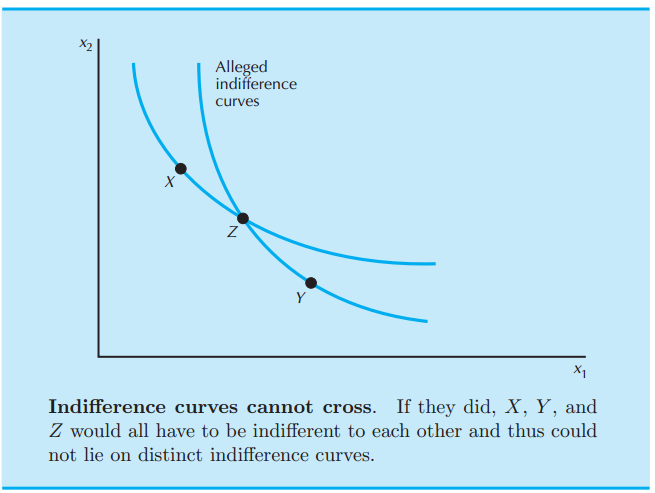
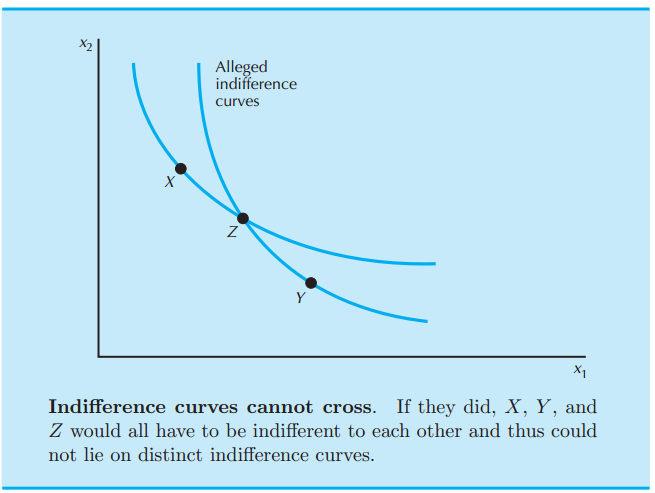
Could Figure 3.2 be a single indifference curve if preferences are mono-tonic?Figure 3.2 : X2 Alleged indifference curves X1 Indifference curves cannot cross. If they did, X, Y, Z would all have to be indifferent to each other and thus could not lie on distinct indifference curves. and
Can an indifference curve cross itself? For example, could Figure 3.2 depict a single indifference curve?Figure 3.2: X2 Alleged indifference curves X1 Indifference curves cannot cross. If they did, X, Y, Z would all have to be indifferent to each other and thus could not lie on distinct
A college football coach says that given any two linemen A and B, he always prefers the one who is bigger and faster. Is this preference relation transitive? Is it complete?
Take the same group of people and consider the relation “strictly taller than.” Is this relation transitive? Is it reflexive? Is it complete?
Consider a group of people A, B, C and the relation “at least as tall as,” as in “A is at least as tall as B.” Is this relation transitive? Is it complete?
If we observe a consumer choosing (x1, x2)when(y1, y2) is available one time, are we justified in concluding that (x1, x2) ≻ (y1,y2)?
On the planet Mungo, they have two kinds of money, blue money and red money. Every commodity has two prices—a red-money price and a blue-money price. Every Mungoan has two incomes—a red income and a blue income. In order to buy an object, a Mungoan has to pay that object’s red-money price in
Harry Hype has $5,000 to spend on advertising a new kind of dehydrated sushi. Market research shows that the people most likely to buy this new product are recent recipients of M.B.A. degrees and lawyers who own hot tubs. Harry is considering advertising in two publications, a boring business
If the income of the consumer increases and one of the prices decreases at the same time, will the consumer necessarily be at least as well-off?
Suppose that a budget equation is given by p1x1 + p2x2 = m.The government decides to impose a lump-sum tax of u, a quantity tax on good 1 oft, and a quantity subsidy on good 2 of s. What is the formula for the new budget line?
Suppose that the government puts a tax of 15 cents a gallon on gasoline and then later decides to put a subsidy on gasoline at a rate of 7 cents a gallon. What net tax is this combination equivalent to?
Suppose that there were 25 people who had a reservation price of $500, and the 26th person had a reservation price of $200. What would the demand curve look like?
In the above example, what would the equilibrium price be if there were 24 apartments to rent? What if there were 26 apartments to rent? What if there were 25 apartments to rent?
If people have different reservation prices, why does the market demand curve slope down?
In the text we assumed that the condominium purchasers came from the inner-ring people—people who were already renting apartments. What would happen to the price of inner-ring apartments if all of the condominium purchasers were outer-ring people—the people who were not currently renting
Suppose now that the condominium purchasers were all inner-ring people, but that each condominium was constructed from two apartments. What would happen to the price of apartments?
What do you suppose the effect of a tax would be on the number of apartments that would be built in the long run?
Suppose the demand curve isD(p) = 100 − 2p. What price would the monopolist set if he had 60 apartments? How many would he rent? What price would he set if he had 40 apartments? How many would he rent?
If our model of rent control allowed for unrestricted subletting, who would end up getting apartments in the inner circle? Would the outcome be Pareto efficient?
Originally the consumer faces the budget line p1x1 + p2x2 = m.Then the price of good 1 doubles, the price of good 2 becomes 8 times larger, and income becomes 4 times larger. Write down an equation for the new budget line in terms of the original prices and income.
What happens to the budget line if the price of good 2 increases, but the price of good 1 and income remain constant?
If the price of good 1 doubles and the price of good 2 triples, does the budget line become flatter or steeper?
What is the definition of a numeraire good?
Showing 5600 - 5700
of 5625
First
43
44
45
46
47
48
49
50
51
52
53
54
55
56
57
Step by Step Answers

 Get 50% OFF
Claim Now
Get 50% OFF
Claim Now