New Semester
Started
Get
50% OFF
Study Help!
--h --m --s
Claim Now
Question Answers
Textbooks
Find textbooks, questions and answers
Oops, something went wrong!
Change your search query and then try again
S
Books
FREE
Study Help
Expert Questions
Accounting
General Management
Mathematics
Finance
Organizational Behaviour
Law
Physics
Operating System
Management Leadership
Sociology
Programming
Marketing
Database
Computer Network
Economics
Textbooks Solutions
Accounting
Managerial Accounting
Management Leadership
Cost Accounting
Statistics
Business Law
Corporate Finance
Finance
Economics
Auditing
Tutors
Online Tutors
Find a Tutor
Hire a Tutor
Become a Tutor
AI Tutor
AI Study Planner
NEW
Sell Books
Search
Search
Sign In
Register
study help
business
intermediate microeconomics
Intermediate Microeconomics 8th edition Hal R. Varian - Solutions
True or false? The distributional consequences of the delineation of property rights are eliminated when preferences are quasilinear.
True or false? An explicit delineation of property rights usually eliminates the problem of externalities.
Romeo loves Juliet and Juliet loves Romeo. Besides love, they consume only one good, spaghetti. Romeo likes spaghetti, but he also likes Juliet to be happy and he knows that spaghetti makes her happy. Juliet likes spaghetti, but she also likes Romeo to be happy andshe knows that spaghetti makes
The ability to set the voting agenda can often be a powerful asset. Assuming that social preferences are decided by pair-wise majority voting and that the preferences given in Table 30.1 hold, demonstrate this fact by producing a voting agenda that results in allocation y winning. Find an agenda
Suppose that an allocation is Pareto efficient, and that each individual only cares about his own consumption. Prove that there must be some individual that envies no one, in the sense described in the text. (This puzzle requires some thought, but it is worth it.)
Suppose that the utility possibilities set is a convex set and that consumers care only about their own consumption. What kind of allocations represent welfare maxima of the Nietzschean welfare function?
A Rawlsian welfare function counts only the welfare of the worst off agent. The opposite of the Rawlsian welfare function might be called the “Nietzschean” welfare function—a welfare function that says the value of an allocation depends only on the welfare of the best off agent. What
Suppose that we say that an allocation x is socially preferred to an allocation y only if every one prefers x toy. (This is sometimes called the Pareto ordering, since it is closely related to the idea of Pareto efficiency.) What shortcoming does this have as a rule for making social decisions?
Suppose that Robinson and Friday both want 60 pounds of fish and 60 pounds of coconuts per day. Using the production rates given in the chapter, how many hours must Robinson and Friday work per day if they don’t help each other? Suppose they decide to work together in the most efficient manner
If Robinson’s marginal rate of substitution between coconuts and fish is −2 and the marginal rate of transformation between the two goods is−1, what should he do if he wants to increase his utility?
In what sense is a competitive equilibrium a good or bad thing for a given economy?
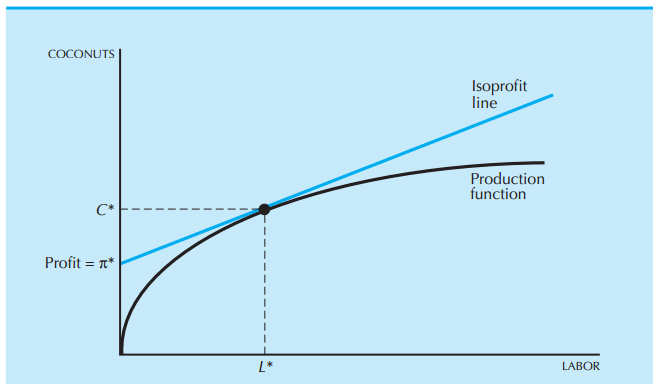
What would happen if the firm depicted in Figure 32.2 decided to pay a higher wage?Figure 32.2: COCONUTS Isoprofit line Production function C* Profit = * L* LABOR
The competitive price of coconuts is $6 per pound and the price of fish is $3 per pound. If society were to give up 1 pound of coconuts, how many more pounds of fish could be produced?
Can some individual be made better off if we are at a Pareto efficient allocation?
If the value of excess demand in 8 out of 10 markets is equal to zero, what must be true about the remaining two markets?
True or false? If we know the contract curve, then we know the outcome of any trading.
Is it possible to have a Pareto efficient allocation where everyone is worse off than they are at an allocation that is not Pareto efficient?
Is it possible to have a Pareto efficient allocation where someone is worse off than he is at an allocation that is not Pareto efficient?
Charley Citrus has to leave town quickly and cannot take his car with him. Since he does not have time to seek another buyer, he must either sell it to his neighbor Harriet Hardnose or simply destroy it. Charley and Harriet both know that the car is worth $500 to Harriet. There is no time for
John decides that he will save $5 this week and $10 next week. But when next week arrives, he decides to save only $8. What is the term used to describe this sort of inconsistent behavior?
What is the probability that a fair coin will come up heads three times in a row when tossed?
In the above example, if the price changes from 4 to 6, what is the change in consumer’s surplus?
You are the human resources director for a medium-size company and are trying to decide how many mutual funds to offer in your employees’ pension plan. Would it be better to offer 10 choices or 50 choices?
Mary plans the entire week’s meals for her family, while Fred shops each day. Which is likely to produce more varied meals? What is this effect called?
Subjects are allowed to buy tickets in a lottery. One group is told that they have a 55 percent chance of winning, the other group is told that they have a 45 percent chance of not winning. Which group is more likely to buy lottery tickets? What is the name for this effect?
Can you explain why taking a monotonic transformation of a utility function doesn’t change the marginal rate of substitution?
The Iron Chicken restaurant is located on a busy interstate highway. Most of its customers are just passing through and will never return to the Iron Chicken. But some are truck drivers whose routes take them past the Iron Chicken on a regular basis. Sybil, the nearsighted waitress at the Iron
The prices are (p1, p2) = (2, 3), and the consumer is currently consuming (x1, x2) = (4, 4). There is a perfect market for the two goods in which they can be bought and sold costlessly. Will the consumer necessarily prefer consuming the bundle (y1, y2) = (3, 5)? Will she necessarily prefer having
A contractor says that he intends to “low-ball the bid and make up for it on change orders.” What does he mean?
If a consumer’s net demands are (5,−3) and her endowment is (4,4), what are her gross demands?
The text claims that row scores 62 percent of the time in equilibrium. Where does this number come from?
Suppose that two goods are perfect complements. If the price of one good changes, what part of the change in demand is due to the substitution effect, and what part is due to the income effect?
If both players make the same choice in a coordination game, all will be well.
Look at the best responses for row and column in the section on mixed strategies. Do these give rise to best response functions?
In this case would the consumers be better off or worse off if the tax with rebate based on original consumption were in effect?
In a two-person Nash equilibrium, each player is making a best response to what? In a dominant strategy equilibrium, each player is making a best response to what?
In the case described in the preceding question, would the government be paying out more or less than it received in tax revenues?
In the case of the gasoline tax, what would happen if the rebate to the consumers were based on their original consumption of gasoline,x,rather than on their final consumption of gasoline, x'?
Suppose that preferences are concave. Is it still the case that the substitution effect is negative?
Suppose a consumer has preferences between two goods that are perfect substitutes. Can you change prices in such a way that the entire demand response is due to the income effect?
In the same framework as the above question, what kind of preferences would leave the consumer just as well-off as he was in the base year, for all price changes?
We saw that the Social Security adjustment for changing prices would typically make recipients at least as well off as they were at the base year. What kind of price changes would leave them just as well-off, no matter what kind of preferences they had?
Suppose that player B rather than player A gets to move first in the sequential game described in this chapter. Draw the extensive form of the new game. What is the equilibrium for this game? Does player B prefer to move first or second?
The prices are (p1, p2) = (2, 3), and the consumer is currently consuming (x1, x2) (4, 4). Now the prices change to (q1, q2) = (2,4). Could the consumer be better off under these new prices?
What is the dominant Nash equilibrium strategy for the repeated prisoner’s dilemma game when both players know that the game will end after one million repetitions? If you were going to run an experiment with human players for such a scenario, would you predict that players would use this
The U.S. currently imports about half of the petroleum that it uses. The rest of its needs are met by domestic production. Could the price of oil rise so much that the U.S. would be made better off?
We know that the single-shot prisoner’s dilemma game results in a dominant Nash equilibrium strategy that is Pareto inefficient. Suppose we allow the two prisoners to retaliate after their respective prison terms. Formally, what aspect of the game would this affect? Could a Pareto efficient
Suppose that by some miracle the number of hours in the day increased from 24 to 30 hours (with luck this would happen shortly before exam week). How would this affect the budget constraint?
Suppose your opponent is not playing her Nash equilibrium strategy. Should you play your Nash equilibrium strategy?
If leisure is an inferior good, what can you say about the slope of the labor supply curve?
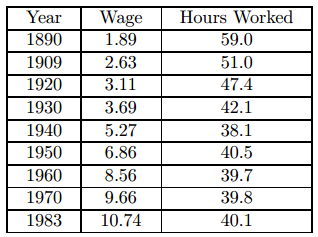
In the United States, real wage rates in manufacturing have risen steadily from 1890 to the present. In the period from 1890 to 1930, the length of the workweek was reduced dramatically. But after 1930, despite the continuing growth of real wage rates, the length of the work week has stayed
Are dominant strategy equilibria always Nash equilibria? Are Nash equilibria always dominant strategy equilibria?
Consider the tit-for-tat strategy in the repeated prisoner’s dilemma. Suppose that one player makes a mistake and defects when he meant to cooperate. If both players continue to play tit for tat after that, what happens?
How much is $1 million to be delivered 20 years in the future worth today if the interest rate is 20 percent?
As the interest rate rises, does the intertemporal budget constraint become steeper or flatter?
Would the assumption that goods are perfect substitutes be valid in a study of intertemporal food purchases?
Nickleby has an income of $2,000 this year, and he expects an income of $1,100 next year. He can borrow and lend money at an interest rate of 10%. Consumption goods cost $1 per unit this year and there is no inflation.(a) What is the present value of Nickleby’s endowment __________ ? What is
In many communities, a restaurant that sells alcoholic beverages is required to have a license. Suppose that the number of licenses is limited and that they may be easily transferred to other restaurant owners. Suppose that the conditions of this industry closely approximate perfect competition. If
What is the present value of $100 one year from now if the interest rate is 10%? What is the present value if the interest rate is 5%?
A consumer, who is initially a lender, remains a lender even after a decline in interest rates. Is this consumer better off or worse off after the change in interest rates? If the consumer becomes a borrower after the change is he better off or worse off?
Suppose asset A can be sold for $11 next period. If assets similar to A are paying a rate of return of 10%, what must be asset A’s current price?
Here are a few problems on present values. In all of the following examples, assume that you can both borrow and lend at annual interest rate of r and that the interest rate will remain the same forever.(a) You would be indifferent between getting $1 now and _______ dollars, one year from now,
Suppose that Carl and Simon sign a marketing agreement. They decide to determine their total output jointly and to each produce the same number of pumpkins. To maximize their joint profits, how many pumpkins should they produce in toto ___________? How much does each one of them produce __________?
A house, which you could rent for $10,000 a year and sell for $110,000 a year from now, can be purchased for $100,000. What is the rate of return on this house?
The payments of certain types of bonds (e.g., municipal bonds) are not taxable. If similar taxable bonds are paying 10% and everyone faces a marginal tax rate of 40%, what rate of return must the nontaxable bonds pay?
Do oligopolies produce an efficient level of output?
Draw a set of reaction curves that result in an unstable equilibrium.
Suppose there are n identical firms in a Cournot equilibrium. Show that the absolute value of the elasticity of the market demand curve must be greater than 1/n.
Can the leader ever get a lower profit in a Stackelberg equilibrium than he would get in the Cournot equilibrium?
Suppose that a scarce resource, facing a constant demand, will be exhausted in 10 years. If an alternative resource will be available at a price of $40 and if the interest rate is 10%, what must the price of the scarce resource be today?
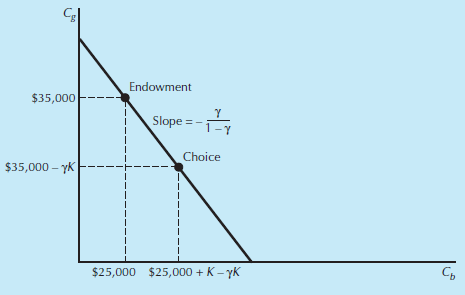
How can one reach the consumption points to the left of the endowment in Figure 12.1? Endowment $35,000 Slope = Choice $35,000 – yK $25,000 $25,000 + K- yK Съ
Consider a cartel in which each firm has identical and constant marginal costs. If the cartel maximizes total industry profits, what does this imply about the division of output between the firms?
Suppose that we have two firms that face a linear demand curve p(Y) = a − bY and have constant marginal costs, c, for each firm. Solve for the Cournot equilibrium output
A risk-averse individual is offered a choice between a gamble that pays $1000 with a probability of 25% and $100 with a probability of 75%, or a payment of $325. Which would he choose?
What if the payment was $320?
It is a slow day at Bunsen Motors, so since he has his calculator warmed up, Clarence Bunsen (whose preferences toward risk were described in the last problem) decides to study his expected utility function more closely.(a) Clarence first thinks about really big gambles. What if he bet his entire
Draw a utility function that exhibits risk-loving behavior for small gambles and risk-averse behavior for larger gambles.
Why might a neighborhood group have a harder time self insuring for flood damage versus fire damage?
If the risk-free rate of return is 6%, and if a risky asset is available with a return of 9% and a standard deviation of 3%, what is the maximum rate of return you can achieve if you are willing to accept a standard deviation of 2%? What percentage of your wealth would have to be invested in the
In our example of the minimum wage, what would happen if the labor market was dominated by a monopsonist and the government set a wage that was above the competitive wage?
We saw that a monopolist never produced where the demand for output was inelastic. Will a monopsonist produce where a factor is inelastically supplied?
What is the price of risk in the above exercise?
In our examination of the upstream and downstream monopolists we derived expressions for the total output produced. What are the appropriate expressions for the equilibrium prices, p and k?
If a stock has a β of 1.5, the return on the market is 10%, and the risk-free rate of return is 5%, what expected rate of return should this stock offer according to the Capital Asset Pricing Model? If the expected value of the stock is $100, what price should the stock be selling for today?
In a congressional district somewhere in the U.S. West a new representative is being elected. The voters all have one-dimensional political views that can be neatly arrayed on a left-right spectrum. We can define the “location” of a citizen’s political views in the following way. The citizen
Disneyland also offers a discount on admissions to residents of Southern California. (You show them your zip code at the gate.) What kind of price discrimination is this? What does this imply about the elasticity of demand for Disney attractions by Southern Californians?
Suppose that the amusement park owner can practice perfect first-degree price discrimination by charging a different price for each ride. Assume that all rides have zero marginal cost and all consumers have the same tastes. Will the monopolist do better charging for rides and setting a zero price
Suppose that a monopolist sells to two groups that have constant elasticity demand curves, with elasticity ε1 and ε2. The marginal cost of production is constant at c. What price is charged to each group?
A good can be produced in a competitive industry at a cost of $10 per unit. There are 100 consumers are each willing to pay $12 each to consume a single unit of the good (additional units have no value to them.) What is the equilibrium price and quantity sold? The government imposes a tax of $1 on
Suppose that the demand curve is given byD(p) = 10 − p. What is the gross benefit from consuming 6 units of the good?
Will a monopoly ever provide a Pareto efficient level of output on its own?
Suppose that a consumer is consuming 10 units of a discrete good and the price increases from $5 per unit to $6. However, after the price change the consumer continues to consume 10 units of the discrete good. What is the loss in the consumer’s surplus from this price change?
Here are some drills on price elasticities. For each demand function, find an expression for the price elasticity of demand. The answer will typically be a function of the price,p. As an example, consider the linear demand curve, D (p) = 30 − 6p. Then dD(p)/dp = −6 and p/q = p/(30−6p), so the
In Gomorrah, New Jersey, there is only one newspaper, the Daily Calumny. The demand for the paper depends on the price and the amount of scandal reported. The demand function is Q = 15S1/2P−3, where Q is the number of issues sold per day, Sis the number of column inches of scandal reported in the
What kinds of economic and technological conditions are conducive to the formation of monopolies?
If the market demand curve is D(p) = 100 − .5p, what is the inverse demand curve?
What problems face a regulatory agency attempting to force a monopolist to charge the perfectly competitive price?
An addict’s demand function for a drug may be very inelastic, but the market demand function might be quite elastic. How can this be?
True or false? Imposing a quantity tax on a monopolist will always cause the market price to increase by the amount of the tax.
If D(p) = 12 − 2p, what price will maximize revenue?
Showing 5400 - 5500
of 5625
First
43
44
45
46
47
48
49
50
51
52
53
54
55
56
57
Step by Step Answers

 Get 50% OFF
Claim Now
Get 50% OFF
Claim Now