New Semester
Started
Get
50% OFF
Study Help!
--h --m --s
Claim Now
Question Answers
Textbooks
Find textbooks, questions and answers
Oops, something went wrong!
Change your search query and then try again
S
Books
FREE
Study Help
Expert Questions
Accounting
General Management
Mathematics
Finance
Organizational Behaviour
Law
Physics
Operating System
Management Leadership
Sociology
Programming
Marketing
Database
Computer Network
Economics
Textbooks Solutions
Accounting
Managerial Accounting
Management Leadership
Cost Accounting
Statistics
Business Law
Corporate Finance
Finance
Economics
Auditing
Tutors
Online Tutors
Find a Tutor
Hire a Tutor
Become a Tutor
AI Tutor
AI Study Planner
NEW
Sell Books
Search
Search
Sign In
Register
study help
business
intermediate microeconomics
Intermediate Microeconomics 8th edition Hal R. Varian - Solutions
Show mathematically that a monopolist always sets its price above marginal cost.
Suppose that the demand curve for a good is given byD(p) = 100/p. What price will maximize revenue?
True or false? In a two good model if one good is an inferior good the other good must be a luxury good.
The government is considering subsidizing the marginal costs of the monopolist described in the question above. What level of subsidy should the government choose if it wants the monopolist to produce the socially optimal amount of output?
What is the effect of a subsidy in a market with a horizontal supply curve? With a vertical supply curve?
Suppose that the demand curve is vertical while the supply curve slopes upward. If a tax is imposed in this market who ends up paying it?
If the demand curve facing the monopolist has a constant elasticity of 2, then what will be the monopolist’s markup on marginal cost?
What is the answer to the above question if the demand curve facing the monopolist has constant elasticity?
A monopolist is operating at an output level where|ε| = 3. The government imposes a quantity tax of $6 per unit of output. If the demand curve facing the monopolist is linear, how much does the price rise?
IfD(p) = 100/p and c(y) = y2, what is the optimal level of output of the monopolist? (Be careful.)
Suppose that all consumers view red pencils and blue pencils as perfect substitutes. Suppose that the supply curve for red pencils is upward sloping. Let the price of red pencils and blue pencils be pr and pb. What would happen if the government put a tax only on red pencils?
The United States imports about half of its petroleum needs. Suppose that the rest of the oil producers are willing to supply as much oil as the United States wants at a constant price of $25 a barrel. What would happen to the price of domestic oil if a tax of $5 a barrel were placed on foreign oil?
Suppose that the supply curve is vertical. What is the deadweight loss of a tax in this market?
The monopolist faces a demand curve given byD(p) = 10p−3. Its cost function is c(y) = 2y. What is its optimal level of output and price?
Consider the tax treatment of borrowing and lending described in the text. How much revenue does this tax system raise if borrowers and lenders are in the same tax bracket?
The monopolist faces a demand curve given by D(p) = 100 - 2p. Its cost function is c(y) = 2y. What is its optimal level of output and price?
Does such a tax system raise a positive or negative amount of revenue when tl < tb?
Consider an auction of antique quilts to collectors. Is this a private-value or a common-value auction?
The market demand curve for heroin is said to be highly inelastic. Heroin supply is also said to be monopolized by the Mafia, which we assume to be interested in maximizing profits. Are these two statements consistent?
Suppose that there are only two bidders with values of $8 and $10 for an item with a bid increment of $1. What should the reservation price be in a profit-maximizing English auction?
Suppose that we have two copies of Intermediate Microeconomics to sell to three (enthusiastic) students. How can we use a sealed-bid auction that will guarantee that the bidders with the two highest values get the books?
Consider the Ucom example in the text. Was the auction design efficient? Did it maximize profits?
A game theorist fills a jar with pennies and auctions it off on the first day of class using an English auction. Is this a private-value or a common-value auction? Do you think the winning bidder usually makes a profit?
Consider the production function f(x1, x2) = x21x22. Does this exhibit constant, increasing, or decreasing returns to scale?
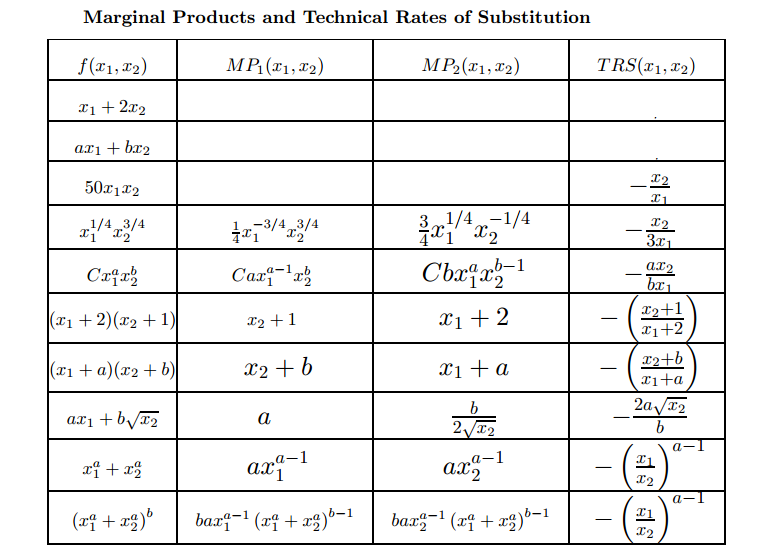
Calculate marginal products and technical rates of substitution for several frequently encountered production functions. Consider the production function f(x1, x2) = 2x1 + √x2. The marginal product of x1 is the derivative of f(x1, x2) with respect to x1, holding x2 fixed. This is just 2. The
Consider the production function f(x1, x2) = 4x11/2x21/3. Does this exhibit constant, increasing, or decreasing returns to scale?
The Cobb-Douglas production function is given by f(x1, x2) = Axa1xb2. It turns out that the type of returns to scale of this function will depend on the magnitude of a+b. Which values of a + b will be associated with the different kinds of returns to scale?
The technical rate of substitution between factors x2 and x1 is −4. If you desire to produce the same amount of output but cut your use of x1 by 3 units, how many more units of x2 will you need?
True or false? If the law of diminishing marginal product did not hold, the world’s food supply could be grown in a flowerpot.
In a production process is it possible to have decreasing marginal product in an input and yet increasing returns to scale?
In the short run, if the price of the fixed factor is increased, what will happen to profits?
If a firm had everywhere increasing returns to scale, what would happen to its profits if prices remained fixed and if it doubled its scale of operation?
A Los Angeles firm uses a single input to produce a recreational commodity according to a production function f(x) = 4√x, where x is the number of units of input. The commodity sells for$100 per unit. The input costs $50 per unit.(a) Write down a function that states the firm’s profit as a
If a firm had decreasing returns to scale at all levels of output and it divided up into two equal-size smaller firms, what would happen to its overall profits?
Brother Jed takes heathens and reforms them into righteous individuals. There are two inputs needed in this process: heathens (who are widely available) and preaching. The production function has the following form: rp = min{h, p}, where rp is the number of righteous persons produced,his the number
A gardener exclaims: “For only $1 in seeds I’ve grown over $20 in produce!” Besides the fact that most of the produce is in the form of zucchini, what other observations would a cynical economist make about this situation?
Is maximizing a firm’s profits always identical to maximizing the firm’s stock market value?
If pMP1 > w1, then should the firm increase or decrease the amount of factor 1 in order to increase profits?
Suppose a firm is maximizing profits in the short run with variable factor x1 and fixed factor x2. If the price of x2 goes down, what happens to the firm’s use of x1? What happens to the firm’s level of profits?
A profit-maximizing competitive firm that is making positive profits in long-run equilibrium (may/may not) have a technology with constant returns to scale.
A firm has two variable factors and a production function, f(x1, x2) = x11/2x21/4 . The price of its output is 4. Factor 1 receives a wage of w1 and factor 2 receives a wage of w2.(a) Write an equation that says that the value of the marginal product of factor 1 is equal to the wage of factor
A New York City cab operator appears to be making positive profits in the long run after carefully accounting for the operating and labor costs. Does this violate the competitive model? Why or why not?
The model of entry presented in this chapter implies that the more firms in a given industry, the (steeper, flatter) is the long-run industry supply curve.
According to the model presented in this chapter, what determines the amount of entry or exit a given industry experiences?
True or false? In long-run industry equilibrium no firm will be losing money.
True or false? Convenience stores near the campus have high prices because they have to pay high rents.
In the short run the demand for cigarettes is totally inelastic. In the long run, suppose that it is perfectly elastic. What is the impact of a cigarette tax on the price that consumers pay in the short run and in the long run?
If S1(p) = p − 10 and S2(p) = p − 15, then at what price does the industry supply curve have a kink in it?
In a perfectly competitive market what is the relationship between the market price and the cost of production for all firms in the industry?
Is it ever better for a perfectly competitive firm to produce output even though it is losing money? If so, when?
If average variable costs exceed the market price, what level of output should the firm produce? What if there are no fixed costs?
In a purely competitive market a firm’s marginal revenue is always equal to what? A profit-maximizing firm in such a market will operate at what level of output?
What is the major assumption that characterizes a purely competitive market?
Classify each of the following as either technological or market constraints: the price of inputs, the number of other firms in the market, the quantity of output produced, and the ability to produce more given the current input levels.
If the long-run cost function is c(y) = y2 + 1, what is the long-run supply curve of the firm?
A firm has a supply function given by S(p) = 4p. Its fixed costs are 100. If the price changes from 10 to 20, what is the change in its profits?
When prices are (p1, p2) = (1,2) a consumer demands (x1,x2) = (1,2), and when prices are (q1, q2) = (2,1) the consumer demands (y1, y2) = (2,1). Is this behavior consistent with the model of maximizing behavior?
In the preceding exercise, which bundle is preferred by the consumer, the x-bundle or the y-bundle?
If the supply curve is given by S(p) = 100 + 20p, what is the formula for the inverse supply curve?
A firm has a cost function given by c(y) = 10y2 + 1000. At what output is average cost minimized?
When prices are (p1, p2) = (2, 1) a consumer demands (x1, x2) = (1, 2), and when prices are (q1, q2) = (1, 2) the consumer demands (y1, y2) = (2,1). Is this behavior consistent with the model of maximizing behavior?
A firm has a cost function given by c(y) = 10y2 + 1000. What is its supply curve?
A competitive firm has a production function of the form Y = 2L + 5K. If w = $2 and r = $3, what will be the minimum cost of producing 10 units of output?
True or false? In the long run a firm always operates at the mini-mum level of average costs for the optimally sized plant to produce a given amount of output.
Casper consumes cocoa and cheese. He has an income of $16. Cocoa is sold in an unusual way. There is only one supplier and the more cocoa one buys from him, the higher the price one has to pay per unit. In fact, x units of cocoa will cost Casper a total of x2 dollars. Cheese is sold in the usual
A firm produces identical outputs at two different plants. If the marginal cost at the first plant exceeds the marginal cost at the second plant, how can the firm reduce costs and maintain the same level of output?
True or false? If the demand function is x1 = −p1, then the inverse demand function is x = −1/p1.
What is the form of the inverse demand function for good 1 in the case of perfect complements?
Which of the following are true? (1) Average fixed costs never increase with output.(2) Average total costs are always greater than or equal to average variable costs. (3) Average cost can never rise while marginal costs are declining.
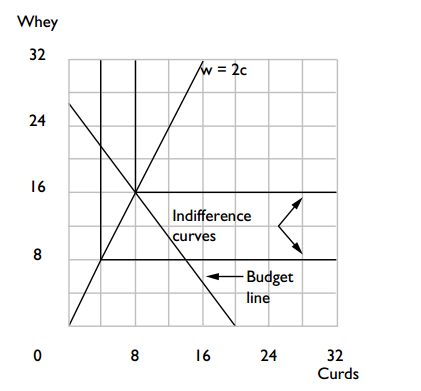
Miss Muffet always likes to have things “just so.” In fact the only way she will consume her curds and whey is in the ratio of 2 units of whey per unit of curds. She has an income of $20. Whey costs $.75 per unit. Curds cost $1 per unit. On the graph below, draw Miss Muffet’s budget line, and
The income offer curve is to the Engel curve as the price offer curve is to. . .?
If a firm uses n inputs (n > 2), what inequality does the theory of revealed cost minimization imply about changes in factor prices (Δwi) and the changes in factor demands (Δxi) for a given level of output?
For what kind of preferences will the consumer be just as well-off facing a quantity tax as an income tax?
If a consumer has a utility function u(x1, x2) = x1x24, what fraction of her income will she spend on good 2?
Suppose that you have highly no nconvex preferences for ice cream and olives, like those given in the text, and that you face prices p1, p2 and have m dollars to spend. List the choices for the optimal consumption bundles.
Suppose that a consumer always consumes 2 spoons of sugar with each cup of coffee. If the price of sugar is p1 per spoonful and the price of coffee is p2 per cup and the consumer has m dollars to spend on coffee and sugar, how much will he or she want to purchase?
Suppose that indifference curves are described by straight lines with a slope of−b. Given arbitrary prices and money income p1, p2, and m, what will the consumer’s optimal choices look like?
The price of paper used by a cost-minimizing firm increases. The firm responds to this price change by changing its demand for certain inputs, but it keeps its output constant. What happens to the firm’s use of paper?
We begin again with Charlie of the apples and bananas. Recall that Charlie’s utility function is U(xA, xB) = xAxB. Suppose that the price of apples is 1, the price of bananas is 2, and Charlie’s income is 40(a) On the graph below, use blue ink to draw Charlie’s budget line. (Use a ruler and
Suppose that a cost-minimizing firm uses two inputs that are perfect substitutes. If the two inputs are priced the same, what do the conditional factor demands look like for the inputs?
If a firm is producing where MP1/w1 > MP2/w2, what can it do to reduce costs but maintain the same output?
Consider the utility function u(x1, x2) = √x1x2. What kind of preferences does it represent? Is the function v(x1, x2) = x21x2 a monotonic transformation of u(x1, x2)? Is the function w(x1, x2) = x21x22 a monotonic transformation of u(x1, x2)?
What kind of preferences are represented by a utility function of the form u(x1, x2) = x1 + √x2? Is the utility function v(x1, x2) = x21 + 2x1√x2 + x2 a monotonic transformation of u(x1, x2)?
Prove that a profit-maximizing firm will always minimize costs.
We claimed in the text that if preferences were monotonic, then a diagonal line through the origin would intersect each indifference curve exactly once. Can you prove this rigorously? (what would happen if it intersected some indifference curve twice?)
Which of the following are monotonic transformations? (1) u = 2v − 13; (2) u = −1/v2; (3) u = 1/v2; (4) u = lnv; (5) u = −e−v; (6) u = v2; (7) u = v2 for v > 0;(8) u = v2 for v < 0.
The text said that raising a number to an odd power was a monotonic transformation. What about raising a number to an even power? Is this a monotonic transformation? Consider the case f(u) = u2.
If the consumer is consuming exactly two goods, and she is always spending all of her money, can both of them be inferior goods?
Show that perfect substitutes are an example of homothetic preferences.
Show that Cobb-Douglas preferences are homothetic preferences.
Our thoughts return to Ambrose and his nuts and berries. Ambrose’s utility function is U(x1, x2) = 4√x1 + x2, where x1 is his consumption of nuts and x2 is his consumption of berries.(a) Let us find his demand function for nuts. The slope of Ambrose’s indifference curve at (x1, x2) is
Are hamburgers and buns complements or substitutes?
If the preferences are concave will the consumer ever consume both of the goods together?
Donald Fribble is a stamp collector. The only things other than stamps that Fribble consumes are Hostess Twinkies. It turns out that Fribble’s preferences are represented by the utility function u(s, t) = s + lnt wheres is the number of stamps he collects and t is the number of Twinkies he
What kind of preferences are represented by a utility function of the form u(x1, x2) = √(x1 + x2)? What about the utility function v(x1, x2) = 13x1 + 13x2?
Think of some other goods for which your preferences might be concave.
Joan likes chocolate cake and ice cream, but after 10 slices of cake, she gets tired of cake, and eating more cake makes her less happy. Joan always prefers more ice cream to less. Joan’s parents require her to eat everything put on her plate. In the axes below, use blue ink to draw a set of
Murphy was consuming 100 units of X and 50 units of Y. The price of X rose from 2 to 3. The price of Y remained at 4. How much would Murphy’s income have to rise so that he can still exactly afford 100 units of X and 50 units of Y?
If good 1 is a “neutral,” what is its marginal rate of substitution for good 2?
What is your marginal rate of substitution of $1 bills for $5 bills?
Showing 5500 - 5600
of 5625
First
43
44
45
46
47
48
49
50
51
52
53
54
55
56
57
Step by Step Answers

 Get 50% OFF
Claim Now
Get 50% OFF
Claim Now