New Semester
Started
Get
50% OFF
Study Help!
--h --m --s
Claim Now
Question Answers
Textbooks
Find textbooks, questions and answers
Oops, something went wrong!
Change your search query and then try again
S
Books
FREE
Study Help
Expert Questions
Accounting
General Management
Mathematics
Finance
Organizational Behaviour
Law
Physics
Operating System
Management Leadership
Sociology
Programming
Marketing
Database
Computer Network
Economics
Textbooks Solutions
Accounting
Managerial Accounting
Management Leadership
Cost Accounting
Statistics
Business Law
Corporate Finance
Finance
Economics
Auditing
Tutors
Online Tutors
Find a Tutor
Hire a Tutor
Become a Tutor
AI Tutor
AI Study Planner
NEW
Sell Books
Search
Search
Sign In
Register
study help
business
microeconomics
Microeconomics In Context 4th Edition Neva Goodwin , Jonathan M. Harris, Julie A. Nelson , Pratistha Joshi Rajkarnikar , Brian Roach , Mariano Torras - Solutions
3. Describe three types of barriers to entry, giving examples of ea.
2. What market conditions aracterize pure monopoly?
1. List and briefly define the three idealized market structure types in addition to perfect competition.
2. Suppose that a seller in a duopoly needs to decide whether to spend a lot or a lile on advertising.Assume that the consumers are already reasonably well informed about the product, so the purpose of a lot of advertising is to draw customers away from the rival. How could the payoffs from this
1. What would it mean for two sellers to act noncooperatively, in a “prisoner’s dilemma” manner? What real world examples can you think of? What, instead, would it mean for these two sellers to collude?Whi of the two outcomes is more common in the real world? Why?
2. Do you think that the amount of variety in the goods and services that you are offered as a consumer is excessive? Just about right? Too limited? Do some forms of nonprice competition have consequences for long-term well-being and sustainability?
1. ink of a somewhat differentiated good or service that you can buy locally in any number of different places—for example, a gallon of gasoline or a cup of coffee. Do you observe differences in prices? What differences might lead to these variations in prices? (Or is the assumption of perfect
2. Does it sometimes make sense to have just one company in arge of providing something? Some users of electronics are frustrated by the la of compatibility among their gadgets and between their gadgets and those of their friends. Might it be beer to have just one company manufacture
1. On many campuses, the official college or university bookstores used to have monopoly power in selling textbooks to students. What would you call this kind of monopoly? Is it still the case at your institution? Why or why not?
5. Mat ea item in Column A with an example in Column B. Column A a. Condition for perfect competition b. Business perspective on competition c. Consumer perspective on competition d. Type of profit equal to zero at the perfectly competitive market equilibrium e. Type of profit that is still
4. Suppose that a perfectly competitive firm manufactures gizmos with the following cost structure(including all opportunity costs):a. Calculate the marginal cost sedule for this firm in a table, and then graph the marginal cost curve.b. If the price of gizmos on the market is $175 ea, how
3. Continuing with the bicycle firm described in the previous problem, consider how the firm’s decision making will ange as the price of bicycles anges. For ea of the following, make a new table.a. If the price per bicycle were $100, what would the profit-maximizing level of output
2. Suppose a firm that manufactures bicycles has the following cost structurea. How mu does this firm have in fixed costs?b. Using graph paper or a computer program, graph the total cost curve for this firm. Suppose that bicycles sell for $200 ea, and the firm is a price taker. Create a table
1. The Top Notch Grill’s marginal costs of producing take-out meals are described below.a. Assuming that the Grill has fixed costs of $7, what is its total cost at ea level of production? (Add a column to the table.)b. Assume that meals sell for $10 ea and the Grill is a perfectly
19. Under what conditions are perfectly competitive markets economically efficient?
18. What are network externalities?
17. What is path dependence?
16. Would a seller be expected to operate at a loss in the long run?
15. How should a producer decide whether to operate at a loss or shut down production in the short run?
14. What is a sunk cost? How does it influence production decisions, according to economic theory?
13. What is the perfectly competitive market equilibrium?
12. What is the graphical relationship between market conditions and an individual perfectly competitive seller’s production decision?
11. What happens to economic profits in a perfectly competitive market in the long run?
10. What is the rule for profit maximization using marginal analysis?
9. How do we determine the profit-maximizing level of production using analysis of total costs and total revenues?
8. What is the difference between accounting and economic profits?
7. What does the demand curve for a perfectly competitive seller look like?
6. What are the four conditions of perfect competition?
5. What is the economists’ perspective on competition and market power?
4. What is the citizen perspective on competition and market power?
3. What is the consumer perspective on competition and market power?
2. What is the business perspective on competition and market power?
1. What is market power?
2. An interesting book published in the 1990s, titled No Contest, argues for the restructuring of society to promote cooperation rather than competition. e book contends that the pervasive existence of competition in society actually destroys social capital, creates anxiety, and lowers
1. Try to think of other examples, not mentioned in the text, of path dependence or network externalities. Do you think that these situations are inefficient? Do you think that government policy should play a role in eliminating path dependence and network externalities?
2. Suppose that you are halfway through a particular course and you decide that you are not learning anything useful and the rest of the course is not worth your effort (obviously we are not describing this course!). It is too late to drop the course and sign up for another one. Is this an example
1. “Why would anyone run a business if he couldn’t make a profit?” is is a frequent response to economists’ idea that all firms in a particular market make zero “economic profits.”a. In your own words, explain what economists mean by zero economic profits and why an entrepreneur
2. How useful do you think the model of a perfectly competitive market presented in this section is in explaining economic behavior in the real world? What do you think is the most relevant insight from the model?
1. Explain, in your words without a table or a graph, why economic profits fall to zero in a perfectly competitive market.
2. In addition to the markets mentioned in this section, can you think of any other markets that meet the assumptions of perfect competition?
1. Suppose that you are thinking of starting your own business. Would you want to start a business in a perfectly competitive market? What do you think are the advantages and disadvantages of selling in a perfectly competitive market?
2. Can you think of an example of an economic actor that is not a business firm but that has “market power” in the sense defined in the text?
1. To whi of the four views of market power and competition do you most relate? Do you think all four views are valid, or is one particular view more worthwhile or “correct” than the others?
6. Suppose that in her first hour of work, Lynn can hand-knit four pairs of miens. During her second consecutive hour, Lynn can hand-knit three additional pairs of miens, and during her third hour of work, as a consequence of fatigue, she can hand-knit only one additional pair. Suppose that
5. Ramona designs Web pages and needs the jolt that she gets from the caffeine in cola drinks to keep herself awake and alert. e total product curve for the relationship between her cola consumption per day and the number of pages that she can design in one day is given in the following
4. Suppose that you have started a small business offering computer consulting. Mat ea concept in Column A with an example in Column B. Column A a. Fixed input b. Variable input c. Opportunity cost d. External cost e. Increasing returns f. Diminishing returns Column B 1. The more months that
3. e production relationship between the number of apters that Tiffany studies in her history book(the variable input) and the number of points that she will earn on a history exam (the output) is as follows:a. Using graph paper or a computer spreadsheet or presentation program, graph the
2. A nonprofit organization dedicated to health care wants to open a new hospital near a residential neighborhood. A group of residents of that neighborhood protests this decision, claiming that traffic caused by the hospital will increase noise and auto emissions. e hospital rejects the idea of
1. Kai’s records show that last month he spent $5,000 on rent for his shop, $3,000 on materials, $3,000 on wages and benefits for an employee, and $500 in interest on the loan that he used to start his business.He quit a job that had paid him $3,000 a month to devote himself full-time to this
18. How do we define the efficient scale of production?
17. Sket a long-run average cost curve illustrating economies of scale, constant returns to scale, and diseconomies of scale.
16. What are economies of scale?
15. What are average costs?
14. Sket a total cost curve illustrating fixed cost and decreasing, constant, and increasing marginal costs.
13. Distinguish among fixed cost, variable cost, total cost, and marginal cost.
12. Sket a total product curve illustrating increasing returns, constant returns, and diminishing returns.
11. Describe the meaning of diminishing returns, constant returns, and increasing marginal returns, and explain how ea might come about.
10. What is marginal product?
9. How can we express a production function graphically?
8. What distinguishes the short run from the long run?
7. What is a limiting factor in production?
6. What is a production function?
5. What is the difference between private costs and external costs?
4. Name all the categories that comprise economic costs.
3. What is the difference between accounting costs and economic costs?
2. What is the difference between fixed costs and variable costs?
1. What is the “triple boom line” and how does it differ from the traditional economic assumption about the goal of production?
2. Diminishing marginal returns is a valuable concept, not only in economics, but in many other areas of life: an obvious example (whi we saw in Chapter 8, on consumption) was the diminishing pleasure received by eating successive units of the same food. Suggest two other areas in life that
1. Explain in your own words why a firm’s marginal cost curve may initially decline, but then increase, as the quantity of output increases.
2. What fairness issues arise when producers are required to take social or environmental costs into account in their decision making? For example, suppose that Gail is just barely making ends meet, using proceeds from the sale of her farm’s output to feed and house her family—while the
1. In order to take this course, you have paid tuition and bought this book. What other costs should be added in to calculate the economic costs of this course to you personally? (Hint: What is your best alternative to spending time taking this course? How are you financing your education?) Also,
2. ink about the processes involved in producing this textbook. Describe these processes, considering all the steps of production from an economic perspective. What inputs were required? What waste was generated?
1. What distinguishes the economic activity of production from the activity of resource management?Of consumption? Of distribution?
4. Mat ea concept in Column A with an example in Column B. Column A a. Equity finance b. Social capital c. A renewable natural resource d. Fixed manufactured capital e. Human capital f. Inventories g. A nonrenewable natural resource Column B 1. Fish in the ocean 2. Starting a business by
3. A forest originally has 10,000 trees. Suppose that the forest naturally replenishes itself by 10 percent per year. at is, at the end of one year, if nothing else happened, it would have 10,000 + (0.10 ×10,000) = 11,000 trees. (is assumption is not biologically accurate, but it keeps the
2. Consider the case of a new computer antivirus soware paage.a. In a paragraph, briefly describe the capital stos that provided the resource base for its creation.b. Whi of the four economic activities is antivirus soware designed to address? (Note: It may address more than one
1. Whi of the following are flows? Whi are stos? If a flow, whi of the five major kind(s) of capital does it increase or decrease? If a sto, what kind of capital is it?a. e fish in a lakeb. e output of a factory during a yearc. e income that you receive in a monthd. e
8. What are the two main types of financial capital?
7. What is social capital?
6. What are the two main types of human capital?
5. What are the two main types of manufactured capital?
4. What are the two main types of natural capital?
3. What are the five major types of capital?
2. How can we distinguish a sto from a flow using a diagram?
1. What distinguishes a sto from a flow?
2. Explain how the concept of opportunity cost can influence the way in whi you think about your use of financial capital.
1. Financial capital is important not only in the business and government spheres but also in the core sphere. What major purases do families oen finance through taking out a loan (i.e., debt finance)?
2. Economic issues are oen discussed in terms of money and prices, but it is difficult to quantify social capital in su terms. Can you think of topics, both within the category of social capital and in other categories, that have economic importance but are hard to express in terms of money?
1. In what ways is it useful to think of knowledge, trust, motivation, and the like as though they were similar to productive mainery? What might be some drawbas of this way of thinking?
2. One obvious way that you are increasing your human capital by going to sool is that you can be more productive in a career. In what other ways do you believe that you are increasing your human capital through your education?
1. In what ways is it useful to think of human bodies and brains as if they were like productive mainery? What might be some drawbas of this way of thinking?
2. In the early twentieth century, photos or drawings of big factories with tall stas beling smoke were popularly used to represent the productivity of the contemporary economy. What images come to mind now, when you think of economic activity in the early twenty-first century?
1. Come up with one new example of ea of the following: fixed manufactured capital, inventory, investment, depreciation.
2. Do you think that your country is becoming more or less sustainable? What specific policies would you recommend to ensure a more sustainable future?
1. Give three examples of renewable natural capital. Give three examples of nonrenewable natural capital. (Do not duplicate examples given in the text.)
2. ink of a common activity that you enjoy. For example, perhaps you like to get together with friends and listen to music while making popcorn in the microwave. List the stos of natural, manufactured, human, financial, and social capital on whi you draw when engaging in this activity.
1. Linda thinks that a ri person is someone who earns a lot of money. Meng thinks that a ri person is someone who has a big house and owns lots of stos and bonds. How would the distinction between stos and flows lend clarity to their discussion?
4. Mat ea concept in Column A with an example in Column B. Column A a. A private good b. A free rider c. Price discrimination d. A public good e. An artificially scarce good f. Individual transferable quotas g. The discount rate Column B 1. A policy solution to the tragedy of the commons 2.
3. e marginal benefits of wildlife habitat preservation in a society with just two individuals, Katya and Miguel, are given in the table below.a. Draw a graph showing the social marginal benefits of wildlife preservation.b. Suppose that wildlife preservation costs $40 per acre. How many acres of
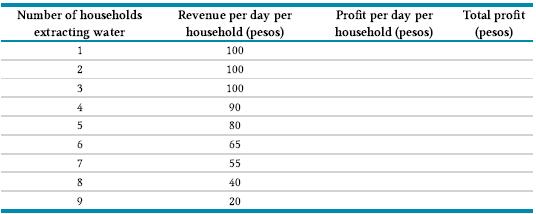
2. An underground aquifer in a developing country is available to all farms in a small community.Assume that it costs 50 pesos per day to operate a pump that can extract groundwater from the aquifer. e value that a farm can obtain by using or selling the water depends on how many farms extract
Showing 1800 - 1900
of 7548
First
12
13
14
15
16
17
18
19
20
21
22
23
24
25
26
Last
Step by Step Answers

 Get 50% OFF
Claim Now
Get 50% OFF
Claim Now