New Semester
Started
Get
50% OFF
Study Help!
--h --m --s
Claim Now
Question Answers
Textbooks
Find textbooks, questions and answers
Oops, something went wrong!
Change your search query and then try again
S
Books
FREE
Study Help
Expert Questions
Accounting
General Management
Mathematics
Finance
Organizational Behaviour
Law
Physics
Operating System
Management Leadership
Sociology
Programming
Marketing
Database
Computer Network
Economics
Textbooks Solutions
Accounting
Managerial Accounting
Management Leadership
Cost Accounting
Statistics
Business Law
Corporate Finance
Finance
Economics
Auditing
Tutors
Online Tutors
Find a Tutor
Hire a Tutor
Become a Tutor
AI Tutor
AI Study Planner
NEW
Sell Books
Search
Search
Sign In
Register
study help
business
personal financial planning
Fundamentals Of Financial Planning 3rd Edition Michael A Dalton, Joseph Gillice - Solutions
The American Opportunity Tax Credit provides a tax credit of up to $2,000 (2012) per family for an unlimited number of years of qualified education expenses.a. Trueb. False
Up to $2,500 of student loan interest is income tax deductible (before adjusted gross income) for loans used for quali- fied education expenses.a. Trueb. False
Identify the income tax consequences associated with education funding from IRA distributions.
Distinguish between scholarships and fellowships.
Distinguish between the American Opportunity Tax Credit and the Life- time Learning Credit.
Identify the criteria required to receive the student loan interest deduction and the deduction for tuition and fees.
Qualified education expenses, including tuition, fees, and room and board can be paid with Series EE and I bonds allowing the interest earned to be excludable from taxable income.a. Trueb. False
Coverdell account contributions must be in cash, no future contributions are allowed once the beneficiary turns 18, and final distributions must be made within 30 days of the beneficiary attain- ing age 30.a. Trueb. False
The American Recovery and Reinvest- ment Act of 2009 expanded qualified education expenses to include books, supplies, and equipment.a. Trueb. False
Distributions for qualified education expenses from a College Savings Plan are federal and state income tax-free when the student is attending any eligi- ble educational institution.a. Trueb. False
Prepaid tuition plans allow a parent to purchase college credits today for avail- ability when the child attends college.a. Trueb. False
Identify the criteria required for an indi- vidual to receive the income exclusion benefit associated with U.S Govern- ment Series EE and I bonds.
Identify the levels and types of educa- tion expenses that can be funded using distributions from a Coverdell educa- tion savings account.
Distinguish between a prepaid tuition plan and a college savings plan.
The interest rate on consolidated loans is based on a weighted average of the interest rates of the loans being consoli- dated.a. Trueb. False
Parent PLUS Loans are for parents to borrow to help pay for a dependent's undergraduate education expenses and are based on financial need.a. Trueb. False
The four repayment plans for a Stafford Loan include the standard repayment, extended repayment, graduated repay- ment, and income based repayment.a. Trueb. False
Students must pay the interest expense as incurred for an unsubsidized Stafford Loan.a. Trueb. False
Identify the consequences of defaulting on student loans.
Define the repayment terms available for government funded loans.
Identify the types of student and parent loans available for college funding.
The FSEOG is awarded to students graduating from a rigorous secondary school program of study.a. Trueb. False
The TEACH grant provides up to $4,000 per year and is converted to a Federal Direct Unsubsidized Stafford Loan if teaching requirements are not met.a. Trueb. False
Pell Grants are based on an academic year, the family's EFC, cost of atten- dance, and whether the student is attending full-time or part-time.a. Trueb. False
Identify different types of education grants and the qualifications required for each grant.
Define a college grant?
The financial aid process is initiated by completing the Student Aid Report.a. Trueb. False
The Expected Family Contribution (EFC) for financial aid can be calculated using the simplified method, which does not consider the family's assets.a. Trueb. False
Identify the financial aid process and describe the three formulas used to determine the EFC.
Identify all costs associated with fund- ing a college education and the impact of tuition inflation on education fund- ing.
Explain the relevant licensing, reporting and compliance issues that may affect the business model used by a financial planning firm.*
Demonstrate a comprehensive understanding of investment advisor regulation and financial planning aspects of the ERISA.*
Differentiate between investment knowledge that is proper to use in the evaluation of securities and insider information.*
Identify the regulatory authorities that impact elements of the financial planning process. (Examples include regulation of accountancy, legal practice, real estate law, insurance regulation, etc.)*
Undetstand asset allocation and investment analysis for an individual client.
Describe investment companies, unit investment trusts exchange traded funds, open-ended investment companies, closed-ended investment companies, and various types of mutual funds.
Identify the risks to investing in bonds, real estate and derivatives.
Identify the methods of valuing an equity security.
Describe alternative investments such as equity, debt, real estate, and derivatives.
Define portfolio statistics including correlation coefficient, the coefficient of determination, and portfolio risk for a two asset portfolio.
Describe modern portfolio theory, the efficient frontier, and the capital asset pricing model.
Be able to identify the risk-adjusted performance measures including Sharpe, Traynor, and Jensen.
Be able to calculate standard deviation and semi-variance and describe beta.
Identify the various types of investment risk and how they.are measured.
Describe and calculate the various measurements of investment returns.
Describe the components of an investment policy statement.
Describe the investment planning process.
Understand historical returns and the relationship between equities, bonds, and treasuries.
Understand risk tolerance and how it is measured.
CJ is 40 and wants to retire in 25 years. He expects to live until age 95.He currently has a salary of $100,000 and expects that he will need about 75% of that if he were retired. He thinks he needs to accumulate $1 million (future dollars) and he will be fine. He currently has $150,000 saved for
George has been in academia his entire career and wholeheartedly believes that education is the key to success. He has two daughters, Cindy and Susie. Cindy is a lingerie and swimsuit model who also believes in education, as well as fashion. Cindy has two children, Red and Mauve, who are ages 4 and
Lanie is a single mom who has 3 children, ages 1, 5 and 9.While she is struggling a bit, she would like to pay for half of their education at a public college. The annual cost of education is currently $20,000 and has been increasing at 6% and is expected to continue. Her portfolio that was
Using previous information, how much do the parents have to save annually at year end through the education of the youngest child at pay all college costs?a. $17,418.31.b. $29,381.57.c. $29,921.11.d. $30,526.52.
What is the present value of the cost of college education for 4 children ages 1, 3, 5, and 7.The current cost of college is $25,000. The children will begin college at age 18 and be in college for 4 years. Education inflation is expected to be 6% and the parents portfolio rate of return is 8%.a.
What is the present value of all college education for 5 children ages 0, 1, 1, 3, and 5 if the cost of education is today’s dollars is $17,000 per year, education inflation is 5%, and the parents expected portfolio rate of return is 8.5%? The children are expected to be in college 4 years and
Kim and Nick are planning to save for their daughter Chloe’s college education. Chloe was born today and will attend college for 4 years, starting at age 18.Tuition currently costs $15,000 per year and tuition inflation is expected to be 6%. They believe they can earn 9% on their investments. How
Peter wants to save some money for his daughter Gwen's education. Tuition costs$12,500 per year in today’s dollars. His daughter was born today and will go to school starting at age 18.She will go to school for 4 years. Peter can earn 11% on his investments and tuition inflation is 7%. How much
Reba has a son, Chad (age 18), a freshman at Tulane University with tuition of $30,000 per year. Reba’s AGI is $45,000. She takes a withdrawal of $20,000 from her 529 Savings Plan and pays the remaining $10,000 in tuition out of her checking account.Which of the following would you recommend?a.
What is one of the primary differences between a Coverdell ESA and a 529 Savings Plan?a. A Coverdell can be used for private elementary, middle, or high school.b. A Coverdell does not have a phase-out limit for participation.c. A 529 Savings Plan has a phaseout limit for participation.d. A
Roshan is a freshman at Florida State University where his tuition is $4,000. Shante, his older sister, is a graduate student at Expensive University, where tuition is $25,000.What is the maximum tax credit Roshan and Shante’s parents can take?a. $2,000.c. $3,650,c. $3,800.d. $4,500.
The following type of financial aid is awarded to students with a low EFC, and funds are guaranteed to be available if a student qualifies:a. Pell Grant.b. Plus Loan.c. Work Study.d. Stafford Loan.
Which of the following types of aid are not need based?a. Pell Grant.b. Plus Loan.c. Perkins Loan.d. Subsidized Stafford Loan.
All of the following statements are true, except:a. The American Opportunity Tax Credit is only available for the first four years of post-secondary education.b. The Lifetime Learning Credit is only available for the first two years of post-secondary education.c. The American Opportunity Tax Credit
Tan and Chia are contemplating making a contribution to their grandchildren’s education fund. They are both retired, have a significant amount of discretionary income and are concerned about estate transfer taxes. Which of the following education planning techniques would you recommend?a. Prepaid
Mitch and Jennifer have AGI of $125,000 and have not planned for their children’s education. Their children are ages 17 and 18 and the parents anticipate paying $20,000 per year, per child for education expenses. Which of the following is the most appropriate recommendation to pay for the
Which of the following statements concerning educational tax credits and savings opportunities is correct?a. The Lifetime Learning Credit is equal to 10% of qualified educational expenses up to a certain limit.b. The American Opportunity Tax Credit (AOTC) is only available for the first 3 years of
List and briefly describe the four primary methods for calculating the amount needed for education funding.
Discuss the features of a nontaxable employer provided education assistance program.
Explain the disadvantages to using UGMA / UTMA accounts to fund a college education.
Discuss the differences between scholarships and fellowships.
Discuss tax deductions / tax credits restrictions as pertains to education expenses.
Distinguish between the American Opportunity Tax Credit and the Lifetime Learning Credit.
Discuss a tax advantage to the student loan interest deduction.
Define a Coverdell Education Savings Account (ESA).
Define the two types of qualified tuition plans.
What are the consequences for defaulting on student loans?
What are the two types of PLUS Loans?
List the repayment options for a Stafford Loan.
Distinguish the difference between an educational grant and an educational loan.
List and define the three methods used to determine the Expected Family Contribution(EFC) for financial aid.
Compare, contrast and recommend appropriate education savings vehicles given tax implications, risk tolerance, investment alternatives, and funds needed.*
Recommend the appropriate use of funding sources including loans, scholarships, grants, and fellowships in funding education.*
Calculate the funds needed to meet the education goals for members of the client's family.*
Calculate education funding needs using the uneven cash flow method, the traditional method, the account balance method, and the hybrid approach.
Describe the American opportunity tax credit and the lifetime learning credit.
Describe the tax implications for education expenses and student loan interest deduction.
Articulate the role of U.S. government savings bonds in higher education funding.
Describe qualified tuition plans including prepaid tuition plans and college savings plans.
Identify the various types of financial aid including grants and loans.
Describe financial aid and the expected family contribution amount.
Describe historical tuition inflation rate and determine its impact on education cost.
Describe current higher education costs and know the cost besides tuition.
You have been working with your client, Brenda, for 3 months now. You developed a mission statement, goals, and objectives with the client. You are now constructing a plan that is led by the client’s mission statement. Which approach to financial planning are you utilizing?a. Life Cycle
During your work with your new client, Brian, you created several visual representations of how your client spends his money. Which approach to financial planning are you utilizing?a. Pie Chart Approach.b. Cash Flow Approach.c. Financial Statement Approach.d. Metrics Approach.
Rachel is 30 years old and single. She is healthy, has no children or pets. Rachel works as a human resources coordinator and earns approximately $40,000 per year. Due to her outstanding student loans, she has a fairly low net worth. She rents an apartment but does own her car outright. All of the
David, 33 years of age, and Kristina, 34 years of age, are married with no children.They anticipate having children within the next five years. David and Kristina both have a graduate degree and student loans. They both have good jobs and earn about$110,000 together. They have mortgage debt of
Paul and Lucy Martin are married and both are 65 years of age. Paul is retired from the military and receives a military pension as well as disability benefits from an injury he sustained during the Vietnam War. Lucy is a retired nurse. Lucy is fairly healthy, although she is borderline diabetic.
Curtis is 60 years old. He plans to retire in a five years. He has amassed a net worth of$1,500,000 which he expects will sustain him during retirement. He is divorced with two adult independent children. Which phase of the life cycle is Curtis most likely in?a. Conservation Phase.b. Asset
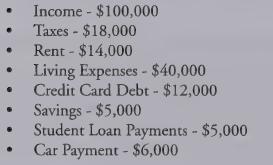
Your new client, Kerri, age 35, came into your office today. She provided you with the following information for the year:After receiving this information you created a pie chart to visually depict where her income was spent. Utilizing targeted benchmarks which of the following statements are you
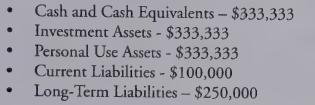
Darrin and Kathi are both 44 years of age. They came to your office today and provided the following financial information:After meeting with them you created a pie chart to visually depict their current balance sheet. Utilizing targeted benchmarks, which of the following statements are you most
Showing 3700 - 3800
of 5381
First
31
32
33
34
35
36
37
38
39
40
41
42
43
44
45
Last
Step by Step Answers

 Get 50% OFF
Claim Now
Get 50% OFF
Claim Now