New Semester
Started
Get
50% OFF
Study Help!
--h --m --s
Claim Now
Question Answers
Textbooks
Find textbooks, questions and answers
Oops, something went wrong!
Change your search query and then try again
S
Books
FREE
Study Help
Expert Questions
Accounting
General Management
Mathematics
Finance
Organizational Behaviour
Law
Physics
Operating System
Management Leadership
Sociology
Programming
Marketing
Database
Computer Network
Economics
Textbooks Solutions
Accounting
Managerial Accounting
Management Leadership
Cost Accounting
Statistics
Business Law
Corporate Finance
Finance
Economics
Auditing
Tutors
Online Tutors
Find a Tutor
Hire a Tutor
Become a Tutor
AI Tutor
AI Study Planner
NEW
Sell Books
Search
Search
Sign In
Register
study help
business
personal financial planning
Fundamentals Of Financial Planning 3rd Edition Michael A Dalton, Joseph Gillice - Solutions
Which of the following is true?a. Debt ratios measure the ability to meet short-term obligations.Liquidity ratios indicate how well a client manages debt.c. Ratios for financial security determine the progress that he client is making toward achieving short-term financial security goals.d.
Ronnie visited your office today. He is 55 years of age. He is divorced and has two children. One child recently graduated from college and the other child is just entering into high school. Ronnie earns $350,000 a year as the operator of a very specific type of medical equipment. There are only
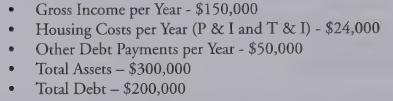
Natalie and Brian visited your office today. They are both in their early 30s and have two children with one on the way. During your meeting they provide you with the following financial information:Which of the following is true?a. The housing ratio 1 (basic) is within the normal range.b. The
Utilizing investment assets to gross pay benchmarks, which of the following individuals is likely on target with their investment assets?a. Jimmy age 55 earns $150,000 a year and has investéd assets of $900,000.b. Sarah age 35 earns $30,000 a year and has invested assets of $15,000.c. Terry age 45
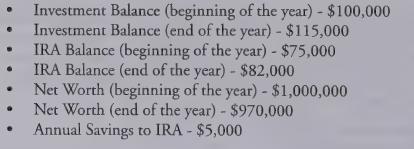
You currently manage Cody’s investment portfolio. He provided you with the following information for the beginning and the end of the year:Which of the following statements is correct?a. The return on investments ratio is within the normal range.b. The return on the IRA ratio is 10%.c. The return
Utilizing the three panel approach, which of the following would be evaluated in Panela. Risk Management?b. Education Fund.c. Retirement Fund.d. Life Insurance.
Robin met with you recently to make some changes to her insurance needs. You have made several recommendations. Which of these recommendations will have a positive cash flow impact from an insurance perspective?a. Cancel an insurance policy.b. Change the name of the beneficiary on her life
CJ bought the following assets this year. Which of these purchases would be considered “bad debt?”a. He purchased a slightly used car from a pre-owned dealer. The car has an estimated useful life of 3 years. He put down 5% and financed the balance over 72 months.b. He bought a new living room
Adriana is an analyst at High Tech Hedge (HTH) where she earns $150,000 base salary with a bonus of $50,000. HTH sponsors a profit-sharing plan with a 401(k) feature and provides for a dollar for dollar match up to 3% of compensation. Her account had$10,000 of capital gains this year and dividends
Candice earns $85,000 working as an administrative assistant in a public company based in New York. The company provides a matching contribution in the 401(k) plan of 50% up to a maximum contribution of 4% of compensation. Her 401(k) plan account had $20,000 in it at the beginning of the year. She
Janice earns $85,000 working as an administrative assistant in a public company based in New York. The company provides a matching contribution in the 401(k) plan of 50% up to a maximum contribution of 4% of compensation. Her 401(k) plan account had $20,000 in it at the beginning of the year. She
Mark and Caren are 36 years old and plan on retiring at age 62 and expect to live until age 95.They currently earn $250,000 and expect to need $200,000 in retirement.They also expect that Social Security will provide $40,000 of benefits in today’s dollars at age 62.They are saving $15,000 each in
Jack and Jill are 41 years old and plan on retiring at age 65 and expect to live until age 95.They currently earn $200,000 and expect to need $100,000 in retirement. They also expect that Social Security will provide $24,000 of benefits in today’s dollars at age 65.They are saving $20,000 each in
Prepare a balance sheet and its components.
Differentiate cash and cash equivalents, from investment assets, and personal use assets.
Clarify the difference between short and long-term liabilities.
Determine the methodology for evaluating various assets.
Determine net worth.
List sources of information to properly value assets and liabilities.
Prepare a statement of income and expenses.
Define a statement of net worth and a statement of cash flows.
Construct statements of financial positions and cash-flow statements as applied to clients consistent with sound personal accounting standards.*
Evaluate client financial statements using ratios and growth rates and by comparing them to relevant norms.*
Describe the fundamental differences between corporate/business accounting practices and those appropriate for personal financial statements.*
Describe the value of forecasting and importance of budgeting.
Describe the purpose of financial statement analysis including vertical and horizontal analysis.
Prepare a ratio analysis including liquidity ratios, debt ratios, ratios for financial security goals, and performance ratios.
List appropriate benchmarks for each of the ratios calculated.
Discuss the limitations of financial statement analysis including, estimating fair market value, inflation, hard to value assets, illiquidity of certain assets, and uncertain returns.
Discuss sensitivity analysis and Monte Carlo analysis.
List and define the major categories on the assets side of the balance sheet.
List and define the liabilities categories on the balance sheet.
Discuss how assets and liability values are reflected on the balance sheet.
Define and discuss the net worth category listed on the balance sheet.
List documents that a client can provide to the financial planner as sources of information to properly prepare financial statements.
List and define the common forms of property ownership.
Discuss the difference between income and savings contribution categories listed on the income statement.
Define the expense category of the income statement and give examples of variable and fixed expenses.
Define net discretionary cash flow.
What is the purpose of the statement of net worth?
List what should be reflected on forecasted financial statements.
What is a financial planner’s purpose in creating a client’s budget?
Define and explain the purpose of financial statement analysis.
Define vertical and horizontal analysis as comparative financial statement tools.
Define ratio analysis.
Define the emergency fund ratio.
Define housing ratios 1 and 2.
Define the savings rate.
Define performance ratios.
Your client, Tom, asked you to prepare his financial statements. He believes that his wife is the root of all of their financial problems because of her spending habits. His wife, on the other hand, believes that most of their money goes to pay routine expenses like, house, auto, etc. Which
Your client, Meg, asked you several questions about her balance sheet. She doesn’t understand how the assets, liabilities and net worth are related. Which of the following statements is true?a. Net Worth = Assets + Liabilities.b. Assets = Net Worth — Liabilities.c. Liabilities = Assets — Net
Craig’s financial planner is preparing his balance sheet. Which of the following would not generally be considered “cash and cash equivalents?”a. Cash value in life insurance.b. Money market account.c. Certificate of deposit with a 6 month maturity.d. Checking account.
Craig’s financial planner is preparing his balance sheet. Which of the following would be considered an “investment asset?”a. A certificate of deposit with a maturity of exactly 1 year.b. The unvested portion of a pension plan.c. A vacation home.d. An education fund.
Which of the following statements concerning the valuation of assets on the balance sheet is correct?a. Since a financial planner has access to all of the client financials, a privately held small business is easier to value than a publicly traded company.b. Assets should be valued on the balance
Which of the following would not generally be considered a short-term liability?a. An automobile loan.b. Credit card bills.c. Medical expenses.d. Unpaid taxes.
Jay purchased a new home for $100,000. He put $20,000 down and financed the$80,000 balance. What is the impact of this transaction on his net worth?a. His net worth increases.b. His net worth decreases.c. His net worth remains the same.d. The net worth will decrease with each mortgage payment made.
Nathan and Evan (two brothers) are joint property owners. Nathan owns 60% and Evan owns 40%. How is this property owned?a. Sole Ownership / Fee Simple.b. Tenants in Common.c. Joint Tenancy.d. Tenancy by the Entirety.
Which of the following property ownership regimes has a right of survivorship feature?a. Sole Ownership / Fee Simple.b. Tenancy in Common.c. Tenancy by the Entirety.d. Community Property.
Which of the following statements concerning income and expenses listed on the Income Statement is correct?a. Charitable contributions are always a discretionary expense.b. Reinvested dividends is an example of income.c. Entertainment expenses is an examples of a fixed expense.d. Social Security
A financial planner is currently preparing a client’s cash flow statement. Which of the following would the planner classify as a financing activity?a. The purchase of a new residence.b. Avcontribution to a retirement account.c. A cash inheritance.d. Paying a credit card debt.
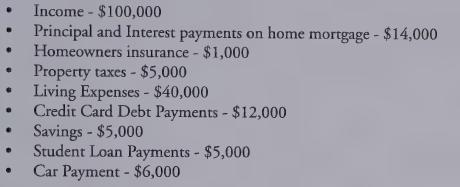
A client, Marie, age 35, came into a financial planner’s office today. She provides the planner with the following information for the upcoming year:When considering the targeted benchmarks, which of the following statements is the planner most likely to make during the next meeting?a. Both the
Roger and Julie are married. Roger is a police officer and earns $50,000 per year. He contributes 10% of his salary to his retirement plan. His employer also makes a 5%match contribution. Julie stays at home with their children and contributes $5,000 to an IRA. What is their total saving rate?a.
While meeting with your new client about his retirement needs you have made several assumptions regarding income growth, savings rate, inflation rates, and investment returns. You engage in the process of changing some of the key assumptions to determine the overall impact of those changes on the
Describe and explain the personal risk management process and its seven steps.
Determine and select the best risk management alternatives using the risk management decision chart for individuals.
Explain the causes and contributors to losses including perils and hazards.
Identify the requisites for an insurable risk.
Describe insurance as a legal contract including the elements of a valid contract and the unique characteristics of an insurance contract.
Describe insurance on the person including life insurance.
Identify the three methods used to determine the amount of life insurance needed and be able to calculate each.Describe the types of life insurance including term and permanent.
Describe a health insurance plan and differentiate between an indemnity plans and managed care options.
Describe the risk associated with long-term disability and the coverages that longterm disability plans provide.
Describe long-term care insurance, activities of daily living, and important features associated with long-term care insurance policies.
Describe homeowners and renters insurance policies.
Describe automobile insurance policies and which factors affect premium rates.
Describe personal liability umbrella insurance policies and the risks that they mitigate against.
Describe how insurers use risk pooling to pay for losses incurred by policyholders.*
Explain the factors that affect policyholder premiums and recommend strategies for reducing household insurance costs.*
Identify and measure liability, automobile, homeowner's, flood, earthquake, health, disability, long-term care, and life risks.*
Identify the process and purpose of financial statement analysis.
Identify the common principal and sup- plementary financial statements used as part of the financial planning process.
Identify the main categories listed on a balance sheet.
Distinguish between cash and cash equivalents, investment assets, and per- sonal use assets.
Distinguish between short-term liabili- ties and long-term liabilities.
The client's balance sheet represents all income earned less expenses incurred for the period being covered.a. Trueb. False
Cash and cash equivalents are assets that are highly liquid and are either cash or can be converted to cash within the next 12 months.a. Trueb. False
Investment assets are those assets that help to maintain the client's lifestyle.a. Trueb. False
Long-term liabilities represent client financial obligations that are owed to creditors beyond the next 12 months.a. Trueb. False
Distinguish between property owned fee simple and tenancy in common.
Distinguish between property owned JTWROS and tenancy by the entirety versus community property.
Identify the importance of footnotes to financial statements.
Identify the main categories listed on the statement of income and expenses.
Identify examples of recurring income.
Identify examples of savings contribu- tions.
Distinguish between variable and fixed expenses.
Determine how net discretionary cash flow is calculated.
Main categories listed on the income statement include income, savings con- tributions, assets, and expenses.a. Trueb. False
Net discretionary cash flow represents the amount of cash flow still available after all savings, expenses, and taxes have been paid.a. Trueb. False
The client's income statement can be prepared from the client's W-2 informa- tion, credit card statement, and other billing statement information.a. Trueb. False
Recognize the purpose of a statement of net worth.
Showing 3800 - 3900
of 5381
First
32
33
34
35
36
37
38
39
40
41
42
43
44
45
46
Last
Step by Step Answers

 Get 50% OFF
Claim Now
Get 50% OFF
Claim Now