New Semester
Started
Get
50% OFF
Study Help!
--h --m --s
Claim Now
Question Answers
Textbooks
Find textbooks, questions and answers
Oops, something went wrong!
Change your search query and then try again
S
Books
FREE
Study Help
Expert Questions
Accounting
General Management
Mathematics
Finance
Organizational Behaviour
Law
Physics
Operating System
Management Leadership
Sociology
Programming
Marketing
Database
Computer Network
Economics
Textbooks Solutions
Accounting
Managerial Accounting
Management Leadership
Cost Accounting
Statistics
Business Law
Corporate Finance
Finance
Economics
Auditing
Tutors
Online Tutors
Find a Tutor
Hire a Tutor
Become a Tutor
AI Tutor
AI Study Planner
NEW
Sell Books
Search
Search
Sign In
Register
study help
business
principles corporate finance
Global Corporate Finance Text And Cases 6th Edition Suk H. Kim, Seung H. Kim - Solutions
What is the major difference in mergers and corporate governance between the USA and Japan?
Discuss some reasons for the recent decline of foreign direct investment in developing markets.
Explain why mergers are often more difficult to evaluate than the establishment of new production facilities.
What are the factors affecting international acquisitions?
GM is analyzing the acquisition of a British company for \($1\) million. The British company has expected cash flows of \($90,000\) per year. The synergistic benefits of the merger will add \($10,000\) per year to cash flow. Finally, the British company has a \($50,000\) tax loss carryforward that
The cost of debt (10 percent), the cost of equity (15 percent), the tax rate (50 percent), and annual earnings after taxes ($10,000) are the same for a domestic firm and a multinational company. The firm’s target debt ratio (optimum capital structure) is 20 percent, while the company’s target
Assume that the worldwide profit breakdown for Ford is 85 percent in the USA, 5 percent in Japan, and 10 percent in the rest of the world. On the other hand, the worldwide profit breakdown for Toyota is 40 percent in Japan, 35 percent in the USA, and 25 percent in the rest of the world. Earnings
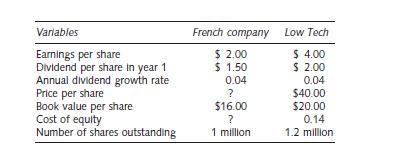
We will assume that IBM is analyzing the acquisition of a privately held French company.The French company is more similar to Low Tech (LT) than any other company whose stock is traded in the public market. To establish a fair market price for the French company, IBM has compiled the statistics
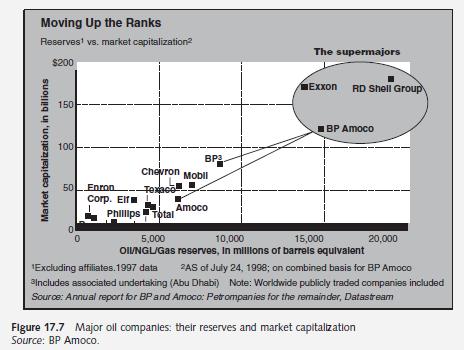
On December 31, 1998, British Petroleum PLC (BP) bought Amoco Corp., the fourth-largest US oil company, for \($52.41\) billion in stock, then the largest industrial merger in history. This deal surpassed the \($40.5\) billion dollar purchase of Chrysler Corp. by Germany’s Daimler-Benz AG,
List the 11 phases of the entire decision-making process for a foreign investment project.Should the decision-maker consider these stages one at a time or analyze several of them simultaneously?
Given the added political and economic risks that exist overseas, are multinational companies more or less risky than purely domestic companies in the same industry? Are purely domestic companies insulated from effects of international events?
Why should subsidiary projects be analyzed from the parent’s perspective?
List additional factors that deserve consideration in a foreign project analysis but are not relevant for a purely domestic project.
Why are transfer pricing policies important in cash flow analysis of a foreign investment project?
Most academicians argue that net present value is better than internal rate of return.However, most practitioners say that internal rate of return is better than net present value. Present the arguments for each side.
List popular risk-assessment and risk-adjustment techniques. What is the major difference between these two types of risk analysis?
Have researchers established a significant relationship between capital budgeting practices and the market price of the common stock? What is the major reason for their finding on this topic?
Discuss the nature of political risk.
List two major forms of political risk.
List some forms of defensive measures against political risks before investment.
Why did the number of expropriations decline in the 1980s?
Assume that the American Electrical Corporation (AEC) is considering the establishment of a freezer manufacturing plant in Spain. AEC wants to invest a total of 10,000 Spanish pesetas in the proposed plant. The Pts10,000 will be financed with only common stock, all of which will be owned by the
The Wayne Company currently exports 500 calculators per month to Jordan at a price of\($60\) and the variable cost per calculator is \($40.\) In May 1990, the company is approached by the government of Jordan with a request that it establish a small manufacturing plant in Jordan. After a careful
Problems 1 and 2 highlight the complexities involved in foreign investment decisions. Identify these problems.Refer from in problem 1.Assume that the American Electrical Corporation (AEC) is considering the establishment of a freezer manufacturing plant in Spain. AEC wants to invest a total of
A project with an initial cost of $15,000 is expected to produce net cash flows of $8,000,$9,000, $10,000, and $11,000 for each of the next 4 years. The firm’s cost of capital is 12 percent, but the financial manager perceives the risk of this particular project to be much higher than 12 percent.
A project has a cost of $1,400. Its net cash flows are expected to be $900, $1,000, and$1,400 for each of the next 3 years. The respective certainty equivalent coefficients are estimated to be 0.75, 0.55, and 0.35. With a 6 percent risk-free discount rate, determine the certain net present value.
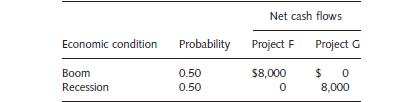
Project F has a cost of $3,000 and project G has a cost of $4,000. These two projects are mutually independent and their possible net cash flows are given below. Assume that the cost of capital is 10 percent.(a) Determine the net present value of projects F and G.(b) Determine the standard
The literature on foreign capital investment theory reveals that business firms should use discounted cash flow techniques for ranking and selecting overseas projects because these methods recognize the time value of money and employ cash flows of a project over its life span. Table 18.6
What are the economic constraints of current asset management for multinational companies?Why do multinational companies face such constraints?
Why are various arbitrage opportunities available to multinational companies in their working capital management?
What techniques are available to a company with operating subsidiaries in many countries to optimize on cash and marketable securities?
What are the advantages of leads and lags over direct loans?
List the two major functions of international cash management.
Why is the problem of floats in international operations more serious than in domestic operations?
Explain the three types of portfolio management available to international cash managers.
Standard advice given to exporters is to invoice in their own currency or a strong currency.Critically analyze this recommendation.
Under what conditions should companies maintain overstocked inventory accounts?
Explain the importance of current asset management.
Why is the literature on international working capital management rather limited?
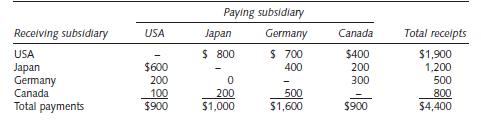
Assume that the netting center uses a matrix of payables and receivables to determine the net payer or creditor position of each subsidiary at the date of clearing. The following table shows an example of such a matrix:(a) Prepare a multilateral netting schedule, such as table 15.3.(b) Determine
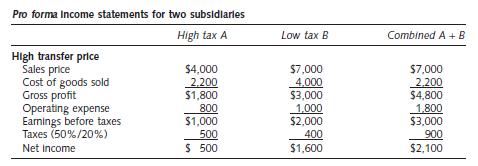
A multinational company has a subsidiary in country A that produces auto parts and sells them to another subsidiary in country B, where the production process is completed.Country A has a tax rate of 50 percent, while country B has a tax rate of 20 percent. The income statements of these two
The foreign subsidiary of a US parent company earns \($1,000\) before any taxes. The parent company wants to receive \($400\) before US taxes. The local tax rate is 50 percent and the US tax rate is 30 percent. The US company is considering two options: option X: \($400\) in cash dividends and
A US company has \($10,000\) in cash available for 45 days. It can earn 1 percent on a 45-day investment in the USA. Alternatively, if it converts the dollars to Swiss francs, it can earn 1.5 percent on a Swiss deposit for 45 days. The spot rate of the Swiss franc is \($0.50\).The spot rate 45 days
Navistar International Corp. was formed in a reorganization of International Harvester in 1987, the farm and equipment manufacturer. Today, Navistar manufactures and markets mediumand heavy-duty trucks, school buses, and mid-range diesel engines in North America and selected export markets. The
Discuss both unsystematic risk and systematic risk within an international context.
Many studies have found that intercountry correlations tend to be substantially lower than intracountry correlations. Explain some reasons for this fact. What significance does this finding have for international investment?
Describe the efficient portfolio, the efficient frontier, and the optimum portfolio.
Is the standard deviation of bond returns in any particular market typically higher or lower than the standard deviation of stock returns in that market? Does this information make any difference for investors?
Is it possible for an international portfolio to reduce the domestic systematic risk?
Describe American depository receipts and global depository receipts.
What are the different methods of international diversification?
The expected rate of return on the market portfolio is 20 percent. The riskless rate of interest is 10 percent. The beta of a multinational company is 0.5. What is the cost of this company’s common equity?
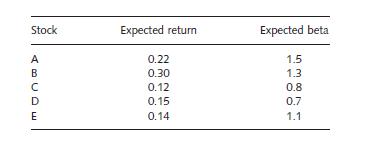
At present, the riskless rate of return is 10 percent and the expected rate of return on the market portfolio is 15 percent. The expected returns for five stocks are listed below, together with their expected betas.On the basis of these expectations, which stocks are overvalued? Which stocks are
The prices of a common stock were \($40,\) \($50,\) and \($60\) for the last 3 days. Compute the average stock price and the standard deviation.
A portfolio manager wishes to invest a total of $10 million in US and British portfolios. The expected returns are 15 percent on the US portfolio and 12 percent on the British portfolio.The standard deviations are 10 percent for the US portfolio and 9 percent for the British portfolio. Their
An international portfolio with a total investment of \($10\) million consists of a US portfolio and a foreign portfolio. The US portfolio requires an investment of \($5\) million and the foreign portfolio requires an investment of \($5\) million. The standard deviations are 4 percent for the US
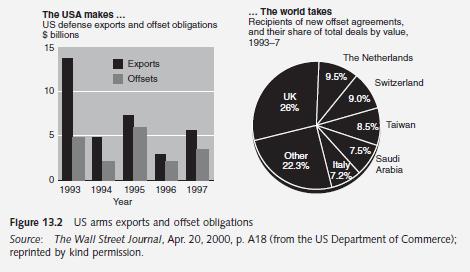
In December 2002, Lockheed Martin, with its F-16 Fighting Falcon, beat French and Anglo-Swedish rivals to land a \($3.6\) billion deal from Poland, which is Eastern Europe’s largest defense order. Do you know how Lockheed won the contract? The answer is simple. Lockheed’s offset offer was
What are the major types of funds supplied by the parent company to its subsidiaries?
Why are parent loans to foreign subsidiaries more popular than equity contributions?
What are the internal sources of funds provided by operations? What is the role of internal funds?
List the types of loans that local banks provide to foreign subsidiaries for nontrade international operations. Are these local credits used to finance current assets or fixed assets?Why are these loans sometimes called self-liquidating loans?
What are the similarities and differences between Edge Act and agreement corporations and international banking facilities?
What are the advantages and disadvantages of joint ventures?
George Cassidy has suggested several guidelines that can be used to determine an optimum financing mix of debt and equity for overseas projects. Explain these guidelines.
What is the role of development banks? How can multinational companies benefit from these development banks?
Describe the role of the European Bank for Reconstruction and Development (EBRD).
There are three alternatives to increase a net working capital of $10,000:(a) Forgo cash discounts with the terms of 2/10, net 40.(b) Borrow the money at 7 percent from the bank. This bank loan requires a minimum compensating balance of 20 percent and interest on the loan is paid at maturity.(c)
A $10,000 bank loan has a coupon rate of 10 percent.(a) Calculate the effective interest cost if the loan is on a discount basis.(b) Calculate the effective interest cost if the loan requires a minimum compensating balance of 20 percent and it is on a discount basis.(c) Calculate the effective
A US company borrows Japanese yen for 1 year at 5 percent. During the year, the yen appreciates from $0.010 to $0.012 against the US dollar.(a) Determine the percentage appreciation of the yen.(b) Compute the effective interest rate of the loan in dollar terms.
A Mexican subsidiary of a US company needs a peso (local) loan. The Mexican loan rate is 15 percent per year, while a foreign loan rate is 7 percent per year. By how much must the foreign currency appreciate to make the cost of the foreign loan equal to that of the local loan?
A US company is considering three financing plans for 1 year: a dollar loan at 6 percent;a Swiss franc loan at 3 percent; and a euro loan at 4 percent. The company has forecasted that the franc will appreciate by 2 percent for the next year and that the euro will appreciate by 3 percent for the
IBM is the world’s largest computer company, with 300,000 employees and annual sales of\($90\) billion. IBM is the company that had almost collapsed in the early 1990s. However, its comeback has been remarkable because of the strategic alliances and other actions taken by the company. IBM earned
The USA and Japan have long been like an old married couple. The USA likes to borrow and spend, while Japan likes to save and invest. And for almost 20 years, this odd relationship has endured, but not without strain. By the late 1990s, however, a new question came to the forefront: whether the
Discuss the types of functions that international banks perform.
Discuss the types of foreign banking offices.
What were the two major causes of the Asian financial crisis of 1997–8?
What are major differences between domestic and foreign loans?
What were the major causes of the international debt crisis of the 1980s?
Explain the various steps taken by debtor countries and international banks to solve the international debt problems of the 1980s.
What is syndicated lending? Why do banks sometimes prefer this form of lending?
What is country risk? How can we assess country risk?
Describe policy responses to solve the Asian crisis.
In addition to the two debt ratios described in this chapter, the World Bank recommends the use of four additional debt ratios in assessing a country’s risk: the ratio of total external debt to GNP, the ratio of total external debt to exports, the debt-service ratio (accrued debt service to
In 1998, Poland had $157 billion in GNP, a debt-to-GNP ratio of 0.32, a debt-to-export ratio of 1.12, a debt-service ratio of 0.11, and an interest-service ratio of 0.06. Calculate Poland’s total external debt, exports, accrued debt service, and accrued interest service for 1998.
Assume that the total external debt of 138 developing countries increased from \($609\) billion in 1980 to \($2,332\) billion in 2001.(a) Determine the annual compound growth rate of the total external debt for these 138 developing countries from 1980 to 2001.(b) Determine the annual simple growth
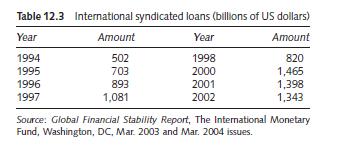
Table 12.3 shows that syndicated loans increased from \($502\) billion in 1994 to \($1,398\) billion in 2001.(a) Determine the annual compound growth rate of the syndicated loans from 1994 to 2001.(b) Determine the annual simple growth rate of the syndicated loans from 1994 to 2001. Table 12.3
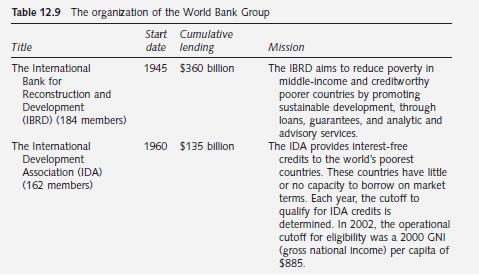
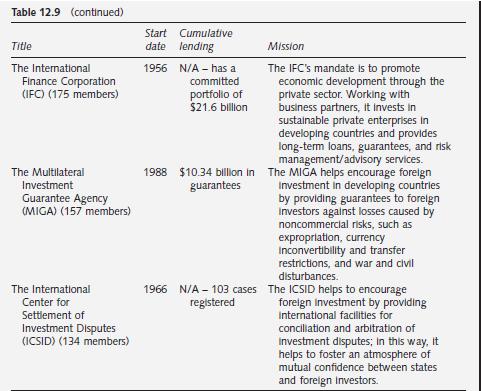
Representatives of 44 governments founded the World Bank on July 1, 1944, during their conference at Bretton Woods, New Hampshire. The Bank is a sister institution to the International Monetary Fund (IMF), but has a separate, distinct objective. The Bank was largely the brainchild of the economist
What are the objectives of documentation in international trade?
What are bills of lading and how do they facilitate trade financing?
The basic problem in assessing different forms of export financing is how to distribute risks between the exporter and the importer. Explain the following export financing documents in this respect:(a) the time draft;(b) the sight draft;(c) the confirmed, revocable letter of credit;(d) the
In addition to the draft, the bill of lading, and the letter of credit necessary in foreign trade, other documents must generally accompany the draft as specified in the letter of credit. Such other documents include commercial invoices, insurance documents, and consular invoices. Briefly describe
What are bankers’ acceptances? What are the advantages of bankers’ acceptances as an export-financing instrument?
What are the major elements of the 1982 Export Trading Company Act? What are the major objectives of the Act?
What is the role of a factor in foreign trade? How can a factor aid an exporter?
What is forfaiting? List the parties involved in a forfaiting transaction.
What is the role of the Export–Import Bank?
For each of the following import purchases, (a) calculate the annual cost of the cash discount forgone, and (b) determine the date and amount paid if the discount is taken.Assume that the invoice date is March 10 and that there are 30 days in a month.(i) $500, 2/10, net 30;(ii) $3,500, 4/20, net
An exporter has a $20,000 bankers’ acceptance for 6 months, the acceptance fee is 2 percent per year, and the discount rate on this bankers’ acceptance is 10 percent per year.(a) How much cash will the exporter receive if it holds the bankers’ acceptance until maturity?(b) How much cash will
An exporter has recently factored its accounts receivable at a rate of $10,000 a month.The factor advances 80 percent of the receivables, charges 1 percent interest per month on advances, and charges a 3 percent factoring fee. The interest and fee are paid on a discount basis.(a) Determine the net
A US company negotiated a forward contract to buy 100,000 British pounds in 90 days.The company was supposed to use the £100,000 to buy British supplies. The 90-day forward rate was \($1.40\) per pound. On the day the pounds were delivered in accordance with the forward contract, the spot rate of
Showing 4600 - 4700
of 5445
First
40
41
42
43
44
45
46
47
48
49
50
51
52
53
54
Last
Step by Step Answers

 Get 50% OFF
Claim Now
Get 50% OFF
Claim Now