New Semester
Started
Get
50% OFF
Study Help!
--h --m --s
Claim Now
Question Answers
Textbooks
Find textbooks, questions and answers
Oops, something went wrong!
Change your search query and then try again
S
Books
FREE
Study Help
Expert Questions
Accounting
General Management
Mathematics
Finance
Organizational Behaviour
Law
Physics
Operating System
Management Leadership
Sociology
Programming
Marketing
Database
Computer Network
Economics
Textbooks Solutions
Accounting
Managerial Accounting
Management Leadership
Cost Accounting
Statistics
Business Law
Corporate Finance
Finance
Economics
Auditing
Tutors
Online Tutors
Find a Tutor
Hire a Tutor
Become a Tutor
AI Tutor
AI Study Planner
NEW
Sell Books
Search
Search
Sign In
Register
study help
business
research methods for business students
Research Methods For Business Students 6th Edition Mark Saunders - Solutions
state your own epistemological, ontological and axiological positions.
understand the importance of your decisions when designing research and the need to achieve methodological coherence throughout your own research design;
explain the differences between quantitative, qualitative and multiple methods research designs and choose between these to design your own research;
explain the differences between exploratory, descriptive and explanatory research to understand the nature of your own research;
identify the main research strategies and choose from amongst these to achieve coherence throughout your research design;
consider the implications of the time frames required for different research designs when designing your own research;
consider some of the main ethical issues implied by your research design;
identify some of the issues that affect the quality of research and consider these when designing your own research;
consider the constraint of your role as researcher when designing your own research.
Why are the radical paradigms relevant in business and management research given that most managers would say that the purpose of organisational investigation is to develop recommendations for action to solve problems without radical change?
Visit an online database or your university library and obtain a copy of a research-based refereed journal article that you think will be of use to an assignment you are currently working on. Read this article carefully. What research philosophy do you think the author has adopted? Use Section
to help you develop a clear justification for your answer.
Think about the last assignment you undertook for your course. In undertaking this assignment, were you predominantly inductive or deductive? Discuss your thoughts with a friend who also undertook this assignment.
Agree with a friend to watch the same television documentary.a To what extent is the documentary inductive, deductive or abductive in its use of data?b Have the documentary makers adopted a positivist, realist, interpretivist or pragmatist philosophy?c Do not forget to make notes regarding your
Why is it important for Zoe to be aware of her values and beliefs as an individual researcher?
Why should Zoe have been concerned about her previous relationship with the Theatre she was researching?
How might Zoe’s interpretivist philosophy and approach impact on how she frames her research question?
Probably the most realistic hypothesis here would be ‘consumers of “Snackers” chocolate bars did not notice the difference between the current bar and its reduced weight successor’.Doubtless that is what the Snackers’ manufacturer would want confirmed!
Although you can see and touch a manager, you are only seeing and touching another human being. The point is that the role of the manager is a socially constructed concept.What a manager is will differ between different national and organisational cultures and will differ over time. Indeed, the
The researcher working in the radical humanist or structuralist paradigms may argue that it is predictable that managers would say that the purpose of organisational investigation is to develop recommendations for action to solve problems without radical change because radical change may involve
The question implies an either/or choice. But as you work through this chapter and, in particular, the next on deciding your research design, you will see that life is rarely so clear-cut! Perhaps the main factor that would cause you to review the appropriateness of the deductive approach would be
You wish to study the reasons why car owners join manufacturer-sponsored owners’clubs. You choose to use a qualitative methodology and narrative inquiry research strategy involving unstructured ‘discussions’ with some members of these owners’ clubs. You are asked by a small group of
You have started conducting interviews in a university with the hourly paid staff (such as porters, gardeners and caterers). The research objective is to establish the extent to which those employees feel a sense of ‘belonging’ to the university. You have negotiated access to your interviewees
You are about to embark on a year-long study of customer service training for sales assistants in two supermarket companies. The purpose of the research is to compare the way in which the training develops and its effectiveness. What measures would you need to take in the research design stage to
Agree with a friend to watch the same television documentary.a Does the documentary use a quantitative, qualitative or multiple methods research methodology?b To what extent is the nature of the documentary exploratory, descriptive or explanatory, or a combination of these?c What other observations
Use the search facilities of an online database to search for scholarly (peer-reviewed) articles which have used firstly a case study, secondly action research and thirdly experiment research strategy in an area of interest to you. Download a copy of each article. What reasons do the articles’
Visit the online gateway to the European Union website ( http://europa.eu/ ) and click on the link in your own language. Discuss with a friend how you might you use the data available via links from this web page in archival research. In particular, you should concentrate on the research questions
What are the possible research strategies from which Sangita might chose to address her research question?
What are the likely advantages and drawbacks of using each possible strategy?
Which research strategy would you use to conduct this research project and why?
Look at Jessica’s research question; is the research ‘purpose’ exploratory, descriptive or explanatory?
Is Jessica’s research design (based only on semi-structured interviews in one case study organisation) likely to be sufficient to answer the research question?
What are the possible issues associated with Jessica interviewing her university friends?
Additional case studies relating to material covered in this chapter are available via the book’s companion website: www.pearsoned.co.uk/saunders .They are:• The effectiveness of computer-based training at Falcon Insurance Company.• Embedded quality at Zarlink Semi-conductor.• The
You would need to stress here that your principal interest would be in getting a deep understanding of why car owners join manufacturer-sponsored owners’ clubs. You would discover why the owners joined these clubs and what they thought of them. In other words, you would establish what you set out
The questionnaire will undoubtedly perform a valuable function in obtaining a comprehensive amount of data that can be compared easily, say, by district or age and gender.However, you would add to the understanding of the problem if you observed managers’meetings. Who does most of the talking?
There is no easy answer to this question! You have to remember that access to organisations to research is an act of goodwill on the part of managers, and they do like to retain a certain amount of control. Selecting whom researchers may interview is a classic way of managers doing this. If this is
This would be a longitudinal study. Therefore, the potential of some of the threats to internal validity explained in Section
is greater simply because they have longer to develop.You would need to make sure that most of these threats were controlled as much as possible.For example, you would need to:• account for the possibility of a major event during the period of the research (widescale redundancies, which might
Get ahead using resources on the companion website at: www.pearsoned.co.uk/saunders• Improve your IBM SPSS for Windows and NVivo research analysis with practice tutorials.• Save time researching on the Internet with the Smarter Online Searching Guide.• Test your progress using self-assessment
aware of issues associated with gaining traditional and Internetmediated access;
able to evaluate a range of strategies to help you to gain access to organisations and to individual participants;
aware of the importance of research ethics and the need to act ethically;
able to anticipate ethical issues at each stage of your research and in relation to particular techniques, and be aware of approaches to help you deal with these;
aware of the principles of data protection and data management.
Which strategies to help to gain access are likely to apply to the following scenarios:a an ‘external’ researcher seeking direct access to managers who will be the research participants;b an ‘external’ researcher seeking access through an organisational gatekeeper/broker to their intended
In relation to your proposed research project, evaluate your scope to use: (a) a traditional approach to gain access; (b) an Internet- or intranet-mediated approach to gain access;(c) a hybrid access strategy to gain access to participants and potential data. Make notes about the advantages and
With a friend, discuss the outcomes of the evaluation you carried out for Question 6.6.From this, discuss how you intend to gain access to the data you need for your research project. In your discussion make a list of possible barriers to your gaining access and how these might be overcome. Make
Agree with a friend to each obtain a copy of your university’s or your own professional association’s ethical code. Make notes regarding those aspects of the ethical code you have obtained that you feel are relevant to each other’s proposed research. Discuss your findings.
Visit the Suzy Lamplugh Trust website at www.suzylamplugh.org and browse their guidance leaflets/web pages. Make a list of the actions you should take to help ensure your own personal safety when undertaking your research project. Make sure you actually put these into practice.
List the problems researchers can encounter when conducting research on children.
What did Helen do to help her gain access to the head teachers?
What impact did the decision to change to healthy snack foods have on the research’s success?
Outline the ethical issues Helen had to consider and how she addressed them.
The types of access that we have referred to in this chapter are: physical entry or initial access to an organisational setting; continuing access, which recognises that researchers often need to develop their access on an incremental basis; and cognitive access, where you will be concerned to gain
Gaining access can be problematic for researchers for a number of reasons. The concept of feasibility recognises this and suggests that in order to be able to conduct your research it will be necessary to design it with access clearly in mind. Sufficiency refers to another issue related to access.
We may consider the three particular scenarios outlined in the question in Table 6.5.
The principal ethical issues you will need to consider irrespective of which research method you use are:•maintaining your integrity and objectivity during the data collection, analysis and reporting stages;•avoiding deception about why you are undertaking the research, its purpose and how the
A number of ethical problems might emerge. These are considered in turn. You may wish to explore a point made by one of your participants but to do so might lead to harmful consequences for this person where the point was attributed to him or her. It may be possible for some people who read your
Get ahead using resources on the companion website at:www.pearsoned.co.uk/saunders••Improve your IBM SPSS Statistics and NVivo research analysis with practice tutorials.•Save time researching on the Internet with the Smarter Online Searching Guide.•Test your progress using self-assessment
understand the need for sampling in business and management research;
be aware of a range of probability and non-probability sampling techniques and the possible need to combine techniques within a research project;
be able to select appropriate sampling techniques for a variety of research scenarios and be able to justify their selection;
be able to use a range of sampling techniques;
be able to assess the representativeness of the sample selected;
be able to assess the extent to which it is reasonable to generalise from a sample;
be able to apply the knowledge, skills and understanding gained to your own research project.
You have been asked to select a 10 per cent sample of firms from the sampling frame used for self-check question 7.3.a Select a 10 per cent systematic random sample and mark those fi rms selected for the sample on the sampling frame.b Calculate the average (mean) annual output in tens of thousands
You need to undertake a face-to-face interview survey of managing directors of small to medium-sized organisations. From the data you collect you need to be able to generalise about the attitude of such managing directors to recent changes in government policy towards these firms. Your
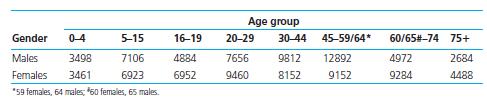
You have been asked to undertake a survey of residents’ opinions regarding the siting of a new supermarket in an inner city suburb (estimated catchment population 111,376 atthe last census). The age and gender distribution of the catchment population at the last census is listed above.a Devise a
For each of the following research questions it has not been possible for you to obtain a sampling frame. Suggest the most suitable non-probability sampling technique to obtain the necessary data, giving reasons for your choice.a What support do people sleeping rough believe they require from
With a friend or colleague choose one of the following research questions (or one of your own) in which you are interested.• What attributes attract people to jobs?• How are financial institutions adapting the services they provide to meet recent legislation?Use the flow charts for both
Obtain a copy of a quality daily newspaper and, within the newspaper, find an article which discusses a ‘survey’ or ‘poll’. Share the article with a friend. Make notes of the process used to select the sample for the ‘survey’ or ‘poll’. As you make your notes, note down any areas
Outline the problems Daniel is likely to face by using his Marketing assignment as his pilot study.
Discuss how the distribution of a link to the Internet questionnaire using Facebook via email might jeopardise the statistical representativeness of Daniel’s findings.
Identify a sampling technique that could enable Daniel to collect reliable data from which he could make statistical inferences. Give reasons for your choice and explain the steps you would take to select your sample.
a A complete list of all directors of large manufacturing firms could be purchased from an organisation that specialised in selling such lists to use as the sampling frame. Alternatively, a list that contained only those selected for the sample could be purchased to reduce costs. These data are
Your draft of Lisa’s tutor’s reply is unlikely to be worded the same way as the one below.However, it should contain the same key points:From: “tutor’s name” To: Sent: today’s date 7:06 Subject: Re: Help!!! Sampling non-response?Hi Lisa Many thanks for the email. This is not in the
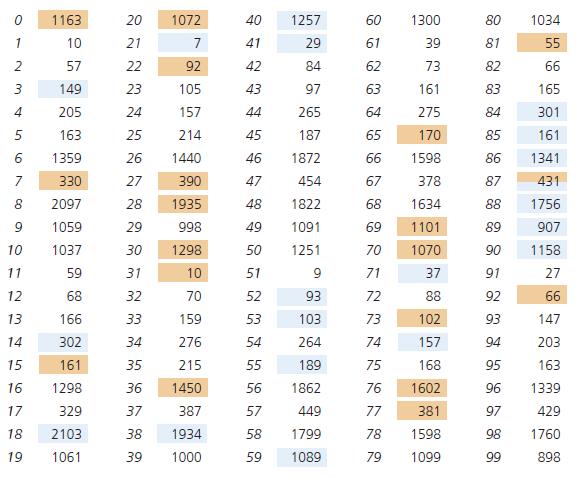
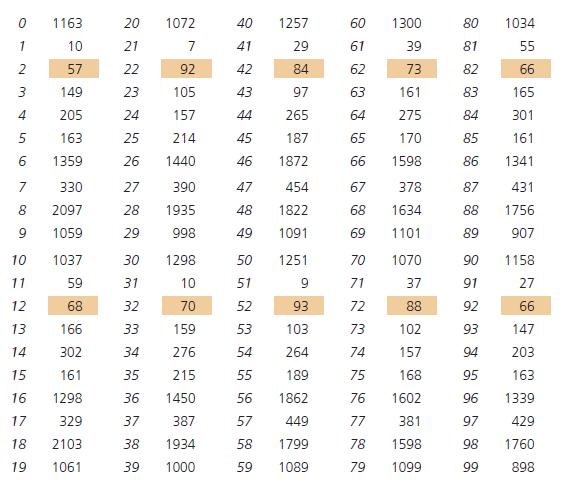
a Your answer will depend on the random numbers you selected. However, the process you follow to select the samples is likely to be similar to that outlined. Starting at randomly selected points, two sets of 20 two-digit random numbers are read from the random number tables ( Appendix 3 ). If a
a Your answer will depend on the random number you select as the starting point for your systematic sample. However, the process you followed to select your sample is likely to be similar to that outlined. As a 10 per cent sample has been requested, the sampling fraction is 1/10. Your starting
a If you assume that there are at least 100,000 managing directors of small to mediumsized organisations from which to select your sample, you will need to interview approximately 380 to make generalisations that are accurate to within plus or minus 5 per cent ( Table 7.1).b Either cluster or
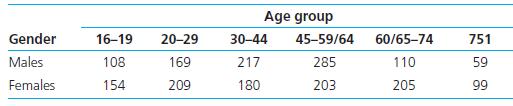
a Prior to deciding on your quota you will need to consider the possible inclusion of residents who are aged under 16 in your quota. Often in such research projects residents aged under 5 (and those aged 5–15) are excluded. You would need a quota of between 2000 and 5000 residents to obtain a
a Either snowball sampling as it would be difficult to identify members of the desired population or, possibly, convenience sampling because of initial difficulties in finding members of the desired population.b Quota sampling to ensure that the variability in the population as a whole is
identify the full variety of secondary data that are available;
appreciate ways in which secondary data can be utilised to help to answer your research question(s) and to meet your objectives;
understand the advantages and disadvantages of using secondary data in research projects;
use a range of techniques to locate secondary data;
evaluate the suitability of secondary data for answering your research question(s) and meeting your objectives in terms of coverage, validity, reliability and measurement bias;
apply the knowledge, skills and understanding gained to your own research project.
You are undertaking a research project as part of your course. Your initial research question is ‘How has the UK’s import and export trade with other countries altered since its entry into the European Union?’ List the arguments that you would use to convince someone of the suitability of
Suggest possible secondary data that would help you answer the following research questions. How would you locate these secondary data?a To what extent do organisations’ employee relocation policies meet the needs of employees?b How have consumer spending patterns in your home country changed in
As part of case study research based in a manufacturing company with over 500 customers, you have been given access to an internal market research report. This was undertaken by the company’s marketing department. The report presents the results of a recent customer survey as percentages. The
With a friend revisit Figure 8.1, types of secondary data, and reread the accompanying text in Section 8.2 Agree to find and, where possible, make copies (either electronic or photocopy)of at least two examples of secondary data for each of the seven subheadings:a text materials;b non-text
Choose an appropriate information gateway from Table 8.2 to search the Internet for secondary data on a topic which you are currently studying as part of your course.a ‘Add to favourites’ (bookmark) those sites which you think appear most relevant.b Make notes regarding any secondary data that
Agree with a friend to each evaluate the same secondary data set obtained via the Internet. This could be one of the data sets you found when undertaking question 8.6.Evaluate independently your secondary data set with regard to its overall and precise suitability using the checklist in Box 8.10 .
How might Liam have got around the various subscription paywalls on certain media websites that prevented him from accessing their material?
In terms of his coding procedure, Liam opted to annotate the documents by hand. How else might he have done the coding in a more systematic and transparent manner?
How might Liam write up his case study, in terms of a structure?
What limitations would Liam need to concede in his write-up?
What’s the difference between primary and secondary data, and what sort of secondary data could be relevant for the research project?
Showing 1000 - 1100
of 1279
1
2
3
4
5
6
7
8
9
10
11
12
13
Step by Step Answers

 Get 50% OFF
Claim Now
Get 50% OFF
Claim Now