New Semester
Started
Get
50% OFF
Study Help!
--h --m --s
Claim Now
Question Answers
Textbooks
Find textbooks, questions and answers
Oops, something went wrong!
Change your search query and then try again
S
Books
FREE
Study Help
Expert Questions
Accounting
General Management
Mathematics
Finance
Organizational Behaviour
Law
Physics
Operating System
Management Leadership
Sociology
Programming
Marketing
Database
Computer Network
Economics
Textbooks Solutions
Accounting
Managerial Accounting
Management Leadership
Cost Accounting
Statistics
Business Law
Corporate Finance
Finance
Economics
Auditing
Tutors
Online Tutors
Find a Tutor
Hire a Tutor
Become a Tutor
AI Tutor
AI Study Planner
NEW
Sell Books
Search
Search
Sign In
Register
study help
business
understanding management
Understanding Management 5th Edition Richard L. Daft, Dorothy Marcic - Solutions
Is he culturally sensitive or insensitive?LO.1
Does Jack Elliot behave as if he had had cross-cultural training before arriving in Japan?LO.1
What do you think of the Unocal representative’s statement that “to withdraw and isolate Myanmar would have no effect” regarding that country’s poor human rights record?Do you believe U.S. companies should stay in such countries in the hope of improving the ethical climate? Discuss.LO.1
Identify and discuss the various types of risks faced by Unocal in emerging markets (consider the economic, legal-political, and sociocultural environment). Which risks seem most threatening to the company?LO.1
What market entry strategies has Unocal used based on the activities described in the case? Would you classify Unocal as an MNC? Why or why not?LO.1
World Trade Organization. Visit the WTO at http://www.wto.org and answer the following questions:a. Where is the WTO located?b. When was it established?c. How many countries are members?d. What are the WTO’s main functions?LO.1
Exchange Rates. Complete the following steps at http://www.x-rates.com, record your findings for each step, and submit them to your instructor: (a) Use the“Currency Calculator” to convert US$200 into three other currencies of your choosing; (b) go to the“Currency Photos” link and examine
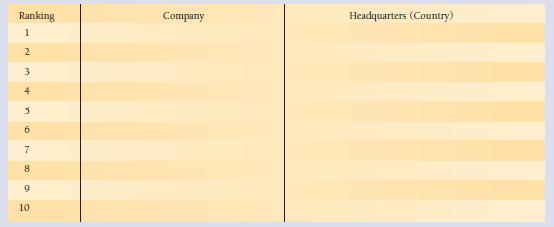
Largest Companies in the World. Fortune magazine, in its annual listing called the “Global 500,” ranks the world’s largest companies based on sales revenue. Using InfoTrac, the online database of articles that comes free with the purchase of your text (http://infotrac.thomsonlearning.com), or
Frame your remarks in terms of the inefficiencies you witnessed in the Asian operation, with specific details to back you up. Recommend that clear, high standards be established for the Asian business and suggest some elements of those standards, including treatment of employees.LO.1
Tell top executives straight out that Zing is mistreating employees and creating an environment that is detrimental to productivity and performance.LO.1
Keep your mouth shut. This is the comptroller’s responsibility.You have just gotten the job you wanted at headquarters, and to rock the boat now could do more harm to your career than it would do good for the company.LO.1
Five items in your town that were manufactured in another country that were not made in that country six years ago.LO.1
Two maps of the world drawn before 1900.LO.1
A list of eight places where a language other than English is displayed (e.g., on a bulletin board, poster).LO.1
Descriptions of interviews from five foreigners (not from your team or the class) asking them to name six things they like about the United States and six things they do not like.LO.1
List of five films in the past five years that had multinational crews and locations. Include at least one that was co-produced by two or more countries.LO.1
List of 12 films in the past five years that starred someone from another country.LO.1
List of books sold in your town from authors of 12 different countries. Where were the books published?Who translated them?LO.1
Articles of clothing from 15 different countries.LO.1
Food items from 25 different countries.LO.1
Five toys or games that had components from one country and assembled in another or somehow developed in more than one country.LO.1
Ten toys or games that originated in other countries.LO.1
Locate a retail store that sells only “Made in America.”LO.1
Evidence from three local businesses to show they do business internationally.LO.1
Brochures of Annual Reports of four MNCs.LO.1
How many countries did your team get items from? How many for the entire class?List for scavenger hunt:LO.1
On that day, each team will give a two-minute presentation on the items that were the most difficult or the most interesting to find.LO.1
Each team is to bring items to a future class from the list below.LO.1
Divide into teams of 4–6 members.LO.1
I feel capable of assessing different cultures on the basis of power distance, uncertainty avoidance, individualism, and masculinity.10 9 8 7 6 5 4 3 2 1 Total Score LO.1
I know which countries tend to cluster into similar sociocultural and economic groupings.10 9 8 7 6 5 4 3 2 1 LO.1
I can speak a foreign language.10 9 8 7 6 5 4 3 2 1 LO.1
I easily adapt to the different work ethics of students from other cultures when we are involved in a team project.10 9 8 7 6 5 4 3 2 1 LO.1
I have spent more than two weeks traveling or working in another country.10 9 8 7 6 5 4 3 2 1 LO.1
I have good listening and empathy skills.10 9 8 7 6 5 4 3 2 1 LO.1
I have a basic knowledge about several countries in addition to my native country.10 9 8 7 6 5 4 3 2 1 LO.1
I believe female expatriates can be as effective as male expatriates.10 9 8 7 6 5 4 3 2 1 LO.1
I frequently attend seminars and lectures about other cultures or international topics.10 9 8 7 6 5 4 3 2 LO.1
I reach out to people from different cultures.10 9 8 7 6 5 4 3 2 1 LO.1
If the world were represented by 100 people, fill in the blanks below to indicate what percentage of people would be the following:would be Asian would be non-white would be non-Christian would live in substandard housing would be illiterate would have a college education would own a computer
Which country gives the least aid as a proportion of its GDP?a. United States of Americab. Saudia Arabiac. Japand. Switzerland LO.1
Sixty-five million girls do not go to school. What is the main reason behind their exclusion from education?a. Girls are less intelligent than boys.b. In many countries it is illegal for girls to go to school.c. Poverty takes a greater toll on girls.d. Girls drop out earlier to get married and have
The average amount of water used per day by a person living in Ethiopia, Eritrea, Djibouti, Gambia, Somalia, Mali, Mozambique, Tanzania, or Uganda, is the same as someone in a developed country:a. making a pot of tea (1 liter)b. cleaning their teeth with the tap running (10 liters)c. filling up a
The world’s urban population will grow from 2.86 billion to billion in 2030.LO.1
Which three countries have the highest rate of HIV infection?Which country had the greatest decrease of cases?LO.1
The number of host computers on the Internet grew by percent from 1990 to 2000.LO.1
The total output of the world economy was $6.3 trillion in 1950. What was it in 2000?LO.1
Which city has the worst air pollution: New York, Mexico City, or Moscow?LO.1
Americans constitute approximately 5 percent of the world’s population. What percentage of the world’s resources do Americans consume?a. 15 percentb. 25 percentc. 35 percentd. 45 percent LO.1
The nations of Africa, Asia. Latin America, and the Middle East, often referred to as the Third World, contain about 78 percent of the world’ population. What percentage of the world’s monetary income do they possess?a. 10 percentb. 20 percentc. 30 percentd. 40 percent LO.1
According to the United Nations, what percentage of the world’s income is earned by women?a. 1/10b. 3/10c. 5/10d. 7/10 LO.1
In some African countries, percent of women have suffered female genital mutilation.LO.1
Women make up percent of the world’s illiterates.LO.1
According to the United Nations, what percentage of the world’s work (paid and unpaid) is done by women?a. 1/3b. 1/2c. 2/3d. 3/4 LO.1
Between 1960 and 1987, the world spent approximately$10 trillion on health care. How much did the world spend on military expenditures?a. $7 trillionb. $10 trillionc. $17 trilliond. $25 trillion LO.1
Between 1970 and 2000, the number of people in the world suffering from malnutrition:a. declinedb. remained about the samec. increased LO.1
The number of people who have immigrated from poorer countries to developed ones has been per year in recent years.LO.1
The proportion of people in the world over age 60 will increase by percent by 2050.LO.1
How many nations were there in 2005?a. 293b. 193c. 93 LO.1
How many living languages (those still spoken) are there in the world?a. 683b. 2600c. 6800 LO.1
Which six most commonly spoken first languages account for one third of the total world population:LO.1
Which six countries make up over half of the world’s population?LO.1
How do you think trade alliances such as NAFTA, the EU, and the Association of Southeast Asian Nations(ASEAN) might affect you as a future manager?LO.1
What is meant by the cultural values of individualism and power distance? How might these values affect organization design and management processes?LO.1
What might managers do to avoid making mistakes concerning control and decision making when operating in a foreign culture?LO.1
What does it mean to say that the world is becoming borderless? That large companies are stateless?LO.1
Should an MNC operate as an integrated, worldwide business system, or would it be more effective to let each national subsidiary operate autonomously?LO.1
Compare the advantages associated with the foreign market entry strategies of exporting, licensing, and wholly owned subsidiaries.LO.1
What steps could a company take to avoid making product design and marketing mistakes when introducing new products into a foreign country?LO.1
What policies or actions would you recommend to an e-commerce company wanting to do business internationally?LO.1
What might be some long-term ramifications of the war in Iraq for U.S. managers and companies operating internationally?LO.1
Why do you think international businesses traditionally prefer to operate in industrialized countries? Discuss.LO.1
A polite way to give your business card to a Japanese business person isa. casually, after several hours of getting to know the personb. when first meeting, presenting your card with both handsc. at the end of the first meetingd. casually during the meeting, with the information down to show
In the United States, scratching one’s head usually means that the person is confused or skeptical. In Russia, it meansa. “You’re crazy!”b. “I am listening carefully.”c. “I want to get to know you better.”d. “I’m confused or skeptical.”e. None of the above LO.1
In many Asian cultures, a direct order such as “Get me the Amex report” is most likely to be given bya. senior management to most subordinatesb. a junior employee to a peerc. senior management only to very junior employeesd. junior employees to outsiderse. none of the above LO.1
In which of the following countries are office arrangements NOT usually an indicator of the person’s status?a. United Kingdomb. Germanyc. Saudi Arabiad. Chinae. United States LO.1
Managers from which country are least likely to tolerate someone being five minutes late for an appointment?a. United Statesb. Australiac. Brazild. Swedene. Saudi Arabia LO.1
While visiting a German client, you give a compliment about the client’s beautiful pen set. What will probably happen?a. the client will insist very strongly that you take itb. the client will tell you where to buy such a pen set at a good pricec. the client will accept the compliment and get on
One of the most universal gestures isa. a pat on the back (congratulations)b. a smile (happiness or politeness)c. scratching your chin (thinking)d. closing your eyes (boredom)e. arm up, shaking back and forth (waving)LO.1
Japanese clients visit you at your office for a major meeting.Where should the top Japanese official be seated?a. closest to the doorb. as close to the middle of the room as is possiblec. anywhere in the room; seating location is not important to Japanese businesspeopled. somewhere away from the
Male guests in many Latin American countries often give their visitors an abrazzo when greeting them. An abrazzo isa. a light kiss on the noseb. a special gift, usually wine or foodc. clapping hands in the air as the visitor approachesd. a strong embrace, or kiss with hand on shouldere. a firm
You want to do business with a Greek company, but the representative insists on examining every detail of your proposal for several hours. This time-consuming detail means that the Greek representativea. does not trust the accuracy of your proposalb. is being polite and does not want to go ahead
If you travel to the increasingly visited out-of-the-way locations, learn to tolerate unpredictiability and go without what you may consider basic amenities. Avoid complaining to business clients about poor phone service, lack of hot water (or any, for that matter), erratic availability of
Be sensitive to the difference between the North American low-context culture, where employees are encouraged to be self-reliant, and high-context cultures (much of Asia, Africa, South America), where workers expect warmly supportive relationships with their American supervisors and co-workers?LO.1
Understand the pace of other countries because some, such as Israel, are faster-paced and people there get impatient with Americans’ small talk?LO.1
Leave the common American task-oriented, fast-paced style at home. Effective transfer of skills to other cultures requires a patient non-judgmentalism. Hasty criticisms of the foreigner’s ideas only serve to shut that person down and close the door to meaningful interactions?LO.1
Most Asian countries are high-context cultures that are based on a complicated system of relationships and moral codes (some of which might not seem “moral” to you). The United States is low context, meaning people are more direct and they rely on legal codes?LO.1
Avoid clique-building and interact with the locals as much as possible. Often, Americans tend to hang together in packs or tribes, which is unwelcoming to the locals?LO.1
Do not embarrass anyone in front of others. Even if you meant it as a “joke,” it likely will not be taken that way?LO.1
Do not lose your temper?LO.1
Do not assume the other country sees leadership in the same way as you do. In many other cultures, “empowerment”seems more like anarchy and the result of an ineffectual manager?LO.1
Do not go alone. Take someone who knows the culture or language better than you. If you are discussing in English and the others “know” your language, you might be surprised how much they miss. Often, taking an excellent translator along is a good investment?LO.1
Save face and “give” face as well, for this can be a way of showing honor to others?LO.1
When there are disagreements, check on the perceived definitions of words. Often, a huge or subtle shade of meaning may be causing the problem. Both of you may be saying the same thing?LO.1
Emphasize points of agreement?LO.1
Understand that your way may not be the best. This can come across as arrogance and rubs salt in deep wounds in some lesser-developed countries?LO.1
Gain an appreciation for the differences between Geert Hofstede’s “masculine” and feminine” cultures. American masculine business behaviors include high achievement and the aquisition of material goods and efficiency, but other, more feminine, cultures value relationships, leisure time with
Always show respect and listen carefully. Do not be in a hurry to finish the “business.” Many other cultures values the social component of these interactions?LO.1
Explain the challenges of managing in a global environment.LO.1
Describe the characteristics of a multinational corporation.LO.1
Showing 6400 - 6500
of 7324
First
58
59
60
61
62
63
64
65
66
67
68
69
70
71
72
Last
Step by Step Answers

 Get 50% OFF
Claim Now
Get 50% OFF
Claim Now