







Question: Studies show that when environmental factors impose an upper bound on the possible size of a population P(t), the population often tends to grow in
Studies show that when environmental factors impose an upper bound on the possible size of a population P(t), the population often tends to grow in such a way that the percentage rate of change of P(t) satisfies
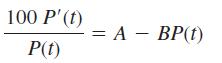
where A and B are positive constants. Where does the graph of P(t) have an inflection point? What is the significance of this point?
100 P' (t) P(t) = A - BP(t)
Step by Step Solution
★★★★★
3.25 Rating (157 Votes )
There are 3 Steps involved in it
1 Expert Approved Answer
Step: 1 Unlock

When Pt AB the population is at the maximum possible and t... View full answer
Question Has Been Solved by an Expert!
Get step-by-step solutions from verified subject matter experts
Step: 2 Unlock
Step: 3 Unlock
 Study Help