







Question: Use data in Table 4H.1 or Appendix 2A to calculate the standard entropy change for each of the following reactions at 25C. For each reaction,
Use data in Table 4H.1 or Appendix 2A to calculate the standard entropy change for each of the following reactions at 25°C. For each reaction, interpret the sign and magnitude of the reaction entropy.
Table 4H.1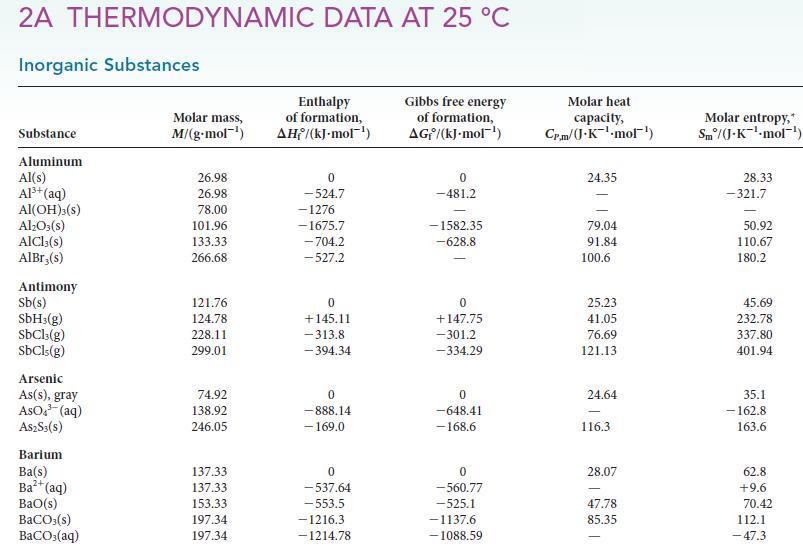
(a) The preparation of manganese metal in the thermite reaction: 4 Al(s) + 3 MnO2(s) → 3 Mn(s) + 2 Al2O3(s).
(b) A reaction used to power rockets: 7 H2O2(l) + N2H4(l) → 2 HNO3(aq) + 8 H2O(l).
(c) The purification of silicon: SiO2(s) + 2 C(s) → Si(s) + 2 CO(g).
(d) The preparation of nitric oxide:
2A THERMODYNAMIC DATA AT 25 C Inorganic Substances Substance Aluminum Al(s) Al+ (aq) AI(OH)3(s) AlO3(s) AICI;(s) AlBr,(s) Antimony Sb(s) SbH3(g) SbCl3(g) SbCls (g) Arsenic As(s), gray AsO (aq) A$2S3(S) Barium Ba(s) Ba+ (aq) BaO(s) BaCO3(s) BaCO3(aq) Molar mass, M/(g-mol-) 26.98 26.98 78.00 101.96 133.33 266.68 121.76 124.78 228.11 299.01 74.92 138.92 246.05 137.33 137.33 153.33 197.34 197.34 Enthalpy of formation, AH/(kJ-mol-) 0 -524.7 -1276 -1675.7 -704.2 -527.2 0 +145.11 -313.8 -394.34 0 -888.14 - 169.0 0 -537.64 -553.5 -1216.3 - 1214.78 Gibbs free energy of formation, AG/(kJ.mol-) 0 -481.2 -1582.35 -628.8 0 +147.75 -301.2 -334.29 0 -648.41 -168.6 0 -560.77 -525.1 -1137.6 -1088.59 Molar heat capacity, Cr.m/(J.K-mol). 24.35 79.04 91.84 100.6 25.23 41.05 76.69 121.13 24.64 116.3 28.07 47.78 85.35 Molar entropy,* Sm/(J-K mol) 28.33 -321.7 - 50.92 110.67 180.2 45.69 232.78 337.80 401.94 35.1 - 162.8 163.6 62.8 +9.6 70.42 112.1 -47.3
Step by Step Solution
3.32 Rating (152 Votes )
There are 3 Steps involved in it
a 4 Als 3 MnO2s 3 Mns 2 Al2O3s AS S Mn s S Al2O3 s S Al s S MnO2 s AS 33201 Jmol ... View full answer

Get step-by-step solutions from verified subject matter experts
 Study Help