







Question: Repeat Exercise 3.16 using analytical techniques, but reverse the order of the two legs of the walk and show that you get the same final
Repeat Exercise 3.16 using analytical techniques, but reverse the order of the two legs of the walk and show that you get the same final result. (This problem shows that adding them in reverse order gives the same result-that is, B+ A = A + B.) Discuss how taking another path to reach the same point might help to overcome an obstacle blocking your other path.
Data given in Example 3.16
Solve the following problem using analytical techniques: Suppose you walk 18.0 m straight west and then 25.0 m straight north. How far are you from your starting point, and what is the compass direction of a line connecting your starting point to your final position? (If you represent the two legs of the walk as vector displacements A and B, as in Figure 3.55, then this problem asks you to find their sum R = A + B.)
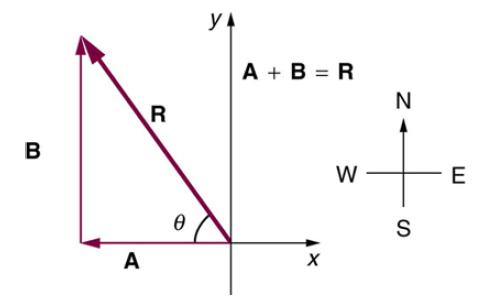
Note that you can also solve this graphically. Discuss why the analytical technique for solving this problem is potentially more accurate than the graphical technique.
B A R 0 YA A + B = R X W ZA N S - E
Step by Step Solution
3.38 Rating (145 Votes )
There are 3 Steps involved in it
308 ... View full answer

Get step-by-step solutions from verified subject matter experts
 Study Help