



Question: (mathrm{A}+10 mathrm{nC}) charge is moved from point (mathrm{c}) to point (mathrm{a}). How much work is required in order to do this? A. (3.5 times 10^{-6}
\(\mathrm{A}+10 \mathrm{nC}\) charge is moved from point \(\mathrm{c}\) to point \(\mathrm{a}\). How much work is required in order to do this?
A. \(3.5 \times 10^{-6} \mathrm{~J}\)
B. \(4.0 \times 10^{-6} \mathrm{~J}\)
C. \(3.5 \times 10^{-3} \mathrm{~J}\)
D. \(4.0 \times 10^{-3} \mathrm{~J}\)
Refer to Figure Q21.24, which shows equipotential lines in a region of space. The equipotential lines are spaced by the same difference in potential, and several of the potentials are given.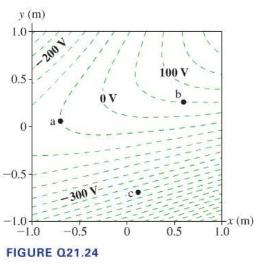
y (m) 1.0- 0.5 0- -200 V OV 100 V b -0.5- 300 V- -1.0+ -1.0 -0.5 -x (m) 0.5 1.0 FIGURE Q21.24
Step by Step Solution
3.43 Rating (162 Votes )
There are 3 Steps involved in it
To find the work done in moving a charge from one point to another in an electric field we can use t... View full answer

Get step-by-step solutions from verified subject matter experts