







Question: Figure 30.13 shows a router using priority queuing at the input port. The arrival and required service times (transmission time is negligible) for 10 packets
Figure 30.13 shows a router using priority queuing at the input port.
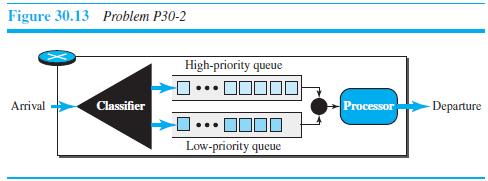
The arrival and required service times (transmission time is negligible) for 10 packets are shown below; ti means that the packet has arrived i ms after a reference time. The values of required service times are also shown in ms. The packets with higher priorities are packets 1, 2, 3, 4, 7, and 9 (shown in color); the other packets are packets with lower priorities.

a. Using time lines, show the arrival time, the processing duration, and the departure time for each packet. Also show the contents of the high-priority queue (Q1) and the low-priority queue (Q2) at each millisecond.
b. For each packet belonging to the high-priority class, find the time spent in the router and the departure delay with respect to the previously departed packet. Find if the router creates jitter for this class.
c. For each packet belonging to the low-priority class, find the time spent in the router and the departure delay with respect to the previously departed packet. Determine whether the router creates jitter for this class.
Figure 30.13 Problem P30-2 High-priority queue Arrival Classifier Processor Departure ... Low-priority queue
Step by Step Solution
3.54 Rating (171 Votes )
There are 3 Steps involved in it
We answer each question below a The following figure shows the time lines and the contents of the ... View full answer

Get step-by-step solutions from verified subject matter experts
 Study Help