New Semester
Started
Get
50% OFF
Study Help!
--h --m --s
Claim Now
Question Answers
Textbooks
Find textbooks, questions and answers
Oops, something went wrong!
Change your search query and then try again
S
Books
FREE
Study Help
Expert Questions
Accounting
General Management
Mathematics
Finance
Organizational Behaviour
Law
Physics
Operating System
Management Leadership
Sociology
Programming
Marketing
Database
Computer Network
Economics
Textbooks Solutions
Accounting
Managerial Accounting
Management Leadership
Cost Accounting
Statistics
Business Law
Corporate Finance
Finance
Economics
Auditing
Tutors
Online Tutors
Find a Tutor
Hire a Tutor
Become a Tutor
AI Tutor
AI Study Planner
NEW
Sell Books
Search
Search
Sign In
Register
study help
computer science
systems analysis and design 12th
Object Oriented Analysis And Design 1st Edition D Jeya Mala, S Geetha - Solutions
In the UML notation, inside each class in a class diagram are printed(a) its name, attributes, operations, and derived classes(b) its name, attributes and operations(c) its name, and attributes(d) just its name
Inheritance relationships are represented in the UML notation by(a) nesting of classes(b) lines with a solid diamond at one end(c) lines with a hollow diamond at one end(d) lines with a triangular arrow at one end
Aggregation (encapsulation) relationships are represented in the UML notation by(a) nesting of classes(b) lines with a solid diamond at one end(c) lines with a hollow diamond at one end(d) lines with an arrow at one end
In the UML notation, parameterized (generic) classes are represented by(a) the normal class representation with a dotted arrow pointing at the template parameter classes(b) the normal class representation but shaded grey.(c) the normal class representation with a dotted outline and the names of its
In a class diagram, an attribute preceded by a minus sign is(a) Public(b) Private(c) Protected(d) void
The distinction between a class and an object is _____________________.(a) A class is a template for creating objects, while an object is an instance of a class(b) An object is a template for creating objects, while a class is an instance of an object(c) Classes can be instantiated from objects,
Each object has _______ that specify information about the object.(a) Methods(b) Messages(c) Procedures(d) Attributes
________ implement an object’s behavior.(a) Methods(b) Messages(c) Procedures(d) Attributes
_________ are instructions sent to an object that in turn trigger methods.(a) Data(b) Messages(c) Procedures(d) Other objects
What in a class diagram is written in italics?(a) A subclass(b) An interface(c) A use case(d) An abstract class
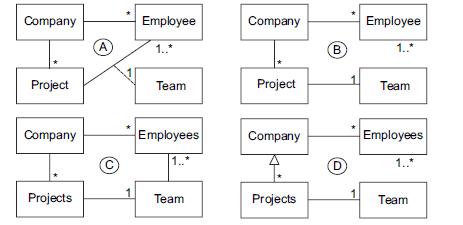
Consider the following situation: a company realizes projects; each project is executed by a team of employees. Which would be a suitable conceptual UML diagram?(a) Diagram A (b) Diagram B (c) Diagram C (d) Diagram D Company Project Company Projects A Employee 1..* Team Employees 1.. Team Company
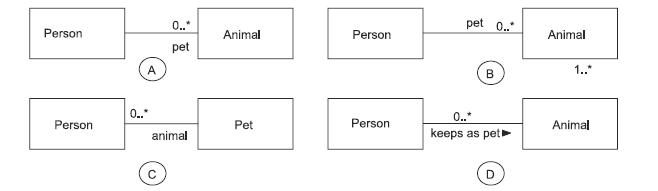
How do you express that some persons keep animals as pets?(a) Diagram A (b) Diagram B (c) Diagram C (d) Diagram D Person Person A 0..* 0..* pet animal Animal Pet Person Person pet 0.. B 0.. keeps as pet D Animal 1..* Animal
What are the three things defined by a UML class?
Summarize the purpose of class diagrams.
What are class diagram and object diagram?
List down the steps in identifying and developing a class diagram for a given application domain.
How do we represent private, public and protected in class diagrams?
What does associations in a class diagram mean?
What does associations in a class diagram mean?
How do we achieve generalization and specialization?
Differentiate aggregation and composition.
Explain what a class diagram is.
Companies may employ many people, and people may work for many companies. Every employee in a company has a manager who may manage many subordinate employees. Show the relationship between the Employee and Company class in UML.
Draw class diagrams showing the data for each of the following aggregations/compositions: ward, bed and hospital canteen department and a department of your own choice.
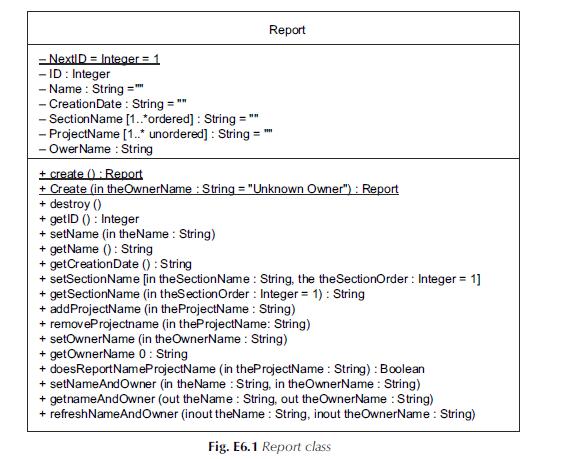
Describe the following Fig. E6.1 and identify the class and describe its attributes and operations. - NextID = Integer = -ID: Integer Report - Name: String=""" - Creation Date: String = "" - Section Name [1..*ordered]: String m - ProjectName [1..* unordered]: String = ' - Ower Name: String w +
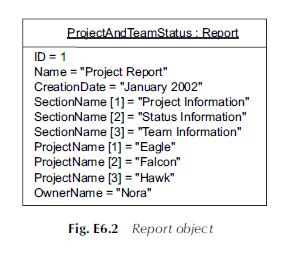
Describe Fig. E6.2: identify the object and describe its attribute values. ProjectAnd TeamStatus: Report ID=1 Name = "Project Report" Creation Date = "January 2002" SectionName SectionName SectionName [1] = "Project Information" [2] = "Status Information" [3] = "Team Information" Project Name [1] =
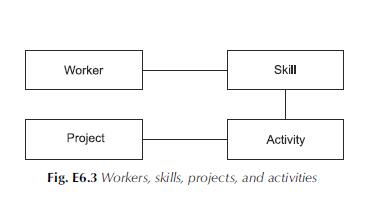
Describe Fig. E6.3: identify the classes and their associations.Update the diagram stepwise to show the following details:(a) When a worker has a skill, the years of experience is maintained for the relationship.(b) A worker may have another worker as a manager, and a worker who is a manager must
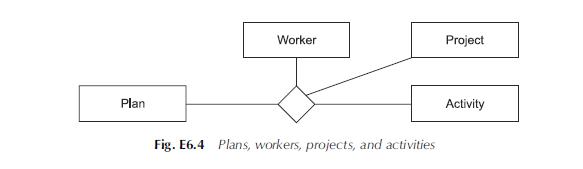
Describe Fig. E6.4: identify the classes and their associations.Update the diagram stepwise.(a) A plan pertains to a single project and involves one or more workers and one or more activities.(b) A worker may have zero or more plans, and a plan must belong to a single worker.(c) Each plan contains
Create a class diagram to communicate the following:(a) Nora manages Andy and Jonathan, who are all workers. You are interested in the following skills: project management, requirements gathering, analysis, design, implementation, testing, deployment, Extensible Markup Language (XML), Structured
Identify a group of five classes of your choice in the system so that any class in this group is linked by a class relationship to at least one other class in the group. Draw the UML class diagram which contains the selected classes and their relationships.
Which of the following is true about a sequence diagram?(a) It describes the behavior in many use cases.(b) It describes the behavior in a single use case.(c) It describes the behavior of a single object.(d) It describes the behavior of several objects.
A sequence diagram is(a) a timeline illustrating a typical sequence of calls between object function members(b) a call tree illustrating all possible sequences of calls between class function members(c) a timeline illustrating the changes in inheritance and instantiation relationships between
Guard conditions tested within a “loop” Combined Fragment include(a) Boolean loop condition(b) minimum iterations(c) maximum iterations(d) All of the above
Which of the following are new introductions in UML 2?(a) Guards(b) Combined fragments(c) Interaction Occurrences(d) Frames
A sequence diagram referenced from another sequence diagram is called(a) “ref” Combined fragment(b) operand(c) interaction(d) interaction Occurrence
A sequence diagram in ________ (UML) is a kind of interaction diagram that shows how processes operate with one another and in what order.(a) C Sharp (programming language)(b) EXPRESS ( data modeling language)(c) C++(d) Unified Modeling Language
The order of events in a sequence diagram is determined(a) by the sequence numbers of the events(b) by the relative position of the events on the timeline(c) by following the order of the events in the use case description(d) by placing numbers in comments along the left-hand margin of the diagram
How much logic should a sequence diagram include?(a) One use case(b) One user interaction(c) One scenario (d) One actor’s use of the system
The first of the two steps in building the sequence diagram is to(a) define the purpose and interfaces of the resource objects(b) define how the actor uses the system resources(c) define how the resource objects interact with the system(d) define how the actor interacts with the system in a use case
The second of the two steps in building the sequence diagram is to(a) define how the system uses the problem domain resources(b) define how the actor uses the system resources(c) define how the resource objects interact with the system(d) define how the actor interacts with the system in a use case
The purpose of the interaction diagram is to(a) discover and define the communication between objects(b) discover and define the sequence of interactions between objects(c) discover and define the interfaces on classes(d) discover and define the attributes that define an object
The definition of an operation includes(a) name, arguments, and return data type where the return data type is optional(b) constraints, name, and arguments where the return data type and constraints are optional(c) return data type, name, and constraints where the return data type and constraints
What elements are discovered using the sequence diagram and added to the class diagram?(a) Interfaces of the objects(b) Classes of the objects in the sequence diagram, attributes, and operations(c) Classes of the objects in the sequence diagram(d) Operations and the associated attributes that
An attribute definition includes(a) name, data type, and default value if applicable(b) name, arguments, and constraints(c) constraints, data type, and a default value, if applicable(d) name, data type, default value, and constraints, if applicable
Where can you find attributes in a sequence diagram?(a) In operation arguments(b) In the objects that own the parameters’ values(c) In the responses to events(d) In operation parameters and responses
How does the sending object obtain data from the object that owns the parameter values?(a) By adding an interface to the sending object and adding it to the interaction sequence(b) By adding an interface to the owning object and adding it to the interaction sequence(c) By reassigning the attributes
Name the two types of interaction diagrams and give very simple example of the same interaction using one type of diagram and the other.
Write down the purposes of interaction diagrams.
What is a found message? What does it mean?
What do the vertical and horizontal dimensions of sequence diagrams represent?
What does an object do when it sends a synchronous message?
What are the types of links supported by collaboration diagrams?
How is a destroyed object depicted in a sequence diagram?
Compare and contrast collaboration and sequence diagrams.
Creation and Deletion of objects supported in collaboration diagrams? If so, how?
How is the runtime constraint on the interacting participants represented in sequence diagram?
If you want to plan project activities such as developing new functionalities or test cases, which OOAD artifacts is the most useful?
Differentiate the message syntax and semantics in sequence and collaboration diagrams.
Develop two sequence diagrams, for a Banking Application.
Show a normal and successful transaction.
Show a transaction where error (and rollback occurs).
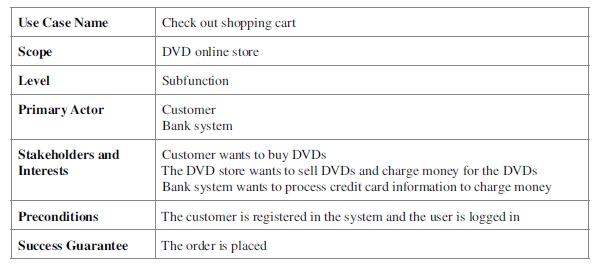
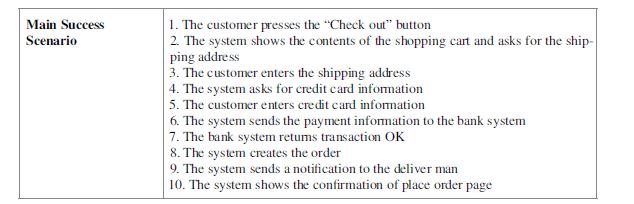
Create a UML Sequence Diagram for the following Use Case “Check out shopping cart” whose description is provided below: Use Case Name Scope Level Primary Actor Stakeholders and Interests Preconditions Success Guarantee Check out shopping cart DVD online store Subfunction Customer Bank system
Draw collaboration diagram for depict how the system calculates the charges when a DVD is returned.(a) You can assume that the objects needed to create DVDVendor (for example, TransactionDB)already exist.(b) Make sure your diagram clearly shows which objects are created when calculating charges in
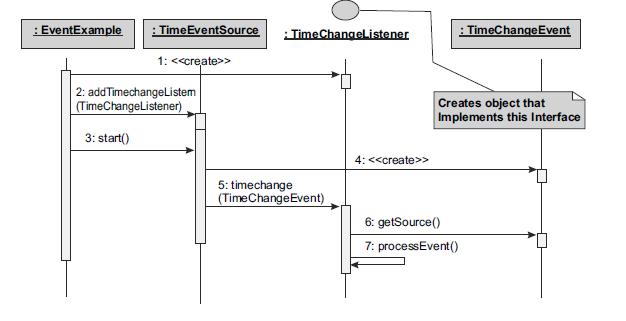
Draw the UML communication diagram that corresponds to the following UML sequence diagram: : EventExample : Time EventSource 3:start() 1: < > 2: addTimechangeListem (TimeChangeListener) Time ChangeListener 5: timechange (Time Change Event) 4: < > : TimeChange Event Creates object that Implements
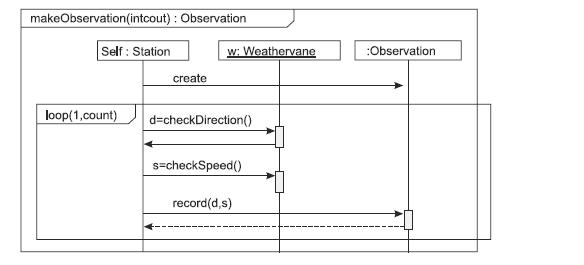
The following UML sequence diagram models an interaction in an automated weather station. Analyze and circle all the errors in the diagram.
Analyze the diagram and answer the following questions:(a) According to the diagram above, what sort of messages are sent to the Weathervane object?(b) How many Observation objects are created?(c) Can a record() operation be called before its parameters have been set?(d) What is the type of the
What are the two different types of state chart/ state machine diagram in UML 2.0?(a) Single and Multi-stage state machines(b) Behavioral and protocol state machines(c) Class and component state machines(d) Complex and Simple state machines
Identify which of the following modeling element is not associated with Activity Diagrams.(a) Associations(b) Swimlanes(c) Initial node, final node(d) Fork and join nodes
In an activity diagram, which of the following steps in the flow of events is called a(n)?(a) Join(b) Form(c) Decision(d) Action
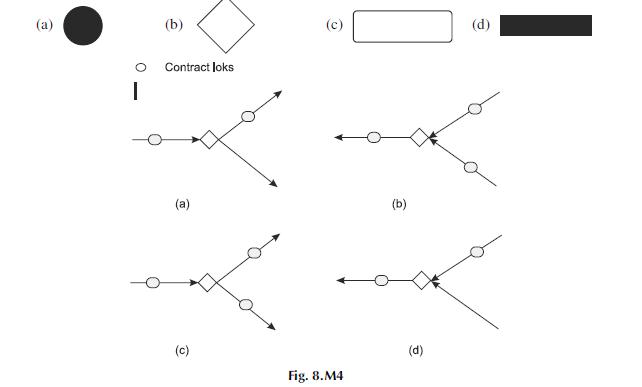
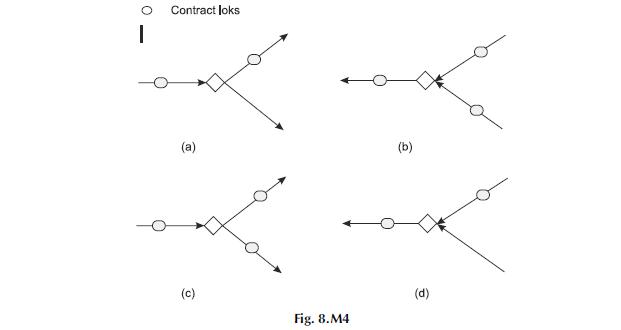
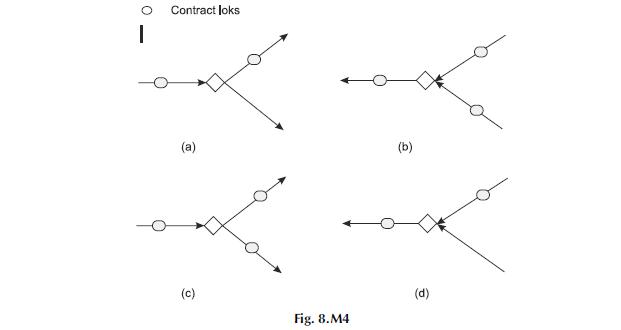
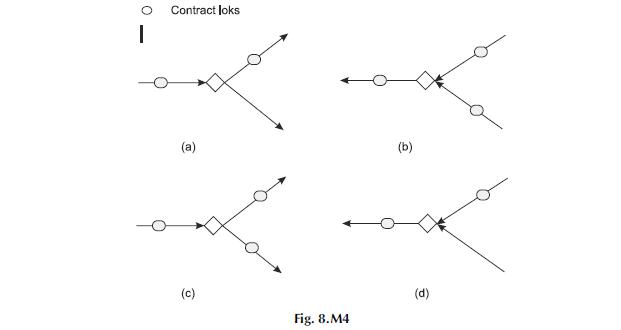
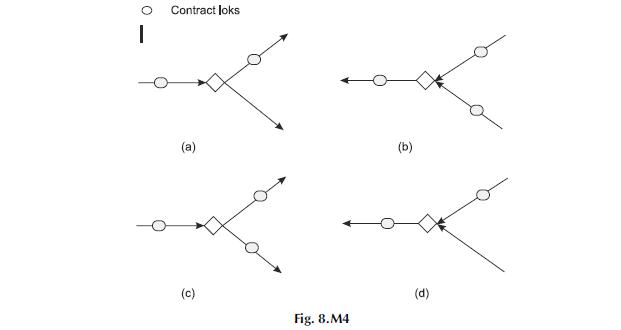
Which of the following symbols identifies a decision in an activity diagram? (a) I (b) Contract loks (a) (c) Fig. 8.M4 (b) (d) (d)
With reference to Fig. 8.M4 above, which one represents a decision node?(a) a(b) b(c) c(d) d 1 Contract loks (a) (c) Fig. 8.M4 (b) (d)
With reference to Fig. 8.M4, which one represents a merge node?(a) a(b) b(c) c(d) d 1 Contract loks (a) (c) Fig. 8.M4 (b) (d)
With reference to Fig. 8.M4, which one represents a fork node?(a) a(b) b(c) c(d) d 1 Contract loks (a) (c) Fig. 8.M4 (b) (d)
With reference to Fig. 8.M4, which one represents a join node?(a) a(b) b(c) c(d) d 1 Contract loks (a) (c) Fig. 8.M4 (b) (d)
A UML model precise style of a business process has(a) activity diagram(b) activity diagram and list of participants(c) activity diagram and class diagram(d) None of the above
A UML model Ultra Light Style of a business process has(a) activity diagram(b) activity diagram and list of participants(c) activity diagram and class diagram(d) None of these
A UML model Light Style of a business process has(a) activity diagram(b) activity diagram and list of participants(c) activity diagram and class diagram(d) None of these
An object node should not be shown before a(a) decision node(b) merge node(c) join node(d) fork node
An object node should not be shown after a(a) decision node(b) merge node(c) join node(d) fork node
The state transition diagram(a) depicts relationships between data objects(b) depicts functions that transforms the data flow(c) indicates how data are transformed by the system(d) indicates system reactions to external events
Which of the following statements about state machine diagram is/are correct?(a) All actions in a statechart diagram are attached to transitions.(b) An event may cause an object to remain in the same state it was prior to the event.(c) Once an object leaves a state, it cannot return to that
Define state chart diagram.
What is a state?
Write the major purposes of state chart diagrams.
List the basic steps to be followed to draw a state chart diagram.
Draw all the notations of a state chart diagram with an example for each.
What is the notation for a composite state?
Draw the notation used for junction point states.
What are the elements of activity diagrams?
Draw the notation for conditional threads in an activity diagram.
What is a swimlane?
Apply the basic notations of a state chart to construct a complete state chart diagram for ‘Online Books Purchase System’.
Use the choice point notation in a state chart diagram to impart its importance.
Use the object nodes to indicate the creation of objects during activity execution in an activity diagram.
Prepare a simple activity diagram for a ‘Workflow Management System’ of an organization using all its notations.
Construct a swimlane activity diagram for ‘E-Job Portal’ application.
Differentiate the purposes of do/action and exit/action in a state notation of a state chart.
When will you use choice and junction points?
Consider a ‘Book Issue’ use case scenario. Construct a state chart machine by analyzing it in detail.
How parameter sets can be represented to be given as input or output in an activity of an activity diagram?
Showing 3500 - 3600
of 4723
First
29
30
31
32
33
34
35
36
37
38
39
40
41
42
43
Last
Step by Step Answers

 Get 50% OFF
Claim Now
Get 50% OFF
Claim Now