New Semester
Started
Get
50% OFF
Study Help!
--h --m --s
Claim Now
Question Answers
Textbooks
Find textbooks, questions and answers
Oops, something went wrong!
Change your search query and then try again
S
Books
FREE
Study Help
Expert Questions
Accounting
General Management
Mathematics
Finance
Organizational Behaviour
Law
Physics
Operating System
Management Leadership
Sociology
Programming
Marketing
Database
Computer Network
Economics
Textbooks Solutions
Accounting
Managerial Accounting
Management Leadership
Cost Accounting
Statistics
Business Law
Corporate Finance
Finance
Economics
Auditing
Tutors
Online Tutors
Find a Tutor
Hire a Tutor
Become a Tutor
AI Tutor
AI Study Planner
NEW
Sell Books
Search
Search
Sign In
Register
study help
computer science
systems analysis and design 12th
Water Systems Analysis Design, And Planning Urban Infrastructure 1st Edition Mohammad Karamouz - Solutions
Which one of the following characteristics is not a measure of basin shape? (a) The length to the center of area, (b) the elongation ratio, (c) the drainage density, and (d) the circularity ratio.
Which one of the following is not a factor in controlling times of concentration of watershed runoff? (a) The drainage density, (b) the roughness of the flow surface, (c) the rainfall intensity, (d) the flow lengths, and (e) all of the above are factors.
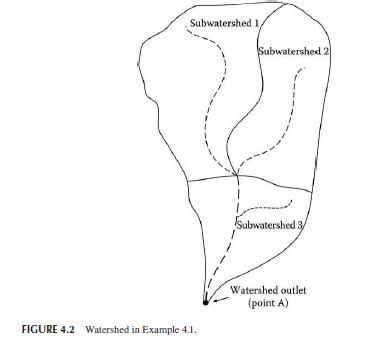
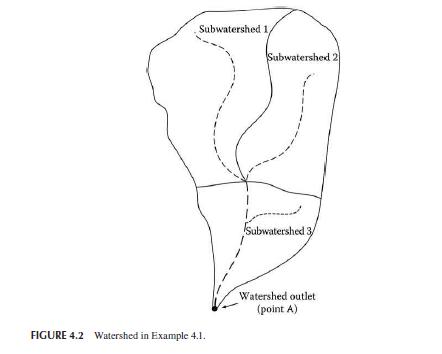
The channel system shown in Figure 4.2 can be viewed as consisting of three reaches. Subareas 1, 2, and 3 have reaches of lengths 4,940, 2,440, and 3,670 m, respectively. As it is shown in Figure 4.2 , the watershed lengths are defined as subwatershed lengths, and the length measurements for
For the given watershed in Figure 4.2 , calculate the channel and watershed slope based on the altitude data given in Table 4.1 . Subwatershed 1, Subwatershed 2 Subwatershed 3/ FIGURE 4.2 Watershed in Example 4.1. Watershed outlet. (point A)
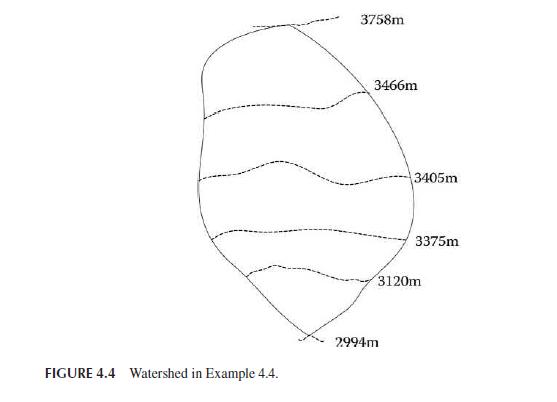
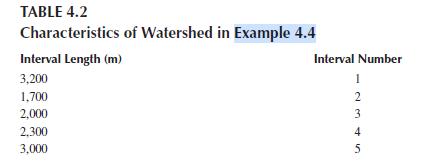
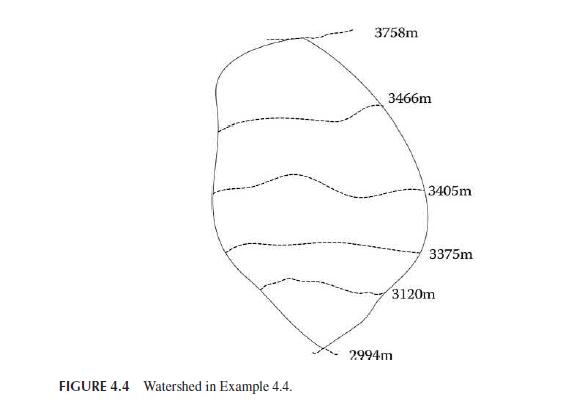
Estimate the average slope of the watershed shown in Figure 4.4 regarding Table 4.2 if the watershed is divided into five intervals. FIGURE 4.4 Watershed in Example 4.4. 3758m 2994m 3466m 3405m 3375m 3120m
Estimate the average slope of Figure 4.4 without any interval. FIGURE 4.4 Watershed in Example 4.4. 3758m 2994m 3466m 3405m 3375m 3120m
Consider a parking lot with length 50 m and slope 0.005 . The effective Manning’s coefficient of the parking lot is 0.020 . Determine the runoff hydrograph for a constant rainfall excess rate equal to 15 mm/h at the downstream end of the parking lot. Solve the example for two rainfall durations
Determine the peak discharge resulting from a 1-hour rainfall with a constant intensity equal to 1.5 × 10⁻⁵ m/s that happens on a pervious rectangular basin with the following characteristics:L = 120 m, S = 0.002 , and n = 0.02 . The infiltration parameters are 9 = 0.414 , K = 1.5 × 10⁶ m/s,
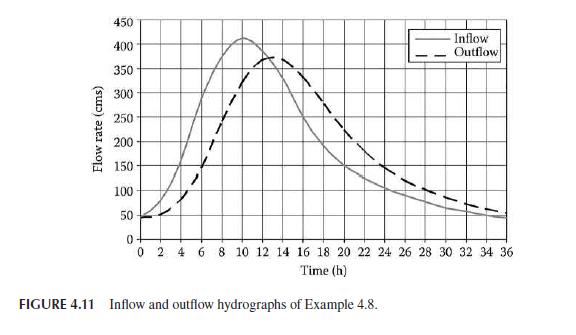
The inflow hydrograph for a channel reach with an initial steady flow equal to 45 m3/s is given in Figure 4.11 . Calculate the outflow hydrograph in 1-hour time increments. The Muskingum parameters are determined as K = 3 hours and X = 0.15 . 350 300 250 200 Flow rate (cms) 150 100 450 400 Inflow
The diameter of a pipe varies between 200 and 100 mm from section A to section B, respectively. The pressure at section A is 8.15 m, and there is a negative pressure equal to 2.5 m at section B. The velocity in section A is 1.8 m/s. If section B is 7 m higher than section A, calculate (a) the flow
Determine the friction factor for water flowing at a rate of 0.028 cm in a cast iron pipe 50 mm in diameter at 80°F. The pipe roughness is e = 2.4 × 10⁻⁴ m.
Determine the head loss in a cast iron pipe that delivers water at a rate of 0.03 cm at 45°C between two points A and B. The pipe diameter and length are 150 mm and 300 m, respectively. If point B is 25 m higher than point A and both of the points have the same pressure, what is the pump head
Compute the head loss in Example 4.11 by using the Hazen–Williams formula.Data from example 4.11 Determine the head loss in a cast iron pipe that delivers water at a rate of 0.03 cm at 45°C between two points A and B. The pipe diameter and length are 150 mm and 300 m, respectively. If point B
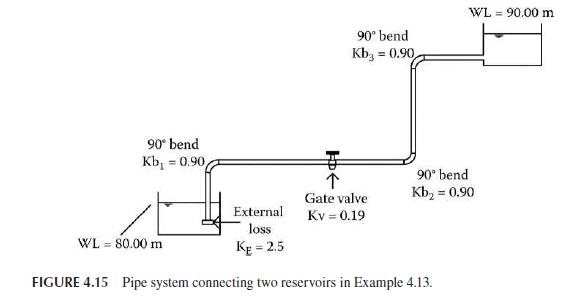
Two reservoirs are connected by a 200-m-long cast iron pipeline, as shown in Figure 4.15 . If the pipeline is proposed to convey a discharge of 0.2 m3/s, what is the required size of the pipeline(υ = 1.3 mm2/s)? 90 bend Kb =0.90, 90 bend Kb3 = 0.90 Gate valve 90 bend Kb = 0.90 External loss Kv
A pumping system is employed to pump a flow rate of 0.15 m3/s. The suction pipe diameter is 200 mm and the discharge pipe diameter is 150 mm. The pressure at the beginning of the suction pipe A is −2 m and at the end of the discharge pipe B is 15 m. The discharge pipe is about 1.5 m above the
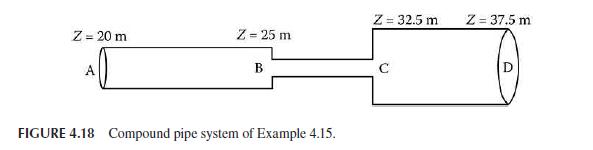
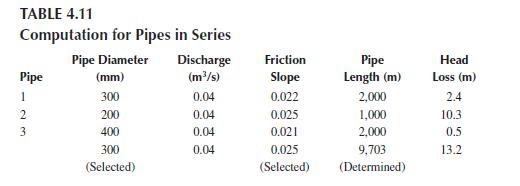
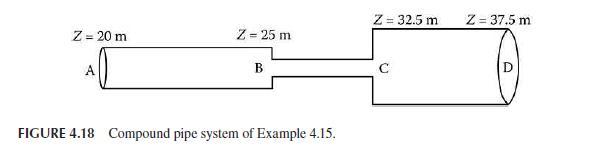
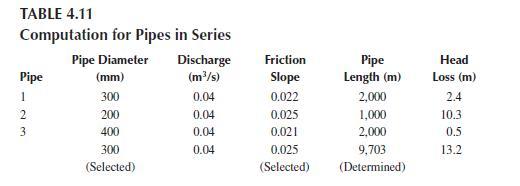
For a flow rate of 0.04 m3/s, determine the pressure and total heads at points A, B, C, and D for the series pipes shown in Figure 4.18 and Table 4.11 . Assume a fully turbulent flow for all cases and the pressure head at point A to be 40 m. Determine the length of an equivalent pipe having a
For the series pipe system in Example 4.15 , find the equivalent roughness coefficient and the total head at point D for a flow rate of 0.03 m3/s.Data from example 4.15 For a flow rate of 0.04 m3/s, determine the pressure and total heads at points A, B, C, and D for the series pipes shown in
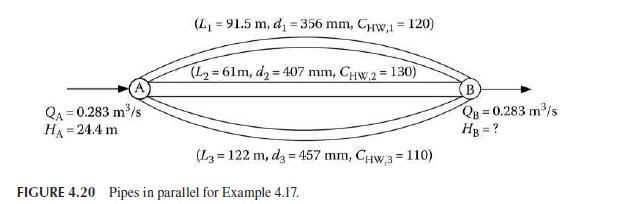
Given the data for the three parallel pipes in Figure 4.20 , compute (1) the equivalent parallel pipe coefficient, (2) the head loss between nodes A and B, (3) the flow rates in each pipe, (4) the total head at node B, and (5) the diameter of an equivalent pipe with length 100 m and Chw = 100.
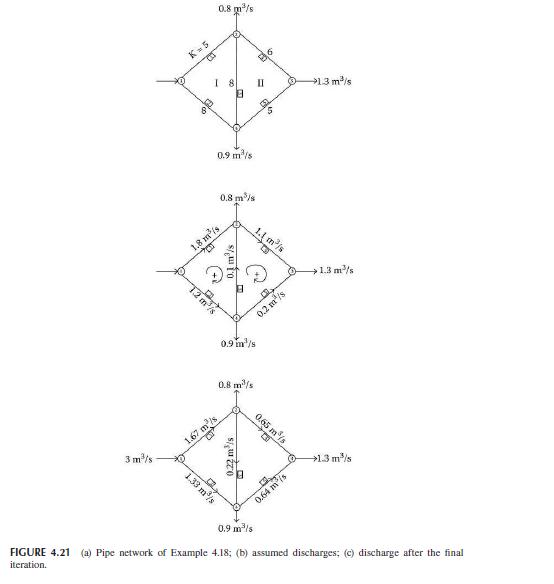
Find the discharge in each pipe of the pipe network shown in Figure 4.21 . The head loss in each pipe is calculated by using hf = KQ1.852, where the values of K for each pipe are given in Figure 4.21 . The pressure head at point 1 is 100 m. Determine the pressure at different nodes. 3 m/s K-5 0.8
A sewer has to be laid in a place where the ground has a slope of 0. 002. If the present and ultimate peak sewage discharges are 40 and 165 L/s, design the sewer section.
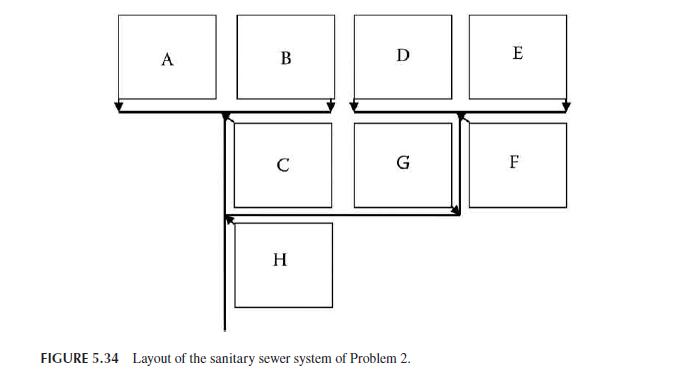
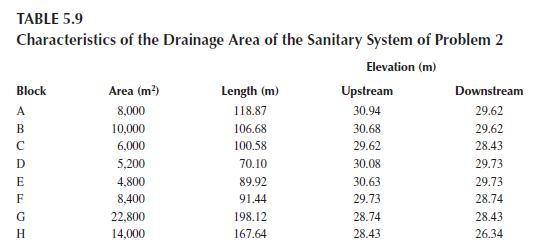
The layout of a sanitary sewer system is as shown in Figure 5. 34. Data on area, length, and elevations are given in Table 5. 9. The current population density, 100 persons/ha, is expected to increase to 250 persons/ha by the conversation of the dwellings to apartments.The peak rate of sewage flow
Storm sewers need to be installed in a new development. Four inlets are proposed with pipes running from inlet A to B, then to C, and finally to D. Data associated with each pipe and inlet are listed below. The size all of the pipes, assuming that rainfall intensity, can be described by the
Does a storm sewer pass its greatest flow rate when it is just flowing full? Explain.
Determine the spacing to the first and second inlets that will drain a section of highway pavement if the runoff coefficient is 0. 9 and the design rainfall is 15 cm/h. The pavement width is 10 m (SX = 0. 02, SL = 0. 02, and n = 0. 016), the efficiency of inlet is 0. 35, and the allowable spread is
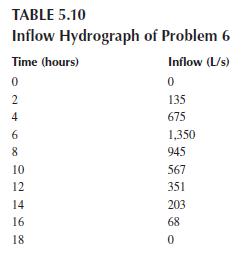
Using the Muskingum method, route the inflow hydrograph given in Table 5. 10, assuming (a) K = 4 hours and X = 0. 12 and (b) K = 4 hours and X = 0. 0. Plot the inflow and outflow hydrographs for each case, assuming the initial outflow equals the inflow. TABLE 5.10 Inflow Hydrograph of Problem 6
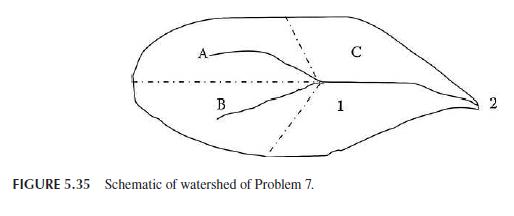
A storm event occurred in a watershed that produced a rainfall pattern of 5 cm/h for the first 10 minutes, 10 cm/h in the second 10 minutes, and 5 cm/h in the next 10 minutes.The watershed is divided into three subbasins (Figure 5. 35) with the 10-minute unit hydrographs (UHs) as specified in Table
Consider an impervious area with a length of 40 m, the slope of 0. 03. The effective Manning coefficient is 0. 03. Determine the runoff hydrograph for a constant rainfall excess rate of 20 mm/h with a 10-minute duration at the exit point of the area.
Determine the HR of a roadway culvert flooded with 50 years of expected service life designed to carry a 100-year storm.
Curb-opening inlets are placed along a 20 m wide street. The length of the inlets is 1 m that are placed on a continuous grade and the runoff coefficient is 0. 9. The inlets drain the stormwater into a triangular gutter with SX = 0. 03, S = 0. 02, and n = 0. 03. Determine the maximum allowable
Determine the depth and width of a straight trapezoidal channel (Cs = 1. 0) lined with weeping love grass which is expected to carry Q = 0. 75 m3/s. The channel bottom slope is S = 0. 02 and its side slopes are the same and equal to z = 1. 5.
Determine the headwater depth for a culvert that conveys a flow of 0. 5 m3/s under inlet control conditions. The culvert is circular and has a square edge inlet which is mitered with a headwall and a diameter of 2 m and a slope of 0. 01.
Calculate the WQCV for a 1.0 -acre subwatershed in New York with a total area-weighted imperviousness of 50% that drains to a rain garden:
The water quality volume (WQV) is determined to be 1.44 acres‐feet for an area of 38 acres with 60% imperviousness.Size the sediment forebay and the permanent pool volume for a wet pond and an extended detention wet pond.
Curb-opening inlets are placed along a 10-m-wide street. The length of the inlets is 0.8 m, and the inlets are placed on a continuous grade, and the runoff coefficient is 0.85 . The inlets drain stormwater to a triangular gutter with SX = 0.025 , S = 0.015 , and n = 0.015 . Determine the maximum
Determine the HR of a roadway culvert with 25 years’ expected service life designed to carry a 50-year storm.
Determine the design return period for the culvert of the previous example if the acceptable HR is 0.15 (or 15%).Data from previous example Determine the HR of a roadway culvert with 25 years’ expected service life designed to carry a 50-year storm.
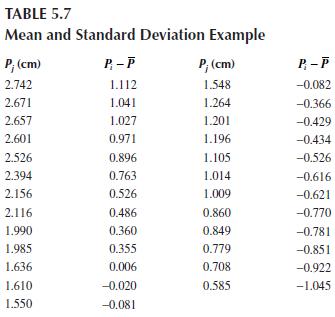
Determine the 15-minute storm depths and the average intensities with return periods of 5, 10, 25, 50, and 100 years for a 25-year annual maximum series of 15-minute storm depths given in the first and third columns of Table 5.7 . Suppose that the extreme value type I distribution (the Gumbel
A laboratory test for BOD5 is carried out by mixing a 10 mL sample with distilled water into a 300 mL bottle. Prior to the test, the DO concentration of the mixture was 7.45 mg/L, and after 5 days, it had reduced to 1.45 mg/L. What is the BOD5 concentration of the sample?
Calculate the water consumption (average daily rate, maximum daily rate, maximum hourly rate, and flow rate) for a town of 10,000 people in semiarid area with limited water supply resources. As it is an old urban area, the buildings do not have good resistance against fire. Almost more than 90% of
A small community with a population of 1,000 has a trucked water supply system that provides water from a lake (3 km from a village). There are 200 houses, one hotel, one hospital, one school, one nursing station, and two general stores in the community and the largest area is about 2,000 m2. The
Why are distribution pipes not sized according to maximum hourly demand plus fire flow instead of maximum daily demand plus fire flow?
Chlorination is the usual method for disinfecting water.a. Name the two parameters that control the extent of disinfection.b. Why is it necessary to guard against an overdose of chlorine?c. Assume that disinfection with chlorine follows a first-order reaction (the disinfection rate has a direct
Water having a temperature of 15°C is flowing through a 150 mm ductile iron main at a rate of 19 L/s. Is the flow laminar, turbulent, or transitional?
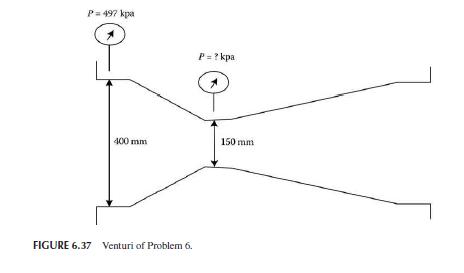
Assuming that there are no head losses through the Venturi meter demonstrated in Figure 6. 37, what is the pressure reading in the throat section of the Venturi? Assume that the discharge through the meter is 0. 6 m3/s. P=497 kpa P = ?kpa 400 mm 150 mm FIGURE 6.37 Venturi of Problem 6.
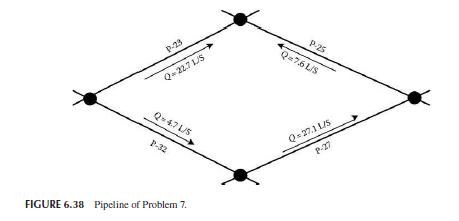
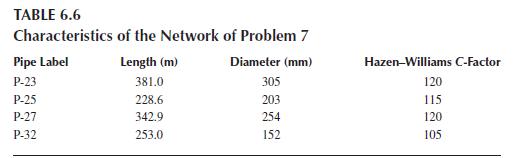
Does conservation of energy apply to the system represented in Figure 6. 38? Based on the conservation of energy, the summation of head losses in a loop should be equal to zero.Data describing the physical characteristics of each pipe are presented in Table 6. 6 and neglect the minor losses in this
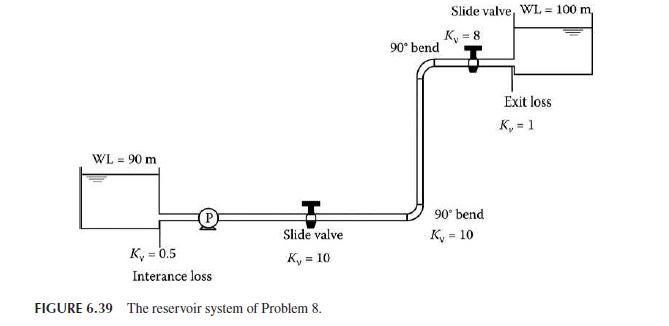
Find the pump head needed to deliver water from the lower reservoir to the upper reservoir in Figure 6. 39 at a rate of 0. 3 m3/s. The suction pipe length, diameter, and roughness coefficient are 20 m, 200 mm, and 130, respectively. The discharge pipe length and diameter are 200 m and 300 mm and
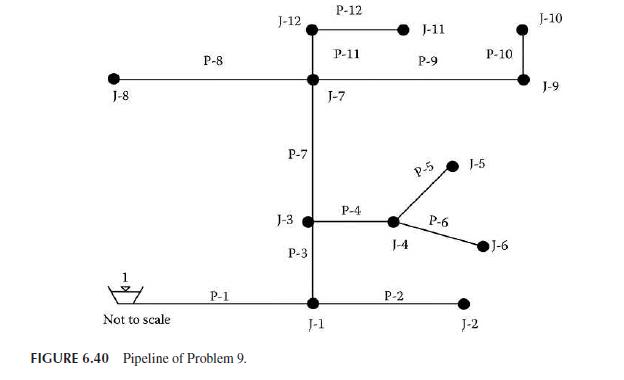
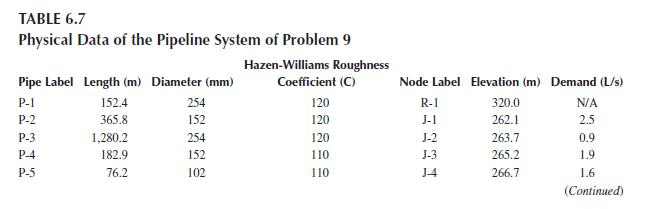
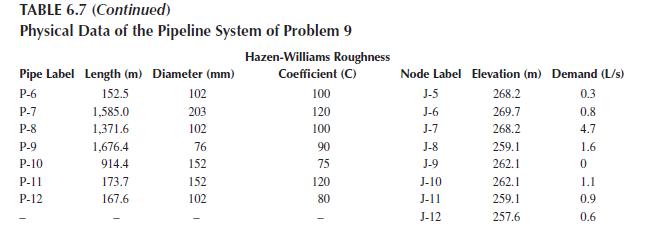
Manually find the discharge through each pipeline and the pressure at each junction node of the rural water system shown in Figure 6. 40. Physical data for this system are given in Table 6. 7. P-12 J-12 J-10 J-11 P-11 P-10 P-8 P-9 J-9 J-8 J-7 P-7 P-5 1-5 J-3 P-4 P-3 P-6 J-4 J-6 P-1 P-2 Not to scale
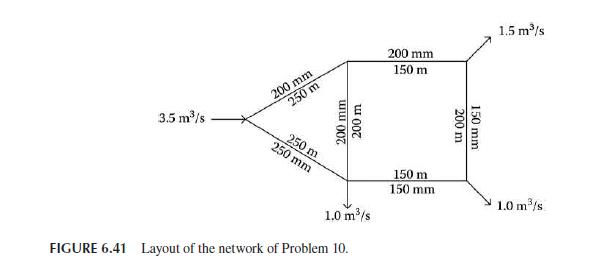
In the network depicted in Figure 6. 41, determine the discharge in each pipe. Assume that f = 0. 015. 3.5 m/s 200 mm 250 m 250 m 250 mm 200 mm 200 m 200 mm 150 m 1.5 m/s 1.0 m/s FIGURE 6.41 Layout of the network of Problem 10. 150 m 150 mm 200 m 150 mm 1.0 m/s
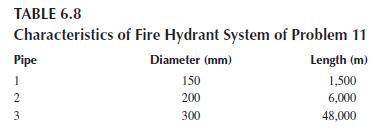
A fire hydrant is supplied through three welded steel pipelines (f = 0. 012) arranged in series(Table 6. 8). The total drop in pressure due to friction in the pipeline is limited to 35 m.What is the discharge through the hydrant? 123 Pipe TABLE 6.8 Characteristics of Fire Hydrant System of Problem
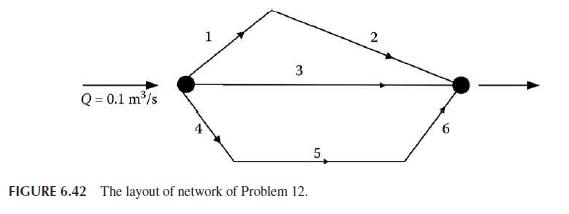
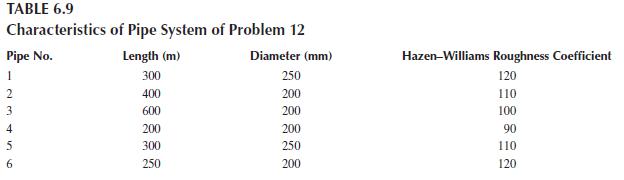
The characteristics of the pipe system illustrated in Figure 6. 42 are presented in Table 6. 9. (a) Determine the diameter of the equivalent pipe of this system with 600 m length and the Hazen–Williams roughness coefficient is equal to 130. (b) Determine the Hazen–Williams roughness coefficient
A cast iron pipe is employed to deliver a flow rate of 0. 1 m3/s, between two points that are 800 m apart. Determine the pipe size if the allowable head loss is 10 m and the Hazen–Williams roughness coefficient is 130.
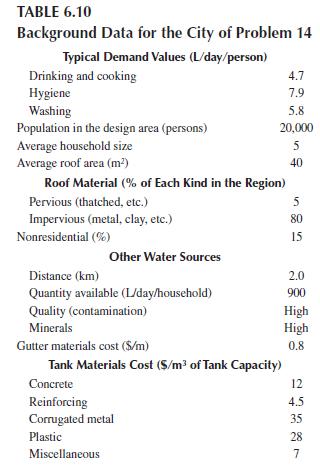
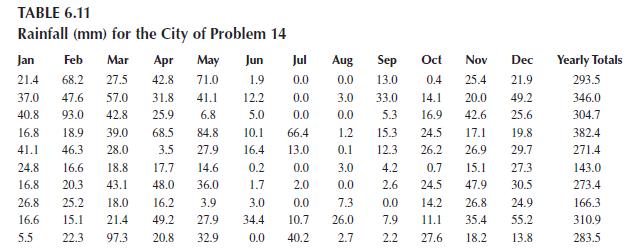
Consider a small city with a river as a major alternate source of water supply. People on the edge of the city are not being served by a central water system. See the background data for the city in Table 6. 10. The rainfall data for this city are given in Table 6. 11. A. Determine whether the
Estimate the storage tank size of the city described in Problem 1, using the curve mass method.Data from problem 1Calculate the water consumption (average daily rate, maximum daily rate, maximum hourly rate, and flow rate) for a town of 10,000 people in semiarid area with limited water supply
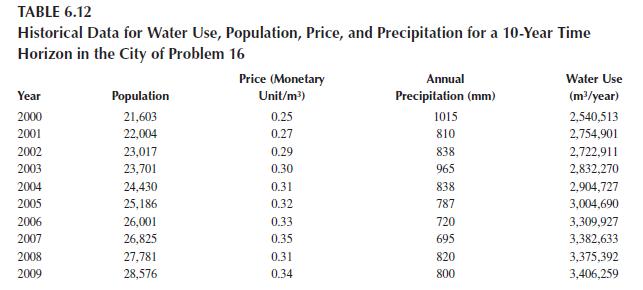
Historical data for water use, population, price, and precipitation in a city for a 10-year time horizon are given in Table 6. 12. Formulate a multiple regression model for estimating the water use data and comment on selecting the independent variables. TABLE 6.12 Historical Data for Water Use,
The monthly data of water price and consumption of a city is given in Table 6. 13. Determine the price elasticity. Discuss the effectiveness of applying pricing strategies for decreasing water consumption. TABLE 6.13 Price and Water Consumption Data of Problem 17 Consumption (MCM) Price ($/cm) 260
Consider a city with about 1 million habitants. The daily water consumption per capital is about 180 L, the average temperature is 28°C, and the weather humidity is
The linear demand model derived by Hanke and de Marg (1982) for Malmo, Sweden, iswhere Q is the quantity of metered water used per house per semiannual period (m3).Inc is the real gross income per house per annum (in Swedish crowns; actual values reported per annum and interpolated values used for
Determine the elasticity of demand for the water demand model in Problem 19 using P = 1. 5 and Q = 75. 2; P = 3. 0 and Q = 75. 2; P = 2. 25 and Q = 45; and P = 2. 25 and Q = 100.
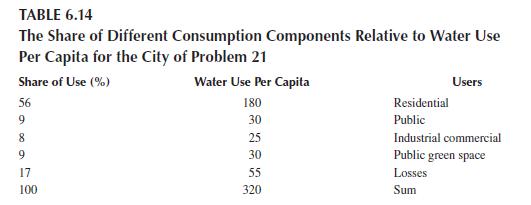
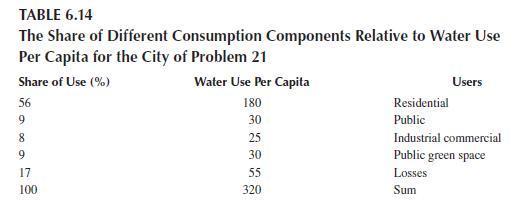
Consider a city with current population of 1 million (year 2009). We are planning to develop the water supply facilities of this city during the next 20 years. The water consumption per capita for this city is presently 320 L/day. The share of different consumption components relative to water
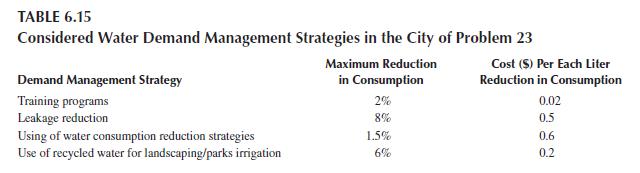
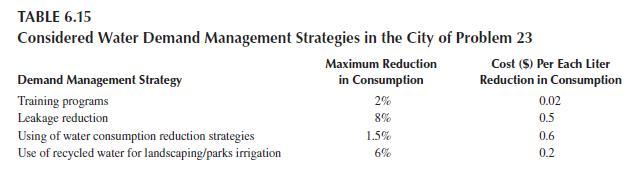
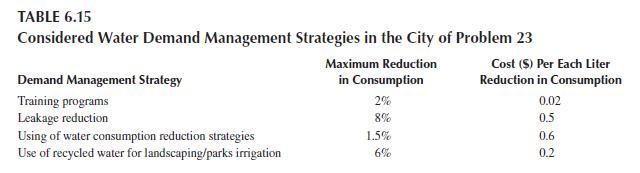
In order to fill the water supply and demand gap of the city of Problem 21 for the year 2029, the following demand management strategies are recommended:a. Water withdrawn from a groundwater source up to 20 MCM/year.b. Reduction of network losses from 17% of total water supply to 15% by
Consider a small city with a population of 100,000. The water consumption per capita in this city is about 250 L/day. The available water supply system of this city includes a surface reservoir with an annual water supply capacity of 15 MCM. The population growth rate has been determined equal to
A survey on a water distribution network with 25% loss shows that 18% of the losses are due to physical losses of the network and the remaining is not a real loss. Fifty percent of physical losses are apparent and reported by people to the water supply agency. The survey result shows that 25% of
In Problem 23, the shortages should be met by supplying from groundwater resources. The cost of meeting the demand by supplying from groundwater is a function of the volume of water that should be extracted. The cost of water extraction for domestic demands is estimated as CDom = 1000 . x2 Dom
In Problem 23, the city discharges its wastewater to the river upstream of the agricultural lands. The monthly wastewater discharge rate is about 20% of the water use of the city in each month. In order to keep the quality of the river flow in an acceptable range for irrigation, the pollution load
Estimate the population of a town in the year 2010 based on the past population data given in Table 6.1 .
(a) What is the main constituent of concern in WWT? (b) For each of the following unit operations in a WWT train, briefly describe how it removes some of the constituents you identified in part a:– Grit chamber– Primary sedimentation basin– Biological reactor– Secondary clarifier– Digestor
Briefly describe how primary WWT differs from secondary WWT.
A rectangular primary clarifier for a domestic wastewater plant is to be designed to settle 2,000 m3/day with an overflow rate of 32 m3/m2 day. The tank is to be 2. 4 m deep and 4. 0 m wide. How long should it be, and what detention time would it have?
4. A final settling tank for a 2-million-gallon-per-day (2 MGD) activated sludge treatment plant has an average overflow rate of 800 g/day ft2. The tank needs to have a minimum detention time of 2. 0 hours and allow proper settling, and it must be at least 11 ft deep.If the tank is circular, what
5. A perfectly mixed aeration pond with no recycling (return line) serves as the small community’s biological reactor. The pond receives 30 m3/day of influent with a BOD5 of 350 mg/L that must be reduced to 20 mg/L before discharge. It has been found that the kinetic constants for the system are
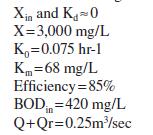
Determine the theoretical hydraulic detention time and volume of a completely mixed reactor with recycle to be used in an activated sludge treatment plant operating at steady state if the following conditions and constants for the wastewater have been determined: Xin and K =0 X=3,000 mg/L K=0.075
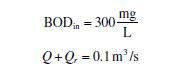
Calculate the required aeration tank volume for an activated sludge treatment plant on the bases of the empirical design factors. The anticipated waste volumetric flow rate is 0. 068 m3/sec and the BOD concentration is 350mg/L. Assume that the concentration of microorganisms in the reactor is kept
In case study 1a. What is the proposed methodology for quantitative and qualitative assessment of reliability for a typical WWTP under coastal flooding?b. What is the main issue and how can it be related to the wastewater infrastructure system?c. What parts do the inflow to the plant system
What is the volume in cubic feet of a rectangular tank that is 10 ft by 30 ft by 16 ft, and how many gallons can fit in it?
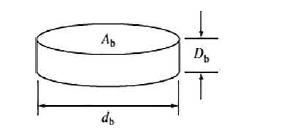
What is the volume of a tank in gallons if it is 12 ft deep and has a diameter of 30 ft?
How many hours will it take to fill each tank above if the flow entering them is 1. 3 MGD?
Your superintendent wants to know how efficient your primary clarifier was at removing solids during a major rainstorm a few days earlier. The lab tech tells you that the average 24-hour composite TSS of the sewage entering the primary settling tank on the day in question was 228 ppm, and the
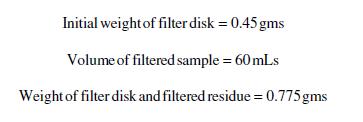
What is the mixed SSs concentration given the following? Initial weight of filter disk = 0.45 gms Volume of filtered sample = 60 mLs Weight of filter disk and filtered residue = 0.775gms
A WWT facility has three primary clarifiers available for use. They are all circular clarifiers with a radius of 40 ft and a depth of 8 ft. The design engineer wants you to maintain a primary clarification detention time of approximately 3. 5 hours. How many tanks will you need to use if the plant
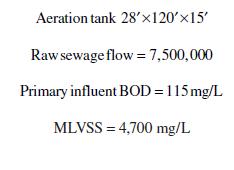
What is the daily food to microorganism ratio given the following? Aeration tank 28'x120'x15' Raw sewage flow=7,500,000 Primary influent BOD = 115 mg/L MLVSS 4,700 mg/L
Laboratory tests indicate that the volatile content of a raw sludge was 77%, and after digestion, the content is 41%. Calculate the percent reduction of volatile matter.
A facility feeds chlorine to the contact tank at a rate of about 280 gallons every day—the plant flow averages about 2. 9 MGD. However, due to filamentous bacteria, you must also chlorinate RAS, using about 20 gallons/day for that purpose. Also, the facility superintendent has about 15
How many pounds of solids are under aeration in an aeration tank that is 30ʹ by 70ʹ by 15ʹ and if the MLSS is 3,200 mg/L?
If an activated sludge aeration basin receives a flow of 0. 69 MGD at a BOD concentration of 175 mg/L, how many pounds of BOD enter the aeration basin each day?
If the aeration basin from question 11 is 130 ft long, 35 ft wide, and 15 ft deep, what is its organic loading in pounds of BOD/day/1,000 ft3?
An activated sludge aeration basin is 90 ft long, 25 ft wide, and 15 ft deep. The flow rate to it is 0. 75 MGD at a CBOD concentration of 210 mg/L. If the MLVSS concentration is 2,500 mg/L, what is the F/M ratio?
An activated sludge aeration basin is 75 ft long, 25 ft wide, and 13 ft deep. The flow rate to it is 0. 68 MGD at a CBOD concentration of 194 mg/L. If the MLVSS concentration is 2,114 mg/L, what is the F/M ratio?
Given the following data about an activated sludge plant, calculate the SRT at which it is operating:Influent flow = 9,020,000 GPD Aeration basin dimensions: 160 × 50 × 18 ft Final clarifier dimensions: 94 ft diameter; 12 ft deep MLVSS Concentration: 2,800 mg/L Waste sludge concentration: 5440
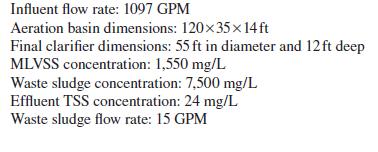
Calculate the SRT for the following activated sludge plant. Influent flow rate: 1097 GPM Aeration basin dimensions: 120x35x14ft Final clarifier dimensions: 55 ft in diameter and 12 ft deep MLVSS concentration: 1,550 mg/L Waste sludge concentration: 7,500 mg/L Effluent TSS concentration: 24 mg/L
A town of 30,000 send 0.5 m3 of wastewater per person per day to the WWTP. A conventional circular primary clarifier would be designed to have an average detention time of 2.0 hours and an average overflow rate of 40 m/day, whereas a high-rate clarifier would have an average overflow rate of 1,500
An aeration basin is 90 ft long, 25 ft wide, and 13 ft deep. If it receives a flow of 0.24 MGD (million gallons per day) at a BOD concentration of 225 mg/L, what is the basin’s loading in pounds of BOD/day/1,000 ft3?
An aeration basin is 80 ft long, 20 ft wide, and 12 ft deep. If the flow rate to it is 0.43 MGD at a CBOD concentration of 150 mg/L and the mixed liquor volatile suspended solid (MLVSS) concentration is 1,350 mg/L, what is the food-to-microorganism ratio (F/M)?
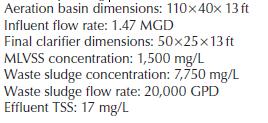
Given the following data about an activated sludge plant, calculate solids retention time (SRT) at which it is operating: Aeration basin dimensions: 110x40x 13ft Influent flow rate: 1.47 MGD Final clarifier dimensions: 50x25x13 ft MLVSS concentration: 1,500 mg/L Waste sludge concentration: 7,750
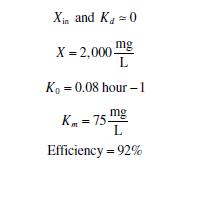
Determine the theoretical hydraulic detention time and volume of a completely mixed reactor with recycle to be used in an activated sludge treatment plant operating at steady state if the following conditions and constants for the wastewater have been determined: Xin and Kd=0 X=2,000mg L K = 0.08
Calculate the required aeration tank volume for an activated sludge treatment plant on the bases of the empirical design factors. The anticipated waste volumetric flow rate is 0.044 m3/s and the BOD concentration is 250 mg/L. Assume that the concentration of microorganisms in the reactor is kept at
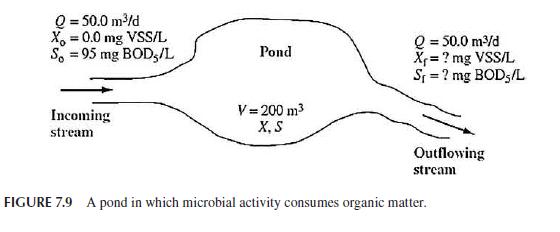
The shallow pond depicted in Figure 7.9 stays well mixed due to the wind and the steady flow-through of a small creek.If the microbes in the pond consume the inflowing biodegradable organic matter according to typical kinetics, determine:a. The BOD5 leaving the pondb. The biodegradable organic
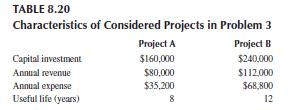
Consider the two mutually exclusive alternatives A and B for a water diversion project as described in Table 8. 20. Assume that the study period is 15 years and repeatability is applicable. Using the annual worth method, which project do you recommend? TABLE 8.20 Characteristics of Considered
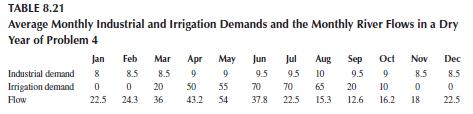
A river supplies water to an industrial complex and agricultural lands located downstream of the complex. The average monthly industrial and irrigation demands and the monthly river flows in a dry year are given in Table 8. 21 (numbers are in million cubic meters). The prices of water for
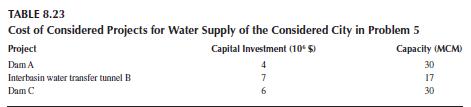
The variation of annual water demand of a city over a 30-year planning time horizon is exhibited in Table 8. 22. The current demand of this city is about 90 million cubic meters.Three projects are studied in order to supply the demands of this city. Considering the cost of each project given in
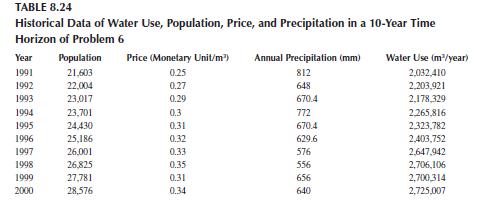
Assume that you want to model the water demand of a city in order to forecast the municipal demands in the coming years. The historical data of water use, population, price, and precipitation in a 10-year time horizon are presented in Table 8. 24. Formulate a multiple regression model for
Showing 3000 - 3100
of 4723
First
24
25
26
27
28
29
30
31
32
33
34
35
36
37
38
Last
Step by Step Answers

 Get 50% OFF
Claim Now
Get 50% OFF
Claim Now