



Question: Derive the SISO black-box identification algorithm described in Section 10.4 when the excitation input u(k) is a unit step signal. SISO black-box 10.4 BLACK-BOX IDENTIFICATION
Derive the SISO black-box identification algorithm described in Section 10.4 when the excitation input u(k) is a unit step signal.
SISO black-box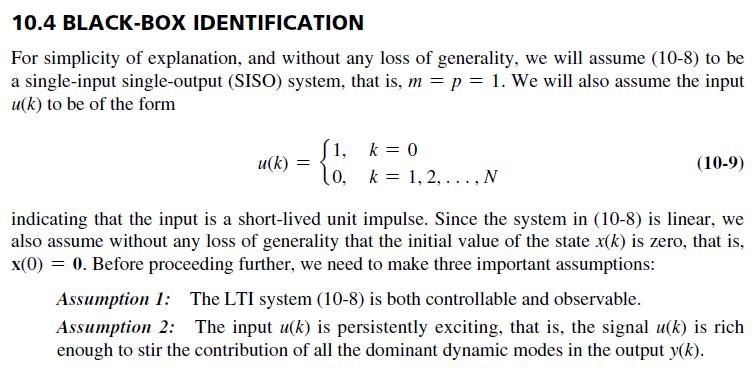
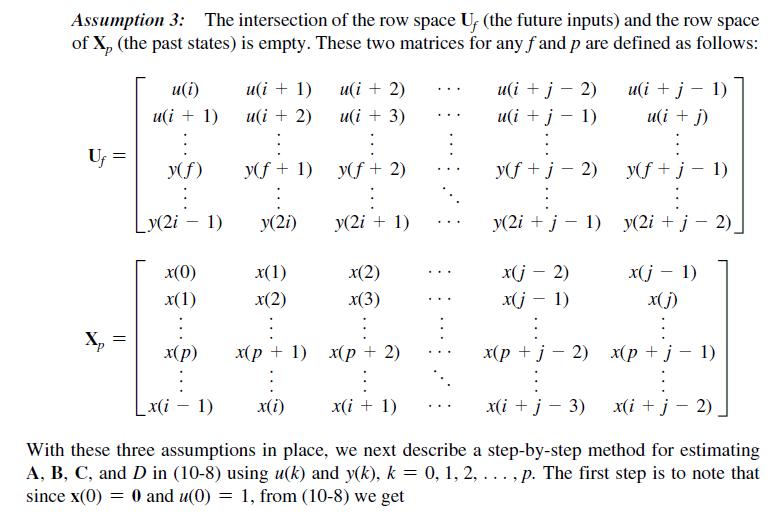
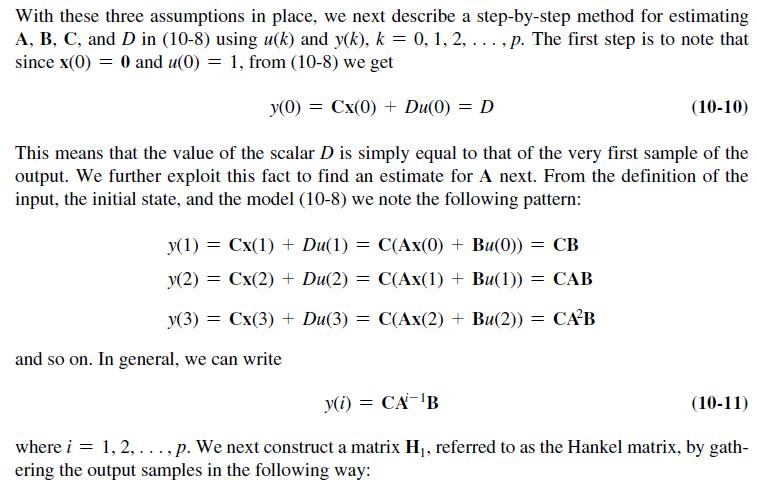
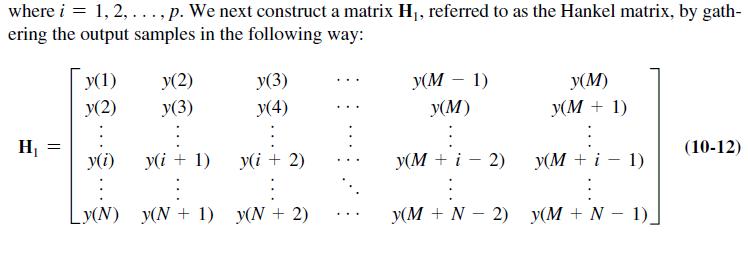
10.4 BLACK-BOX IDENTIFICATION For simplicity of explanation, and without any loss of generality, we will assume (10-8) to be a single-input single-output (SISO) system, that is, m = p = 1. We will also assume the input u(k) to be of the form 1, k = 0 u(k) = lo, k = 1, 2,...,N (10-9) indicating that the input is a short-lived unit impulse. Since the system in (10-8) is linear, we also assume without any loss of generality that the initial value of the state x(k) is zero, that is, x(0) = 0. Before proceeding further, we need to make three important assumptions: Assumption 1: The LTI system (10-8) is both controllable and observable. Assumption 2: The input u(k) is persistently exciting, that is, the signal u(k) is rich enough to stir the contribution of all the dominant dynamic modes in the output y(k).
Step by Step Solution
There are 3 Steps involved in it

Get step-by-step solutions from verified subject matter experts