



Question: For the elliptical hole problem in Example 12.5, show that by letting m = 0, the stress results will reduce to those of the circular
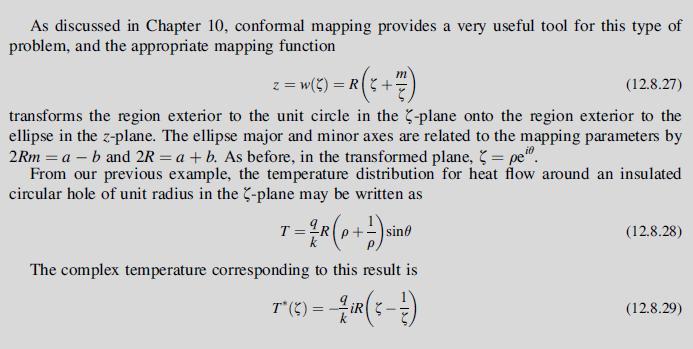
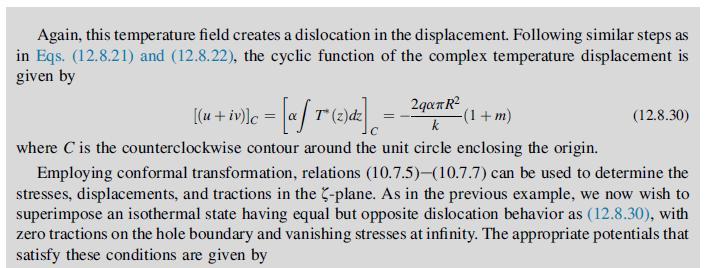
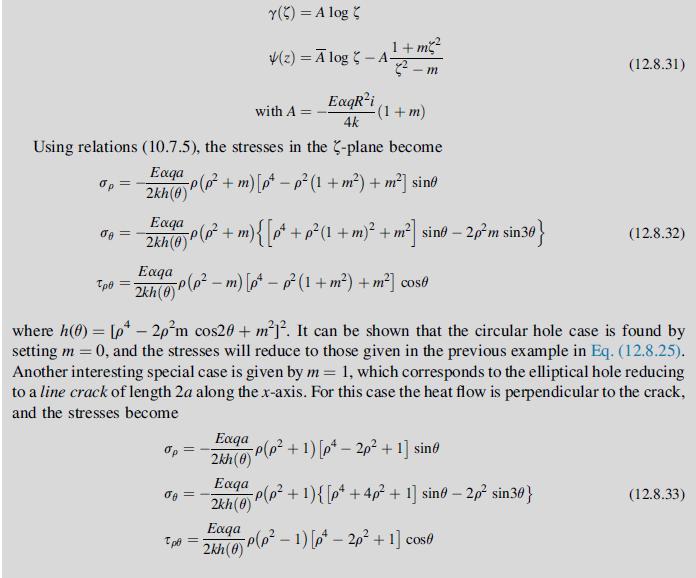
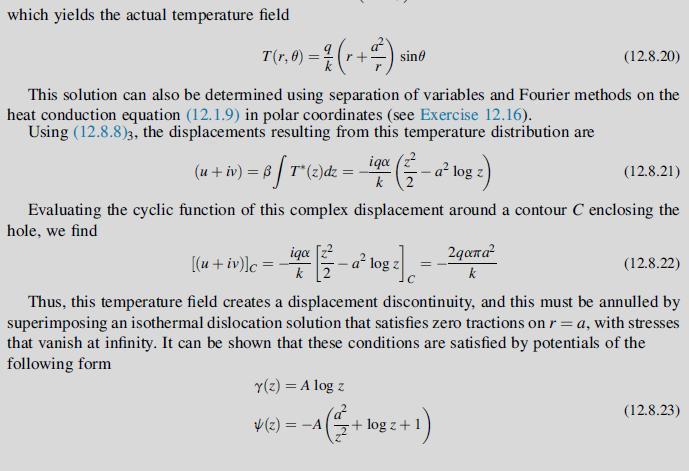
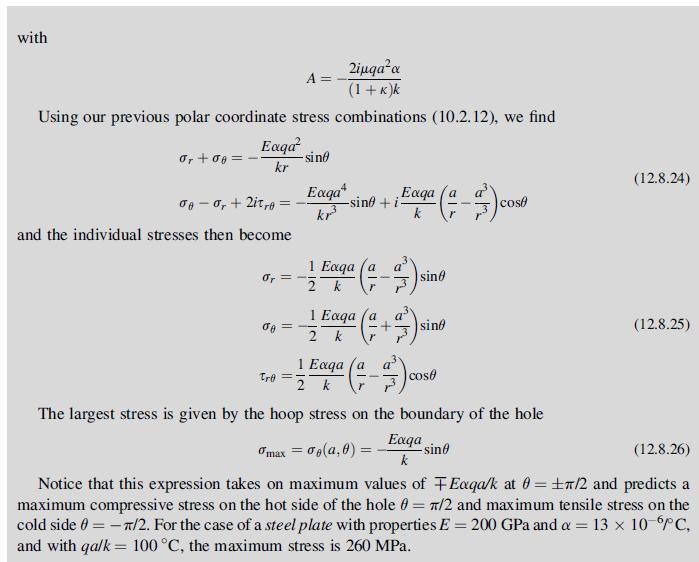
For the elliptical hole problem in Example 12.5, show that by letting m = 0, the stress results will reduce to those of the circular hole problem given in Example 12.4.
Data from example 12.5
![with h(0) = [p* - 2p cos20 + 1]. On the surface of the crack (p = 1), the hoop stress becomes Je (1,0) Exqa 3](https://dsd5zvtm8ll6.cloudfront.net/images/question_images/1705/1/3/0/18665a238cab48181705130185326.jpg)
Data from example 12.4
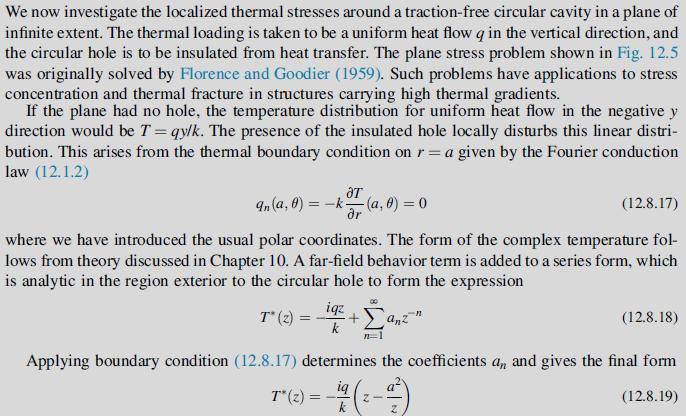
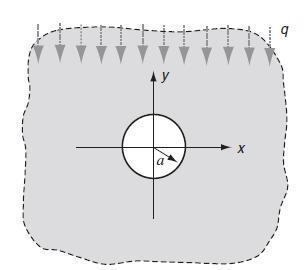
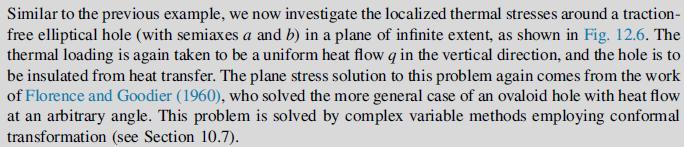
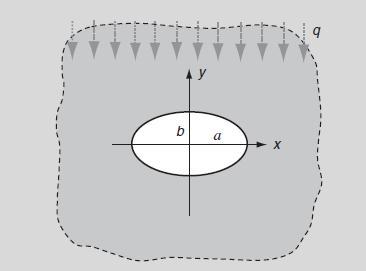
Similar to the previous example, we now investigate the localized thermal stresses around a traction- free elliptical hole (with semiaxes a and b) in a plane of infinite extent, as shown in Fig. 12.6. The thermal loading is again taken to be a uniform heat flow q in the vertical direction, and the hole is to be insulated from heat transfer. The plane stress solution to this problem again comes from the work of Florence and Goodier (1960), who solved the more general case of an ovaloid hole with heat flow at an arbitrary angle. This problem is solved by complex variable methods employing conformal transformation (see Section 10.7).
Step by Step Solution
3.52 Rating (152 Votes )
There are 3 Steps involved in it
To extract the circular hole case from Example 125 let a b m 0 and ... View full answer

Get step-by-step solutions from verified subject matter experts