







Question: Repeat Prob. 1424, but with a rough pipepipe roughness = 0.12 mm. Assume that a modified pump is used, such that the new pump
Repeat Prob. 14–24, but with a rough pipe—pipe roughness ε = 0.12 mm. Assume that a modified pump is used, such that the new pump operates at its free delivery conditions, just as in Prob. 14–24. Assume all other dimensions and parameters are the same as in that problem. Do your results agree with intuition? Explain.
Data from Problem 14–24.
Suppose the pump of Fig. P14–23 is operating at free delivery conditions. The pipe, both upstream and downstream of the pump, has an inner diameter of 2.0 cm and nearly zero roughness. The minor loss coefficient associated with the sharp inlet is 0.50, each valve has a minor loss coefficient of 2.4, and each of the three elbows has a minor loss coefficient of 0.90. The contraction at the exit reduces the diameter by a factor of 0.60 (60% of the pipe diameter), and the minor loss coefficient of the contraction is 0.15. Note that this minor loss coefficient is based on the average exit velocity, not the average velocity through the pipe itself. The total length of pipe is 8.75 m, and the elevation difference is (z1 = z2) = 4.6 m. Estimate the volume flow rate through this piping system.
FIGURE P14–23
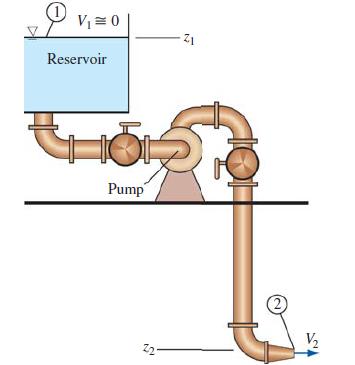
1 V = 0 Reservoir Pump 22 Z1 V/
Step by Step Solution
3.42 Rating (161 Votes )
There are 3 Steps involved in it
To repeat Problem 1424 with a rough pipe of roughness 012 mm we can use the following steps Calculate the friction factor f using the Colebrook equati... View full answer

Get step-by-step solutions from verified subject matter experts
 Study Help