







Question: Repeat Prob. 1460, but with the pipe diameter increased by a factor of 2 (all else being equal). Does the volume flow rate at which
Repeat Prob. 14–60, but with the pipe diameter increased by a factor of 2 (all else being equal). Does the volume flow rate at which cavitation occurs in the pump increase or decrease with the larger pipe? Discuss.
Data from Problem 14–60
A self-priming centrifugal pump is used to pump water at 25°C from a reservoir whose surface is 2.2 m above the centerline of the pump inlet (Fig. P14–60). The pipe is PVC pipe with an ID of 24.0 mm and negligible average inner roughness height. The pipe length from the submerged pipe inlet to the pump inlet is 2.8 m. There are only two minor losses in the piping system from the pipe inlet to the pump inlet: a sharp-edged reentrant inlet (KL = 0.85), and a flanged smooth 90° regular elbow (KL = 0.3). The pump’s required net positive suction head is provided by the manufacturer as a curve fit: NPSHrequired = 2.2 m + (0.0013 m/Lpm2)V̇2, where volume flow rate is in Lpm. Estimate the maximum volume flow rate (in units of Lpm) that can be pumped without cavitation.
FIGURE P14–60
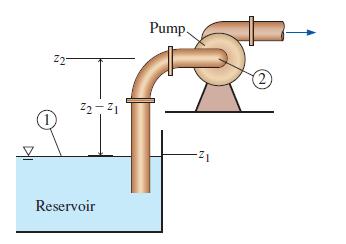
22 N 22-1 Reservoir Pump N (2)
Step by Step Solution
3.46 Rating (159 Votes )
There are 3 Steps involved in it
To repeat Prob 1460 with the pipe diameter increased by a factor of 2 we need to consider the follow... View full answer

Get step-by-step solutions from verified subject matter experts
 Study Help