





Question: We can represent a path from the root to a given node of a binary tree by means of a binary string, where 0 means
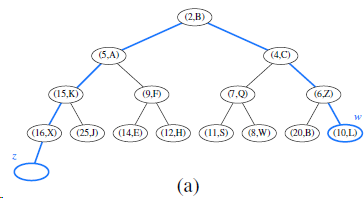
We can represent a path from the root to a given node of a binary tree by means of a binary string, where 0 means €œgo to the left child€ and 1 means €œgo to the right child.€ For example, the path from the root to the node storing (8,W) in the heap of Figure 9.12a is represented by €œ101.€ Design an O(logn)-time algorithm for finding the last node of a complete binary tree with n nodes, based on the above representation. Show how this algorithm can be used in the implementation of a complete binary tree by means of a linked structure that does not keep an explicit reference to the last node instance.

(2,B) (5.A) (4,C) (15,K) (7,Q) (9,F) (6,Z) (14,E) (11,S) (8,W) (10,1) (12.H) (16,X) (25 J) (20,B) (a)

(2,B) (5.A) (4,C) (15,K) (7,Q) (9,F) (6,Z) (14,E) (11,S) (8,W) (10,1) (12.H) (16,X) (25 J) (20,B) (a)

Step by Step Solution

3.36 Rating (168 Votes )

There are 3 Steps involved in it

1 Expert Approved Answer
Step: 1 Unlock

The path to the last node ... View full answer

blur-text-image
Question Has Been Solved by an Expert!

Get step-by-step solutions from verified subject matter experts

Step: 2 Unlock
Step: 3 Unlock

Students Have Also Explored These Related Introduction to Algorithms Questions!