







Question: We can represent a path from the root to a given node of a binary tree by means of a binary string, where 0 means
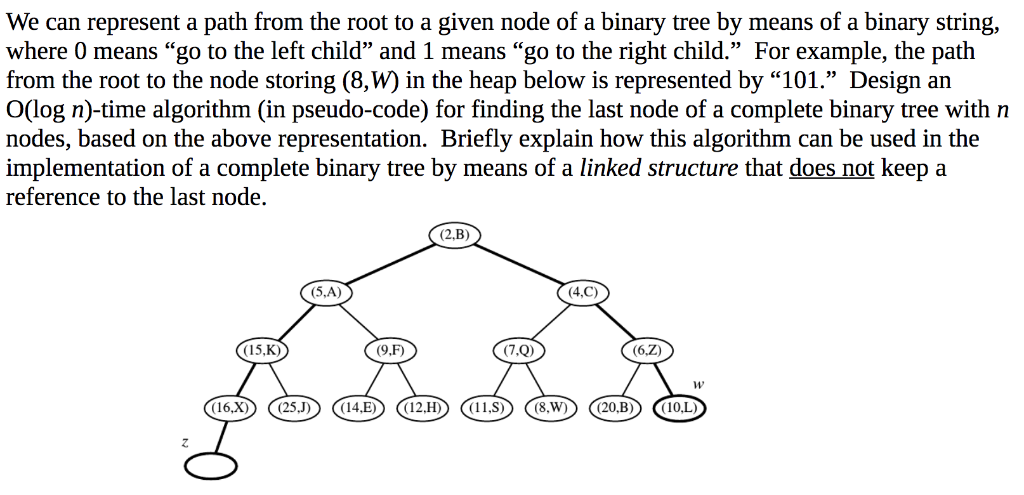
We can represent a path from the root to a given node of a binary tree by means of a binary string, where 0 means "go to the left child" and 1 means "go to the right child." For example, the path from the root to the node storing (8,W) in the heap below is represented by "101." Design an O(log n)-time algorithm (in pseudo-code) for finding the last node of a complete binary tree with n nodes, based on the above representation. Briefly explain how this algorithm can be used in the implementation of a complete binary tree by means of a linked structure that does not keep a reference to the last node. (2.B) (5,A) (4,C) (15,K) (9,F) (7.Q) (6,Z) We can represent a path from the root to a given node of a binary tree by means of a binary string, where 0 means "go to the left child" and 1 means "go to the right child." For example, the path from the root to the node storing (8,W) in the heap below is represented by "101." Design an O(log n)-time algorithm (in pseudo-code) for finding the last node of a complete binary tree with n nodes, based on the above representation. Briefly explain how this algorithm can be used in the implementation of a complete binary tree by means of a linked structure that does not keep a reference to the last node. (2.B) (5,A) (4,C) (15,K) (9,F) (7.Q) (6,Z)
Step by Step Solution
There are 3 Steps involved in it

Get step-by-step solutions from verified subject matter experts
 Study Help