New Semester
Started
Get
50% OFF
Study Help!
--h --m --s
Claim Now
Question Answers
Textbooks
Find textbooks, questions and answers
Oops, something went wrong!
Change your search query and then try again
S
Books
FREE
Study Help
Expert Questions
Accounting
General Management
Mathematics
Finance
Organizational Behaviour
Law
Physics
Operating System
Management Leadership
Sociology
Programming
Marketing
Database
Computer Network
Economics
Textbooks Solutions
Accounting
Managerial Accounting
Management Leadership
Cost Accounting
Statistics
Business Law
Corporate Finance
Finance
Economics
Auditing
Tutors
Online Tutors
Find a Tutor
Hire a Tutor
Become a Tutor
AI Tutor
AI Study Planner
NEW
Sell Books
Search
Search
Sign In
Register
study help
mathematics
basic technical mathematics
Basic Technical Mathematics 12th Edition Allyn J. Washington, Richard Evans - Solutions
Show that tan( x− π/3) = −tan(π/3 − x) on a calculator.
What is the period of the function y = 2 cos 0.5x + sin 3x?
What is the period of the function y = sin πx + 3sin 0.25πx ?
Find the function and graph it if it is of the form y = a sin x and passes through (5π/2, 3).
Find the function and graph it if it is of the form y = a cos x and passes through (4π, −3).
Find the function and graph it if it is of the form y = 3 cos bx and passes through (π/3, −3) and b has the smallest possible positive value.
Find the function and graph it if it is of the form y = 3 sin bx and passes through (π/3, 0) and b has the smallest possible positive value.
Find the function and graph it for a function of the form y = 3 sin(πx + c) that passes through (−0.25, 0) and for which c has the smallest possible positive value.
Write the equation of the cosecant function with zero displacement, a period of 2, and that passes through (0.5, 4).
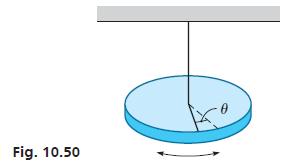
A circular disk suspended by a thin wire attached to the center of one of its flat faces is twisted through an angle θ. Torsion in the wire tends to turn the disk back in the opposite direction (thus, the name torsion pendulum is given to this device). The angular displacement θ (in rad) as a
The blade of a saber saw moves vertically up and down at 18 strokes per second. The vertical displacement y (in cm) is given by y = 1.2 sin 36πt, where t is in seconds. Sketch at least two cycles of the graph of y vs. t.
The velocity v (in cm/s) of a piston in a certain engine is given by v = ωD cosωt, where ω is the angular velocity of the crankshaft in radians per second and t is the time in seconds. Sketch the graph of v vs. t if the engine is at 3000 r/min and D = 3.6 cm.
A light wave for the color yellow can be represented by the equation y = A sin 3.4 × 10¹⁵ t. With A as a constant, sketch two cycles of y as a function of t (in s).
The electric current i (in A) in a circuit in which there is a full-wave rectifier is i = 10 |sin120πt| . Sketch the graph of i = f (t) for 0 ≤ t ≤ 0.05 s. What is the period of the current?
The vertical displacement y of a point at the end of a propeller blade of a small boat is y = 14.0 sin 40.0πt. Sketch two cycles of y (in cm) as a function of t (in s).
In optics, two waves are said to interfere destructively if, when they both pass through a medium, the amplitude of the resulting wave is zero. Sketch the graph of y = sin x + cos(x + π/2) and find whether or not it would represent destructive interference of two waves.
The vertical displacement y (in ft) of a buoy floating in water is given by y = 3.0 cos 0.2t + 1.0 sin 0.4t, where t is in seconds. Sketch the graph of y as a function of t for the first 40 s.
Find the simplest function that represents the vertical projection y of a 12-mm sweep second hand on a watch as a function of time t (in s).
The London Eye Ferris wheel has a circumference of 424 m, and it takes 30 min for one complete revolution. Find the equation for the height y (in m) above the bottom as a function of the time t (in min). Sketch the graph.
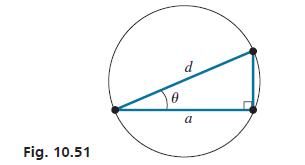
A drafting student draws a circle through the three vertices of a right triangle. The hypotenuse of the triangle is the diameter d of the circle, and from Fig. 10.51, we see that d = a sec θ. Sketch the graph of d as a function of θ for a = 3.00 in. Fig. 10.51 0 d a
The vertical motion of a rubber raft on a lake approximates simple harmonic motion due to the waves. If the amplitude of the motion is 0.250 m and the period is 3.00 s, find an equation for the vertical displacement y as a function of the time t. Sketch two cycles.
In Exercises sketch the appropriate curves. A calculator may be used.At 40°N latitude the number of hours h of daylight each day during the year is approximately h = 12.2 + 2.8 sin [π/6 (x − 2.7)], where x is measured in months (x = 0.5 is Jan. 15, etc.). Sketch the graph of h vs. x for
In Exercises sketch the appropriate curves. A calculator may be used.The equation in Exercise 83 can be used for the number of hours of daylight at 40°S latitude with the appropriate change. Explain what change is necessary and determine the proper equation. Sketch the graph. (This would be
In Exercises sketch the appropriate curves. A calculator may be used.If the upper end of a spring is not fixed and is being moved with a sinusoidal motion, the motion of the bob at the end of the spring is affected. Sketch the curve if the motion of the upper end of a spring is being moved by an
In Exercises sketch the appropriate curves. A calculator may be used.One wave in a medium will affect another wave in the same medium depending on the difference in displacements. For water waves y1 = 2 cos x, y2 = 4 sin(x + π/2), and y = 4 sin(x + 3π/2), 3 show this effect by graphing y1 +
Sketch the appropriate curves. A calculator may be used.The height y (in cm) of an irregular wave in a string as a function of time t (in s) is y = 0.15 − cos 0.25t + 0.50 sin 0.5t. Sketch the graph.
Sketch the appropriate curves. A calculator may be used. The loudness L (in decibels) of a fire siren as a function of the time t (in s) is approximately L = 40 − 35cos 2t + 60 sin t. Sketch this function for 0 ≤ t ≤ 10 s.
Sketch the appropriate curves. A calculator may be used. The path of a roller mechanism used in an assembly-line process is given by x = θ − sinθ and y = 1 − cosθ. Sketch the path for 0 ≤ θ ≤ 2π.
Sketch the appropriate curves. A calculator may be used. The equations for two microwave signals that give a resulting curve on an oscilloscope are x = 6sinπt and y = 4 cos4πt. Sketch the graph of the curve displayed on the oscilloscope.
Sketch the appropriate curves. A calculator may be used. The current in a certain alternating-current circuit is given by i = 2.0 sin(120 πt). Find the function for voltage if the amplitude is 5.0 V and voltage lags current by 30°. Graph both functions in the same window for 0 ≤ t ≤ 0.02 s.
Sketch the appropriate curves. A calculator may be used. The charge q (in C) on a certain capacitor as a function of the time t (in s) is given by q = 0.0003(3 − 2 sin100t cos100t). Sketch one complete cycle of q vs. t.
The instantaneous power p (in W) in an electric circuit is defined as the product of the instantaneous voltage e and the instantaneous current i (in A). If we have e = 100 cos 200t and i = 2 cos(200t + π/4), plot the graph e vs. t and the graph of i vs. t on the same coordinate system. Then sketch
A wave passing through a string can be described at any instant by the equation y = a sin(bx + c). Write one or two paragraphs explaining the change in the wave (a) If a is doubled, (b) If b is doubled(c) If c is doubled.
Graph the function if the given changes are made in the indicated examples of this section.In Example 4, if the sign of the coefficient of sin x is changed, display the graph of the resulting function.Data from Example 4A certain water wave can be represented by the equation y = −2 sin x
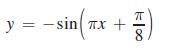
Determine the amplitude, period, and displacement for each function. Then sketch the graphs of the functions. Check each using a calculator. y = -sin x + -F)
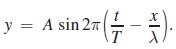
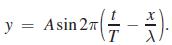
Refer to the wave in the string described in Exercise 37 of Section 10.3. For a point on the string, the displacement y is given by We see that each point on the string moves with simple harmonic motion. Sketch two cycles of y as a function of t for the given valuesA = 3.20 mm, T = 0.050 s, λ
Display the graphs of the given functions on a calculator.y = 8 sin 0.5x − 12 sin x
Give the amplitude and sketch the graphs of the given functions. Check each using a calculator.y = −30 sin x
Give the amplitude and sketch the graphs of the given functions. Check each using a calculator.y = −sin x
Find the amplitude and period of each function and then sketch its graph.y = 15 sin 1/3x
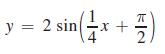
Determine the amplitude, period, and displacement for each function. Then sketch the graphs of the functions. Check each using a calculator. y = 3 cos 100 8
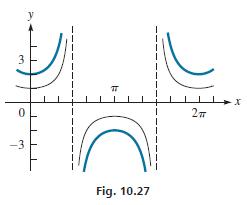
Sketch the graphs of the given functions by use of the basic curve forms (Figs. 10.23, 10.24, 10.25, and 10.26). See Example 1.y = −60 sec xData from Example 1:Sketch the graph of y = 2sec x.First, we sketch in y = sec x, the curve shown in black in Fig. 10.27. Then we multiply the y-values of
Sketch the curves of the given trigonometric functions. Check each using a calculator.y = −3 cos1/3x
View at least two cycles of the graphs of the given functions on a calculator.y = tan 2x
Display the graphs of the given functions on a calculator.y = 2 sin x − cos1.5x
Give the amplitude and sketch the graphs of the given functions. Check each using a calculator.y = 3/2cos x
Find the amplitude and period of each function and then sketch its graph.y = 4 cos 10πx
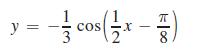
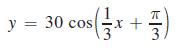
Determine the amplitude, period, and displacement for each function. Then sketch the graphs of the functions. Check each using a calculator. 0s (1/x- y = 30 cos + π 3/
For an alternating-current circuit in which the voltage e is given by e = E cos(ωt + ∅), sketch two cycles of the voltage as a function of time for the given values.E = 80 mV, ω = 377 rad s, ∅ = π/2
Sketch the curves of the given trigonometric functions. Check each using a calculator.y = 24 cos6x
Sketch the graphs of the given functions by use of the basic curve forms (Figs. 10.23, 10.24, 10.25, and 10.26). See Example 1.y = −3 csc xData from Example 1:Sketch the graph of y = 2sec x.First, we sketch in y = sec x, the curve shown in black in Fig. 10.27. Then we multiply the y-values of
Display the graphs of the given functions on a calculator.y = 1/2 sin4x + cos2x
Give the amplitude and sketch the graphs of the given functions. Check each using a calculator.y = 0.8 cos x
Find the amplitude and period of each function and then sketch its graph.y = 3 cos 4πx
For an alternating-current circuit in which the voltage e is given by e = E cos(ωt + ∅), sketch two cycles of the voltage as a function of time for the given values.E = 170 V, f = 60.0 Hz, ∅ = −π/3
Sketch the curves of the given trigonometric functions. Check each using a calculator.y = 0.4 cos 4x
Determine the amplitude, period, and displacement for each function. Then sketch the graphs of the functions. Check each using a calculator. y = = 2 sin(x + 1)
Display the graphs of the given functions on a calculator.y = 20 cos2x + 30 sin x
Sketch the graphs of the given functions by use of the basic curve forms (Figs. 10.23, 10.24, 10.25, and 10.26). See Example 1.y = −0.1 tan xData from Example 1:Sketch the graph of y = 2sec x.First, we sketch in y = sec x, the curve shown in black in Fig. 10.27. Then we multiply the y-values of
Give the amplitude and sketch the graphs of the given functions. Check each using a calculator.y = 0.25 cos x
Find the amplitude and period of each function and then sketch its graph.y = 2 sin 3πx
A satellite is orbiting Earth such that its displacement D north of the equator (or south if D < 0) is given by D = A sin(ωt + ∅). Sketch two cycles of D as a function of t for the given values.A = 850 km, f = 1.6 × 10⁻⁴ Hz, ∅ = π/3
Sketch the curves of the given trigonometric functions. Check each using a calculator.y = 4.5 sin12x
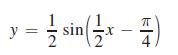
Determine the amplitude, period, and displacement for each function. Then sketch the graphs of the functions. Check each using a calculator. ㅠ - I sin (2 x - 4) 2 y =
Display the graphs of the given functions on a calculator.y = cos3x − 3 sin x
Give the amplitude and sketch the graphs of the given functions. Check each using a calculator.y = 200 cos x
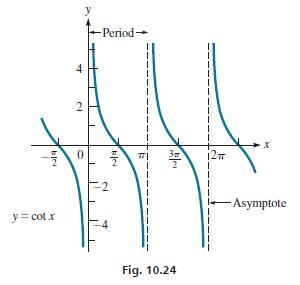
Sketch the graphs of the given functions by use of the basic curve forms (Figs. 10.23, 10.24, 10.25, and 10.26). See Example 1.y = −8 cot xData from Example 1:Sketch the graph of y = 2sec x.First, we sketch in y = sec x, the curve shown in black in Fig. 10.27. Then we multiply the y-values of
Find the amplitude and period of each function and then sketch its graph.y = 520 sin 2πx
A satellite is orbiting Earth such that its displacement D north of the equator (or south if D < 0) is given by D = A sin(ωt + ∅). Sketch two cycles of D as a function of t for the given values.A = 500 mi, ω = 3.60 rad/h, ∅ = 0
Sketch the graphs of the given functions by use of the basic curve forms (Figs. 10.23, 10.24, 10.25, and 10.26). See Example 1.y = 3/2 csc xData from Example 1:Sketch the graph of y = 2sec x.First, we sketch in y = sec x, the curve shown in black in Fig. 10.27. Then we multiply the y-values of this
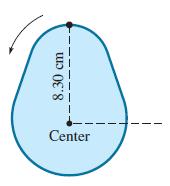
A point on a cam is 8.30 cm from the center of rotation. The cam is rotating with a constant angular velocity, and the vertical displacement d = 8.30 cm for t = 0 s. See Fig. 10.37. Sketch two cycles of d as a function of t for the given values.ω = 3.20 rad/sFig. 10.37. Center 8.30 cm
Sketch the curves of the given trigonometric functions. Check each using a calculator.y = 2 sin 3x
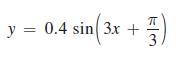
Determine the amplitude, period, and displacement for each function. Then sketch the graphs of the functions. Check each using a calculator. y = 0.4 sin(3x + FIM
Display the graphs of the given functions on a calculator.y = sin x− 1.5 sin 2x
Give the amplitude and sketch the graphs of the given functions. Check each using a calculator.y = 35 sin x
Find the amplitude and period of each function and then sketch its graph.y = −4 cos 3x
A point on a cam is 8.30 cm from the center of rotation. The cam is rotating with a constant angular velocity, and the vertical displacement d = 8.30 cm for t = 0 s. See Fig. 10.37. Sketch two cycles of d as a function of t for the given values.f = 3.20 HzFig. 10.37. Center 8.30 cm
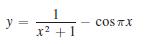
Display the graphs of the given functions on a calculator. y = 1 x² +1 COS TX
Sketch the curves of the given trigonometric functions. Check each using a calculator.y = 2.3 cos(−x)
Find the function of the form y = 2 sin bx if its graph passes through (π/3, 2) and b is the smallest possible positive value. Then graph the function.
Sketch the graphs of the given functions by use of the basic curve forms (Figs. 10.23, 10.24, 10.25, and 10.26). See Example 1.y = 1/2 sec xData from Example 1:Sketch the graph of y = 2sec x.First, we sketch in y = sec x, the curve shown in black in Fig. 10.27. Then we multiply the y-values of this
Give the amplitude and sketch the graphs of the given functions. Check each using a calculator.y = 5/2sin x
Find the amplitude and period of each function and then sketch its graph.y = −cos 16x
Determine the amplitude, period, and displacement for each function. Then sketch the graphs of the functions. Check each using a calculator.y = −cos(2x − π)
Sketch the curves of the given trigonometric functions. Check each using a calculator.y = −2cos x
Sketch two cycles of the curve of a projection of the end of a radius on the y-axis. The radius is of length R and it is rotating counterclockwise about the origin at 2.00 rad/s. It starts at an angle of π/6 with the positive x-axis.
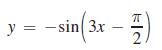
Determine the amplitude, period, and displacement for each function. Then sketch the graphs of the functions. Check each using a calculator. y = -sin(3x - 2
Display the graphs of the given functions on a calculator.y = x3 + 10 sin 2x
Sketch the graphs of the given functions by use of the basic curve forms (Figs. 10.23, 10.24, 10.25, and 10.26). See Example 1.y = 3cot xData from Example 1:Sketch the graph of y = 2sec x.First, we sketch in y = sec x, the curve shown in black in Fig. 10.27. Then we multiply the y-values of this
Give the amplitude and sketch the graphs of the given functions. Check each using a calculator.y = 15 sin x
A graphing calculator may be used in the following exercises. In Exercises, sketch two cycles of the curve given by d = Rsin ωt for the given values.R = 18.5 ft, f = 0.250 Hz
Find the amplitude and period of each function and then sketch its graph.y = -1/5 sin 5x
Sketch the curves of the given trigonometric functions. Check each using a calculator.y = −4sin x
Use a calculator to display the Lissajous figure for which x = sinπt and y = 2 cos 2πt.
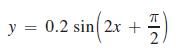
Determine the amplitude, period, and displacement for each function. Then sketch the graphs of the functions. Check each using a calculator. +/-) y = 0.2 sin 2x +
Sketch the curves of the given functions by addition of ordinates.y = sin x + sin 2x
Give the amplitude and sketch the graphs of the given functions. Check each using a calculator.y = 3 sin x
In Exercises, sketch the graphs of the given functions by use of the basic curve forms (Figs. 10.23, 10.24, 10.25, and 10.26). See Example 1.y = 2 tan xData from Example 1:Sketch the graph of y = 2sec x.First, we sketch in y = sec x, the curve shown in black in Fig. 10.27. Then we multiply the
A graphing calculator may be used in the following exercises. In Exercises, sketch two cycles of the curve given by d = Rsin ωt for the given values.R = 2.40 cm, ω = 2.00 rad/s
Find the amplitude and period of each function and then sketch its graph.y = −2 sin 12x
Showing 5000 - 5100
of 9193
First
44
45
46
47
48
49
50
51
52
53
54
55
56
57
58
Last
Step by Step Answers

 Get 50% OFF
Claim Now
Get 50% OFF
Claim Now