New Semester
Started
Get
50% OFF
Study Help!
--h --m --s
Claim Now
Question Answers
Textbooks
Find textbooks, questions and answers
Oops, something went wrong!
Change your search query and then try again
S
Books
FREE
Study Help
Expert Questions
Accounting
General Management
Mathematics
Finance
Organizational Behaviour
Law
Physics
Operating System
Management Leadership
Sociology
Programming
Marketing
Database
Computer Network
Economics
Textbooks Solutions
Accounting
Managerial Accounting
Management Leadership
Cost Accounting
Statistics
Business Law
Corporate Finance
Finance
Economics
Auditing
Tutors
Online Tutors
Find a Tutor
Hire a Tutor
Become a Tutor
AI Tutor
AI Study Planner
NEW
Sell Books
Search
Search
Sign In
Register
study help
mathematics
calculus 10th edition
Calculus 10th Edition Ron Larson, Bruce H. Edwards - Solutions
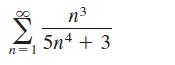
In Exercises use the divergence test given in Exercise 31 to show that the series diverges.Data from in Exercise 31Use the Limit Comparison Test with the harmonic series to show that the series Σ an (where 0 < an < an-1) diverges when is finite and nonzero. n=1 n3 5n4 +3
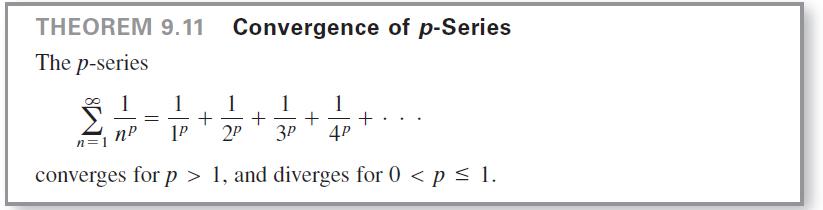
In Exercises use Theorem 9.11 to determine the convergence or divergence of the p-series.Data from in Theorem 9.11 THEOREM 9.11 Convergence of p-Series The p-series n=1 1 1 1 = + + nP 1P 2P 1 3P + 1 4P converges for p > 1, and diverges for 0 < p ≤ 1.
In Exercises(a) Write the repeating decimal as a geometric series(b) Write its sum as the ratio of two integers.0.81̅
In Exercises determine the convergence or divergence of the sequence with the given nth term. If the sequence converges, find its limit. an 5n 3″
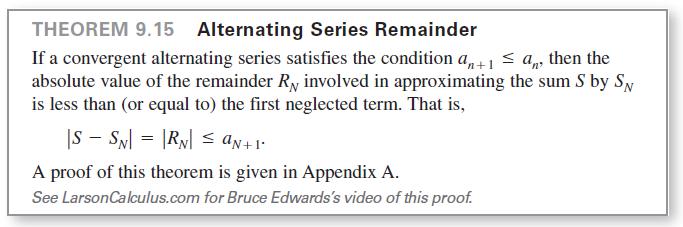
In Exercises use Theorem 9.15 to determine the number of terms required to approximate the sum of the series with an error of less than 0.001.Data from in Theorem 9.15 THEOREM 9.15 Alternating Series Remainder If a convergent alternating series satisfies the condition an+1 ≤ a, then the absolute
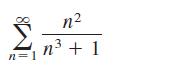
In Exercises use the polynomial test given in Exercise 32 to determine whether the series converges or diverges.Data from in Exercise 32Prove that, if P(n) and Q(n) are polynomials of degree j and k, respectively, then the seriesconverges if j < k - 1 and diverges if j ≥ k - 1.
In Exercises(a) Write the repeating decimal as a geometric series(b) Write its sum as the ratio of two integers.0.36̅
In Exercises use Theorem 9.15 to determine the number of terms required to approximate the sum of the series with an error of less than 0.001.Data from in Theorem 9.15 THEOREM 9.15 Alternating Series Remainder If a convergent alternating series satisfies the condition an+1 ≤ a, then the absolute
In Exercises use Theorem 9.11 to determine the convergence or divergence of the p-series.Data from in Theorem 9.11 THEOREM 9.11 Convergence of p-Series The p-series n=1 1 1 1 = + + nP 1P 2P 1 3P + 1 4P converges for p > 1, and diverges for 0 < p ≤ 1.
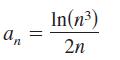
In Exercises determine the convergence or divergence of the sequence with the given nth term. If the sequence converges, find its limit. an || In(n³) 2n
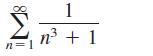
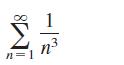
In Exercises use the polynomial test given in Exercise 32 to determine whether the series converges or diverges.Data from in Exercise 32Prove that, if P(n) and Q(n) are polynomials of degree j and k, respectively, then the seriesconverges if j < k - 1 and diverges if j ≥ k - 1. n=1 1 n³
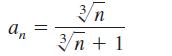
In Exercises determine the convergence or divergence of the sequence with the given nth term. If the sequence converges, find its limit. an /n 3√/n + 1
In Exercises use Theorem 9.11 to determine the convergence or divergence of the p-series.Data from in Theorem 9.11 THEOREM 9.11 Convergence of p-Series The p-series n=1 1 1 1 = + + nP 1P 2P 1 3P + 1 4P converges for p > 1, and diverges for 0 < p ≤ 1.
In Exercises use the polynomial test given in Exercise 32 to determine whether the series converges or diverges.Data from in Exercise 32Prove that, if P(n) and Q(n) are polynomials of degree j and k, respectively, then the seriesconverges if j < k - 1 and diverges if j ≥ k - 1. 13 + - +
In Exercises use Theorem 9.11 to determine the convergence or divergence of the p-series.Data from in Theorem 9.11 THEOREM 9.11 Convergence of p-Series The p-series n=1 1 1 1 = + + nP 1P 2P 1 3P + 1 4P converges for p > 1, and diverges for 0 < p ≤ 1.
In Exercises(a) Write the repeating decimal as a geometric series(b) Write its sum as the ratio of two integers.0.4̅
In Exercises use Theorem 9.15 to determine the number of terms required to approximate the sum of the series with an error of less than 0.001.Data from in Theorem 9.15 THEOREM 9.15 Alternating Series Remainder If a convergent alternating series satisfies the condition an+1 ≤ a, then the absolute
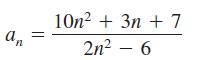
In Exercises determine the convergence or divergence of the sequence with the given nth term. If the sequence converges, find its limit. an 10n² + 3n+ 7 2n² - 6
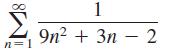
In Exercises find the sum of the convergent series. n=1 1 9n² + 3n - 2
In Exercises use Theorem 9.15 to determine the number of terms required to approximate the sum of the series with an error of less than 0.001.Data from in Theorem 9.15 THEOREM 9.15 Alternating Series Remainder If a convergent alternating series satisfies the condition an+1 ≤ a, then the absolute
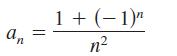
In Exercises determine the convergence or divergence of the sequence with the given nth term. If the sequence converges, find its limit. an || 1 + (−1)n 2 n²
In Exercises use Theorem 9.15 to determine the number of terms required to approximate the sum of the series with an error of less than 0.001.Data from in Theorem 9.15 THEOREM 9.15 Alternating Series Remainder If a convergent alternating series satisfies the condition an+1 ≤ a, then the absolute
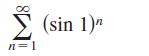
In Exercises find the sum of the convergent series. n=1 (sin 1)n
In Exercises use the polynomial test given in Exercise 32 to determine whether the series converges or diverges.Data from in Exercise 32Prove that, if P(n) and Q(n) are polynomials of degree j and k, respectively, then the seriesconverges if j < k - 1 and diverges if j ≥ k - 1.
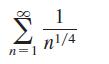
In Exercises use the Integral Test to determine the convergence or divergence of the p-series. 18 n=1 1 n¹/4
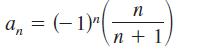
In Exercises determine the convergence or divergence of the sequence with the given nth term. If the sequence converges, find its limit. an = (-1)" n n+ 1,
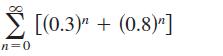
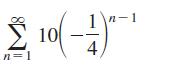
In Exercises find the sum of the convergent series. Σ [(0.3) + (0.8)"] n=0
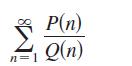
Prove that, if P(n) and Q(n) are polynomials of degree j and k, respectively, then the seriesconverges if j < k - 1 and diverges if j ≥ k - 1. n=1 P(n) Q(n)
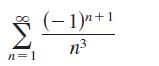
In Exercises use Theorem 9.15 to determine the number of terms required to approximate the sum of the series with an error of less than 0.001.Data from in Theorem 9.15 n=1 (−1)n +1 那
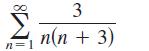
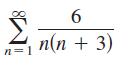
In Exercises test for convergence or divergence, using each test at least once. Identify which test was used.(a) nth-Term Test (b) Geometric Series Test(c) p-Series Test (d) Telescoping Series Test(e) Integral Test (f ) Direct Comparison Test(g) Limit Comparison Test n=1 3 n(n + 3)
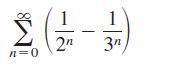
In Exercises find the sum of the convergent series. n=0 1 1 2n 3n 1
Use the Limit Comparison Test with the harmonic series to show that the series Σ an (where 0 < an < an-1) diverges when is finite and nonzero. lim na 81x n- n
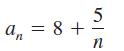
In Exercises determine the convergence or divergence of the sequence with the given nth term. If the sequence converges, find its limit. טי 5 = 8+. ן n
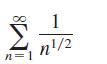
In Exercises use the Integral Test to determine the convergence or divergence of the p-series. 18 n=1 n 1 1/2
In Exercises find the sum of the convergent series. 9 − 3 + 1 − 3 + ··
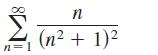
In Exercises test for convergence or divergence, using each test at least once. Identify which test was used.(a) nth-Term Test (b) Geometric Series Test(c) p-Series Test (d) Telescoping Series Test(e) Integral Test (f ) Direct Comparison Test(g) Limit Comparison Test n Σ (n² +
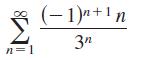
In Exercises approximate the sum of the series by using the first six terms. n=1 (−1)n+1 n 3n
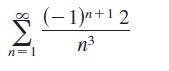
In Exercises approximate the sum of the series by using the first six terms. n=1 (-1)+12 n³
In Exercises find the sum of the convergent series. 8 + 6 + 2/2 + 2²/7/7 +
In Exercises use the Integral Test to determine the convergence or divergence of the p-series. n=1 -| 1 n³ 3
In Exercises test for convergence or divergence, using each test at least once. Identify which test was used.(a) nth-Term Test (b) Geometric Series Test(c) p-Series Test (d) Telescoping Series Test(e) Integral Test (f ) Direct Comparison Test(g) Limit Comparison Test n=1 1 \n +
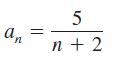
In Exercises determine the convergence or divergence of the sequence with the given nth term. If the sequence converges, find its limit. an || 5 n+ 2
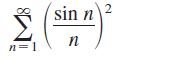
In Exercises explain why the Integral Test does not apply to the series. n=1 sin n2 n
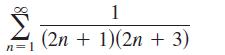
In Exercises find the sum of the convergent series. n=1 1 (2n + 1)(2n + 3)
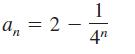
In Exercises use a graphing utility to graph the first 10 terms of the sequence. Use the graph to make an inference about the convergence or divergence of the sequence. Verify your inference analytically and, if the sequence converges, find its limit. a₁ = 2 an 1 4n
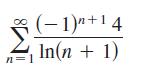
In Exercises approximate the sum of the series by using the first six terms. n=1 (-1)^²+14 In(n + 1)
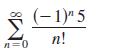
In Exercises approximate the sum of the series by using the first six terms. n=0 (-1)^5 n!
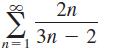
In Exercises test for convergence or divergence, using each test at least once. Identify which test was used.(a) nth-Term Test (b) Geometric Series Test(c) p-Series Test (d) Telescoping Series Test(e) Integral Test (f ) Direct Comparison Test(g) Limit Comparison Test n=1 2n 3n - 2
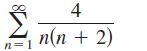
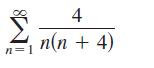
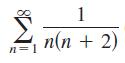
In Exercises find the sum of the convergent series. n=1 4 n(n + 2)
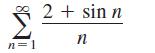
In Exercises explain why the Integral Test does not apply to the series. n=1 2 + sin n n
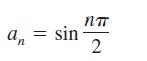
In Exercises use a graphing utility to graph the first 10 terms of the sequence. Use the graph to make an inference about the convergence or divergence of the sequence. Verify your inference analytically and, if the sequence converges, find its limit. an sin NTT 2
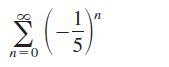
In Exercises find the sum of the convergent series. n=0 5 n
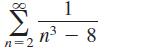
In Exercises test for convergence or divergence, using each test at least once. Identify which test was used.(a) nth-Term Test (b) Geometric Series Test(c) p-Series Test (d) Telescoping Series Test(e) Integral Test (f ) Direct Comparison Test(g) Limit Comparison Test n=2 1 n³ - 8
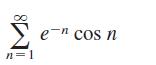
In Exercises explain why the Integral Test does not apply to the series. n=1 en cos n
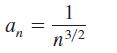
In Exercises use a graphing utility to graph the first 10 terms of the sequence. Use the graph to make an inference about the convergence or divergence of the sequence. Verify your inference analytically and, if the sequence converges, find its limit. an 1 n3/2
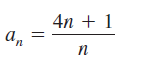
In Exercises use a graphing utility to graph the first 10 terms of the sequence. Use the graph to make an inference about the convergence or divergence of the sequence. Verify your inference analytically and, if the sequence converges, find its limit. an 4n+ 1 n
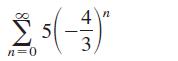
In Exercises test for convergence or divergence, using each test at least once. Identify which test was used.(a) nth-Term Test (b) Geometric Series Test(c) p-Series Test (d) Telescoping Series Test(e) Integral Test (f ) Direct Comparison Test(g) Limit Comparison Test n=0 5 4 3 n
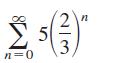
In Exercises find the sum of the convergent series. n=0 5 2/3 n
In Exercises determine the convergence or divergence of the series. n=1 2(−1)n+1 en e-n - n=1 (-1)n +¹ csch n
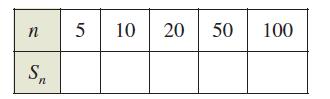
In Exercises(a) Find the sum of the series(b) Use a graphing utility to find the indicated partial sum Sn and complete the table(c) Use a graphing utility to graph the first 10 terms of the sequence of partial sums and a horizontal line representing the sum(d) Explain the relationship between the
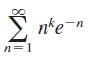
In Exercises use the Integral Test to determine the convergence or divergence of the series, where is a positive integer. 18 n=1 nke-n
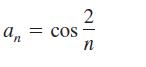
In Exercises find the limit (if possible) of the sequence. an = COS 2 n
In Exercises determine the convergence or divergence of the series. Σ (-1)+1. n=1 1.3.5. 1.4.7 · (2η – 1) (3n - 2)
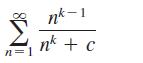
In Exercises use the Integral Test to determine the convergence or divergence of the series, where is a positive integer. n=1 nk-1 nk + c
In Exercises(a) Find the sum of the series(b) Use a graphing utility to find the indicated partial sum Sn and complete the table(c) Use a graphing utility to graph the first 10 terms of the sequence of partial sums and a horizontal line representing the sum(d) Explain the relationship between the
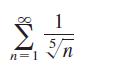
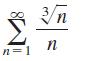
In Exercises test for convergence or divergence, using each test at least once. Identify which test was used.(a) nth-Term Test (b) Geometric Series Test(c) p-Series Test (d) Telescoping Series Test(e) Integral Test (f ) Direct Comparison Test(g) Limit Comparison Test 18 n=1 3√/n n
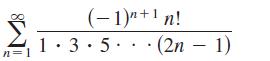
In Exercises determine the convergence or divergence of the series. n=1 (-1)"+¹ n! 1.3.5 (2n - 1) .
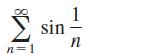
In Exercises use the Limit Comparison Test to determine the convergence or divergence of the series. n=1 sin n
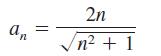
In Exercises find the limit (if possible) of the sequence. an 2n n² + 1
In Exercises(a) Find the sum of the series(b) Use a graphing utility to find the indicated partial sum Sn and complete the table(c) Use a graphing utility to graph the first 10 terms of the sequence of partial sums and a horizontal line representing the sum(d) Explain the relationship between the
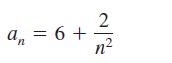
In Exercises find the limit (if possible) of the sequence. an = 6+ 2 n²
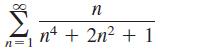
In Exercises confirm that the Integral Test can be applied to the series. Then use the Integral Test to determine the convergence or divergence of the series. n=1 n n² + 2n² + 1
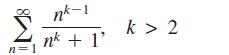
In Exercises use the Limit Comparison Test to determine the convergence or divergence of the series. n=1 nk-1 nk + 1' k> 2
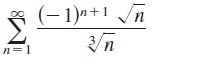
In Exercises determine the convergence or divergence of the series. n=1 (−1)n+1 √√n 3√/n
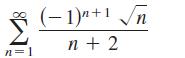
In Exercises determine the convergence or divergence of the series. n=1 u 1+u(I-) n+2 n
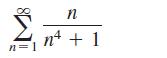
In Exercises confirm that the Integral Test can be applied to the series. Then use the Integral Test to determine the convergence or divergence of the series. n=1 n n4+1 -
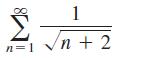
In Exercises confirm that the Integral Test can be applied to the series. Then use the Integral Test to determine the convergence or divergence of the series. n=1 1 √n + 2
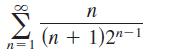
In Exercises use the Limit Comparison Test to determine the convergence or divergence of the series. n=1 n (n + 1)2n-1
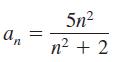
In Exercises find the limit (if possible) of the sequence. an || 5n² n² + 2
In Exercises(a) Find the sum of the series(b) Use a graphing utility to find the indicated partial sum Sn and complete the table(c) Use a graphing utility to graph the first 10 terms of the sequence of partial sums and a horizontal line representing the sum(d) Explain the relationship between the
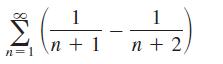
In Exercises verify that the infinite series converges. n=1 1 n(n + 2)
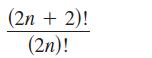
In Exercises simplify the ratio of factorials. (2n + 2)! (2n)!
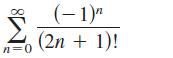
In Exercises determine the convergence or divergence of the series. n=0 (−1)n (2n + 1)!
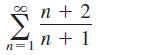
In Exercises confirm that the Integral Test can be applied to the series. Then use the Integral Test to determine the convergence or divergence of the series. n=1 n+2 n+ 1 +1
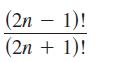
In Exercises simplify the ratio of factorials. (2n − 1)! (2n + 1)!
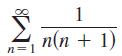
In Exercises verify that the infinite series converges. n=1 1 n(n + 1)
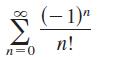
In Exercises determine the convergence or divergence of the series. Ë n=0 (-1)" n!
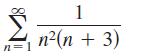
In Exercises use the Limit Comparison Test to determine the convergence or divergence of the series. n=1 1 n²(n + 3)
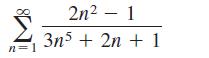
In Exercises use the Limit Comparison Test to determine the convergence or divergence of the series. n=1 2n² - 1 3n5 + 2n + 1
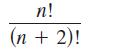
In Exercises simplify the ratio of factorials. n! (n + 2)!
In Exercises verify that the infinite series converges. n=0 (-0.6)" = 1 - 0.6 + 0.36 – 0.216 + · -
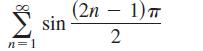
In Exercises determine the convergence or divergence of the series. n=1 sin (2n-1) T п 2
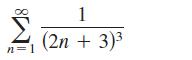
In Exercises confirm that the Integral Test can be applied to the series. Then use the Integral Test to determine the convergence or divergence of the series. n=1 1 (2n + 3)³
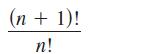
In Exercises simplify the ratio of factorials. (n + 1)! n!
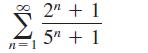
In Exercises use the Limit Comparison Test to determine the convergence or divergence of the series. n=1 2+1 5 + 1
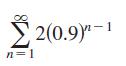
In Exercises verify that the infinite series converges. n=0 (0.9) = 1 +0.9 +0.81 +0.729 +
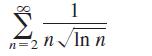
In Exercises confirm that the Integral Test can be applied to the series. Then use the Integral Test to determine the convergence or divergence of the series. 1 n=2 n√Inn
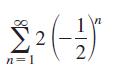
In Exercises verify that the infinite series converges. 요. n=1 2 2,
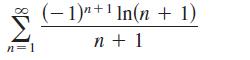
In Exercises determine the convergence or divergence of the series. n=1 (-1)+¹ In(n + 1) n+ 1
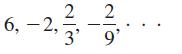
Write the next two apparent terms of the sequence. Describe the pattern you used to find these terms. 6, -2, 0|N IN
Showing 4600 - 4700
of 9867
First
40
41
42
43
44
45
46
47
48
49
50
51
52
53
54
Last
Step by Step Answers

 Get 50% OFF
Claim Now
Get 50% OFF
Claim Now