New Semester
Started
Get
50% OFF
Study Help!
--h --m --s
Claim Now
Question Answers
Textbooks
Find textbooks, questions and answers
Oops, something went wrong!
Change your search query and then try again
S
Books
FREE
Study Help
Expert Questions
Accounting
General Management
Mathematics
Finance
Organizational Behaviour
Law
Physics
Operating System
Management Leadership
Sociology
Programming
Marketing
Database
Computer Network
Economics
Textbooks Solutions
Accounting
Managerial Accounting
Management Leadership
Cost Accounting
Statistics
Business Law
Corporate Finance
Finance
Economics
Auditing
Tutors
Online Tutors
Find a Tutor
Hire a Tutor
Become a Tutor
AI Tutor
AI Study Planner
NEW
Sell Books
Search
Search
Sign In
Register
study help
mathematics
calculus 10th edition
Calculus 10th Edition Ron Larson, Bruce H. Edwards - Solutions
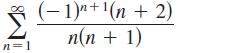
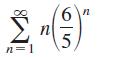
In Exercises use the Ratio Test to determine the convergence or divergence of the series. n=1 (-1)+1(n + 2) n(n + 1)
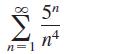
In Exercises use the Ratio Test to determine the convergence or divergence of the series. 18 n=1 n 5 4n
In Exercises use the Ratio Test to determine the convergence or divergence of the series. 18
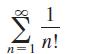
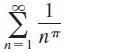
In Exercises use the Ratio Test to determine the convergence or divergence of the series. 18 n=1 1 n!
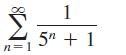
In Exercises use the Ratio Test to determine the convergence or divergence of the series. ∞0 n=1 1 5n
In Exercises use the Ratio Test to determine the convergence or divergence of the series. 18 n=1 5n n4
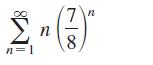
In Exercises use the Ratio Test to determine the convergence or divergence of the series. n=1 n 7 n 8,
In Exercises use the Ratio Test to determine the convergence or divergence of the series. 18 n=1 nlo n
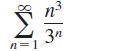
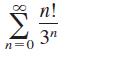
In Exercises use the Ratio Test to determine the convergence or divergence of the series. n=0 n! 3n
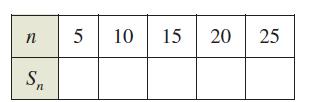
In Exercises (a) Verify that the series converges(b) Use a graphing utility to find the indicated partial sum Sn and complete the table(c) Use a graphing utility to graph the first 10 terms of the sequence of partial sums(d) Use the table to estimate the sum of the series(e) Explain the
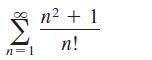
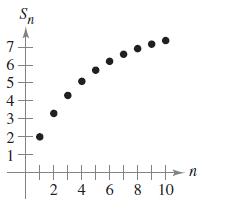
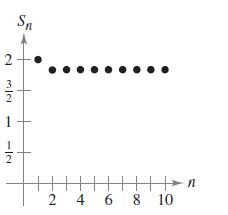
In Exercises match the series with the graph of its sequence of partial sums. [The graphs are labeled (a), (b), (c), (d), (e), and (f).](a)(b)(c)(d)(e)(f) Sn 7 65446 3+ 2 1 ||||||| 2 4 6 8 10 n
In Exercises match the series with the graph of its sequence of partial sums. [The graphs are labeled (a), (b), (c), (d), (e), and (f).](a)(b)(c)(d)(e)(f) Sn 7 65446 3+ 2 1 ||||||| 2 4 6 8 10 n
In Exercises match the series with the graph of its sequence of partial sums. [The graphs are labeled (a), (b), (c), (d), (e), and (f).](a)(b)(c)(d)(e)(f) Sn 7 65446 3+ 2 1 ||||||| 2 4 6 8 10 n
In Exercises match the series with the graph of its sequence of partial sums. [The graphs are labeled (a), (b), (c), (d), (e), and (f).](a)(b)(c)(d)(e)(f) Sn 7 65446 3+ 2 1 ||||||| 2 4 6 8 10 n
In Exercises match the series with the graph of its sequence of partial sums. [The graphs are labeled (a), (b), (c), (d), (e), and (f).](a)(b)(c)(d)(e)(f) Sn 7 65446 3+ 2 1 ||||||| 2 4 6 8 10 n
In Exercises match the series with the graph of its sequence of partial sums. [The graphs are labeled (a), (b), (c), (d), (e), and (f).](a)(b)(c)(d)(e)(f) Sn 7 65446 3+ 2 1 ||||||| 2 4 6 8 10 n
In Exercises verify the formula. 1 1.3.5 (2k - 5) . . . 2kk! (2k-3)(2k-1) (2k)! k≥ 3
In Exercises verify the formula. 1.3.5.. (2k-1)= (2k)! 2kk!
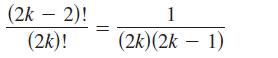
In Exercises verify the formula. (2k - 2)! (2k)! 1 (2k)(2k-1)
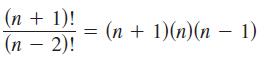
In Exercises verify the formula. (n + 1)! (n − 2)! - = (n + 1)(n)(n-1)
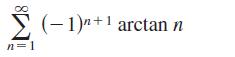
In Exercises determine whether the series converges absolutely or conditionally, or diverges. Σ (−1)n+1 arctan n n=1
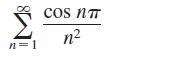
In Exercises determine whether the series converges absolutely or conditionally, or diverges. n=1 COS NTT n²
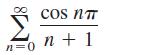
In Exercises determine whether the series converges absolutely or conditionally, or diverges. n=0 COS NTT n+ 1 42
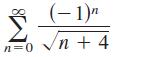
In Exercises determine whether the series converges absolutely or conditionally, or diverges. (-1)n √n + 4 n=0 v
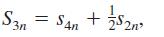
Assume as known the (true) fact that the alternating harmonic series(1)is convergent, and denote its sum by s. Rearrange the series (1) as follows:(2)Assume as known the (true) fact that the series (2) is also convergent, and denote its sum by S. Denote by Sk, Sk the kth partial sum of the series
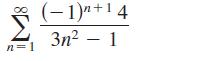
In Exercises test for convergence or divergence and identify the test used. n=1 (-1)+14 3n² - 1 -
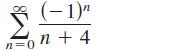
In Exercises test for convergence or divergence and identify the test used. (-1)" n=on +4
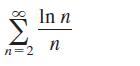
In Exercises test for convergence or divergence and identify the test used. n=2 In n n
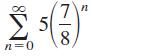
In Exercises test for convergence or divergence and identify the test used. n=0 5 718 L n
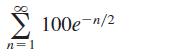
In Exercises test for convergence or divergence and identify the test used. n=1 100e=n/2
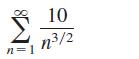
In Exercises test for convergence or divergence and identify the test used. n=1 10 n³/2
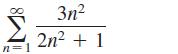
In Exercises test for convergence or divergence and identify the test used. n=1 3n² 2n² + 1
The following argument, that 0 = 1, is incorrect. Describe the error. 0 = 0 + 0 + 0 + ·· = (1 - 1) + (1 − 1) + (1 - 1) + ··· = 1 + (-1 + 1) + (−1 + 1) + ... = 1 + 0 + 0 +. = 1.
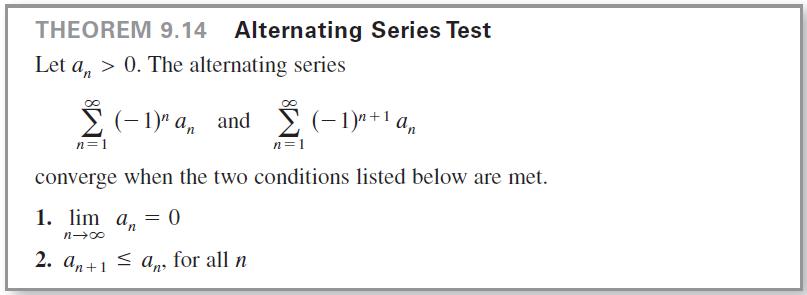
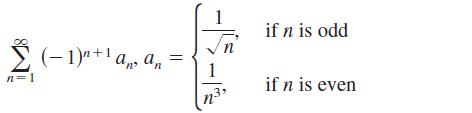
In Exercises use the given series.(a) Does the series meet the conditions of Theorem 9.14? Explain why or why not.(b) Does the series converge? If so, what is the sum?Data from in Theorem 9.14 THEOREM 9.14 Alternating Series Test Let a > 0. The alternating series (-1)" a, and 2 (−1)²+¹
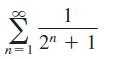
In Exercises test for convergence or divergence and identify the test used. n=1 1 2 + 1
In Exercises use the given series.(a) Does the series meet the conditions of Theorem 9.14? Explain why or why not.(b) Does the series converge? If so, what is the sum?Data from in Theorem 9.14 THEOREM 9.14 Alternating Series Test Let a > 0. The alternating series (-1)" a, and 2 (−1)²+¹
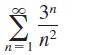
In Exercises test for convergence or divergence and identify the test used. 18 n=1 3 n² 2
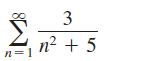
In Exercises test for convergence or divergence and identify the test used. n=1 3 n² + 5
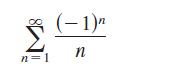
In Exercises determine whether the statement is true or false. If it is false, explain why or give an example that shows it is false.For the alternating seriesthe partial sum S100 is an overestimate of the sum of the series. n=1 (-1) n
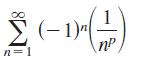
Use the result of Exercise 63 to give an example of an alternating p-series that converges, but whose corresponding p-series diverges.Data from in Exercise 63In Exercises find the values of p for which the series converges. ∞o n=1 1 (-1)^( nP
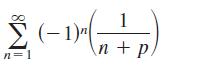
In Exercises find the values of p for which the series converges. n=1 (-1)^(n + p)
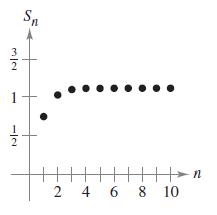
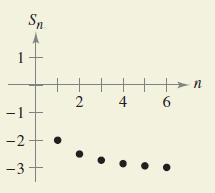
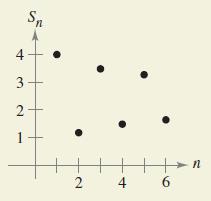
The graphs of the sequences of partial sums of two series are shown in the figures. Which graph represents the partial sums of an alternating series? Explain.(a)(b) -1 -2 1 Sn -3 -3+ 2 4 ● ton. 6
In Exercises find the values of p for which the series converges. ∞o n=1 1 (-1)^( nP
Find all values of x for which the series Σ (x/n) (a) Converges absolutely (b) Converges conditionally
Give an example of a series that demonstrates the statement you proved in Exercise 65.Data from in Exercise 65Prove that if Σ|an|converges, then Σa2n converges. Is the converse true? If not, give an example that shows it is false.
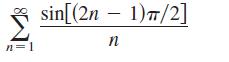
In Exercises determine whether the series converges absolutely or conditionally, or diverges. n=1 sin[(2n-1)π/2] n
Prove that if Σ|an|converges, then Σa2n converges. Is the converse true? If not, give an example that shows it is false.
In Exercises determine whether the statement is true or false. If it is false, explain why or give an example that shows it is false.If Σ an and Σ bn both converge, then Σ an bn converges.
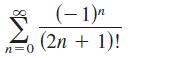
In Exercises determine whether the series converges absolutely or conditionally, or diverges. n=0 (−1)n (2n + 1)!
Do you agree with the following statements? Why or why not?(a) If both Σan and Σ(-an) converge, then Σ |an| converges.(b) If Σ an diverges, then Σ |an| diverges.
In your own words, state the difference between absolute and conditional convergence of an alternating series.
Give the remainder after N terms of a convergent alternating series.
Define an alternating series.
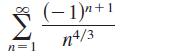
In Exercises determine whether the series converges absolutely or conditionally, or diverges. n=1 (-1)+1 n4/3
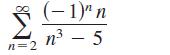
In Exercises determine whether the series converges absolutely or conditionally, or diverges. n=2 (-1)" n n³ - 5
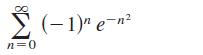
In Exercises determine whether the series converges absolutely or conditionally, or diverges. n=0 (-1)" e-n²
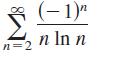
In Exercises determine whether the series converges absolutely or conditionally, or diverges. n=2 (-1)¹ n In n
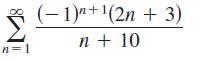
In Exercises determine whether the series converges absolutely or conditionally, or diverges. n=1 (-1)+¹(2n + 3) n+ 10
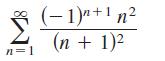
In Exercises determine whether the series converges absolutely or conditionally, or diverges. n=1 (-1)^²+1 n² 2 (n + 1)²
State the definitions of convergent and divergent series.
State the Limit Comparison Test and give an example of its use.
State the Direct Comparison Test and give an example of its use.
State the Integral Test and give an example of its use.
In Exercises use the Integral Test to determine the convergence or divergence of the p-series. 18 n=1 - 113 n
In Exercises determine the convergence or divergence of the series. n=1 2(-1)"+1 en + e-n Σ (-1)"+¹ sech n n=1
In Exercises test for convergence or divergence, using each test at least once. Identify which test was used.(a) nth-Term Test (b) Geometric Series Test(c) p-Series Test (d) Telescoping Series Test(e) Integral Test (f ) Direct Comparison Test(g) Limit Comparison Test n=1 1 5 + 1
In Exercises explain why the Integral Test does not apply to the series. n=1 (-1)" n
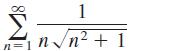
In Exercises use the Limit Comparison Test to determine the convergence or divergence of the series. ∞0 1 2 n=11√√√n²+1
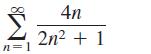
In Exercises confirm that the Integral Test can be applied to the series. Then use the Integral Test to determine the convergence or divergence of the series. n=1 4n 2n² + 1
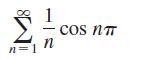
In Exercises determine the convergence or divergence of the series. n=1 1 n cos nπ
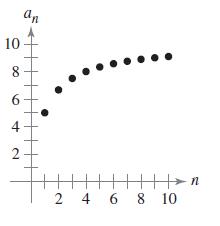
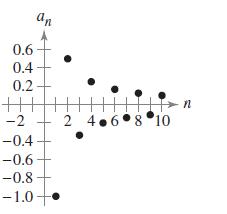
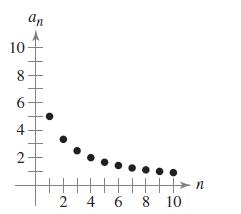
In Exercises match the sequence with its graph. [The graphs are labeled (a), (b), (c), and (d).](a)(b)(c)(d) an 10 8 6 42 2 4 +n 6 8 10
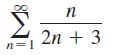
In Exercises verify that the infinite series diverges. n=1 n 2n + 3
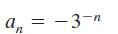
In Exercises determine the convergence or divergence of the sequence with the given nth term. If the sequence converges, find its limit. a, = -3-n n
Find a divergent sequence {an} such that {a2n} converges.
Define a p-series and state the requirements for its convergence.
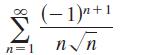
In Exercises determine whether the series converges absolutely or conditionally, or diverges. n=1 (-1)+1 n√√n
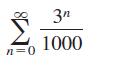
In Exercises determine the convergence or divergence of the series. n=0 3n 1000
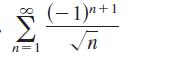
In Exercises determine whether the series converges absolutely or conditionally, or diverges. n=1 (−1)n+1 √n
In Exercises determine the convergence or divergence of the series. 1 + + 201 208 227 + + 264
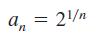
In Exercises determine the convergence or divergence of the sequence with the given nth term. If the sequence converges, find its limit. an = 21/n
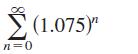
In Exercises determine the convergence or divergence of the series. n=0 (1.075)"
In Exercises determine the convergence or divergence of the series. 201 204 + 209 + 216 +
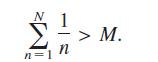
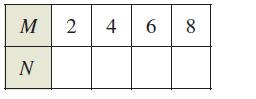
Because the harmonic series diverges, it follows that for any positive real number M, there exists a positive integer N such that the partial sum(a) Use a graphing utility to complete the table.(b) As the real number M increases in equal increments, does the number N increase in equal increments?
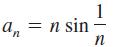
In Exercises determine the convergence or divergence of the sequence with the given nth term. If the sequence converges, find its limit. an n sin 1 n
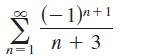
In Exercises determine whether the series converges absolutely or conditionally, or diverges. n=1 (−1)n+1 n+ 3
In Exercises determine the convergence or divergence of the series. + 200 210 + 220 +230 +
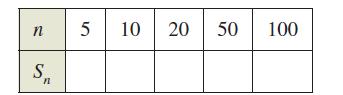
Use a graphing utility to find the indicated partial sum Sn and complete the table. Then use a graphing utility to graph the first 10 terms of the sequence of partial sums. For each series, compare the rate at which the sequence of partial sums approaches the sum of the series.(a)(b) n S n1 5 10 20
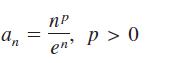
In Exercises determine the convergence or divergence of the sequence with the given nth term. If the sequence converges, find its limit. an пр en P> o Р
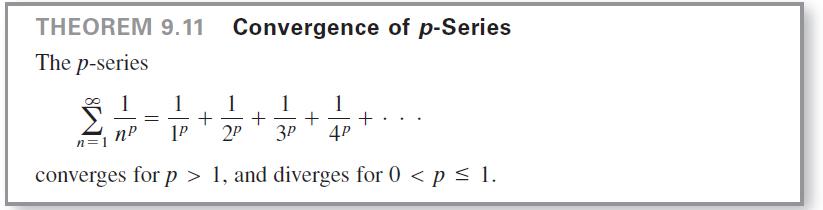
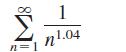
In Exercises use Theorem 9.11 to determine the convergence or divergence of the p-series.Data from in Theorem 9.11 THEOREM 9.11 Convergence of p-Series The p-series n=1 1 1 1 = + + nP 1P 2P 1 3P + 1 4P converges for p > 1, and diverges for 0 < p ≤ 1.
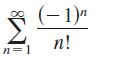
In Exercises determine whether the series converges absolutely or conditionally, or diverges. n=1 (−1)n n!
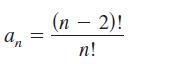
In Exercises determine the convergence or divergence of the sequence with the given nth term. If the sequence converges, find its limit. an (n − 2)! n!
In Exercises(a) Write the repeating decimal as a geometric series(b) Write its sum as the ratio of two integers.0.215̅
In Exercises determine the convergence or divergence of the series. + + + + 200 400 600 800
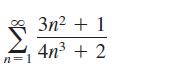
In Exercises use the divergence test given in Exercise 31 to show that the series diverges.Data from in Exercise 31Use the Limit Comparison Test with the harmonic series to show that the series Σ an (where 0 < an < an-1) diverges when is finite and nonzero. n=1 3n² 4n³ + 1 + 2
In Exercises use Theorem 9.11 to determine the convergence or divergence of the p-series.Data from in Theorem 9.11 THEOREM 9.11 Convergence of p-Series The p-series n=1 1 1 1 = + + nP 1P 2P 1 3P + 1 4P converges for p > 1, and diverges for 0 < p ≤ 1.
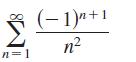
In Exercises determine whether the series converges absolutely or conditionally, or diverges. n=1 (−1)n+1 n²
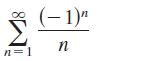
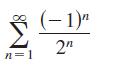
In Exercises determine whether the series converges absolutely or conditionally, or diverges. 18 n=1 (-1)" n 2″
In Exercises(a) Write the repeating decimal as a geometric series(b) Write its sum as the ratio of two integers.0.075̅
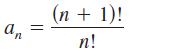
In Exercises determine the convergence or divergence of the sequence with the given nth term. If the sequence converges, find its limit. an (n + 1)! n!
In Exercises(a) Write the repeating decimal as a geometric series(b) Write its sum as the ratio of two integers.0.01̅
Showing 4500 - 4600
of 9867
First
39
40
41
42
43
44
45
46
47
48
49
50
51
52
53
Last
Step by Step Answers

 Get 50% OFF
Claim Now
Get 50% OFF
Claim Now