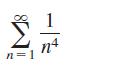
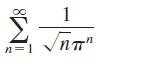
New Semester
Started
Get
50% OFF
Study Help!
--h --m --s
Claim Now
Question Answers
Textbooks
Find textbooks, questions and answers
Oops, something went wrong!
Change your search query and then try again
S
Books
FREE
Study Help
Expert Questions
Accounting
General Management
Mathematics
Finance
Organizational Behaviour
Law
Physics
Operating System
Management Leadership
Sociology
Programming
Marketing
Database
Computer Network
Economics
Textbooks Solutions
Accounting
Managerial Accounting
Management Leadership
Cost Accounting
Statistics
Business Law
Corporate Finance
Finance
Economics
Auditing
Tutors
Online Tutors
Find a Tutor
Hire a Tutor
Become a Tutor
AI Tutor
AI Study Planner
NEW
Sell Books
Search
Search
Sign In
Register
study help
mathematics
calculus 10th edition
Calculus 10th Edition Ron Larson, Bruce H. Edwards - Solutions
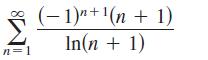
In Exercises determine the convergence or divergence of the series. n=1 (-1)+¹(n+1) In(n + 1)
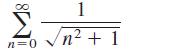
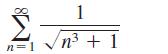
In Exercises use the Limit Comparison Test to determine the convergence or divergence of the series. 3 n=0 1 √n² + 1 2
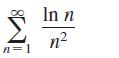
In Exercises confirm that the Integral Test can be applied to the series. Then use the Integral Test to determine the convergence or divergence of the series. 18 n=1 In n n²
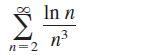
In Exercises confirm that the Integral Test can be applied to the series. Then use the Integral Test to determine the convergence or divergence of the series. n=2 In n n³
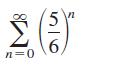
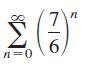
In Exercises verify that the infinite series converges. 오 n=0 5 6)
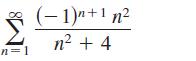
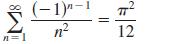
In Exercises determine the convergence or divergence of the series. n=1 (−1)n+1 n² n² + 4
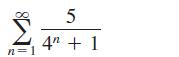
In Exercises use the Limit Comparison Test to determine the convergence or divergence of the series. n=1 5 4 + 1
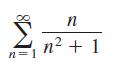
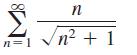
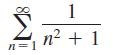
In Exercises use the Limit Comparison Test to determine the convergence or divergence of the series. n=1 n n² + 1
Write the next two apparent terms of the sequence. Describe the pattern you used to find these terms.5, 10, 20, 40, . . .
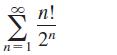
In Exercises verify that the infinite series diverges. 18 n=1 n! 2n
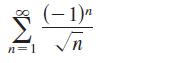
In Exercises determine the convergence or divergence of the series. ζ n=1 (-1) γη n
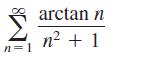
In Exercises confirm that the Integral Test can be applied to the series. Then use the Integral Test to determine the convergence or divergence of the series. n=1 arctan n n² + 1
Write the next two apparent terms of the sequence. Describe the pattern you used to find these terms.8, 13, 18, 23, 28, . . .
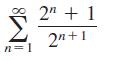
In Exercises verify that the infinite series diverges. n=1 2n + 1 2n+1
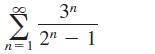
In Exercises use the Direct Comparison Test to determine the convergence or divergence of the series. n=1 3n 2" - 1
Write the next two apparent terms of the sequence. Describe the pattern you used to find these terms.2, 5, 8, 11, . . .
In Exercises confirm that the Integral Test can be applied to the series. Then use the Integral Test to determine the convergence or divergence of the series. 14 2 3 + + 12 n n² + 3
In Exercises verify that the infinite series diverges. n=1 n n² + 1
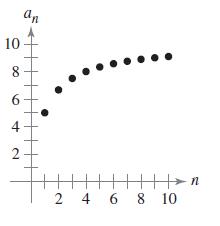
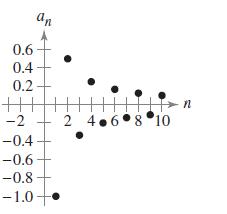
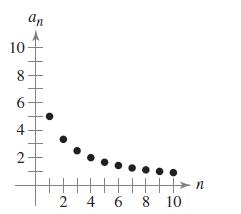
In Exercises match the sequence with its graph. [The graphs are labeled (a), (b), (c), and (d).](a)(b)(c)(d) an 10 8 6 42 2 4 +n 6 8 10
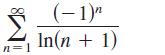
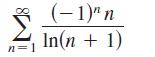
In Exercises determine the convergence or divergence of the series. n=1 (-1)" In(n + 1)
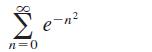
In Exercises use the Direct Comparison Test to determine the convergence or divergence of the series. Sent n=0
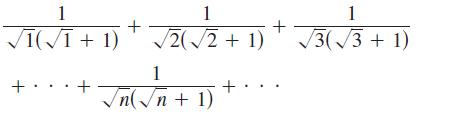
In Exercises confirm that the Integral Test can be applied to the series. Then use the Integral Test to determine the convergence or divergence of the series. 1 1 + ✓ī(√ī + 1) + √2(√² + 1) + + 1 + √n(√n + 1) 1 √√3(√√√3+1)
In Exercises match the sequence with its graph. [The graphs are labeled (a), (b), (c), and (d).](a)(b)(c)(d) an 10 8 6 42 2 4 +n 6 8 10
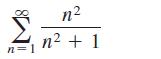
In Exercises verify that the infinite series diverges. n=1 n² n² + 1
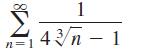
In Exercises use the Direct Comparison Test to determine the convergence or divergence of the series. ∞o n=1 1 43/n - 1
In Exercises determine the convergence or divergence of the series. n=1 (-1)" n In(n + 1)
In Exercises confirm that the Integral Test can be applied to the series. Then use the Integral Test to determine the convergence or divergence of the series. In 2 √2 + In 3 √√√3 + In 4 4 + In 5 √√5 + In 6 √6 +
In Exercises confirm that the Integral Test can be applied to the series. Then use the Integral Test to determine the convergence or divergence of the series. In 2 2 + In 3 3 + In 4 4 + In 5 5 + In 6 6 +
In Exercises match the sequence with its graph. [The graphs are labeled (a), (b), (c), and (d).](a)(b)(c)(d) an 10 8 6 42 2 4 +n 6 8 10
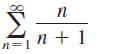
In Exercises verify that the infinite series diverges. n=1 n n+1
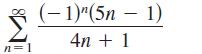
In Exercises determine the convergence or divergence of the series. n=1 (-1)^(5n-1) 4n+ 1
In Exercises use the Direct Comparison Test to determine the convergence or divergence of the series. n=1 1 n³ + 1
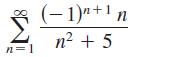
In Exercises determine the convergence or divergence of the series. n=1 (-1)+¹ n n² + 5
In Exercises use the Direct Comparison Test to determine the convergence or divergence of the series. 18 n=0 1 n!
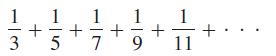
In Exercises confirm that the Integral Test can be applied to the series. Then use the Integral Test to determine the convergence or divergence of the series. + - + + +++ · 11
In Exercises write the first five terms of the recursively defined sequence. 걸어든 = 1+10 69 = 10 1+p9
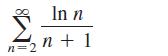
In Exercises use the Direct Comparison Test to determine the convergence or divergence of the series. In n n=2n + 1
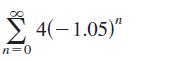
In Exercises verify that the infinite series diverges. n=0 4(-1.05)"
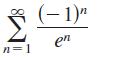
In Exercises determine the convergence or divergence of the series. n=1 (-1)" en
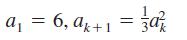
In Exercises write the first five terms of the recursively defined sequence. a₁ = 3, ak+1 = 2(a − 1) - 1
In Exercises confirm that the Integral Test can be applied to the series. Then use the Integral Test to determine the convergence or divergence of the series. 1 + + 2 5 10 17 + + -18 26 +
In Exercises verify that the infinite series diverges. 18 n=0 6/ n
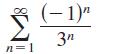
In Exercises determine the convergence or divergence of the series. n=1 (-1)" 3n
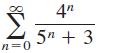
In Exercises use the Direct Comparison Test to determine the convergence or divergence of the series. n=0 4n 5n+ 3
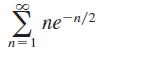
In Exercises confirm that the Integral Test can be applied to the series. Then use the Integral Test to determine the convergence or divergence of the series. Σ n=1 ne-n/2
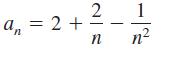
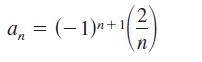
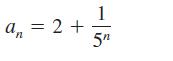
In Exercises write the first five terms of the sequence. an = 2 + 2 n 1 n²
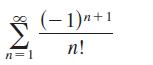
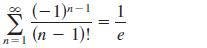
In Exercises find the sequence of partial sums S1, S2, S3, S4, and S5. n=1 (−1)n+1 n!
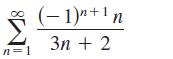
In Exercises determine the convergence or divergence of the series. n=1 (-1)"+1 n 3n + 2
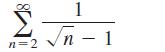
In Exercises use the Direct Comparison Test to determine the convergence or divergence of the series. Σ n=2 1 n - 1
In Exercises confirm that the Integral Test can be applied to the series. Then use the Integral Test to determine the convergence or divergence of the series. 00 n=1 -n
In Exercises write the first five terms of the sequence. 2 ¹ (²7) n |t+u([ −) = "v
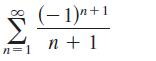
In Exercises determine the convergence or divergence of the series. n=1 (−1)n+1 n+ 1
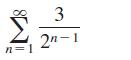
In Exercises find the sequence of partial sums S1, S2, S3, S4, and S5. n=1 3 2n-1
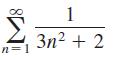
In Exercises use the Direct Comparison Test to determine the convergence or divergence of the series. n=1 1 3n2 + 2
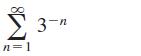
In Exercises confirm that the Integral Test can be applied to the series. Then use the Integral Test to determine the convergence or divergence of the series. Σ n=1 3-n
In Exercises find the sequence of partial sums S1, S2, S3, S4, and S5. ·· +++우++두 + I
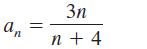
In Exercises write the first five terms of the sequence. an || 3n n + 4
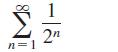
In Exercises confirm that the Integral Test can be applied to the series. Then use the Integral Test to determine the convergence or divergence of the series. n=1 1 2n
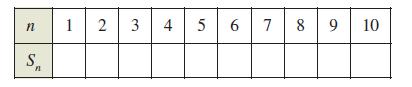
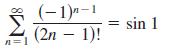
In Exercises explore the Alternating Series Remainder.(a) Use a graphing utility to find the indicated partial sum Sn and complete the table.(b) Use a graphing utility to graph the first 10 terms of the sequence of partial sums and a horizontal line representing the sum.(c) What pattern exists
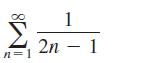
In Exercises use the Direct Comparison Test to determine the convergence or divergence of the series. n=1 1 2n 1
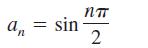
In Exercises write the first five terms of the sequence. an = sin NTT 2
In Exercises find the sequence of partial sums S1, S2, S3, S4, and S5. 27 243 3-2 3 - 올 + 뀨 - 1 + 2층 - 4 8 16
In Exercises explore the Alternating Series Remainder.(a) Use a graphing utility to find the indicated partial sum Sn and complete the table.(b) Use a graphing utility to graph the first 10 terms of the sequence of partial sums and a horizontal line representing the sum.(c) What pattern exists
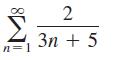
In Exercises confirm that the Integral Test can be applied to the series. Then use the Integral Test to determine the convergence or divergence of the series. n=1 2 3n + 5
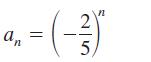
In Exercises write the first five terms of the sequence. an n 2 5
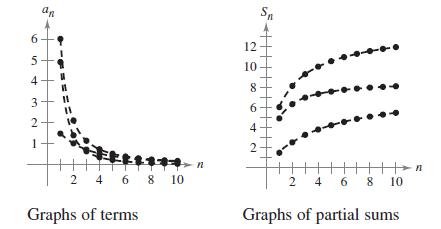
The figures show the graphs of the first 10 terms, and the graphs of the first 10 terms of the sequence of partial sums, of each series.(a) Identify the series in each figure.(b) Which series is a p-series? Does it converge or diverge?(c) For the series that are not p-series, how do the magnitudes
In Exercises find the sequence of partial sums S1, S2, S3, S4, and S5. 1 + 2.3 2 3.4 + 3 4.5 + 4 5.6 + 5 6.7 +
In Exercises explore the Alternating Series Remainder.(a) Use a graphing utility to find the indicated partial sum Sn and complete the table.(b) Use a graphing utility to graph the first 10 terms of the sequence of partial sums and a horizontal line representing the sum.(c) What pattern exists
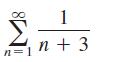
In Exercises confirm that the Integral Test can be applied to the series. Then use the Integral Test to determine the convergence or divergence of the series. n=1 1 n+ 3
In Exercises find the sequence of partial sums S1, S2, S3, S4, and S5. 1+++++
In Exercises explore the Alternating Series Remainder.(a) Use a graphing utility to find the indicated partial sum Sn and complete the table.(b) Use a graphing utility to graph the first 10 terms of the sequence of partial sums and a horizontal line representing the sum.(c) What pattern exists
In Exercises write the first five terms of the sequence.an = 3n
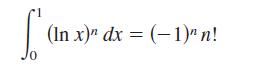
(a) Evaluate the integrals(b) Prove thatfor all positive integers n. In x dx and S (In x)² dx.
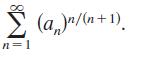
Consider the sequence {an} where(a) Show that {an} is increasing and bounded.(b) Prove thatexists.(c) Find a₁ √k, an+1 = √√√k + a,, and k > 0.
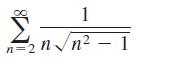
In Exercises determine the convergence or divergence of the series. 1 n=2n√n² = 1
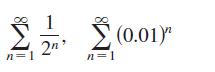
In Exercises use a graphing utility to determine the first term that is less than 0.0001 in each of the convergent series. Note that the answers are very different. Explain how this will affect the rate at which the series converges. n=1 -|8 1 2n Σ n=1 (0.01)”
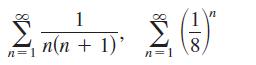
In Exercises use a graphing utility to determine the first term that is less than 0.0001 in each of the convergent series. Note that the answers are very different. Explain how this will affect the rate at which the series converges. 1 ¦ n(n + 1)’ n=1 Σ. (3) n=1
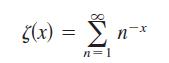
The Riemann zeta function for real numbers is defined for all x for which the seriesconverges. Find the domain of the function. g(x) = n-x n=1
In your own words, define each of the following.(a) Sequence (b) Convergence of a sequence(c) Monotonic sequence (d) Bounded sequence
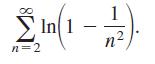
Find the sum of the series In|1 n=2 -19 2 n
Prove that ifis a convergent series of positive real numbers, then so is Σ n=1 an
In Exercises (a) Find the common ratio of the geometric series(b) Write the function that gives the sum of the series(c) Use a graphing utility to graph the function and the partial sums S3 and S5 What do you notice?1 + x + x2 + x3 +. . .
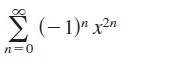
In Exercises find all values of x for which the series converges. For these values of x, write the sum of the series as a function of x. n=0 (-1)n x2n
Using a p-Series Ten terms are used to approximate a convergent p-series. Therefore, the remainder is a function of p and is(a) Perform the integration in the inequality.(b) Use a graphing utility to represent the inequality graphically.(c) Identify any asymptotes of the error function and
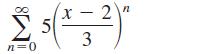
In Exercises find all values of x for which the series converges. For these values of x, write the sum of the series as a function of x. n=0 5 x-2) 3
Show thatconverges by comparison with 18 In n n=1 n n
In Exercises (a) Use Theorem 9.5 to show that the sequence with the given th term converges(b) Use a graphing utility to graph the first 10 terms of the sequence and find its limit.Data from in Theorem 9.5 THEOREM 9.5 Bounded Monotonic Sequences If a sequence {a} is bounded and monotonic, then
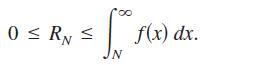
In Exercises use the result of Exercise 53 to find N such that RN ≤ 0.001 for the convergent series.Data from in Exercise 53 Let ƒ be a positive, continuous, and decreasing function for x ≥ 1, such that an = ƒ(n). Prove that if the seriesconverges to S, then the remainder RN S - SN
In Exercises use the result of Exercise 53 to find N such that RN ≤ 0.001 for the convergent series.Data from in Exercise 53 Let ƒ be a positive, continuous, and decreasing function for x ≥ 1, such that an = ƒ(n). Prove that if the seriesconverges to S, then the remainder RN S - SN
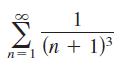
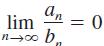
Use the result of Exercise 59 to show that each series converges.(a)(b)Data from in Exercise 59Suppose that Σ an and Σ bn are series with positive an n→∞ b n terms. Prove that if and Σ bn converges, Σ an also converges. n=1 1 (n + 1)³
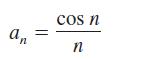
In Exercises determine whether the sequence with the given nth term is monotonic and whether it is bounded. Use a graphing utility to confirm your results. an cos n n
(a) You delete a finite number of terms from a divergent series. Will the new series still diverge? Explain your reasoning.(b) You add a finite number of terms to a convergent series. Will the new series still converge? Explain your reasoning.
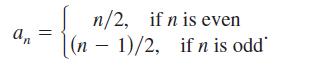
Let f(n) be the sum of the first n terms of the sequence 0, 1, 1, 2, 2, 3, 3, 4, . . ., where the nth term is given by Show that if x and y are positive integers and x > y then xy = f(x + y) = f(x - y). an n/2, if n is even if n is odd (n-1)/2,
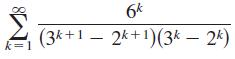
Expressas a rational number. k=1 (3k+1- 6k 2k+1)(3k - 2k)
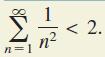
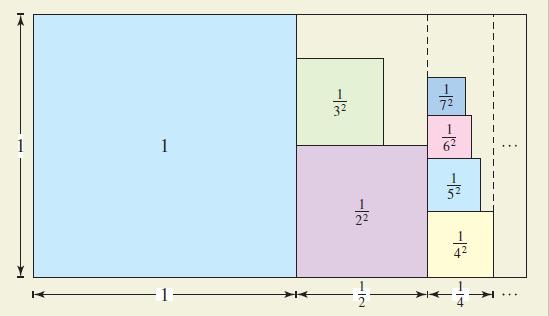
The figure below represents an informal way of showing thatExplain how the figure implies this conclusion. 00 n=1 1 2 n² < 2.
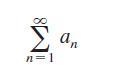
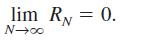
Let Σan be a convergent series, and let n be the remainder of the series after the first N terms. Prove that RN = aN+1 + aN+2 +
Prove that + -R 1 1' for r > 1.
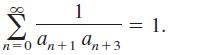
The Fibonacci sequence is defined recursively by an+ 2 = an + an+1 where a₁ = 1 and a₂ = 1.(a) Show that(b) Show that 1 an+1 an+3 1 an+1 an+2 1 an+2an+3
Given two infinite series Σ an and Σ bn, such thatΣan converges and Σ bn, diverges, prove that Σ(an + bn) diverges.
In Exercises determine whether the statement is true or false. If it is false, explain why or give an example that shows it is false. The series n=1 n 1000(n + 1) diverges.
Showing 4700 - 4800
of 9867
First
41
42
43
44
45
46
47
48
49
50
51
52
53
54
55
Last
Step by Step Answers

 Get 50% OFF
Claim Now
Get 50% OFF
Claim Now