New Semester
Started
Get
50% OFF
Study Help!
--h --m --s
Claim Now
Question Answers
Textbooks
Find textbooks, questions and answers
Oops, something went wrong!
Change your search query and then try again
S
Books
FREE
Study Help
Expert Questions
Accounting
General Management
Mathematics
Finance
Organizational Behaviour
Law
Physics
Operating System
Management Leadership
Sociology
Programming
Marketing
Database
Computer Network
Economics
Textbooks Solutions
Accounting
Managerial Accounting
Management Leadership
Cost Accounting
Statistics
Business Law
Corporate Finance
Finance
Economics
Auditing
Tutors
Online Tutors
Find a Tutor
Hire a Tutor
Become a Tutor
AI Tutor
AI Study Planner
NEW
Sell Books
Search
Search
Sign In
Register
study help
mathematics
calculus 4th
Calculus 4th Edition Jon Rogawski, Colin Adams, Robert Franzosa - Solutions
Use the Discriminant Test to determine the type of the conic section (in each case, the equation is nondegenerate). Use a graphing utility or computer algebra system to plot the curve.2x2 − 8xy + 3y2 − 4 = 0
Use a computer algebra system to calculate the total length to two decimal places.r = √θ, 0≤ θ ≤ 4π
Use the Discriminant Test to determine the type of the conic section (in each case, the equation is nondegenerate). Use a graphing utility or computer algebra system to plot the curve.2x2 − 3xy + 5y2 − 4 = 0
Suppose that the polar coordinates of a moving particle at time t are (r(t), θ(t)). Prove that the particle’s speed is equal to (dr/dt)2 + r2(dθ/dt)2.
Show that the “conic” x2 + 3y2 − 6x + 12y + 23 = 0 has no points.
For which values of a does the conic 3x2 + 2y2 − 16y + 12x = a have at least one point?
Show that b/a = √1 − e2 for a standard ellipse of eccentricity e.
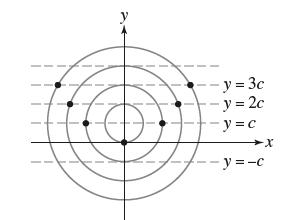
Explain why the dots in Figure 23 lie on a parabola. Where are the focus and directrix located? - y =3c - y = 2c - y =c - y =-c X
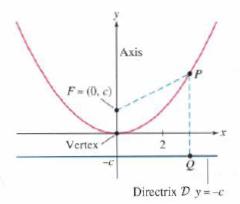
A latus rectum of a conic section is a chord through a focus parallel to the directrix. Find the area bounded by the parabola y = x2/(4c) and its latus rectum (refer to Figure 8). F-(0.c) Vertex Axis 2 Directrix D y=-c
Show that the eccentricity of a hyperbola in standard position is e = √1 + m2, where ±m are the slopes of the asymptotes.
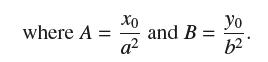
Show that the tangent line at a point P = (x0, y0) on the hyperbola (x/a)2 −(y/b)2 = 1 has equation Ax − By = 1 where A = Хо a² and B Yo 62
Find the equation of the ellipse consisting of points P such that PF1 + PF2 = 12, where F1 = (4, 0) and F2 = (−2, 0).
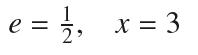
Find the polar equation of the conic with the given eccentricity and directrix, and focus at the origin. e = 1, 2 x = 3
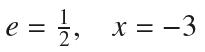
Find the polar equation of the conic with the given eccentricity and directrix, and focus at the origin. e = 1/1, 2 x = -3
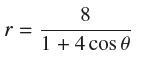
Identify the type of conic, the eccentricity, and the equation of the directrix. r = 8 1 + 4 cos 0
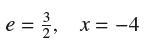
Find the polar equation of the conic with the given eccentricity and directrix, and focus at the origin. e = x = -4
Find the polar equation of the conic with the given eccentricity and directrix, and focus at the origin.e = 1, x = 4
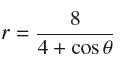
Identify the type of conic, the eccentricity, and the equation of the directrix. r = 8 4 + cos 0
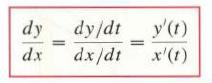
Use Eq. (6) to find dy/dx at the given point.(sec θ, tan θ), t = π/4 dy dx dy/dt dx/dt y' (t) x' (t)
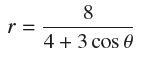
Identify the type of conic, the eccentricity, and the equation of the directrix. r = 8 4 + 3 cos 0
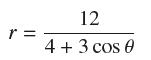
Identify the type of conic, the eccentricity, and the equation of the directrix. r = 12 4+3 cos 0
Find a polar equation for the hyperbola with focus at the origin, directrix x = −2, and eccentricity e = 1.2.
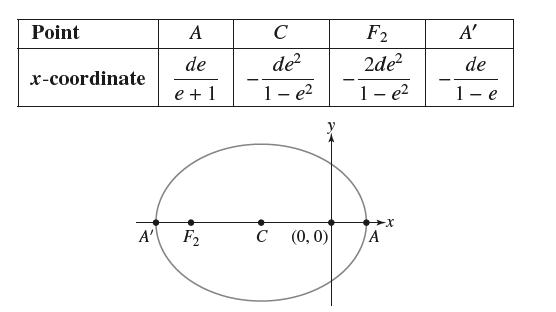
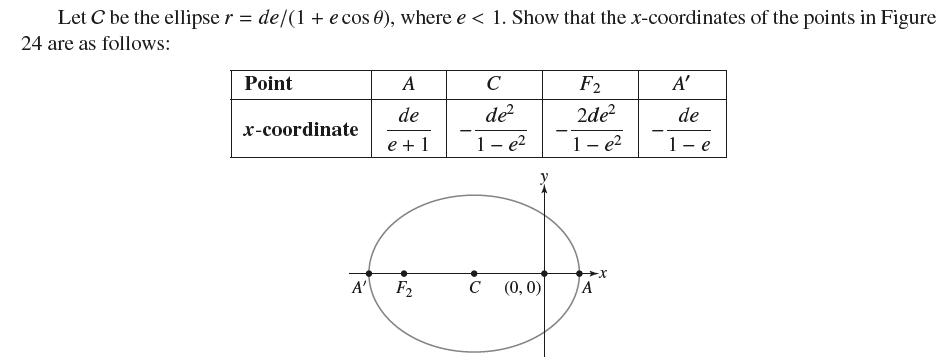
Let C be the ellipse r = de/(1 + e cos θ), where e Point x-coordinate A' A de e + 1 F₂ C de² 1-e² C (0, 0) F2 2de² 1-e² →X A A' de 1 e
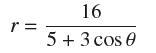
Find an equation in rectangular coordinates of the conicUse the results of Exercise 60.Data From Exercise 60 16 5 + 3 cos 0
Let e > 1. Show that the vertices of the hyperbola r = de 1 + e cos 0 have x-coordinates ed e + 1 and ed e-1
Let y = ƒ(x) be a periodic function of period 2π—that is, ƒ(x) = ƒ(x + 2π). Explain how this periodicity is reflected in the graph of:(a) y = ƒ(x) in rectangular coordinates.(b) r = ƒ(θ) in polar coordinates.
Kepler’s First Law states that planetary orbits are ellipses with the sun at one focus. The orbit of Pluto has eccentricity e ≈ 0.25. Its perihelion (closest distance to the sun) is approximately 2.7 billion miles. Find the aphelion (farthest distance from the sun).
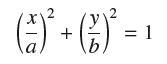
Prove that if a > b > 0 and c =√a2 − b2, then a point P = (x, y) on the ellipsesatisfies PF = ePD with F = (c, 0), e = c/a, and vertical directrix D at x = a/e. + b. = 1
Kepler’s Third Law states that the ratio T/a3/2 is equal to a constant C for all planetary orbits around the sun, where T is the period (time for a complete orbit) and a is the semimajor axis.(a) Compute C in units of days and kilometers, given that the semimajor axis of the earth’s orbit is
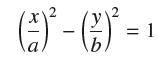
Prove that if a, b > 0 and c =√a2 + b2, then a point P = (x, y) on the hyperbola satisfies PF = ePD with F = (c, 0), e = c/a, and vertical directrix D at x = a/e. 2 (E)` – (B)” - a b. = 1
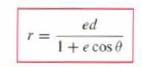
Verify that if e > 1, then Eq. (11) defines a hyperbola of eccentricity e, with its focus at the origin and directrix at x = d. 7= ed 1+ e cos 0
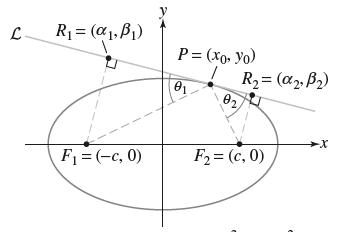
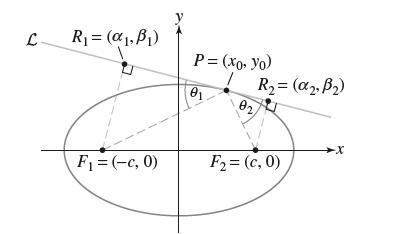
We prove that the focal radii at a point on an ellipse make equal angles with the tangent line L. Let P = (x0, y0) be a point on the ellipse in Figure 25 with foci F1 = (−c, 0) and F2 = (c, 0), and eccentricity e = c/a.Show that the equation of the tangent line at P is Ax + By = 1, where A =
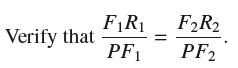
(a) Prove that PF1 = a + x0e and PF2 = a − x0e. Show that PF12 − PF22 = 4x0c. Then use the defining property PF1 + PF2 = 2a and the relation e = c/a.(b) (c) Show that sin θ1 = sin θ2. Conclude that θ1 = θ2. Verify that F₁R₁ PF₁ F2R₂ PF2
Here is another proof of the Reflective Property.(a) Figure 25 suggests that L is the unique line that intersects the ellipse only in the point P. Assuming this, prove that QF1 + QF2 > PF1 + PF2 for all points Q on the tangent line other than P.(b) Use the Principle of Least Distance to prove
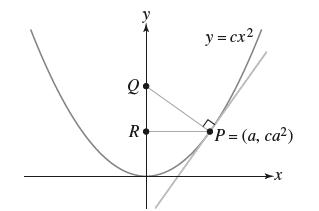
Show that the length QR in Figure 26 is independent of the point P. Q R y = cx²/ *P = (a, ca²) >X
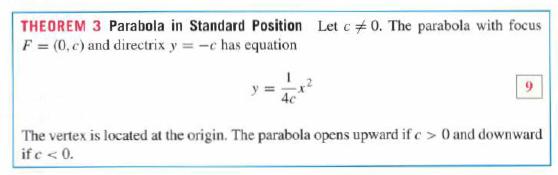
Show that y = x2/4c is the equation of a parabola with directrix y = −c, focus (0, c), and the vertex at the origin, as stated in Theorem 3. THEOREM 3 Parabola in Standard Position Let c#0. The parabola with focus F = (0, c) and directrix y = -c has equation The vertex is located at the origin.
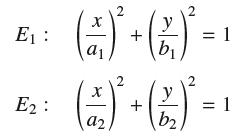
Consider two ellipses in standard position:We say that E1 is similar to E2 under scaling if there exists a factor r > 0 such that for all (x, y) on E1, the point (rx, ry) lies on E2. Show that E1 and E2 are similar under scaling if and only if they have the same eccentricity. Show that any two
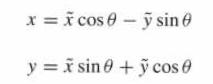
Derive Eqs. (13) and (14) in the text as follows. Write the coordinates of P with respect to the rotated axes in Figure 21 in polar form x̃ = r cos α, ỹ = r sin α. Explain why P has polar coordinates (r, α + θ) with respect to the standard x- and y-axes, and derive Eqs. (13) and (14) using
Find the derivative using either method of Example 8.ƒ(x) = x3x EXAMPLE 8 Differentiate (for x > 0): (a) f(x) = x and (b) g(x)=xsin.x
Find the derivative using either method of Example 8.ƒ(x) = xcos x EXAMPLE 8 Differentiate (for x > 0): (a) f(x)=x* and (b) g(x)= xsin.x
Find the derivative using either method of Example 8.ƒ(x) = xex EXAMPLE 8 Differentiate (for x > 0): (a) f(x)= x and (b)g(x)=xsin.x
Find the derivative using either method of Example 8.ƒ(x) = xx2 EXAMPLE 8 Differentiate (for x > 0): (a) f(x)=x and (b)g(x)=xsin.x
Find the derivative using either method of Example 8.ƒ(x) = x3x EXAMPLE 8 Differentiate (for x > 0): (a) f(x) = x and (b) g(x)=xsin.x
Evaluate ∫ √x2 + 16 dx using trigonometric substitution. Then use Exercise 31 to verify that your answer agrees with the answer in Example 3. EXAMPLE 3 Hyperbolic Substitution Calculate •√ √x² +16dx.
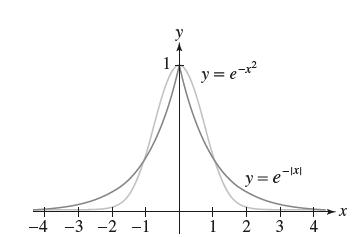
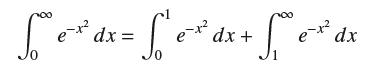
Show that 0 ≤ e−x2 ≤ e−x for x ≥ 1 (Figure 12). Use the Comparison Test to show that ∫∞0 e−x2 dx converges. It suffices (why?) to make the comparison for x ≥ 1 because -4 -3 -2 -1 1 y = elx -2 نیا 3 4
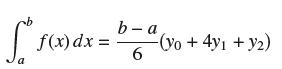
Show that if ƒ(x) = px2 + qx + r is a quadratic polynomial, then S2 = ∫ba ƒ(x) dx. In other words, show that So f₁² f(x) dx = ! b-a 6 -(yo+ 4y1 + y2)
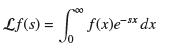
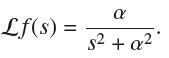
The Laplace transform of a function ƒ is the function L ƒ(s) of the variable s defined by the improper integral (if it converges):Laplace transforms are widely used in physics and engineering.Show that if ƒ(x) = sin αx, then Lf(s) = ™* f(x)e~** dx
The Laplace transform of a function ƒ is the function L ƒ(s) of the variable s defined by the improper integral (if it converges):Laplace transforms are widely used in physics and engineering.Show that if ƒ(x) = C, where C is a constant, then L ƒ(s) = C/s for s > 0. Lf(s) = ™* f(x)e-** dx
Calculate M4 for the integral I = ∫10 x sin(x2) dx.(a) Use a plot of ƒ" to show that K2 = 3.2 may be used in the Error Bound and find a bound for the error.(b) Evaluate I numerically and check that the actual error is less than the bound computed in (a).
The Laplace transform of a function ƒ is the function L ƒ(s) of the variable s defined by the improper integral (if it converges):Laplace transforms are widely used in physics and engineering.Compute L ƒ(s), where ƒ(x) = eαx and s > α. Lf(s) = ™* f(x)e-** dx
The Laplace transform of a function ƒ is the function L ƒ(s) of the variable s defined by the improper integral (if it converges):Laplace transforms are widely used in physics and engineering.Compute L ƒ(s), where ƒ(x) = cos αx and s > 0. Lf(s) = ™* f(x)e-** dx
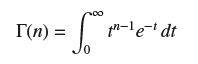
Use the results of Exercise 101 to show that the Laplace transform of xn is n!/sn+1.Data From Exercise 101The gamma function, which plays an important role in advanced applications, is defined for n ≥ 1 by = 5²°₁ I(n) = t-le-t dt
A box of height 6 m and square base of side 3 m is submerged in a pool of water. The top of the box is 2 m below the surface of the water.(a) Calculate the fluid force on the top and bottom of the box.(b) Write a Riemann Sum that approximates the fluid force on a side of the box by dividing the
Find a constant C such that p is a probability density function on the given interval, and compute the probability indicated. p(x) = C (x + 1)³ on [0, 0); P(0 ≤ X ≤ 1)
The function p(x) = cos x satisfies ∫π−π/2 p(x) dx = 1. Is p a probability density function on [−π/2, π]?
What are the x- and y-moments of a lamina whose center of mass is located at the origin?
Which integral represents the length of the curve y = cos x between 0 and π/4? k S³ 0 √1+ cos² xdx, 6² v V1 +sin’ xdx
On a line, there are particles located at −3, −1, 1, 2, and 5. Their masses are 8, 2, 3, 2, and 1, respectively.(a) What is the center of mass of the system?(b) Keeping the other four masses the same, what would the mass at 5 need to be in order to have the center of mass be 0?
Express the arc length of the curve y = x4 between x = 2 and x = 6 as an integral (but do not evaluate).
Compute p(X ≤ 1), where X is a continuous random variable with probability density p(x) = 1/π(x2 + 1).
How is pressure defined?
A square plate that is 2 by 2 m is submerged in water so that its top edge is level with the surface of the water. Calculate the fluid force on one side of it.
Estimate P(2 ≤ X ≤ 2.1) assuming that the probability density function of X satisfies p(2) = 0.2.
Find a constant C such that p is a probability density function on the given interval, and compute the probability indicated.p(x) = Cx(4 − x) on[0, 4]; P(3 ≤ X ≤ 4)
A thin plate has mass 3. What is the x-moment of the plate if its center of mass has coordinates (2, 7)?
On a line, there are particles located at 1, 2, 3, 4, and 5. Their masses are 1, 2, 3, 4, and 5, respectively.(a) What is the center of mass of the system?(b) If we add a particle of mass 6 at 6, what is the center of mass?(c) If we add particles of mass j at j for j = 6 to n, what is the center of
By rotating the line y = r about the x-axis, for x in the interval [0, h], and applying the surface area formula, obtain the well-known fact that the surface area of a cylinder of radius r and length h is given by 2πrh.
Express the arc length of the curve y = tan x for 0 ≤ x ≤ π/4 as an integral (but do not evaluate).
Show that p(x) = 1/4 e−x/2 + 1/6 e−x/3 is a probability density over the domain [0,∞) and find its mean.
A cold metal bar at −30◦C is submerged in a pool maintained at a temperature of 40◦C. Half a minute later, the temperature of the bar is 20◦C. How long will it take for the bar to attain a temperature of 30◦C?
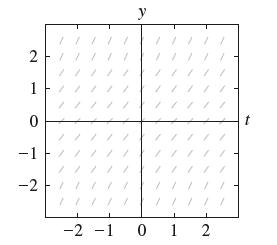
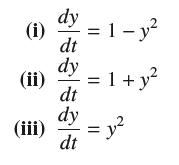
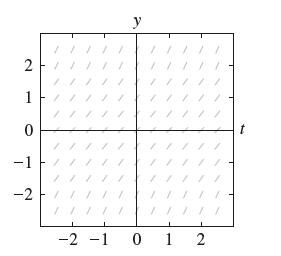
Let y(t) be the solution to the differential equation with the slope field as shown in Figure 2, satisfying y(0) = 0. Sketch the graph of y(t). Then use your answer to Exercise 14 to solve for y(t).Data From Exercise 14Which of the equations (i)–(iii) corresponds to the slope field in Figure 2?
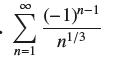
Determine whether the series converges absolutely, conditionally, or not at all. n=1 (-1)-1 n¹/3
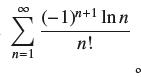
Find a value of N such that SN approximates the series with an error of at most 10−5. Using technology, compute this value of SN. 8 n=1 (-1)"+¹ Inn n! O
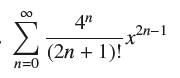
Find the interval of convergence. 00 M18 4" (2n + 1)! Σ 2-1 n=0
What is the definition of arc length?
Decide if the equation defines an ellipse, a hyperbola, a parabola, or no conic section at all.(a) 4x2 − 9y2 = 12 (b) −4x + 9y2 = 0(c) 4y2 + 9x2 = 12(d) 4x3 + 9y3 = 12
Polar coordinates are suited to finding the area (choose one):(a) Under a curve between x = a and x = b.(b) Bounded by a curve and two rays through the origin.
Find the vertices and foci of the conic section. X 2 + 1
Describe the shape of the curve x = 3 cos t, y = 3 sin t.
Sketch the region bounded by the circle r = 5 and the rays θ = π/2 and θ = π, and compute its area as an integral in polar coordinates.
Can the distance traveled by a particle ever be less than its displacement? When are they equal?
For which conic sections do the vertices lie between the foci?
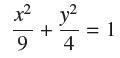
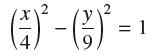
Find the vertices and foci of the conic section. 9 + 4 = || 1
Is the formula for area in polar coordinates valid if ƒ(θ) takes negative values?
Give two polar representations for the point (x, y) = (0, 1), one with negative r and one with positive r.
How does x = 4 + 3 cos t, y = 5 + 3 sin t differ from the curve in the previous question?
Sketch the region bounded by the line r = sec θ and the rays θ = 0 and θ = π/3. Compute its area in two ways: as an integral in polar coordinates and using geometry.
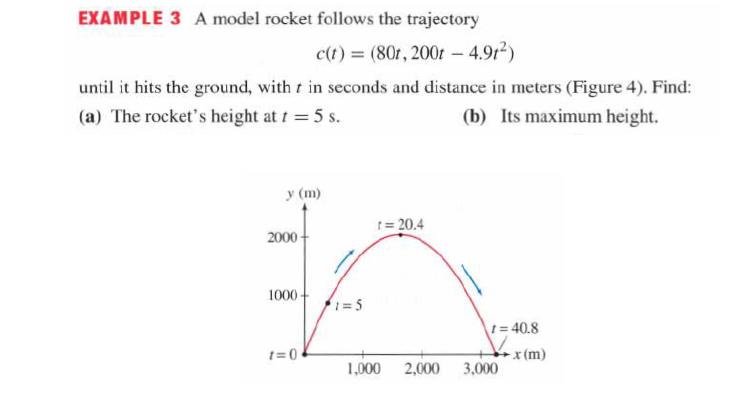
Show that the path traced by the model rocket in Example 3 is a parabola by eliminating the parameter. EXAMPLE 3 A model rocket follows the trajectory c(t) = (80t, 200t - 4.91²) until it hits the ground, with t in seconds and distance in meters (Figure 4). Find: (a) The rocket's height at t = 5
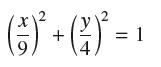
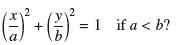
What are the foci of (²)² + ( 1 ) ² = 1 ifa
What is the interpretation of √x(t)2 + √y'(t)2 for a particle following the trajectory (x(t), y(t))?
Find the vertices and foci of the conic section. | F ()-()
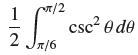
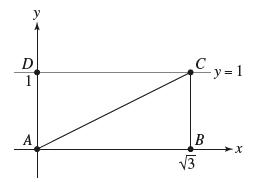
The horizontal line y = 1 has polar equation r = csc θ. Which area is represented by the integral (Figure 10)?(a) ABCD (b) ΔABC (c) ΔACD 1 2 T/2 π/6 csc² 0 de
Describe each of the following curves:(a) r = 2 (b) r2 = 2 (c) r cos θ = 2
What is the maximum height of a particle whose path has parametric equations x = t9, y = 4 − t2?
What is the geometric interpretation of b/a in the equation of a hyperbola in standard position?
A particle travels along a path from (0, 0) to (3, 4). What is the displacement? Can the distance traveled be determined from the information given?
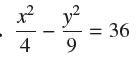
Find the vertices and foci of the conic section. x² 4 9 y² = 36
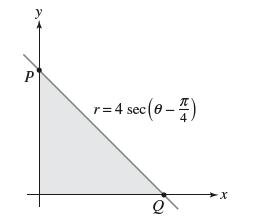
Find the area of the shaded triangle in Figure 11 as an integral in polar coordinates. Then find the rectangular coordinates of P and Q, and compute the area via geometry. y P = 4 sec (0 - ) -X
Can the parametric curve (t, sin t) be represented as a graph y = ƒ(x)? What about (sin t, t)?
A particle traverses the parabola y = x2 with constant speed 3 cm/s. What is the distance traveled during the first minute?
Showing 2800 - 2900
of 8339
First
22
23
24
25
26
27
28
29
30
31
32
33
34
35
36
Last
Step by Step Answers

 Get 50% OFF
Claim Now
Get 50% OFF
Claim Now