New Semester
Started
Get
50% OFF
Study Help!
--h --m --s
Claim Now
Question Answers
Textbooks
Find textbooks, questions and answers
Oops, something went wrong!
Change your search query and then try again
S
Books
FREE
Study Help
Expert Questions
Accounting
General Management
Mathematics
Finance
Organizational Behaviour
Law
Physics
Operating System
Management Leadership
Sociology
Programming
Marketing
Database
Computer Network
Economics
Textbooks Solutions
Accounting
Managerial Accounting
Management Leadership
Cost Accounting
Statistics
Business Law
Corporate Finance
Finance
Economics
Auditing
Tutors
Online Tutors
Find a Tutor
Hire a Tutor
Become a Tutor
AI Tutor
AI Study Planner
NEW
Sell Books
Search
Search
Sign In
Register
study help
mathematics
calculus 4th
Calculus 4th Edition Jon Rogawski, Colin Adams, Robert Franzosa - Solutions
Solve the Initial Value Problem using Separation of Variables.xyy'= 1, y(3) = 2
Use Newton’s Law of Cooling.When a hot object is placed in a water bath whose temperature is 25°C, it cools from 100°C to 50°C in 150 seconds. In another bath, the same cooling occurs in 120 s. Find the temperature of the second bath.
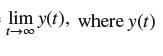
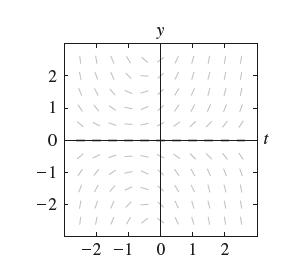
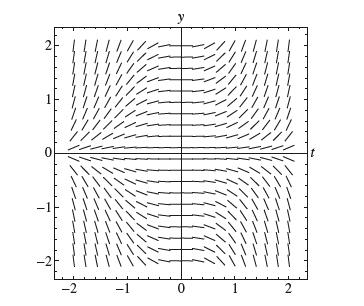
Sketch the slope field of dy/dt = ty for −2 ≤ t ≤ 2, −2 ≤ y ≤ 2. Based on the sketch, determine where y(t) is a solution with y(0) > 0. lim y(t), where y(t) 1-00
Find the general solution of the first-order linear differential equation.y' + x−1y = cos(x2)
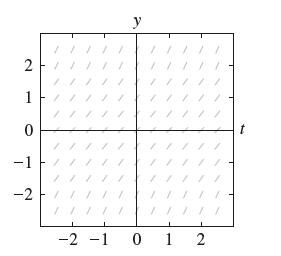
Figure 1 shows the slope field for dy/dt = sin y + ty. Sketch the graphs of the solutions with the initial conditions y(0) = 1 , y(0) = 0, and y(0) = −1. 2 1 0 -1 -2 y / Л 1 I I -2 -1 0 1 2
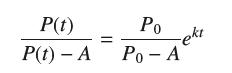
Let k = 1 and A = 1 in the logistic equation.(a) Find the solutions satisfying y1(0) = 10 and y2(0) = −1.(b) Find the time t when y1(t) = 5.(c) When does y2(t) become infinite?
Use Separation of Variables to find the general solution. 0 = ET واح }/
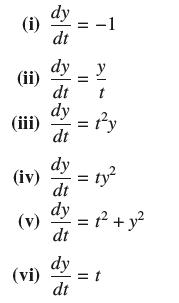
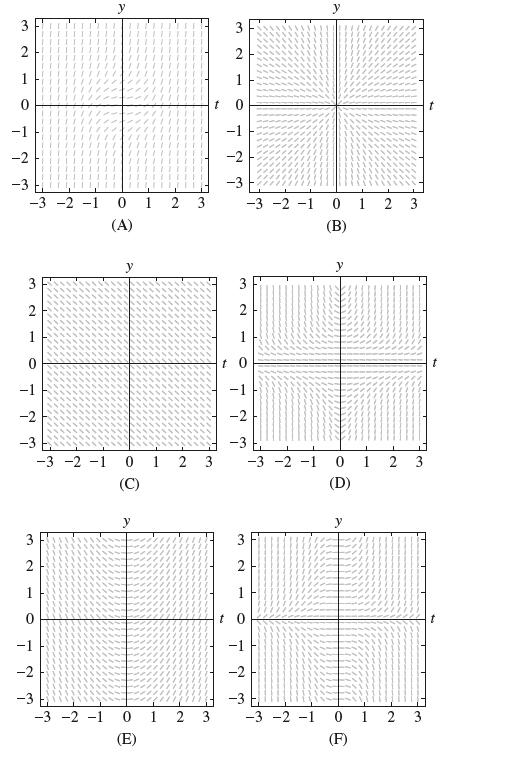
Match each differential equation with its slope field in Figure 13(A)–(F). (i) | 7 (D) || || 4 (9) (vi) " = = = 民 那 F+² =t
Use Newton’s Law of Cooling.Objects A and B are placed in a warm bath at temperature T0 = 40Q°C. Object A has initial temperature −20°C and cooling constant k = 0.004 s−1. Object B has initial temperature 0°C and cooling constant k = 0.002 s−1. Plot the temperatures of A and B for 0 ≤
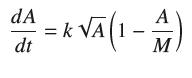
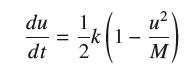
A tissue culture grows until it has a maximum area of M square centimeters. The area A(t) of the culture at time t may be modeled by the differential equationwhere k is a growth constant.(a) Show that if we set A = u2, thenThen find the general solution using Separation of Variables.(b) Show that
Find the general solution of the first-order linear differential equation.xy'= y − x
Sketch the slope field for dy/dt = t2y for −2 ≤ t ≤ 2, −2 ≤ y ≤ 2. 2 1 0 -2 77 -2 - - - -1 0 |||| // w 1 - - 2
Use Separation of Variables to find the general solution.y' + 4xy2 = 0
In Newton’s Law of Cooling, the constant τ = 1/k is called the characteristic time. Show that τ is the time required for the temperature difference (y − T0) to decrease by the factor e−1 ≈ 0.37. For example, if y(0) = 100°C and T0 = 0°C, then the object cools to 100/e ≈ 37°C in time
Find the general solution of the first-order linear differential equation.xy'= x−2 − 3y/x
In the model of Exercise 12, let A(t) be the area at time t (hours) of a growing tissue culture with initial size A(0) = 1 cm2, assuming that the maximum area is M = 16 cm2 and the growth constant is k = 0.1.(a) Find a formula for A(t). The initial condition is satisfied for two values of the
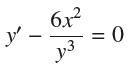
Sketch the solution of dy/dt = ty2 satisfying y(0) = 1 in the appropriate slope field of Figure 13(A)–(F).Then show, using Separation of Variables, that if y(t) is a solution such that y(0) > 0, then y(t) tends to infinity as t → √2/y(0).
Sketch the slope field for dy/dt = y sin t for −2π ≤ t ≤ 2π, −2 ≤ y ≤ 2.
Use Separation of Variables to find the general solution.y'+ x2y = 0
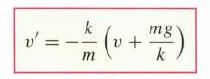
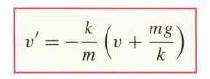
Use Eq. (3) as a model for free-fall with air resistance.A 60-kg skydiver jumps out of an airplane. What is her terminal velocity, in meters per second, assuming that k = 10 kg/s for free-fall (no parachute)? V = k m mg k (+a).
Find the general solution of the first-order linear differential equation.y' + y = ex
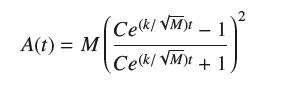
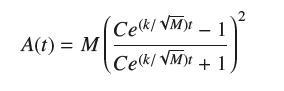
Show that if a tissue culture grows according to Eq. (7), then the growth rate reaches a maximum when A = M/3. A(t) = M J (Cek/ √M) - 1 Cek/VM)1 + 1
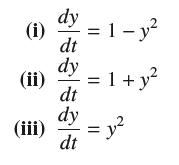
Which of the equations (i)–(iii) corresponds to the slope field in Figure 2? dy dt dy dt dy (iii) = y dt (i) (ii) = 1-y² =1+y² 2
(a) Sketch the slope field of dy/dt = t/y in the region −2 ≤ t ≤ 2, −2 ≤ y ≤ 2.(b) Check that y = ± √t2 + C is the general solution.(c) Sketch the solutions on the slope field with initial conditions y(0) = 1 and y(0) = −1.
Use Eq. (3) as a model for free-fall with air resistance.Find the terminal velocity of a skydiver of weight w = 192 pounds if k = 1.2 lb-s/ft. How long does it take him to reach half of his terminal velocity if his initial velocity is zero? Mass and weight are related by w = mg, and Eq. (3) becomes
Use Separation of Variables to find the general solution.y' − ex+y = 0
Find the general solution of the first-order linear differential equation.y' − y = ex
In 1751, Benjamin Franklin predicted that the U.S. population P(t) would increase with growth constant k = 0.028 year−1. According to the census, the U.S. population was 5 million in 1800 and 76 million in 1900. Assuming logistic growth with k = 0.028, find the predicted carrying capacity for the
Sketch the slope field of dy/dt = t2 − y in the region −3 ≤ t ≤ 3, −3 ≤ y ≤ 3 and sketch the solutions satisfying y(1) = 0, y(1) = 1, and y(1) = −1.
An 80-kg skydiver jumps out of an airplane (with zero initial velocity). Assume that k = 12 kg/s with a closed parachute and k = 70 kg/s with an open parachute. What is the skydiver’s velocity at t = 25 s if the parachute opens after 20 s of free-fall?
Find the general solution of the first-order linear differential equation.y' + (tan x)y = cos x
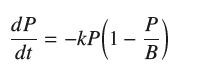
Consider the following logistic equation (with k, B > 0): dP dt = : -KP(1 – B) ||
Let F(t, y) = t2 − y and let y(t) be the solution of dy/dt = F(t, y) satisfying y(2) = 3. Let h = 0.1 be the time step in Euler’s Method, and set y0 = y(2) = 3.(a) Calculate y1 = y0 + hF(2, 3).(b) Calculate y2 = y1 + hF(2.1, y1).(c) Calculate y3 = y2 + hF(2.2, y2) and continue computing
Find the general solution of the first-order linear differential equation.y' + (sec x)y = cos x
Let y(t) be the solution of 4 dy/dt = y2 + t satisfying y(2) = 1. Carry out Euler’s Method with time step h = 0.05 for n = 6 steps.
Use Separation of Variables to find the general solution.t3y'+ 4y2 = 0
Does a heavier or a lighter skydiver reach terminal velocity more quickly?
Use Euler’s Method to approximate the given value of y(t) with the time step h indicated. y(0.5); dy dt = y +t, y(0) = 1, h = 0.1
Let y(t) be the solution to dy/dt = te−y satisfying y(0) = 0.(a) Use Euler’s Method with time step h = 0.1 to approximate y(0.1), y(0.2), . . . , y(0.5).(b) Use Separation of Variables to find y(t) exactly.(c) Compute the errors in the approximations to y(0.1) and y(0.5).
Use Separation of Variables to find the general solution.yy' = x
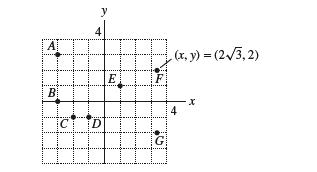
Find polar coordinates for each of the seven points plotted in Figure 17. A B C y 4 D I E G (x, y) = (2√3,2) 4 X
Plot the points with polar coordinates: (a) (2,7) (b) (4,3) (c) (3,-5) (d) (0,5)
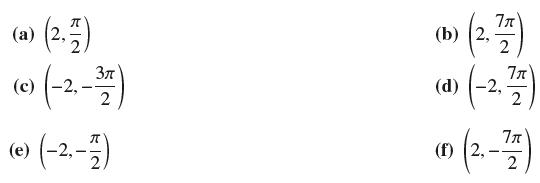
Which of the following are possible polar coordinates for the point P with rectangular coordinates (0, −2)? (a) (2,3 2.2 (0) (-2-21) (с) (-2,-2) 7П (b) (2, 2 (d) -2, (-2,7/17) (0) (2,-727)
Convert from polar to rectangular coordinates: (a) (3,7) (b) (6, ³7) (c) (0, 3) (d) (5,-2)
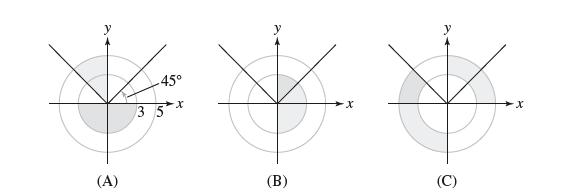
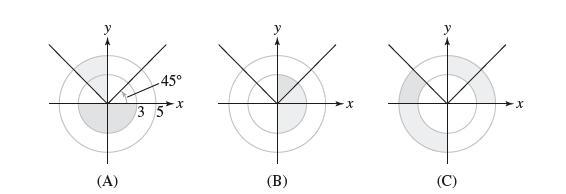
Describe each tan shaded sector in Figure 18 by inequalities in r and θ. (A) -45° 35 x (B) X D (C) x
Convert from rectangular to polar coordinates:(a) (1, 0) (b) (3,√3) (c) (−2, 2) (d) (−1,√3)
Convert from rectangular to polar coordinates using a calculator (make sure your choice of θ gives the correct quadrant):(a) (2, 3) (b) (4, −7) (c) (−3, −8) (d) (−5, 2)
Describe each green shaded sector in Figure 18 by inequalities in r and θ. (A) -45⁰ 35 x (B) x D (C) x
Find an equation in polar coordinates of the line through the origin with slope √1/3.
Find an equation in polar coordinates of the line through the origin with slope 1 − √2.
What is the slope of the line θ = 3π/5?
One of r = 2 sec θ and r = 2 csc θ is a horizontal line, and the other is a vertical line. Convert each to rectangular coordinates to show which is which.
Convert to an equation in rectangular coordinates.r = 7
Convert to an equation in rectangular coordinates.r = sin θ
Convert to an equation in rectangular coordinates.r = 2 sin θ
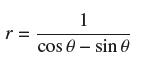
Convert to an equation in rectangular coordinates. r = cos 1 sin e
Convert to an equation in rectangular coordinates.r = 2 csc θ − sec θ
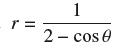
Convert to an equation in rectangular coordinates. r = 1 2- cos 0
Convert to an equation in polar coordinates of the form r = ƒ(θ).x2 + y2 = 5
Convert to an equation in polar coordinates of the form r = ƒ(θ).x = 5
Convert to an equation in polar coordinates of the form r = ƒ(θ).y = x2
Convert to an equation in polar coordinates of the form r = ƒ(θ).xy = 1
Convert to an equation in polar coordinates of the form r = ƒ(θ).e√x2+y2 = 1
Convert to an equation in polar coordinates of the form r = ƒ(θ).ln x = 1
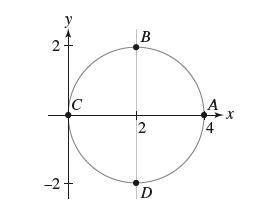
Find the values of θ in the plot of r = 4 cos θ corresponding to points A, B, C, D in Figure 19. Then indicate the portion of the graph traced out as θ varies in the following intervals: (a) 0 ≤ 0 < (b) {
Match each equation with its description:(a) r = 2 (i) Vertical line(b) θ = 2 (ii) Horizontal line(c) r = 2 sec θ (iii) Circle(d) r = 2 csc θ (iv) Line through origin
Suppose that P = (x, y) has polar coordinates (r, θ). Find the polar coordinates for the points:(a) (x, −y) (b) (−x, −y) (c) (−x, y) (d) (y, x)
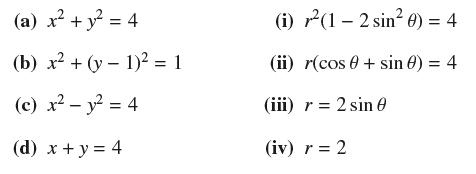
Match each equation in rectangular coordinates with its equation in polar coordinates: (a) x² + y² = 4 (b) x² + (y- 1)² = 1 (c) x² - y² = 4 (d) x + y = 4 (i) r²(1-2 sin²0) = 4 (ii) r(cos + sin 8) = 4 (iii) r = 2 sin 0 (iv) r = 2
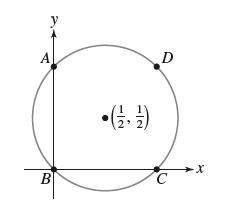
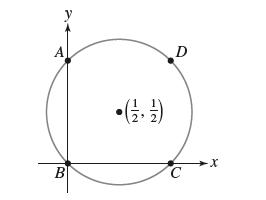
Show that the circle with its center at (1/2, 1/2) in Figure 20 has polar equation r = sin θ + cos θ and find the values of θ between 0 and π corresponding to points A, B, C, and D. A B • (-/---/-) D C -X
What are the polar equations of the lines parallel to the line r cos (θ − π/3) = 1?
Sketch r = 3 cos θ − 1 (see Example 9). EXAMPLE 9 Symmetry About the x-Axis Sketch the limaçon curve r = 2 cos 0 - 1.
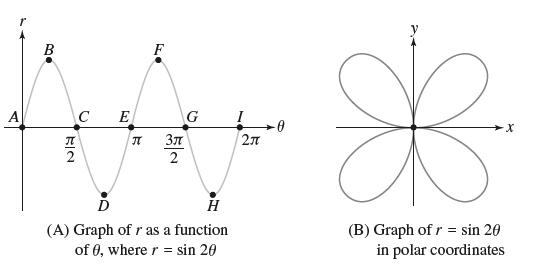
Figure 21 displays the graphs of r = sin 2θ in r versus θ rectangular coordinates and in polar coordinates, where it is a “rose with four petals.” Identify:(a) The points in (B) corresponding to points A–I in (A).(b) The parts of the curve in (B) corresponding to the angle intervals [0,
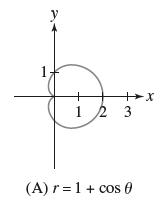
Show that the cardioid of Exercise 33 has equation (x2 + y2 − x)2 = x2 + y2 in rectangular coordinates.Data From Exercise 33Sketch the cardioid curve r = 1 + cos θ.
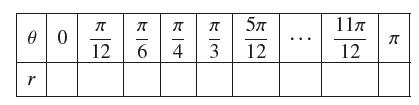
Sketch the curve r = sin 3θ by filling in the table of r-values below and plotting the corresponding points of the curve. Notice that the three petals of the curve correspond to the angle intervals [0, π/3], [π/3, 2π/3], and [π/3, π]. Then plot r = sin 3θ in rectangular coordinates and label
(a) Plot the curve r = 1/π−θ for 0 ≤ θ ≤ 2π.(b) With r as in (a), compute the limitsExplain how the limits in (b) show that the curve approaches a horizontal asymptote as θ approaches π, both from the left and from the right. What is the asymptote? lim rcos 0, lim r cos 0, lim r sin 0,
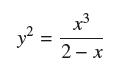
Plot the cissoid r = 2 sin θ tan θ and show that its equation in rectangular coordinates is ܐ = 3 2-x
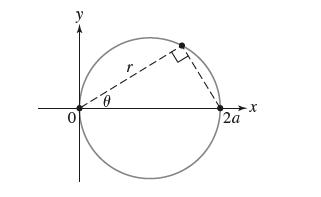
Prove that r = 2a cos θ is the equation of the circle in Figure 22 using only the fact that a triangle inscribed in a circle with one side a diameter is a right triangle. 0 2a -X
Show that r = a cos θ + b sin θ is the equation of a circle passing through the origin. Express the radius and center (in rectangular coordinates) in terms of a and b and write the equation in rectangular coordinates.
Use the previous exercise to write the equation of the circle of radius 5 and center (3, 4) in the form r = a cos θ + b sin θ.
Use the identity cos 2θ = cos2θ − sin2θ to find a polar equation of the hyperbola x2 − y2 = 1.
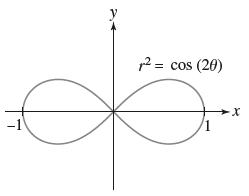
Find an equation in rectangular coordinates for the curve r2 = cos 2θ.
Use the addition formula for the cosine to show that the line L with polar equation r cos(θ − α) = d has the equation in rectangular coordinates (cos α)x + (sin α)y = d. Show that L has slope m = − cot α and y-intercept d/sin α.
Find an equation in polar coordinates of the line L with the given description.The point on L closest to the origin has polar coordinates 2, π9.
Find an equation in polar coordinates of the line L with the given description.The point on L closest to the origin has rectangular coordinates (−2, 2).
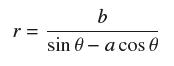
Show that every line that does not pass through the origin has a polar equation of the formwhere b ≠ 0. r = b sin 8-a cos
Show that cos 3θ = cos3 θ − 3 cos θ sin2 θ and use this identity to find an equation in rectangular coordinates for the curve r = cos 3θ.
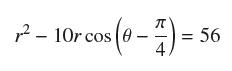
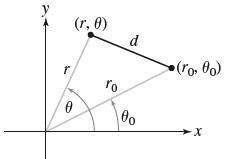
By the Law of Cosines, the distance d between two points (Figure 23) with polar coordinates (r, θ) and (r0, θ0) isUse this distance formula to show thatis the equation of the circle of radius 9 whose center has polar coordinates (5, π/4). d² = r² + r-2rro cos(8 - 00)
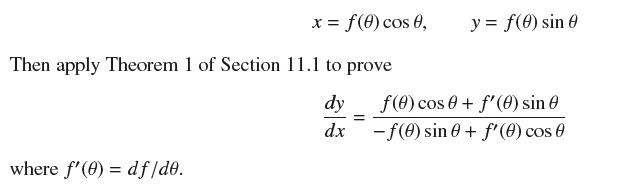
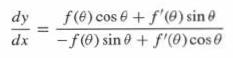
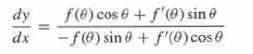
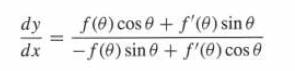
Show that a polar curve r =ƒ(θ) has parametric equations x = f(0) cos 0, Then apply Theorem 1 of Section 11.1 to prove dy dx where f'(0) = df/de. = y = f(0) sin 0 f(0) cos 0 + f'(0) sin -f(0) sin 0+ f'(0) cos 0
For a > 0, a lemniscate curve is the set of points P such that the product of the distances from P to (a, 0) and (−a, 0) is a2. Show that the equation of the lemniscate is (x 0. + y2)2 = 2a2(x2 − y2)Then find the equation in polar coordinates. To obtain the simplest form of the equation, use
Let c be a fixed constant. Explain the relationship between the graphs of:(a) y = ƒ(x + c) and y = ƒ(x) (rectangular).(b) r = ƒ(θ + c) and r = ƒ(θ) (polar).(c) y = ƒ(x) + c and y = ƒ(x) (rectangular).(d) r = ƒ(θ) + c and r = ƒ(θ) (polar).
Use Eq. (2) to find the slope of the tangent line to r = sin θ at θ = π/3. dy dx f(0) cose + f'(0) sin -f(0) sin 0 + f'(0) cos0
Use Eq. (2) to find the slope of the tangent line to r = θ at θ = π/2 and θ = π. dy dx f(0) cos 6 + f'(0) sin -f(0) sin 0 + f'(0) cos 0
Find the polar coordinates of the points on the lemniscate r2 = cos 2θ in Figure 24 where the tangent line is horizontal. r² = cos (20) ·x
Find the equation in rectangular coordinates of the tangent line to r = 4 cos 3θ at θ = π/6.
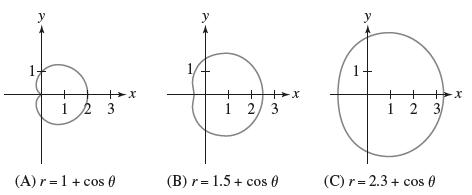
Find the polar coordinates of the points on the cardioid r = 1 + cos θ where the tangent line is horizontal (see Figure 25(A)). 1; +X 1 2 3 (A) r= 1 + cos (
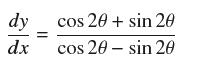
Use Eq. (2) to show that for r = sin θ + cos θ,Then calculate the slopes of the tangent lines at points A, B,C in Figure 20. dy dx || cos 20 + sin 20 cos 20-sin 20
Use a graphing utility to convince yourself that the polar equations r = ƒ1(θ) = 2 cos θ − 1 and r = ƒ2(θ) = 2 cos θ + 1 have the same graph. Then explain why. Show that the points (ƒ1(θ + π), θ + π) and (ƒ2(θ), θ) coincide.
We investigate how the shape of the limac¸on curve r = b + cos θ depends on the constant b (see Figure 25).(a) Argue as in Exercise 63 to show that the constants b and −b yield the same curve.(b) Plot the limac¸on for b = 0, 0.2, 0.5, 0.8, 1 and describe how the curve changes.(c) Plot the
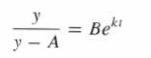
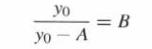
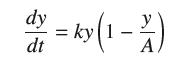
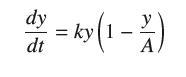
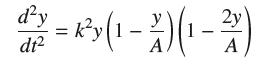
In Exercises 17 and 18, let y(t) be a solution of the logistic equationwhere A > 0 and k > 0.(a) Differentiate Eq. (9) with respect to t and use the Chain Rule to show that dt = ky(1 A
Find the general solution of the first-order linear differential equation.ex y'= 1 + 2exy
Showing 3000 - 3100
of 8339
First
24
25
26
27
28
29
30
31
32
33
34
35
36
37
38
Last
Step by Step Answers

 Get 50% OFF
Claim Now
Get 50% OFF
Claim Now