New Semester
Started
Get
50% OFF
Study Help!
--h --m --s
Claim Now
Question Answers
Textbooks
Find textbooks, questions and answers
Oops, something went wrong!
Change your search query and then try again
S
Books
FREE
Study Help
Expert Questions
Accounting
General Management
Mathematics
Finance
Organizational Behaviour
Law
Physics
Operating System
Management Leadership
Sociology
Programming
Marketing
Database
Computer Network
Economics
Textbooks Solutions
Accounting
Managerial Accounting
Management Leadership
Cost Accounting
Statistics
Business Law
Corporate Finance
Finance
Economics
Auditing
Tutors
Online Tutors
Find a Tutor
Hire a Tutor
Become a Tutor
AI Tutor
AI Study Planner
NEW
Sell Books
Search
Search
Sign In
Register
study help
mathematics
calculus early transcendentals
Calculus Early Transcendentals 2nd edition William L. Briggs, Lyle Cochran, Bernard Gillett - Solutions
Let u = (u1, u2, u3), v = (v1, v2, v3), and w = (w1, w2, w3). Prove the following vector properties, where c is a scalar.c(u • v) = (cu) • v = u • (cv) Associative property
Let u = (u1, u2, u3), v = (v1, v2, v3), and w = (w1, w2, w3). Prove the following vector properties, where c is a scalar.u • v = v • u Commutative property
Let u = (u1, u2, u3), v = (v1, v2, v3), and w = (w1, w2, w3). Prove the following vector properties, where c is a scalar.|u • v| ≤ |u | |v|
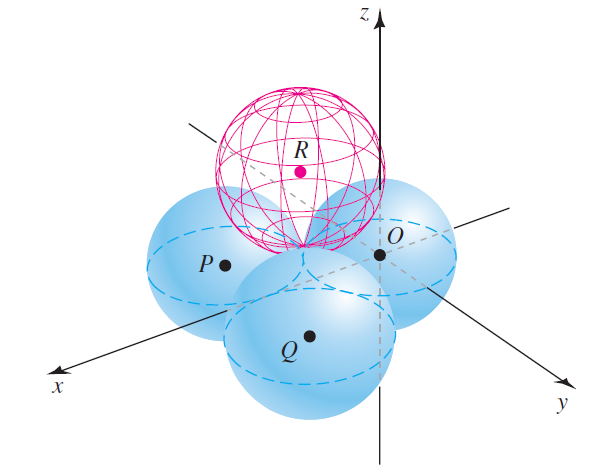
Imagine three unit spheres (radius equal to 1) with centers at O(0, 0, 0), P(√3, -1, 0), and Q(√3, 1, 0). Now place another unit sphere symmetrically on top of these spheres with its center at R (see figure).a. Find the coordinates of R. The distance between the centers of any two spheres is
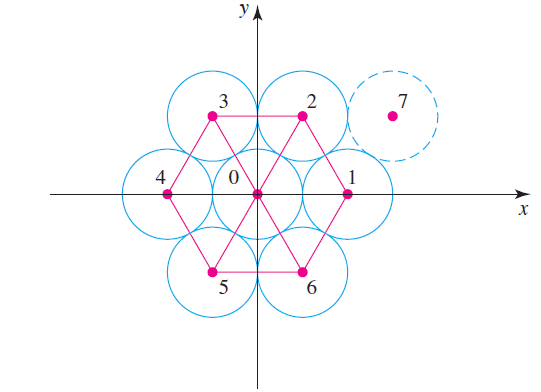
The German mathematician Gauss proved that the densest way to pack circles with the same radius in the plane is to place the centers of the circles on a hexagonal grid (see figure). Some molecular structures use this packing or its three-dimensional analog. Assume all circles have a radius of 1 and
Let D be a solid heat-conducting cube formed by the planes x = 0, x = 1, y = 0, y = 1, z = 0, and z = 1. The heat flow at every point of D is given by the constant vector Q = (0, 2, 1).a. Through which faces of D does Q point into D?b. Through which faces of D does Q point out of D?c. On which
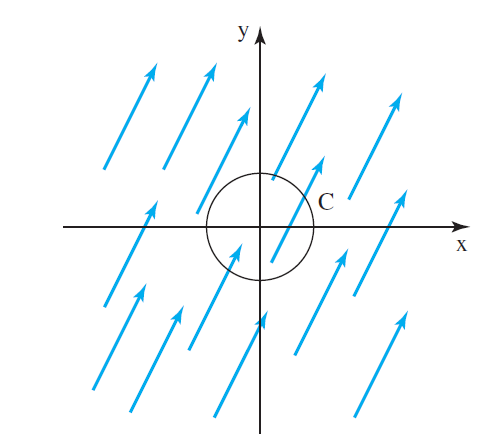
Suppose water flows in a thin sheet over the xy-plane with a uniform velocity given by the vector v = (1, 2); this means that at all points of the plane, the velocity of the water has components 1 m/s in the x-direction and 2 m/s in the y-direction (see figure). Let C be an imaginary unit circle
For the given points P, Q, and R, find the approximate measurements of the angles of ΔPQR.P(0, -1, 3), Q(2, 2, 1), R(-2, 2, 4)
For the given points P, Q, and R, find the approximate measurements of the angles of ΔPQR.P(1, -4), Q(2, 7), R(-2, 2)
Consider the vectors I = (1/2, 1/2, 1/√2), J = (-1/√2, 1/√2, 0), and K = (1/2, 1/2, -1√2).a. Sketch I, J, and K and show that they are unit vectors.b. Show that I, J, and K are pairwise orthogonal.c. Express the vector (1, 0, 0) in terms of I, J, and K.
Consider the vectors I = (1/√2, 1/√2) and J = (-1/√2, 1/√2).Write the vector (2, -6) in terms of I and J.
Consider the vectors I = (1/√2, 1/√2) and J = (-1/√2, 1/√2).Express I and J in terms of the usual unit coordinate vectors i andj. Then write i and j in terms of I and J.
Consider the vectors I = (1/√2, 1/√2) and J = (-1/√2, 1/√2).Show that I and J are orthogonal unit vectors.
Carry out the following steps to determine the (least) distance between the point P and the line ℓ through the origin.a. Find any vector v in the direction of ℓ.b. Find the position vector u corresponding to P.c. Find projvu.d. Show that w = u - projvu is a vector orthogonal to v whose length
Carry out the following steps to determine the (least) distance between the point P and the line ℓ through the origin.a. Find any vector v in the direction of ℓ.b. Find the position vector u corresponding to P.c. Find projvu.d. Show that w = u - projvu is a vector orthogonal to v whose length
Carry out the following steps to determine the (least) distance between the point P and the line ℓ through the origin.a. Find any vector v in the direction of ℓ.b. Find the position vector u corresponding to P.c. Find projvu.d. Show that w = u - projvu is a vector orthogonal to v whose length
Carry out the following steps to determine the (least) distance between the point P and the line ℓ through the origin.a. Find any vector v in the direction of ℓ.b. Find the position vector u corresponding to P.c. Find projvu.d. Show that w = u - projvu is a vector orthogonal to v whose length
For the following vectors u and v, express u as the sum u = p + n, where p is parallel to v and n is orthogonal to v.u = (-1, 2, 3), v = (2, 1, 1)
For the following vectors u and v, express u as the sum u = p + n, where p is parallel to v and n is orthogonal to v.u = (4, 3, 0), v = (1, 1, 1)
For the following vectors u and v, express u as the sum u = p + n, where p is parallel to v and n is orthogonal to v.u = (-2, 2), v = (2, 1)
For the following vectors u and v, express u as the sum u = p + n, where p is parallel to v and n is orthogonal to v.u = (4, 3), v = (1, 1)
Given a fixed vector v, there is an infinite set of vectors u with the same value of projvu.Let v = (0, 0, 1). Give a description of all position vectors u such that projvu = projv(1, 2, 3).
Given a fixed vector v, there is an infinite set of vectors u with the same value of projvu.Find another vector that has the same projection onto v = (1, 1, 1) as u = (1, 2, 3).
Given a fixed vector v, there is an infinite set of vectors u with the same value of projvu.Let v = (1, 1). Give a description of the position vectors u such that projvu = projv(1, 2).
Given a fixed vector v, there is an infinite set of vectors u with the same value of projvu.Find another vector that has the same projection onto v = (1, 1) as u = (1, 2). Draw a picture.
Consider the set of all unit position vectors u in R3 that make a 60° angle with the unit vector k in R3.a. Prove that projku is the same for all vectors in this set.b. Is scalku the same for all vectors in this set?
Let a and b be real numbers.Find two vectors that are orthogonal to (0, 1, 1) and to each other.
Let a and b be real numbers.Describe all unit vectors orthogonal to v = i + j + k.
Let a and b be real numbers.Find three mutually orthogonal unit vectors in R3 besides ±i, ±j, and ±k.
Let a and b be real numbers.Find all vectors (1, a, b) orthogonal to (4, -8, 2).
Let a and b be real numbers.Find all unit vectors orthogonal to v = (3, 4, 0).
Determine whether the following statements are true and give an explanation or counterexample.a. projvu = projuv.b. If nonzero vectors u and v have the same magnitude, they make equal angles with u + v.c. (u • i)2 + (u • j)2 + (u • k)2 = |u|2.d. If u is orthogonal to v and v is
Find the components of the vertical force F = (0, -10) in the directions parallel to and normal to the following inclined planes. Show that the total force is the sum of the two component forces.A plane that makes an angle of θ = tan-1 4/5 with the positive x-axis
Find the components of the vertical force F = (0, -10) in the directions parallel to and normal to the following inclined planes. Show that the total force is the sum of the two component forces.A plane that makes an angle of π/3 with the positive x-axis
Find the components of the vertical force F = (0, -10) in the directions parallel to and normal to the following inclined planes. Show that the total force is the sum of the two component forces.A plane that makes an angle of π/6 with the positive x-axis
Find the components of the vertical force F = (0, -10) in the directions parallel to and normal to the following inclined planes. Show that the total force is the sum of the two component forces.A plane that makes an angle of π/4 with the positive x-axis
Calculate the work done in the following situations.A constant force F = (2, 4, 1) (in newtons) moves an object from (0, 0, 0) to (2, 4, 6). (Distance is measured in meters.)
Calculate the work done in the following situations.A constant force F = (40, 30) (in newtons) is used to move a sled horizontally 10 m.
Calculate the work done in the following situations.A constant force F = (4, 3, 2) (in newtons) moves an object from (0, 0, 0) to (8, 6, 0). (Distance is measured in meters.)
Calculate the work done in the following situations.A sled is pulled 10 m along horizontal ground with a constant force of 5 N at an angle of 45° above the horizontal.
Calculate the work done in the following situations.A stroller is pushed 20 m with a constant force of 10 N at an angle of 15° below the horizontal.
Calculate the work done in the following situations.A suitcase is pulled 50 ft along a horizontal sidewalk with a constant force of 30 lb at an angle of 30° above the horizontal.
For the given vectors u and v, calculate projvu and scalvu.u = i + 4j + 7k and v = 2i - 4j + 2k
For the given vectors u and v, calculate projvu and scalvu.u = 5 i + j - 5 k and v = -i + j - 2 k
For the given vectors u and v, calculate projvu and scalvu.u = (5, 0, 15) and v = (0, 4, -2)
For the given vectors u and v, calculate projvu and scalvu.u = (-8, 0, 2) and v = (1, 3, -3)
For the given vectors u and v, calculate projvu and scalvu.u = (13, 0, 26) and v = (4, -1, -3)
For the given vectors u and v, calculate projvu and scalvu.u = (3, 3, -3) and v = (1, -1, 2)
For the given vectors u and v, calculate projvu and scalvu.u = (10, 5) and v = (2, 6)
For the given vectors u and v, calculate projvu and scalvu.u = (-1, 4) and v = (-4, 2)
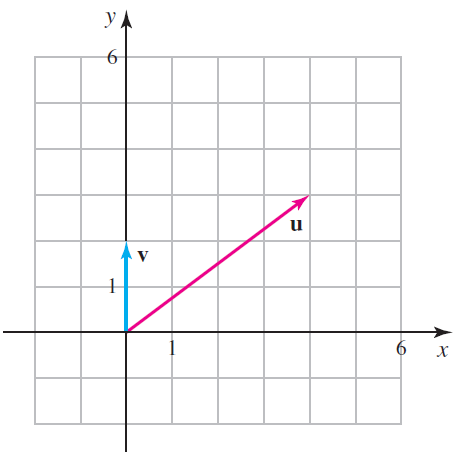
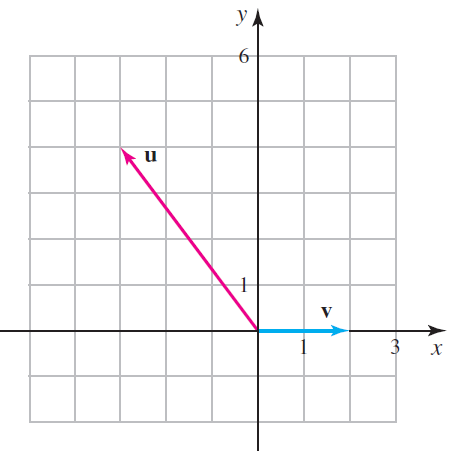
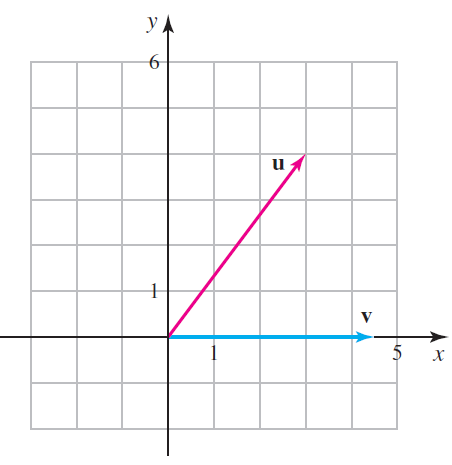
Find projvu and scalvu by inspection without using formulas. 4
Find projvu and scalvu by inspection without using formulas. х
Find projvu and scalvu by inspection without using formulas. УА х
Find projvu and scalvu by inspection without using formulas. y, х
Compute the dot product of the vectors u and v, and find the angle between the vectors.u = i - 4j - 6k and v = 2i - 4j + 2k
Compute the dot product of the vectors u and v, and find the angle between the vectors.u = 2i - 3k and v = i + 4j + 2k
Compute the dot product of the vectors u and v, and find the angle between the vectors.u = (3, -5, 2) and v = (-9, 5, 1)
Compute the dot product of the vectors u and v, and find the angle between the vectors.u = (-10, 0, 4) and v = (1, 2, 3)
Compute the dot product of the vectors u and v, and find the angle between the vectors.u = (3, 4, 0) and v = (0, 4, 5)
Compute the dot product of the vectors u and v, and find the angle between the vectors.u = 4i + 3j and v = 4i - 6j
Compute the dot product of the vectors u and v, and find the angle between the vectors.u = √2 i + √2 j and v = -√2 i - √2 j
Compute the dot product of the vectors u and v, and find the angle between the vectors.u = i and v = i + √3 j
Compute the dot product of the vectors u and v, and find the angle between the vectors.u = (10, 0) and v = (-5, 5)
Compute the dot product of the vectors u and v, and find the angle between the vectors.u = i + j and v = i - j
Compute u • v if u is a unit vector, |v| = 2, and the angle between them is 3π/4.
Compute u • v if u and v are unit vectors and the angle between them is π/3.
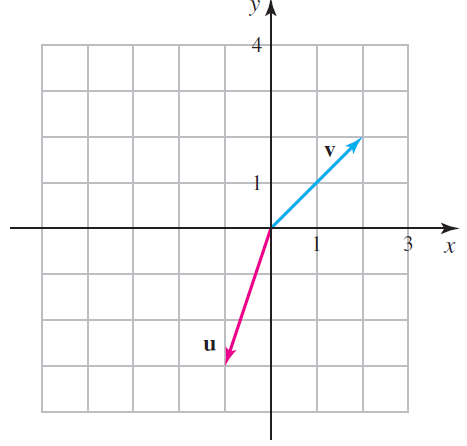
Consider the following vectors u and v. Sketch the vectors, find the angle between the vectors, and compute the dot product using the definition u • v = |u| |v| cos θ.u = (-√3, 1) and v = (√3, 1)
Consider the following vectors u and v. Sketch the vectors, find the angle between the vectors, and compute the dot product using the definition u • v = |u| |v| cos θ.u = (10, 0) and v = (10, 10)
Consider the following vectors u and v. Sketch the vectors, find the angle between the vectors, and compute the dot product using the definition u • v = |u| |v| cos θ.u = (-3, 2, 0) and v = (0, 0, 6)
Consider the following vectors u and v. Sketch the vectors, find the angle between the vectors, and compute the dot product using the definition u • v = |u| |v| cos θ.u = 4i and v = 6j
Explain how the work done by a force in moving an object is computed using dot products.
Use a sketch to illustrate the scalar component of u in the direction of v.
Use a sketch to illustrate the projection of u onto v.
Explain how to find the angle between two nonzero vectors.
What is the dot product of two orthogonal vectors?
Compute (2, 3, -6) • (1, -8, 3).
Express the dot product of u and v in terms of the components of the vectors.
Express the dot product of u and v in terms of their magnitudes and the angle between them.
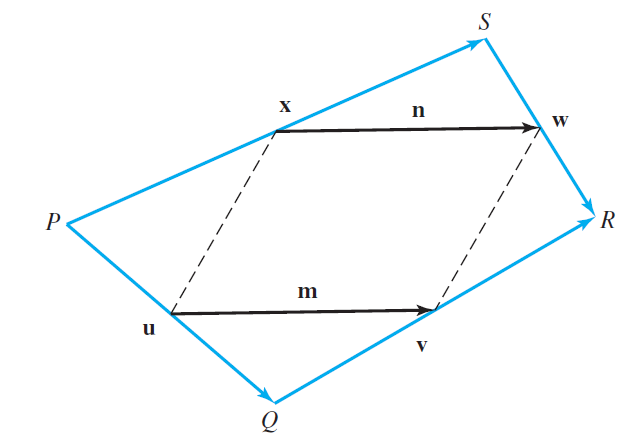
Prove the quadrilateral property in Exercise 83, assuming the coordinates of P, Q, R, and S are P(x1, y1, 0), Q(x2, y2, 0), R(x3, y3, 0), and S(x4, y4, z4), where we assume that P, Q, and R lie in the xy-plane without loss of generality.Data from Exercise 83The points P, Q, R, and S, joined by the
The points P, Q, R, and S, joined by the vectors u, v, w, and x, are the vertices of a quadrilateral in R3. The four points needn’t lie in a plane (see figure). Use the following steps to prove that the line segments joining the midpoints of the sides of the quadrilateral form a parallelogram.
In contrast to the proof in Exercise 81, we now use coordinates and position vectors to prove the same result. Without loss of generality, let P(x1, y1, 0) and Q(x2, y2, 0) be two points in the xy-plane and let R(x3, y3, z3) be a third point, such that P, Q, and R do not lie on a line. Consider
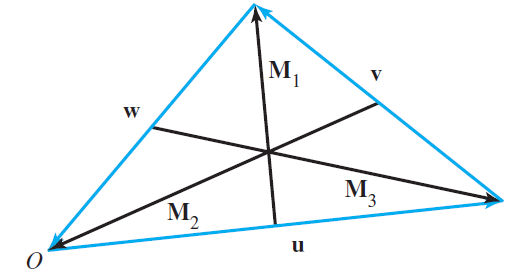
Assume that u, v, and w are vectors in R3 that form the sides of a triangle (see figure). Use the following steps to prove that the medians intersect at a point that divides each median in a 2:1 ratio. The proof does not use a coordinate system.a. Show that u + v + w = 0.b. Let M1 be the median
For constants a, b, c, and d, show that the equationx2 + y2 + z2 - 2ax - 2by - 2cz = ddescribes a sphere centered at (a, b, c) with radius r, where r2 = d + a2 + b2 + c2, provided d + a2 + b2 + c2 > 0.
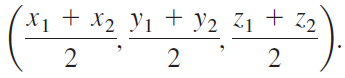
Prove that the midpoint of the line segment joining P(x1, y1, z1) and Q(x2, y2, z2) is X1 + x2 y1 + y2 Z1 + Z2 2
Two sides of a parallelogram are formed by the vectors u and v. Prove that the diagonals of the parallelogram are u + v and u - v.
The points O(0, 0, 0), P(1, 4, 6), and Q(2, 4, 3) lie at three vertices of a parallelogram. Find all possible locations of the fourth vertex.
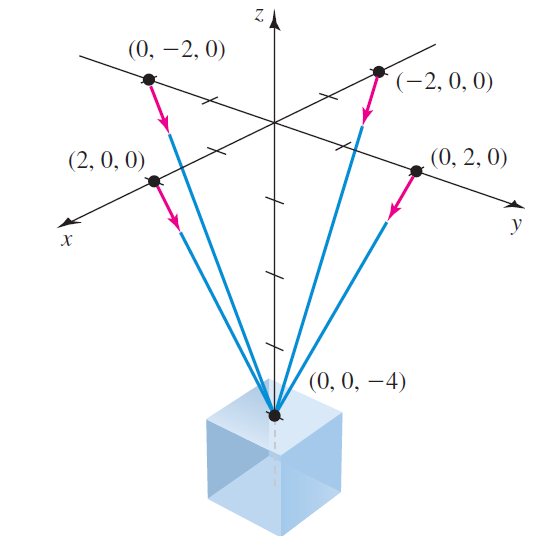
A 500-lb load hangs from four cables of equal length that are anchored at the points (±2, 0, 0) and (0, ±2, 0). The load is located at (0, 0, -4). Find the vectors describing the forces on the cables due to the load. (0, –2, 0) (-2, 0, 0) (0, 2, 0) (2, 0, 0) х (0, 0, –4)
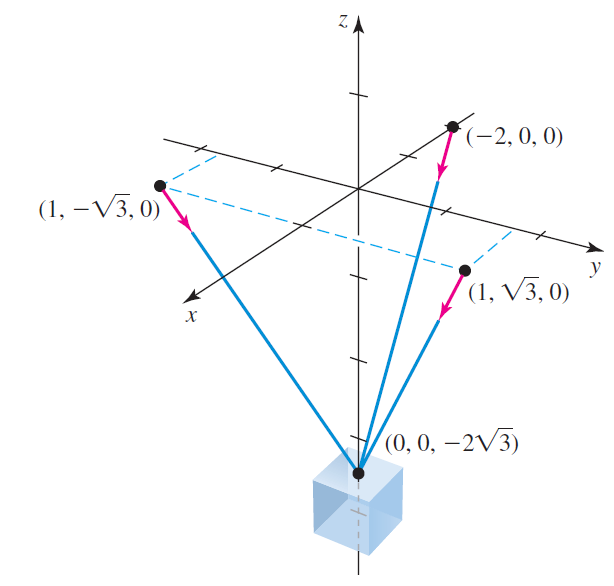
A 500-kg load hangs from three cables of equal length that are anchored at the points (-2, 0, 0), (1, 13 , 0), and (1, -√3, 0). The load is located at (0, 0, -2√3). Find the vectors describing the forces on the cables due to the load. (-2, 0, 0) (1, –V3, 0) Ja. V5.0) (1, V3, 0) х (0, 0,
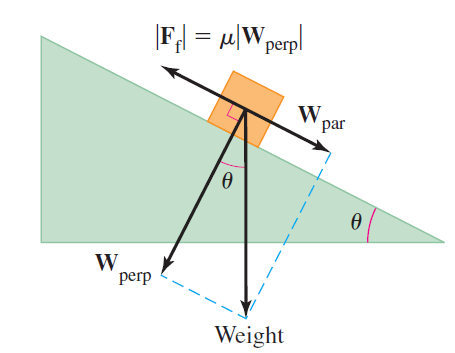
An object on an inclined plane does not slide provided the component of the object’s weight parallel to the plane |Wpar| is less than or equal to the magnitude of the opposing frictional force |Ff|. The magnitude of the frictional force, in turn, is proportional to the component of the object’s
What is the longest diagonal of a rectangular 2 ft × 3 ft × 4 ft box?
Determine the values of x and y such that the points (1, 2, 3), (4, 7, 1), and (x, y, 2) are collinear (lie on a line).
Determine whether the points P, Q, and R are collinear (lie on a line) by comparingIf the points are collinear, determine which point lies between the other two points.a. P(1, 6, -5), Q(2, 5, -3), R(4, 3, 1)b. P(1, 5, 7), Q(5, 13, -1), R(0, 3, 9)c. P(1, 2, 3), Q(2, -3, 6), R(3, -1, 9)d. P(9, 5, 1),
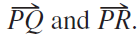
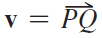
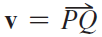
Find vectors parallel to v of the given length.with P(1, 0, 1) and Q(2, -1, 1); length = 3 PO
Find vectors parallel to v of the given length.with P(3, 4, 0) and Q(2, 3, 1); length = 3 РФ PO
Find vectors parallel to v of the given length.v = (3, -2, 6); length = 10
Find vectors parallel to v of the given length.v = (6, -8, 0); length = 20
Find a pair of equations describing a line passing through the point (-2, -5, 1) that is parallel to the x-axis.
Find a pair of equations describing a circle of radius 3 centered at (2, 4, 1) that lies in a plane parallel to the xz-plane.
Give a geometric description of the set of points (x, y, z) that lie on the intersection of the sphere x2 + y2 + z2 = 36 and the plane z = 6.
Give a geometric description of the set of points (x, y, z) that lie on the intersection of the sphere x2 + y2 + z2 = 5 and the plane z = 1.
Showing 1100 - 1200
of 6775
First
5
6
7
8
9
10
11
12
13
14
15
16
17
18
19
Last
Step by Step Answers

 Get 50% OFF
Claim Now
Get 50% OFF
Claim Now