New Semester
Started
Get
50% OFF
Study Help!
--h --m --s
Claim Now
Question Answers
Textbooks
Find textbooks, questions and answers
Oops, something went wrong!
Change your search query and then try again
S
Books
FREE
Study Help
Expert Questions
Accounting
General Management
Mathematics
Finance
Organizational Behaviour
Law
Physics
Operating System
Management Leadership
Sociology
Programming
Marketing
Database
Computer Network
Economics
Textbooks Solutions
Accounting
Managerial Accounting
Management Leadership
Cost Accounting
Statistics
Business Law
Corporate Finance
Finance
Economics
Auditing
Tutors
Online Tutors
Find a Tutor
Hire a Tutor
Become a Tutor
AI Tutor
AI Study Planner
NEW
Sell Books
Search
Search
Sign In
Register
study help
mathematics
calculus early transcendentals
Calculus Early Transcendentals 2nd edition William L. Briggs, Lyle Cochran, Bernard Gillett - Solutions
A boat is towed with a force of 150 lb with a rope that makes an angle of 30° to the horizontal. Find the horizontal and vertical components of the force.
A sailboat floats in a current that flows due east at 1 m/s. Due to a wind, the boat’s actual speed relative to the shore is √3 m/s in a direction 30° north of east. Find the speed and direction of the wind.
A woman in a canoe paddles due west at 4 mi/hr relative to the water in a current that flows northwest at 2 mi/hr. Find the speed and direction of the canoe relative to the shore.
An airplane flies horizontally from east to west at 320 mi/hr relative to the air. If it flies in a steady 40 mi/hr wind that blows horizontally toward the southwest (45° south of west), find the speed and direction of the airplane relative to the ground.
In still air, a parachute with a payload falls vertically at a terminal speed of 4 m/s. Find the direction and magnitude of its terminal velocity relative to the ground if it falls in a steady wind blowing horizontally from west to east at 10 m/s.
The water in a river moves south at 5 km/hr. A motorboat travels due east at a speed of 40 km/hr relative to the water. Determine the speed of the boat relative to the shore.
The water in a river moves south at 10 mi/hr. A motorboat travels due east at a speed of 20 mi/hr relative to the shore. Determine the speed and direction of the boat relative to the moving water.
Define the points P(-4, 1), Q(3, -4), and R(2, 6).Find two vectors parallel towith length 4.
Define the points P(-4, 1), Q(3, -4), and R(2, 6).Find two vectors parallel to with length 4. RP
Define the points P(-4, 1), Q(3, -4), and R(2, 6).Find two unit vectors parallel to PR.
Define the points P(-4, 1), Q(3, -4), and R(2, 6).Find the unit vector with the same direction as QR.
Define the points P(-4, 1), Q(3, -4), and R(2, 6).Expressin the form ai + bj. OR
Define the points P(-4, 1), Q(3, -4), and R(2, 6).Expressin the form ai + bj. PQ
Let u = (3, -4), v = (1, 1), and w = (-1, 0).Which has the greater magnitude, u - v or w - u?
Let u = (3, -4), v = (1, 1), and w = (-1, 0).Which has the greater magnitude, 2u or 7v?
Let u = (3, -4), v = (1, 1), and w = (-1, 0).Find two vectors parallel to v with three times the magnitude of v.
Let u = (3, -4), v = (1, 1), and w = (-1, 0).Find two vectors parallel to u with four times the magnitude of u.
Let u = (3, -4), v = (1, 1), and w = (-1, 0).Find |2u + 3v - 4w|.
Let u = (3, -4), v = (1, 1), and w = (-1, 0).Find |u + v + w|.
Let u = (3, -4), v = (1, 1), and w = (-1, 0).Find |-2v|.
Let u = (3, -4), v = (1, 1), and w = (-1, 0).Find |u + v|.
Let u = (4, -2), v = (-4, 6), and w = (0, 8). Express the following vectors in the form (a, b).8w + v - 6u
Let u = (4, -2), v = (-4, 6), and w = (0, 8). Express the following vectors in the form (a, b).10u - 3v + w
Let u = (4, -2), v = (-4, 6), and w = (0, 8). Express the following vectors in the form (a, b).w - 3v
Let u = (4, -2), v = (-4, 6), and w = (0, 8). Express the following vectors in the form (a, b).2u + 3v
Let u = (4, -2), v = (-4, 6), and w = (0, 8). Express the following vectors in the form (a, b).w - u
Let u = (4, -2), v = (-4, 6), and w = (0, 8). Express the following vectors in the form (a, b).u + v
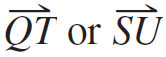
Which of the vectorsis equal to (5, 0)? от QT or SU
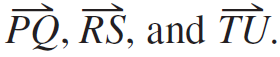
Find the equal vectors among PQ, RS, and TỦ.
Sketch and the corresponding position vectors. QU, PT, and RS
Define the points P(-3, -1), Q(-1, 2), R(1, 2), S(3, 5), T(4, 2), and U(6, 4).Sketchand the corresponding position vectors. PU, TR, and SQ
Define the points O(0, 0), P(3, 2), Q(4, 2), and R(-6, -1). For each vector, do the following. (i) Sketch the vector in an xy-coordinate system.(ii) Compute the magnitude of the vector.a.b.c. OP
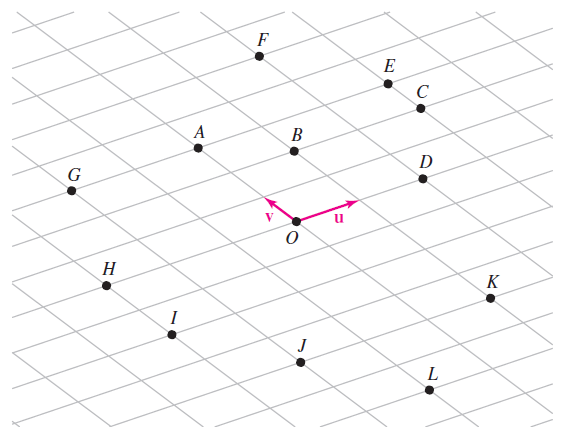
Refer to the figure and carry out the following vector operations.a.b.c.d.e.f.g.h. i. G D Н K BF
Refer to the figure and carry out the following vector operations.Write the following vectors as sums of scalar multiples of u and v.a.b.c.d.e.f.g.h.i. G D Н K OÈ
Refer to the figure and carry out the following vector operations.Write the following vectors as scalar multiples of u or v.a.b.c. d. e. G D Н K IH
Refer to the figure and carry out the following vector operations.Write the following vectors as scalar multiples of u or v.a.b.c.d.e. G D Н K OA
Refer to the figure and carry out the following vector operations.Which of the following vectors equals a. 6v b. -6v c.d.e. G D Н K
Refer to the figure and carry out the following vector operations.Which of the following vectors equals (There may be more than one correct answer.)a. vb.c.d. ue. G D Н K CE?
If a force of magnitude 100 is directed 45° south of east, what are its components?
How do you find a vector of length 10 in the direction of v = (3, -2)?
Explain how to find two unit vectors parallel to a vector v.
How do you computefrom the coordinates of the points P and Q? | PÒ|
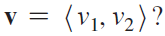
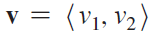
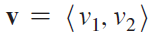
Express the vector v = (v1, v2) in terms of the unit vectors i and j.
How do you compute the magnitude of (V1, V2) ?
Ifand c is a scalar, how do you find cv? (V1, V2)
If u = (u1, u2) and how do you find u + v? (V1, V2)
Given two points P and Q, how are the components of determined? PO
Explain how to find a scalar multiple of a vector geometrically.
Explain how to add two vectors geometrically.
Given a position vector v, why are there infinitely many vectors equal to v?
On the diagram of Exercise 3, draw the position vector that is equal to PO.
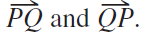
Draw x- and y-axes on a page and mark two points P and Q. Then draw PQ and QP.
What is a position vector?
Interpret the following statement: Points have a location, but no size or direction; nonzero vectors have a size and direction, but no location.
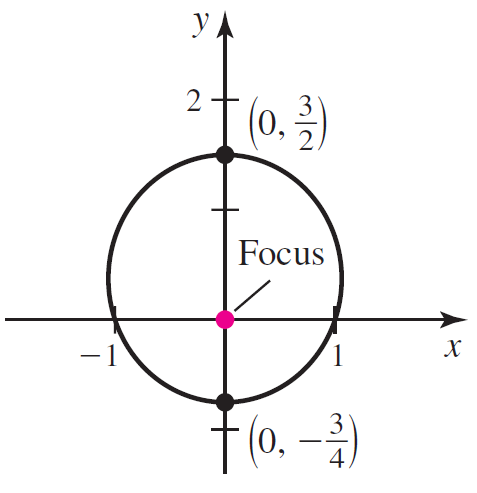
Find a polar equation for the conic sections in the figures. У 2 I(. ) Focus -1 (0. – 2) 3
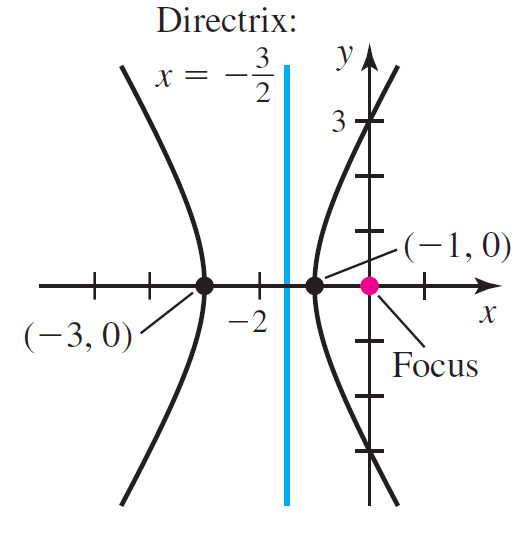
Find a polar equation for the conic sections in the figures. Directrix: 3 х 2 3 -(-1,0) + х -2 (-3, 0)· Focus
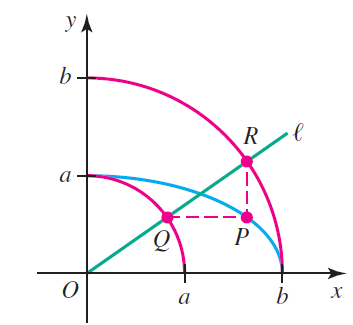
Start with two circles centered at the origin with radii 0 < a < b (see figure). Assume the line ℓ through the origin intersects the smaller circle at Q and the larger circle at R. Let P(x, y) have the y-coordinate of Q and the x-coordinate of R. Show that the set of points P(x, y)
Let P be the parabola y = px2 and H be the right half of the hyperbola x2 - y2 = 1. a. For what value of p is P tangent to H?b. At what point does the tangency occur?c. Generalize your results for the hyperbola x2/a2 - y2/b2 = 1.
Let R be the region in the first quadrant bounded by the ellipse x2/a2 + y2/b2 = 1. Find the value of m (in terms of a and b) such that the line y = mx divides R into two subregions of equal area.
Let S be the square centered at the origin with vertices (±a, ±a). Describe and sketch the set of points that are equidistant from the square and the origin.
Among all rectangles centered at the origin with vertices on the ellipse x2/a2 + y2/b2 = 1, what are the dimensions of the rectangle with the maximum area (in terms of a and b)? What is that area?
Consider the polar equation of an ellipse r = ed/(1 ± e cos θ), where 0 < e < 1. Evaluate an integral in polar coordinates to show that the area of the region enclosed by the ellipse is πab, where 2a and 2b are the lengths of the major and minor axes, respectively.
Use analytical methods to find as many intersection points of the following curves as possible. Use methods of your choice to find the remaining intersection points.r = θ/2 and r = -θ, for θ ≥ 0
Use analytical methods to find as many intersection points of the following curves as possible. Use methods of your choice to find the remaining intersection points.r2 = sin 2θ and r = 1 - 2 sin θ
Use analytical methods to find as many intersection points of the following curves as possible. Use methods of your choice to find the remaining intersection points.r2 = sin 2θ and r = θ
Use analytical methods to find as many intersection points of the following curves as possible. Use methods of your choice to find the remaining intersection points.r = 1 - cos θ and r = θ
An ellipse has vertices (0, ±6) and foci (0, ±4). Find the eccentricity, the directrices, and the minor-axis vertices.
A hyperbola has eccentricity e = 2 and foci (0, ±2). Find the location of the vertices and directrices.
Find an equation of the following curves, assuming the center is at the origin. Graph the curve, labeling vertices, foci, asymptotes (if they exist), and directrices.A hyperbola with vertices (0, ±2) and directrices y = ±1
Find an equation of the following curves, assuming the center is at the origin. Graph the curve, labeling vertices, foci, asymptotes (if they exist), and directrices.A hyperbola with vertices (±4, 0) and directrices x = ±2
Find an equation of the following curves, assuming the center is at the origin. Graph the curve, labeling vertices, foci, asymptotes (if they exist), and directrices.An ellipse with vertices (0, ±4) and directrices y = ±10
Find an equation of the following curves, assuming the center is at the origin. Graph the curve, labeling vertices, foci, asymptotes (if they exist), and directrices.An ellipse with foci (±4, 0) and directrices x = ±8
Consider the equation r2 = sec 2u.a. Convert the equation to Cartesian coordinates and identify the curve.b. Find the vertices, foci, directrices, and eccentricity of the curve.c. Graph the curve. Explain why the polar equation does not have the form given in the text for conic sections in polar
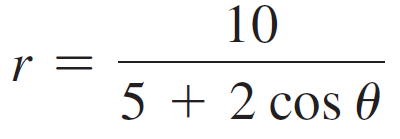
Graph the following conic sections, labeling vertices, foci, directrices, and asymptotes (if they exist). Give the eccentricity of the curve. Use a graphing utility to check your work. 10 5 + 2 cos 0
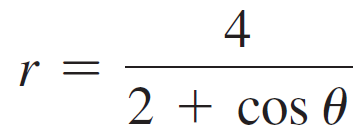
Graph the following conic sections, labeling vertices, foci, directrices, and asymptotes (if they exist). Give the eccentricity of the curve. Use a graphing utility to check your work. 4 2 + cos 0
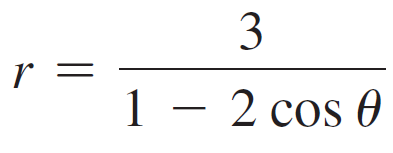
Graph the following conic sections, labeling vertices, foci, directrices, and asymptotes (if they exist). Give the eccentricity of the curve. Use a graphing utility to check your work. 1 - 2 cos 6
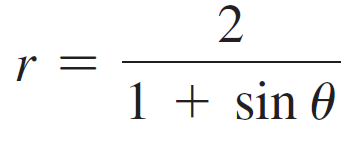
Graph the following conic sections, labeling vertices, foci, directrices, and asymptotes (if they exist). Give the eccentricity of the curve. Use a graphing utility to check your work. 1 + sin 0
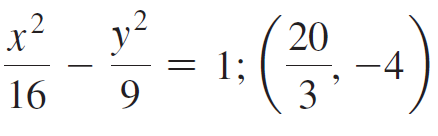
Find an equation of the line tangent to the following curves at the given point. Check your work with a graphing utility. .2 y? 13; -4 16 3
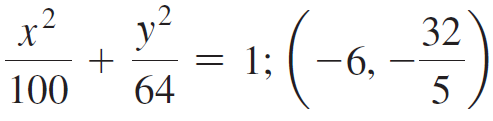
Find an equation of the line tangent to the following curves at the given point. Check your work with a graphing utility. .2 y? v2 32 1; ( -6, 5 100 64
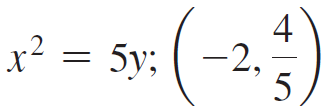
Find an equation of the line tangent to the following curves at the given point. Check your work with a graphing utility. 4 -2, 5. x2 5y;
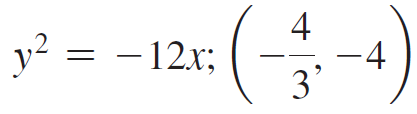
Find an equation of the line tangent to the following curves at the given point. Check your work with a graphing utility. 4 -4 3' – 12x; ,2
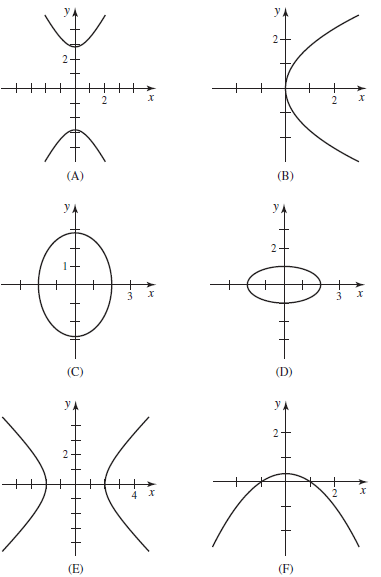
Match equations a–f with graphs A–F.a. x2 - y2 = 4 b. x2 + 4y2 = 4c. y2 - 3x = 0 d. x2 + 3y = 1e. x2/4 + y2/8 = 1f. y2/8 - x2/2 = 1 (A) (B) 2- 3 (C) (D) У, (E) (F)
a. Determine whether the following equations describe a parabola, an ellipse, or a hyperbola.b. Use analytical methods to determine the location of the foci, vertices, and directrices.c. Find the eccentricity of the curve.d. Make an accurate graph of the curve.4x2 + 8y2 = 16
a. Determine whether the following equations describe a parabola, an ellipse, or a hyperbola.b. Use analytical methods to determine the location of the foci, vertices, and directrices.c. Find the eccentricity of the curve.d. Make an accurate graph of the curve.y = 8x2 + 16x + 8
a. Determine whether the following equations describe a parabola, an ellipse, or a hyperbola.b. Use analytical methods to determine the location of the foci, vertices, and directrices.c. Find the eccentricity of the curve.d. Make an accurate graph of the curve.y2 - 4x2 = 16
a. Determine whether the following equations describe a parabola, an ellipse, or a hyperbola.b. Use analytical methods to determine the location of the foci, vertices, and directrices.c. Find the eccentricity of the curve.d. Make an accurate graph of the curve.x2/4 + y2/25 = 1
a. Determine whether the following equations describe a parabola, an ellipse, or a hyperbola.b. Use analytical methods to determine the location of the foci, vertices, and directrices.c. Find the eccentricity of the curve.d. Make an accurate graph of the curve.x2 - y2/2 = 1
a. Determine whether the following equations describe a parabola, an ellipse, or a hyperbola.b. Use analytical methods to determine the location of the foci, vertices, and directrices.c. Find the eccentricity of the curve.d. Make an accurate graph of the curve.x = 16y2
Find the area of the following regions. In each case, graph the curve(s) and shade the region in question.The area that is inside the cardioid r = 1 + cos θ and outside the cardioid r = 1 - cos θ
Find the area of the following regions. In each case, graph the curve(s) and shade the region in question.The area that is inside both the cardioids r = 1 - cos θ and r = 1 + cos θ
Find the area of the following regions. In each case, graph the curve(s) and shade the region in question.The region inside the lemniscate r2 = 4 cos 2θ and outside the circle r = 1/2
Find the area of the following regions. In each case, graph the curve(s) and shade the region in question.The region inside the limaçon r = 2 + cos θ and outside the circle r = 2
Find the area of the following regions. In each case, graph the curve(s) and shade the region in question.The region enclosed by the limaçon r = 3 - cos θ
Find the area of the following regions. In each case, graph the curve(s) and shade the region in question.The region enclosed by all the leaves of the rose r = 3 sin 4θ
a. Find all points where the following curves have vertical and horizontal tangent lines.b. Find the slope of the lines tangent to the curve at the origin (when relevant).c. Sketch the curve and all the tangent lines identified in parts (a) and (b).r2 = 2 cos 2 θ
a. Find all points where the following curves have vertical and horizontal tangent lines.b. Find the slope of the lines tangent to the curve at the origin (when relevant).c. Sketch the curve and all the tangent lines identified in parts (a) and (b).r = 3 - 6 cos θ
a. Find all points where the following curves have vertical and horizontal tangent lines.b. Find the slope of the lines tangent to the curve at the origin (when relevant).c. Sketch the curve and all the tangent lines identified in parts (a) and (b).r = 4 + 2 sin θ
a. Find all points where the following curves have vertical and horizontal tangent lines.b. Find the slope of the lines tangent to the curve at the origin (when relevant).c. Sketch the curve and all the tangent lines identified in parts (a) and (b).r = 2 cos 2θ
Consider the polar equations r = 1 and r = 2 - 4 cos θ.a. Graph the curves. How many intersection points do you observe?b. Give approximate polar coordinates of the intersection points.
Write the equation x = y2 in polar coordinates and state values of θ that produce the entire graph of the parabola.
Showing 1300 - 1400
of 6775
First
7
8
9
10
11
12
13
14
15
16
17
18
19
20
21
Last
Step by Step Answers

 Get 50% OFF
Claim Now
Get 50% OFF
Claim Now