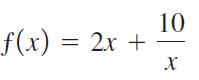
New Semester
Started
Get
50% OFF
Study Help!
--h --m --s
Claim Now
Question Answers
Textbooks
Find textbooks, questions and answers
Oops, something went wrong!
Change your search query and then try again
S
Books
FREE
Study Help
Expert Questions
Accounting
General Management
Mathematics
Finance
Organizational Behaviour
Law
Physics
Operating System
Management Leadership
Sociology
Programming
Marketing
Database
Computer Network
Economics
Textbooks Solutions
Accounting
Managerial Accounting
Management Leadership
Cost Accounting
Statistics
Business Law
Corporate Finance
Finance
Economics
Auditing
Tutors
Online Tutors
Find a Tutor
Hire a Tutor
Become a Tutor
AI Tutor
AI Study Planner
NEW
Sell Books
Search
Search
Sign In
Register
study help
mathematics
calculus with applications
Calculus With Applications 12th Edition Margaret L. Lial - Solutions
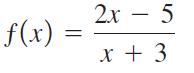
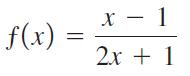
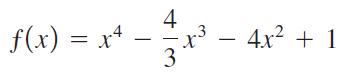
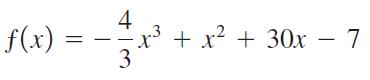
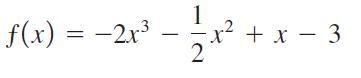
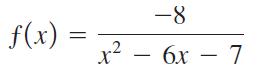
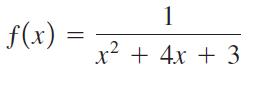
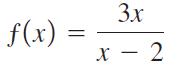
In Exercises, complete the following for each function.(a) Find intervals where the function is increasing or decreasing, and determine any relative extrema.(b) Find intervals where the function is concave upward or concave downward, and determine any inflection points.(c) Graph each function,
In Exercises, complete the following for each function.(a) Find intervals where the function is increasing or decreasing, and determine any relative extrema.(b) Find intervals where the function is concave upward or concave downward, and determine any inflection points.(c) Graph each function,
In Exercises, find the open intervals where the functions are concave upward or concave downward. Find any inflection points.ƒ(x) = (3 - x)4
In Exercises, complete the following for each function.(a) Find intervals where the function is increasing or decreasing, and determine any relative extrema.(b) Find intervals where the function is concave upward or concave downward, and determine any inflection points.(c) Graph each function,
In Exercises, complete the following for each function.(a) Find intervals where the function is increasing or decreasing, and determine any relative extrema.(b) Find intervals where the function is concave upward or concave downward, and determine any inflection points.(c) Graph each function,
In Exercises, find the open intervals where the functions are concave upward or concave downward. Find any inflection points.ƒ(x) = -(x + 2)6
In Exercises, sketch the graph of a single function that has all of the properties listed. (a) Continuous for all real numbers(b) Differentiable everywhere except at x = 4(c) ƒ(1) = 5(d) ƒ′(1) = 0 and ƒ′(3) = 0(e) ƒ′(x) > 0 on (-∞, 1) and (4, ∞)(f) ƒ′(x) < 0 on (1, 3)
In Exercises, complete the following for each function.(a) Find intervals where the function is increasing or decreasing, and determine any relative extrema.(b) Find intervals where the function is concave upward or concave downward, and determine any inflection points.(c) Graph each function,
In Exercises, find the open intervals where the functions are concave upward or concave downward. Find any inflection points.ƒ(x) = -x3 - 12x2 - 45x + 2
In Exercises, find the open intervals where the functions are concave upward or concave downward. Find any inflection points.ƒ(x) = -2x3 + 9x2 + 168x - 3
In Exercises, complete the following for each function.(a) Find intervals where the function is increasing or decreasing, and determine any relative extrema.(b) Find intervals where the function is concave upward or concave downward, and determine any inflection points.(c) Graph each function,
In Exercises, sketch the graph of a single function that has all of the properties listed.(a) Continuous for all real numbers(b) f'(x) > 0 on (-∞, -2) and (0, 3)(c) f'(x) < 0 on (-2, 0) and (3, 0)(d) f"(x) < 0 on (-∞, 0) and (0,5)(e) f"(x) > 0 on (5, ∞)(f) f'(-2) = f'(3) = 0(g)
In Exercises, find the open intervals where the functions are concave upward or concave downward. Find any inflection points.ƒ(x) = 8 - 6x - x2
In Exercises, sketch the graph of a single function that has all of the properties listed.(a) Continuous and differentiable for all real numbers(b) f'(x) > 0 on (-∞, -3) and (1, 4)(c) f'(x) < 0 on (-3, 1) and (4,00)(d) f"(x) < 0 on (-∞, -1) and (2, ∞)(e) f"(x) > 0 on (-1,2)(f)
In Exercises, find the open intervals where the functions are concave upward or concave downward. Find any inflection points.ƒ(x) = x2 + 10x - 9
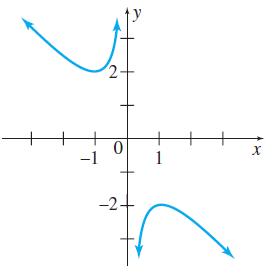
In Exercises, find the open intervals where the functions are concave upward or concave downward. Find any inflection points. -1 2- 0 -2- + 1 x
In Exercises, complete the following for each function.(a) Find intervals where the function is increasing or decreasing, and determine any relative extrema.(b) Find intervals where the function is concave upward or concave downward, and determine any inflection points.(c) Graph each function,
In Exercises, complete the following for each function.(a) Find intervals where the function is increasing or decreasing, and determine any relative extrema.(b) Find intervals where the function is concave upward or concave downward, and determine any inflection points.(c) Graph each function,
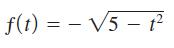
Find the second derivative of each function, and then find f″(1) and f″(-3). f(t)=√5 - 1²
In Exercises, sketch the graph of a single function that has all of the properties listed.(a) Continuous for all real numbers(b) f'(x) < 0 on (-∞, -6) and (1,3)(c) f'(x) > 0 on (-6, 1) and (3,00)(d) f"(x) > 0 on (-∞, -6) and (3, 0)(e) f"(x) < 0 on (-6, 3)(f) A y-intercept at (0, 2)
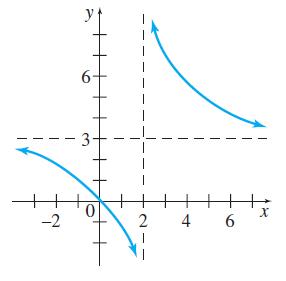
In Exercises, find the open intervals where the functions are concave upward or concave downward. Find any inflection points. -2 درا 3- 0 | 2 ++ 4 6
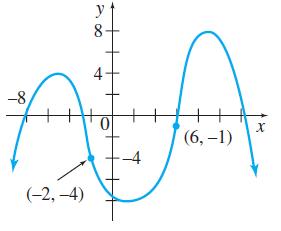
In Exercises, find the open intervals where the functions are concave upward or concave downward. Find any inflection points. -8 86 (-2,-4) y 4 PEA (6, -1) -4 X
In Exercises, sketch the graph of a single function that has all of the properties listed.(a) Continuous and differentiable everywhere except at x = 1, where it has a vertical asymptote(b) f'(x) < 0 everywhere it is defined(c) A horizontal asymptote at y = 2(d) f"(x) < 0 on (-∞, 1) and (2,
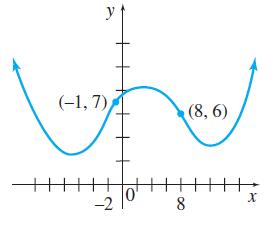
In Exercises, find the open intervals where the functions are concave upward or concave downward. Find any inflection points. y (-1,7), -2 0' 8 (8,6) 艹 X
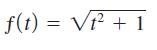
Find the second derivative of each function, and then find f″(1) and f″(-3). f(t) = √² + 1
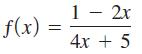
Find the second derivative of each function, and then find f″(1) and f″(-3). f(x) 1 - 2x 4x + 5
Repeat Exercise 35 for the even exercises between 22 and 34.Data from Exercise 35:The default window on many calculators is [-10, 10] by [-10, 10]. For the odd exercises between 7 and 19, tell which would give a poor representation in this window. (Note: Your answers may differ from ours, depending
Repeat Exercise 35 for the odd exercises between 21 and 33.Data from Exercise 35:The default window on many calculators is [-10, 10] by [-10, 10]. For the odd exercises between 7 and 19, tell which would give a poor representation in this window. (Note: Your answers may differ from ours, depending
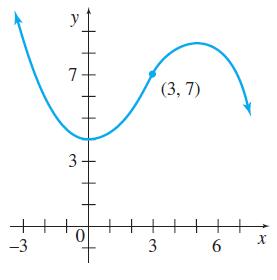
In Exercises, find the open intervals where the functions are concave upward or concave downward. Find any inflection points. H -3 7 3 0 (3,7) ||||||| 3 دیا 6 r
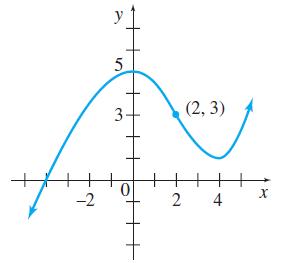
In Exercises, find the open intervals where the functions are concave upward or concave downward. Find any inflection points. -2 y 5 3- نرا 0 2 (2, 3) 4 X
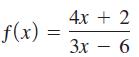
Find the second derivative of each function, and then find f″(1) and f″(-3). f(x) 4x + 2 3x - 6 -
Repeat Exercise 35 for the even exercises between 8 and 20.Data from Exercise 35:The default window on many calculators is [-10, 10] by [-10, 10]. For the odd exercises between 7 and 19, tell which would give a poor representation in this window.
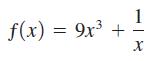
Find the second derivative of each function, and then find f″(1) and f″(-3). f(x) = 9x³ + 1 X
The default window on many calculators is [-10, 10] by [-10, 10]. For the odd exercises between 7 and 19, tell which would give a poor representation in this window. (Note: Your answers may differ from ours, depending on what you con- sider "poor.")
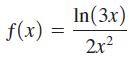
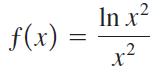
Find the locations and values of all relative maxima and minima. f(x) = In (3x) 2x²
In Exercises, complete the following for each function.(a) Find intervals where the function is increasing or decreasing, and determine any relative extrema.(b) Find intervals where the function is concave upward or concave downward, and determine any inflection points.(c) Graph each function,
For ƒ(x) = ax, find ƒ′′(x) and ƒ′′′(x). What is the nth derivative of ƒ with respect to x?
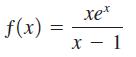
Find the locations and values of all relative maxima and minima. f(x) = xex x-1
Find the second derivative of each function, and then find f″(1) and f″(-3).ƒ(x) = 3x4 - 5x2 - 11x
In Exercises, complete the following for each function.(a) Find intervals where the function is increasing or decreasing, and determine any relative extrema.(b) Find intervals where the function is concave upward or concave downward, and determine any inflection points.(c) Graph each function,
For ƒ(x) = ex, find ƒ′′(x) and ƒ′′′(x). What is the nth derivative of ƒ with respect to x?
In Exercises, complete the following for each function.(a) Find intervals where the function is increasing or decreasing, and determine any relative extrema.(b) Find intervals where the function is concave upward or concave downward, and determine any inflection points.(c) Graph each function,
Let ƒ(x) = ln x.(a) Compute ƒ′(x),ƒ′′(x),ƒ′′′(x), ƒ(4)(x), and ƒ(5)(x).(b) Guess a formula for ƒ(n)(x), where n is any positive integer.
In Exercises, complete the following for each function.(a) Find intervals where the function is increasing or decreasing, and determine any relative extrema.(b) Find intervals where the function is concave upward or concave downward, and determine any inflection points.(c) Graph each function,
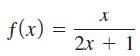
In Exercises, find ƒ″″(x), the third derivative of ƒ, and ƒ(4)(x), the fourth derivative of ƒ, for each function. f(x) || = X 2x + 1
Let ƒ be an nth degree polynomial of the form ƒ(x) = xn + an-1xn-1 + ··· + a1x + a0.(a) Find ƒ(n)(x).(b) Find ƒ(k)(x) for k > n.
Find the locations and values of all relative maxima and minima.ƒ(x) = 2x3 + 3x2 - 12x + 5
In Exercises, complete the following for each function.(a) Find intervals where the function is increasing or decreasing, and determine any relative extrema.(b) Find intervals where the function is concave upward or concave downward, and determine any inflection points.(c) Graph each function,
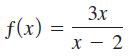
In Exercises, find ƒ″″(x), the third derivative of ƒ, and ƒ(4)(x), the fourth derivative of ƒ, for each function. f(x) = = x X 3x - 2
Find the locations and values of all relative maxima and minima.ƒ(x) = 2x3 + 3x2 - 36x + 20
In Exercises, complete the following for each function.(a) Find intervals where the function is increasing or decreasing, and determine any relative extrema.(b) Find intervals where the function is concave upward or concave downward, and determine any inflection points.(c) Graph each function,
Find the locations and values of all relative maxima and minima.ƒ(x) = -3x2 + 2x - 5
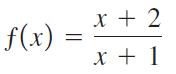
For each function in Exercises, find (a) The critical numbers;(b) The open intervals where the function is increasing; and(c) The open intervals where it is decreasing. f(x) = x + 2 x + 1
In Exercises, complete the following for each function.(a) Find intervals where the function is increasing or decreasing, and determine any relative extrema.(b) Find intervals where the function is concave upward or concave downward, and determine any inflection points.(c) Graph each function,
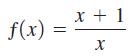
In Exercises, find ƒ″″(x), the third derivative of ƒ, and ƒ(4)(x), the fourth derivative of ƒ, for each function. f(x) = x + 1 X
In Exercises, complete the following for each function.(a) Find intervals where the function is increasing or decreasing, and determine any relative extrema.(b) Find intervals where the function is concave upward or concave downward, and determine any inflection points.(c) Graph each function,
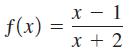
In Exercises, find ƒ″″(x), the third derivative of ƒ, and ƒ(4)(x), the fourth derivative of ƒ, for each function. f(x) = x - 1 x + 2
Find the locations and values of all relative maxima and minima.ƒ(x) = 2x2 - 8x + 1
Find the locations and values of all relative maxima and minima.ƒ(x) = x2 - 6x + 4
In Exercises, complete the following for each function.(a) Find intervals where the function is increasing or decreasing, and determine any relative extrema.(b) Find intervals where the function is concave upward or concave downward, and determine any inflection points.(c) Graph each function,
In Exercises, find ƒ″″(x), the third derivative of ƒ, and ƒ(4)(x), the fourth derivative of ƒ, for each function.ƒ(x) = 2x5 + 3x4 - 5x3 + 9x - 2
Find the locations and values of all relative maxima and minima.ƒ(x) = -x2 + 4x - 8
In Exercises, complete the following for each function.(a) Find intervals where the function is increasing or decreasing, and determine any relative extrema.(b) Find intervals where the function is concave upward or concave downward, and determine any inflection points.(c) Graph each function,
In Exercises, find ƒ″″(x), the third derivative of ƒ, and ƒ(4)(x), the fourth derivative of ƒ, for each function.ƒ(x) = 5x5 - 3x4 + 2x3 + 7x2 + 4
In Exercises, complete the following for each function.(a) Find intervals where the function is increasing or decreasing, and determine any relative extrema.(b) Find intervals where the function is concave upward or concave downward, and determine any inflection points.(c) Graph each function,
Find the open intervals where f is increasing or decreasing.ƒ(x) = 8xe-4x
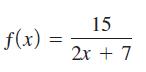
Find the open intervals where f is increasing or decreasing. f(x) 15 2x + 7
In Exercises, complete the following for each function.(a) Find intervals where the function is increasing or decreasing, and determine any relative extrema.(b) Find intervals where the function is concave upward or concave downward, and determine any inflection points.(c) Graph each function,
In Exercises, complete the following for each function.(a) Find intervals where the function is increasing or decreasing, and determine any relative extrema.(b) Find intervals where the function is concave upward or concave downward, and determine any inflection points.(c) Graph each function,
In Exercises, find ƒ″″(x), the third derivative of ƒ, and ƒ(4)(x), the fourth derivative of ƒ, for each function.ƒ(x) = -2x4 + 7x3 + 4x2 + x
Find the open intervals where f is increasing or decreasing.ƒ(x) = ln |x2 - 1|
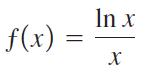
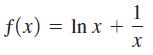
Find ƒ″(x) for each function. Then find ƒ″(0) and ƒ″(2). f(x) = ln x In + 1 X
In Exercises, find ƒ″″(x), the third derivative of ƒ, and ƒ(4)(x), the fourth derivative of ƒ, for each function.ƒ(x) = 7x4 + 6x3 + 5x2 + 4x + 3
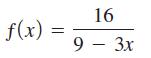
Find the open intervals where f is increasing or decreasing. f(x) = 16 9 - 3x
In Exercises, complete the following for each function.(a) Find intervals where the function is increasing or decreasing, and determine any relative extrema.(b) Find intervals where the function is concave upward or concave downward, and determine any inflection points.(c) Graph each function,
In Exercises, complete the following for each function.(a) Find intervals where the function is increasing or decreasing, and determine any relative extrema.(b) Find intervals where the function is concave upward or concave downward, and determine any inflection points.(c) Graph each function,
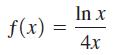
Find ƒ″(x) for each function. Then find ƒ″(0) and ƒ″(2). f(x) = In x 4x
In Exercises, complete the following for each function.(a) Find intervals where the function is increasing or decreasing, and determine any relative extrema.(b) Find intervals where the function is concave upward or concave downward, and determine any inflection points.(c) Graph each function,
Find the open intervals where f is increasing or decreasing.ƒ(x) = 4x3 + 8x2 - 16x + 11
Find ƒ″(x) for each function. Then find ƒ″(0) and ƒ″(2).ƒ(x) = 0.5ex2
Find the open intervals where f is increasing or decreasing.ƒ(x) = -x3 + 2x2 + 15x + 16
In Exercises, complete the following for each function.(a) Find intervals where the function is increasing or decreasing, and determine any relative extrema.(b) Find intervals where the function is concave upward or concave downward, and determine any inflection points.(c) Graph each function,
Find ƒ″(x) for each function. Then find ƒ″(0) and ƒ″(2).ƒ(x) = 5e-x2
Find the open intervals where f is increasing or decreasing.ƒ(x) = -2x2 + 7x + 14
In Exercises, complete the following for each function.(a) Find intervals where the function is increasing or decreasing, and determine any relative extrema.(b) Find intervals where the function is concave upward or concave downward, and determine any inflection points.(c) Graph each function,
Find ƒ″(x) for each function. Then find ƒ″(0) and ƒ″(2).ƒ(x) = -6x1/3
Find the open intervals where f is increasing or decreasing.ƒ(x) = x2 + 9x + 8
In Exercises, complete the following for each function.(a) Find intervals where the function is increasing or decreasing, and determine any relative extrema.(b) Find intervals where the function is concave upward or concave downward, and determine any inflection points.(c) Graph each function,
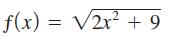
Find ƒ″(x) for each function. Then find ƒ″(0) and ƒ″(2). f(x) = √2x² + 9
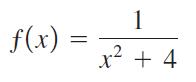
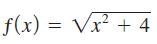
Find ƒ″(x) for each function. Then find ƒ″(0) and ƒ″(2). f(x) = √x² + 4
Find ƒ″(x) for each function. Then find ƒ″(0) and ƒ″(2).ƒ(x) = 32x3/4
In Exercises, complete the following for each function.(a) Find intervals where the function is increasing or decreasing, and determine any relative extrema.(b) Find intervals where the function is concave upward or concave downward, and determine any inflection points.(c) Graph each function,
What information about a graph can be found from the second derivative?
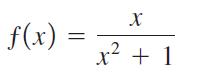
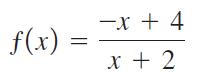
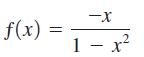
Find ƒ″(x) for each function. Then find ƒ″(0) and ƒ″(2). f(x) = -X 1 - x²
Does a relative maximum of a function always have the largest y-value in the domain of the function? Explain your answer.
When given the equation for a function, how can you determine where the relative extrema are located? Give two ways to test whether a relative extremum is a minimum or a maximum.
In Exercises, complete the following for each function.(a) Find intervals where the function is increasing or decreasing, and determine any relative extrema.(b) Find intervals where the function is concave upward or concave downward, and determine any inflection points.(c) Graph each function,
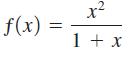
Find ƒ″(x) for each function. Then find ƒ″(0) and ƒ″(2). f(x) = x² 1 + x
When given the equation for a function, how can you determine where it is increasing and where it is decreasing?
In Exercises, complete the following for each function.(a) Find intervals where the function is increasing or decreasing, and determine any relative extrema.(b) Find intervals where the function is concave upward or concave downward, and determine any inflection points.(c) Graph each function,
Showing 6900 - 7000
of 8662
First
63
64
65
66
67
68
69
70
71
72
73
74
75
76
77
Last
Step by Step Answers

 Get 50% OFF
Claim Now
Get 50% OFF
Claim Now