New Semester
Started
Get
50% OFF
Study Help!
--h --m --s
Claim Now
Question Answers
Textbooks
Find textbooks, questions and answers
Oops, something went wrong!
Change your search query and then try again
S
Books
FREE
Study Help
Expert Questions
Accounting
General Management
Mathematics
Finance
Organizational Behaviour
Law
Physics
Operating System
Management Leadership
Sociology
Programming
Marketing
Database
Computer Network
Economics
Textbooks Solutions
Accounting
Managerial Accounting
Management Leadership
Cost Accounting
Statistics
Business Law
Corporate Finance
Finance
Economics
Auditing
Tutors
Online Tutors
Find a Tutor
Hire a Tutor
Become a Tutor
AI Tutor
AI Study Planner
NEW
Sell Books
Search
Search
Sign In
Register
study help
mathematics
college algebra graphs and models
College Algebra With Modeling And Visualization 6th Edition Gary Rockswold - Solutions
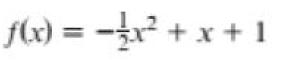
Sketch a graph of f. f(x) = − 1x² + x + 1
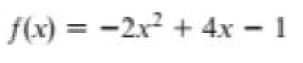
Sketch a graph of f. f(x) = 2x² + 4x − 1 -
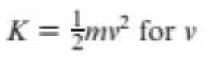
Solve for the specified variable. K = my² for v
Find the formula for a quadratic function that satisfies the given conditions.Vertex (3, 1) passing through the point (1, 9)
Find the average rate of change of f from 1 to 3. f(x)=-3x² + 5x
Sketch a graph of f. f(x) = 12.2x² - 2x + 2
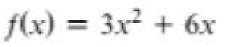
Sketch a graph of f. f(x) = 3x² + 6x
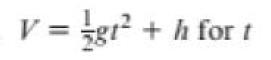
Solve for the specified variable. V = gt² + h for t
Sketch a graph of f. 1 + x9-₂X = (x)/
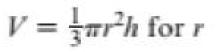
Solve for the specified variable. V = r²h for r
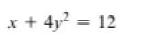
Solve the equation for y. Determine if y is a function of x. x + 4y² = 12
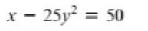
Solve the equation for y. Determine if y is a function of x. x - 25y² = 50
Complex numbers are used in the study of electrical circuits. Impedance Z (or the opposition to the flow of electricity), voltage V, and current I can all be represented by complex numbers. They are related by the equation Z = V/I Find the value of the missing variable. Z = 10 + 5i V = 10 + 8i
Give an example of a quadratic function that has only real zeros and an example of one that has only nonreal complex zeros. How do their graphs compare? Explain how to determine from a graph whether a quadratic function has real zeros.
Complete the square to write the given expression as f(x) = a (x - h)2 + k and find the vertex. f(x) = x² + 4x - 5
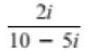
Write the expression in standard form. 21 10-5i
Solve the quadratic equation. Check your answers. 2x(x + 2) = (x - 1)(x + 2)
Write the expression in standard form. 10 1- 4i
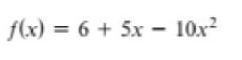
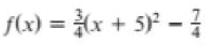
Write the given expression in the form f(x) = a(x - h)2 + k. Identify the vertex. f(x) = 6 + 5x - 10.x²
Write the expression in standard form. 5-i
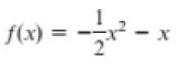
Write the given expression in the form f(x) = a(x - h)2 + k. Identify the vertex. I f(x) = - = -²₁ r²-x
Solve the quadratic equation. Check your answers. −0.1x? + 1 = 0.5x
Write the expression in standard form. 1-i 2+3i
Write the given expression in the form f(x) = a(x - h)2 + k. Identify the vertex. f(x) = 2 - 6x - 3x²
Write the expression in standard form. 1 1 + i
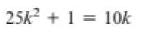
Solve the quadratic equation. Check your answers. 25k² + 1 = 10k
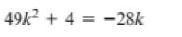
Solve the quadratic equation. Check your answers. 49k² + 4 = -28k
Write the given expression in the form f(x) = a(x - h)2 + k. Identify the vertex. f(x) = 2x² - 8x - 1
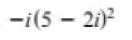
Write the expression in standard form. -i(5-2i)²
Solve the quadratic equation. Check your answers. -4z²+z+1=0
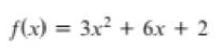
Write the given expression in the form f(x) = a(x - h)2 + k. Identify the vertex. f(x) = 3x² + 6x + 2
Solve the quadratic equation. Check your answers. ܐ3- -32²- 2z+4= 0
Write the given expression in the form f(x) = a(x - h)2 + k. Identify the vertex. S + XL-₂X = (x)f
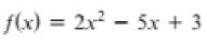
Write the given expression in the form f(x) = a(x - h)2 + k. Identify the vertex. f(x) = 2x² = 5x + 3
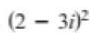
Write the expression in standard form. (2-3i)²
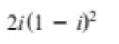
Write the expression in standard form. 2¡(1 - i)²
Solve the quadratic equation. Check your answers. x²+x-1=0
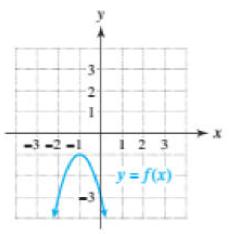
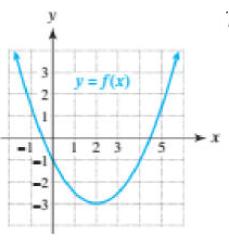
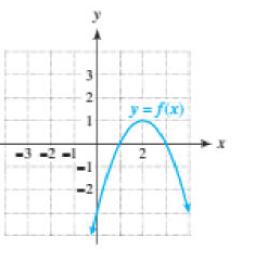
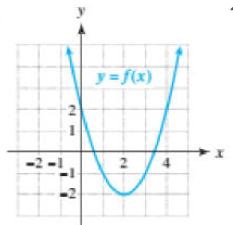
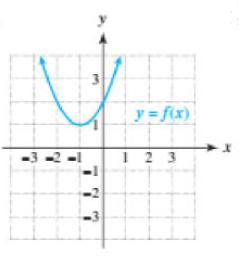
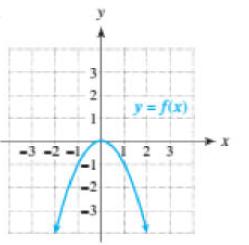
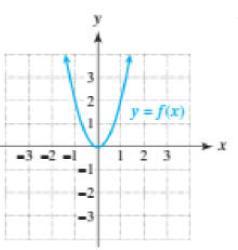
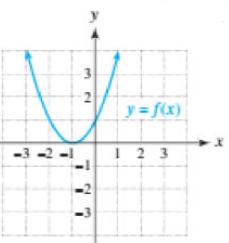
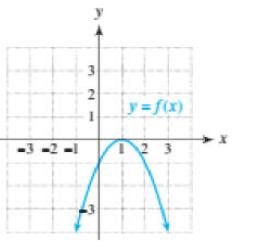
Use the graph of the quadratic function f to write its formula as f(x) = a(x - h)2 + k. -3-2-1 32 123 -y=f(x) X
Use the graph of the quadratic function f to write its formula as f(x) = a(x - h)2 + k. 32 y = f(x) 123 5
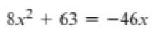
Solve the quadratic equation. Check your answers. 8x² + 63 = -46x
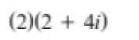
Write the expression in standard form. (2)(2 + 4i)
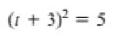
Solve the quadratic equation. Check your answers. (1 + 3)² = 5
Write the expression in standard form. (7 + i)-(-8 + 5i)
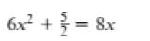
Solve the quadratic equation. Check your answers. 6x² + ² = 8x
Use the graph of the quadratic function f to write its formula as f(x) = a(x - h)2 + k. 3 2 y = f(x)
Use the graph of the quadratic function f to write its formula as f(x) = a(x - h)2 + k. -2-1 1 y=f(x) 2 X
Write the expression in standard form. (127) (-1 + 9i)
Write the expression in standard form. 3-(4-61)
Use the graph of the quadratic function f to write its formula as f(x) = a(x - h)2 + k. V y = f(x) 123 X
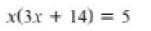
Solve the quadratic equation. Check your answers. x(3x + 14) = 5
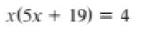
Solve the quadratic equation. Check your answers. x(5x + 19) = 4
Use the graph of the quadratic function f to write its formula as f(x) = a(x - h)2 + k. -3-2 32 1 777 y = f(x) 23
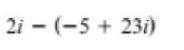
Write the expression in standard form. 2i(-5+23i)
Write the expression in standard form. (-4+ 2) + (7 + 35i)
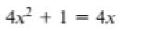
Solve the quadratic equation. Check your answers. 4x² + 1 = 4x
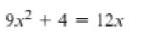
Solve the quadratic equation. Check your answers. 9x² + 4 = 12x
Use the graph of the quadratic function f to write its formula as f(x) = a(x - h)2 + k. 3 2 y = f(x) 123
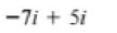
Write the expression in standard form. -7i+ Si
Write the expression in standard form. (3 + i) + (-5-2i)
Solve the quadratic equation. Check your answers. 0 = 91 + x8
Use the graph of the quadratic function f to write its formula as f(x) = a(x - h)2 + k. -3 -2 -1 32 y = f(x) 123
Use the graph of the quadratic function f to write its formula as f(x) = a(x - h)2 + k. 3 2 y=f(r) ܪ ܕ
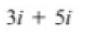
Write the expression in standard form. 3i + 5i
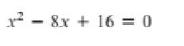
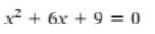
Solve the quadratic equation. Check your answers. x² + 6x + 9 = 0
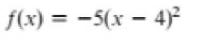
Identify the vertex and leading coefficient. Then write the expression as f(x) f(x) = ax2 + bx + c. f(x) = -5(x-4)²
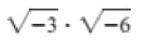
Simplify by using the imaginary unit i. √-3-√-6
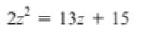
Solve the quadratic equation. Check your answers. 22² = 13z + 15
Identify the vertex and leading coefficient. Then write the expression as f(x) f(x) = ax2 + bx + c. f(x) = (x+3)²-5
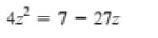
Solve the quadratic equation. Check your answers. 42² = 7-27z
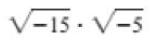
Simplify by using the imaginary unit i. V-15-V-5
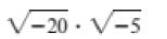
Simplify by using the imaginary unit i. V-20. V-5
Identify the vertex and leading coefficient. Then write the expression as f(x) f(x) = ax2 + bx + c. f(x) = (x + 5)² - 1
Identify the vertex and leading coefficient. Then write the expression as f(x) f(x) = ax2 + bx + c. f(x) = 5-2(x-4)²
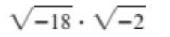
Simplify by using the imaginary unit i. V-18. V-2
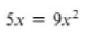
Solve the quadratic equation. Check your answers. 5x = 9x²
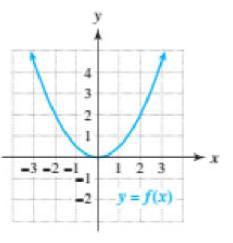
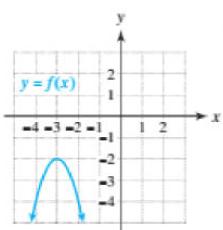
Use the graph to find the following. (a) Sign of the leading coefficient (b) Vertex (c) Axis of symmetry (d) Intervals where f is increasing and where f is decreasing (e) Domain and range in interval notation 432 -3-2-1 123 -2 - = f(x)
Identify the vertex and leading coefficient. Then write the expression as f(x) f(x) = ax2 + bx + c. f(x) = 5(x + 2)² - 5
Identify the vertex and leading coefficient. Then write the expression as f(x) f(x) = ax2 + bx + c. f(x) = -3(x - 1)² + 2
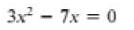
Solve the quadratic equation. Check your answers. 3x² - 7x = 0
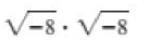
Simplify by using the imaginary unit i. √-8. √-8
Solve the quadratic equation. Check your answers. t² = 21
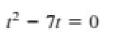
Solve the quadratic equation. Check your answers. 2²-7=0
Use the graph to find the following. (a) Sign of the leading coefficient (b) Vertex (c) Axis of symmetry (d) Intervals where f is increasing and where f is decreasing (e) Domain and range in interval notation y=f(x) H -4-3-2-1 12 X
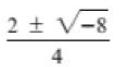
Simplify by using the imaginary unit i. 2 ± V-8 4 at
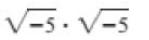
Simplify by using the imaginary unit i. √-5. √-5
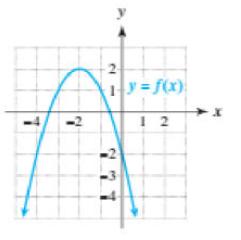
Use the graph to find the following. (a) Sign of the leading coefficient (b) Vertex (c) Axis of symmetry (d) Intervals where f is increasing and where f is decreasing (e) Domain and range in interval notation 2 1+ y = f(x) 12
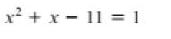
Solve the quadratic equation. Check your answers. x² + x = 11 = 1 -
The formulas for f(x) and g(x) are identical except for their leading coefficients a. Compare the graphs of f and g. You may want to support your answers by graphing f and g together. f(x) = x² + x, g(x) = x² + x
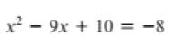
Solve the quadratic equation. Check your answers. x²9x + 10 = -8
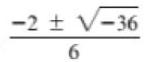
Simplify by using the imaginary unit i. -2 ± √-36 6
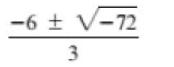
Simplify by using the imaginary unit i. -6 ± V-72 3
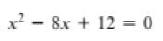
Solve the quadratic equation. Check your answers. x²8x + 12 = 0
The formulas for f(x) and g(x) are identical except for their leading coefficients a. Compare the graphs of f and g. You may want to support your answers by graphing f and g together. f(x) 2x I + zxf- = (x) *T + zXT =
Simplify by using the imaginary unit i. V-28
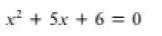
Solve the quadratic equation. Check your answers. x 45x46=0
The formulas for f(x) and g(x) are identical except for their leading coefficients a. Compare the graphs of f and g. You may want to support your answers by graphing f and g together. jx) = Ar? g(x) zxf— = -
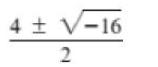
Simplify by using the imaginary unit i. 4 ± V-16 2
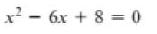
Solve the quadratic equation. Check your answers. x² - 6x + 8 = 0
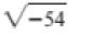
Simplify by using the imaginary unit i. V-54
The formulas for f(x) and g(x) are identical except for their leading coefficients a. Compare the graphs of f and g. You may want to support your answers by graphing f and g together. f(x) = x², g(x) = 2x²
Showing 10800 - 10900
of 13634
First
102
103
104
105
106
107
108
109
110
111
112
113
114
115
116
Last
Step by Step Answers

 Get 50% OFF
Claim Now
Get 50% OFF
Claim Now