New Semester
Started
Get
50% OFF
Study Help!
--h --m --s
Claim Now
Question Answers
Textbooks
Find textbooks, questions and answers
Oops, something went wrong!
Change your search query and then try again
S
Books
FREE
Study Help
Expert Questions
Accounting
General Management
Mathematics
Finance
Organizational Behaviour
Law
Physics
Operating System
Management Leadership
Sociology
Programming
Marketing
Database
Computer Network
Economics
Textbooks Solutions
Accounting
Managerial Accounting
Management Leadership
Cost Accounting
Statistics
Business Law
Corporate Finance
Finance
Economics
Auditing
Tutors
Online Tutors
Find a Tutor
Hire a Tutor
Become a Tutor
AI Tutor
AI Study Planner
NEW
Sell Books
Search
Search
Sign In
Register
study help
mathematics
college algebra
College Algebra 11th Edition Michael Sullivan, Michael Sullivan III - Solutions
Find the discriminant of 2x2 - 5x - 8 = 0. Then identify the number of real solutions of the equation.
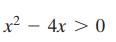
In Problems 7–22, solve each inequality. x² - 4x > 0
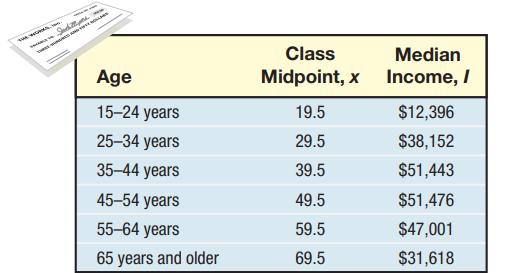
An individual’s income varies with his or her age. The following table shows the median income I of males of different age groups within the United States for 2016. For each age group, let the class midpoint represent the independent variable, x. For the class “65 years and older,” we will
If f(x) = 7.5x + 15, find f(-2).
Complete the square of 3x2 + 7x. Factor the new expression.
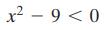
In Problems 7–22, solve each inequality. x²-9
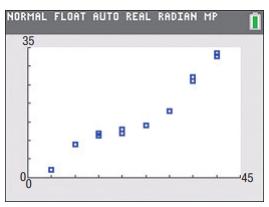
In Problems 5–10, examine each scatter plot and determine whether the relation is linear or nonlinear. NORMAL FLOAT AUTO REAL RADIAN MP 35 -45
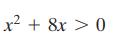
In Problems 7–22, solve each inequality. x² + 8x > 0
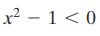
In Problems 7–22, solve each inequality. x²-1
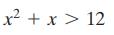
In Problems 7–22, solve each inequality. x² + x> 12
A car has 12,500 miles on its odometer. Say the car is driven an average of 40 miles per day. Choose the model that expresses the number of miles N that will be on its odometer after x days. (a) N(x) (c) N(x) = -40x+12,500 = 12,500x + 40 (b) N(x) 40x 12,500 (d) N(x) = 40x + 12,500
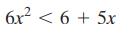
In Problems 7–22, solve each inequality. 6x² < 6 + 5x
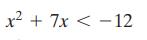
In Problems 7–22, solve each inequality. x² + 7x < -12
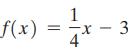
In Problems 13–20, a linear function is given. (a) Find the slope and y-intercept of each function. (b) Use the slope and y-intercept to graph each function. (c) What is the average rate of change of each function? (d) Determine whether each function is increasing, decreasing, or constant.
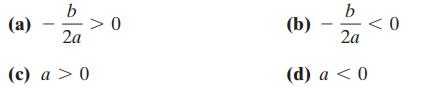
Multiple Choice If the graph of f(x) = ax2 + bx + c, a ≠ 0, has a maximum value at its vertex, which condition must be true? b ام (a) 2a (c) a > 0 0 b 2a (d) a < 0 (b)
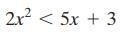
In Problems 7–22, solve each inequality. 2x² < 5x + 3
Multiple Choice What is the only type of function that has a constant average rate of change? (a) Linear function (b) Quadratic function (c) Step function (d) Absolute value function
Multiple Choice If b2 - 4ac > 0, which conclusion can be made about the graph of f(x) = ax2 + bx + c, a ≠ 0?(a) The graph has two distinct x-intercepts. (b) The graph has no x-intercepts. (c) The graph has three distinct x-intercepts. (d) The graph has one x-intercept.
In Problems 14–16, determine whether the given quadratic function has a maximum value or a minimum value, and then find the value.f(x) = 3x2 -6x + 4
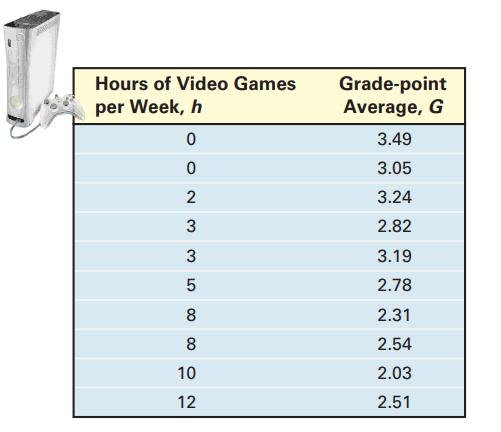
Professor Grant Alexander wanted to find a linear model that relates the number h of hours a student plays video games each week to the cumulative grade-point average G of the student. He randomly selected 10 full-time students at his college and asked each student to disclose the number of hours
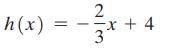
In Problems 13–20, a linear function is given. (a) Find the slope and y-intercept of each function. (b) Use the slope and y-intercept to graph each function. (c) What is the average rate of change of each function? (d) Determine whether each function is increasing, decreasing, or constant
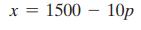
The price p (in dollars) and the quantity x sold of a certain product satisfy the demand equation.(a) Find a model that expresses the revenue R as a function of the price p. (b) What is the domain of R? Assume R is nonnegative. (c) What unit price should be used to maximize revenue? (d) If this
In Problems 17 and 18, solve each quadratic inequality. x² + 6x 16 < 0
In Problems 19 and 20, find the quadratic function for which: Vertex is (2, -4); y-intercept is -16
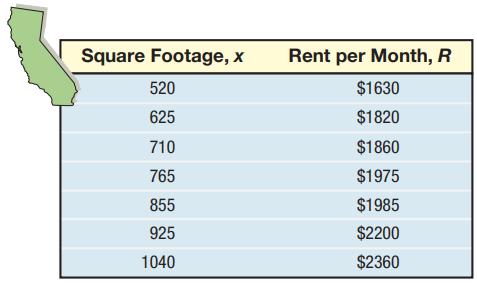
The following data represent the square footage and rents (dollars per month) for apartments in the La Jolla area of San Diego, California. (a) Using a graphing utility, draw a scatter plot of the data treating square footage as the independent variable. What type of relation appears to exist
In Problems 7–22, solve each inequality. 0=1+x-zx
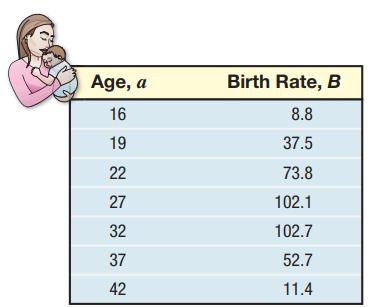
The following data represent the birth rate (births per 1000 population) for women whose age is a, in 2016. (a) Using a graphing utility, draw a scatter plot of the data, treating age as the independent variable. What type of relation appears to exist between age and birth rate? (b) Based on your
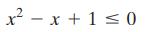
In Problems 7–22, solve each inequality. x² - 2x + 4 > 0
In Problems 13–20, a linear function is given. F(x) = 4(a) Find the slope and y-intercept of each function. (b) Use the slope and y-intercept to graph each function. (c) What is the average rate of change of each function? (d) Determine whether each function is increasing,
Bill was just offered a sales position for a computer company. His salary would be $25,000 per year plus 1% of his total annual sales. (a) Find a linear function that relates Bill’s annual salary, S, to his total annual sales, x. (b) If Bill’s total annual sales were $1,000,000, what
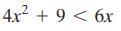
In Problems 7–22, solve each inequality. 4x² + 9 < 6x
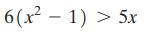
In Problems 7–22, solve each inequality. 6(r? − 1) > 5x -
In Problems 7–22, solve each inequality. 25x² + 16 40x
In Problems 7–22, solve each inequality. 2 (2x² 3x) > −9 -9
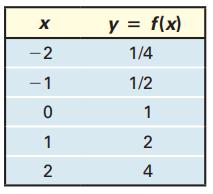
In Problems 21–28, determine whether each function is linear or nonlinear. If it is linear, determine the slope. X -2 -1 0 1 2 y = f(x) 1/4 1/2 1 2 4
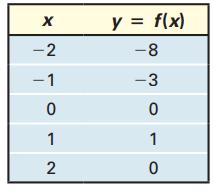
In Problems 21–28, determine whether each function is linear or nonlinear. If it is linear, determine the slope. X -2 -1 0 1 2 y = f(x) -8 -3 0 1 0
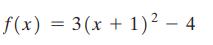
In Problems 23–30, (a) Find the vertex and axis of symmetry of each quadratic function. (b) Determine whether the graph is concave up or concave down. (c) Graph the quadratic function. f(x) = 3(x + 1)² - 4 2
In Problems 23–30, f(x) = (x - 3)2 - 2(a) Find the vertex and axis of symmetry of each quadratic function. (b) Determine whether the graph is concave up or concave down. (c) Graph the quadratic function.
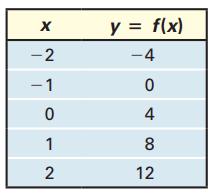
In Problems 21–28, determine whether each function is linear or nonlinear. If it is linear, determine the slope. X -2 -1 0 1 2 y = f(x) - 4 0 4 8 12
In Problems 23–30, f(x) = -(x + 4)2 - 1(a) Find the vertex and axis of symmetry of each quadratic function. (b) Determine whether the graph is concave up or concave down. (c) Graph the quadratic function.
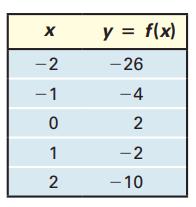
In Problems 21–28, determine whether each function is linear or nonlinear. If it is linear, determine the slope. X -2 -1 0 1 2 y = f(x) -26 -4 2 -2 -10
In Problems 23–30, f(x) = -(1x - 3)2 + 5(a) Find the vertex and axis of symmetry of each quadratic function. (b) Determine whether the graph is concave up or concave down. (c) Graph the quadratic function.
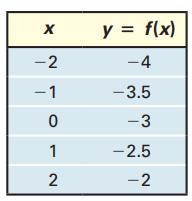
In Problems 21–28, determine whether each function is linear or nonlinear. If it is linear, determine the slope. X -2 -1 0 1 2 y = f(x) -4 -3.5 - 3 -2.5 -2
Problems 27–36 are based on material learned earlier in the course. The purpose of these problems is to keep the material fresh in your mind so that you are better prepared for the final exam. Solve. Write the answer in interval notation 5(2x + 7) - 6x ≥ 10 - 3(x + 9)
In Problems 23–30, (a) Find the vertex and axis of symmetry of each quadratic function. (b) Determine whether the graph is concave up or concave down. (c) Graph the quadratic function. f(x) = 2(x6)² + 3
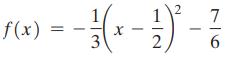
In Problems 23–30, (a) Find the vertex and axis of symmetry of each quadratic function. (b) Determine whether the graph is concave up or concave down. (c) Graph the quadratic function. f(x) - 1/√(x-1) 3 2 2 7 6
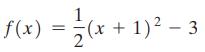
In Problems 23–30, (a) Find the vertex and axis of symmetry of each quadratic function. (b) Determine whether the graph is concave up or concave down. (c) Graph the quadratic function. f(x) = (x + 1)² − 3 1 2 -
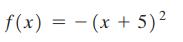
In Problems 23–30, (a) Find the vertex and axis of symmetry of each quadratic function. (b) Determine whether the graph is concave up or concave down. (c) Graph the quadratic function. f(x) = -(x + 5)²
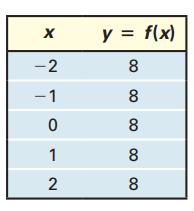
In Problems 21–28, determine whether each function is linear or nonlinear. If it is linear, determine the slope. X -2 -1 0 1 2 y = f(x) 8 8 00 00 8 8 8
In Problems 43–58, f(x) = x2 + 2x(a) Find the vertex and the axis of symmetry of each quadratic function, and determine whether the graph is concave up or concave down. (b) Find the y-intercept and the x-intercepts, if any. (c) Use parts (a) and (b) to graph the function. (d) Find
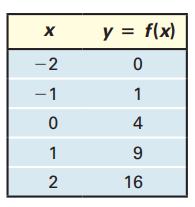
In Problems 21–28, determine whether each function is linear or nonlinear. If it is linear, determine the slope. X -2 -1 0 1 2 y = f(x) 0 1 4 9 16
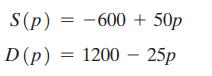
Suppose that the quantity supplied S and the quantity demanded D of T-shirts at a concert are given by the following functions:Where p is the price of a T-shirt.(a) Find the equilibrium price for T-shirts at this concert. What is the equilibrium quantity? (b) Determine the prices for which
The monthly cost C, in dollars, for calls from the United States to Germany on a certain wireless plan is modeled by the function C(x) = 0.26x + 5, where x is the number of minutes used.(a) What is the cost if you talk on the phone for 50 minutes? (b) Suppose that your monthly bill is $21.64.
The cost C, in dollars, to tow a car is modeled by the function C(x) = 2.5x + 85, where x is the number of miles towed.(a) What is the cost of towing a car 40 miles? (b) If the cost of towing a car is $245, how many miles was it towed? (c) Suppose that you have only $150. What is the
The function T(x) = 0.12(x - 9525) + 952.50 represents the tax bill T of a single person whose adjusted gross income is x dollars for income over $9525 but not over $38,700, in 2018.(a) What is the domain of this linear function? (b) What is a single filer’s tax bill if adjusted gross income
Problems 27–36 are based on material learned earlier in the course. The purpose of these problems is to keep the material fresh in your mind so that you are better prepared for the final exam. Solve: x2 - 4x = 3
The relationship between the height H of an adult male and the length x of his humerus, in centimeters, can be modeled by the linear function H(x) = 2.89x + 78.10.(a) If incomplete skeletal remains of an adult male include a humerus measuring 37.1 centimeters, approximate the height of this male to
The relationship between the height H of an adult female and the length x of her femur, in centimeters, can be modeled by the linear function H(x) = 2.47x + 54.10.(a) If incomplete skeletal remains of an adult female include a femur measuring 46.8 centimeters, approximate the height of this female
In Problems 43–58, (a) Find the vertex and the axis of symmetry of each quadratic function, and determine whether the graph is concave up or concave down. (b) Find the y-intercept and the x-intercepts, if any. (c) Use parts (a) and (b) to graph the function. (d) Find the
In Problems 43–58, (a) Find the vertex and the axis of symmetry of each quadratic function, and determine whether the graph is concave up or concave down. (b) Find the y-intercept and the x-intercepts, if any. (c) Use parts (a) and (b) to graph the function. (d) Find the
In Problems 43–58, (a) Find the vertex and the axis of symmetry of each quadratic function, and determine whether the graph is concave up or concave down. (b) Find the y-intercept and the x-intercepts, if any. (c) Use parts (a) and (b) to graph the function. (d) Find the
In Problems 43–58, f(x) = -x2 + 4x(a) Find the vertex and the axis of symmetry of each quadratic function, and determine whether the graph is concave up or concave down. (b) Find the y-intercept and the x-intercepts, if any. (c) Use parts (a) and (b) to graph the function. (d)
In Problems 43–58, (a) Find the vertex and the axis of symmetry of each quadratic function, and determine whether the graph is concave up or concave down. (b) Find the y-intercept and the x-intercepts, if any. (c) Use parts (a) and (b) to graph the function. (d) Find the
Under the 2017–2021 labor agreement between Major League Baseball and the players, any team whose payroll exceeded $195 million in 2017 had to pay a competitive balance tax of 50%. The linear function T(p) = 0.50(p - 195) describes the competitive balance tax T for a team whose payroll was p (in
Problems 44–53 are based on material learned earlier in the course. The purpose of these problems is to keep the material fresh in your mind so that you are better prepared for the final exam. Find the domain of f(x) = V10 - 2x.
Problems 44–53 are based on material learned earlier in the course. The purpose of these problems is to keep the material fresh in your mind so that you are better prepared for the final exam. Determine algebraically whether f(x) odd, or neither. -X x² + 9 is even,
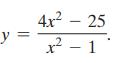
Problems 44–53 are based on material learned earlier in the course. The purpose of these problems is to keep the material fresh in your mind so that you are better prepared for the final exam.Find the intercepts of the graph of y 4x² - 25 1²-1
Problems 44–53 are based on material learned earlier in the course. The purpose of these problems is to keep the material fresh in your mind so that you are better prepared for the final exam.Write a general formula to describe the variation: d varies directly with t; d = 203 when t = 3.5.
Problems 44–53 are based on material learned earlier in the course. The purpose of these problems is to keep the material fresh in your mind so that you are better prepared for the final exam.Find the zeros of f(x) = x2 + 6x - 8
In Problems 43–58, (a) Find the vertex and the axis of symmetry of each quadratic function, and determine whether the graph is concave up or concave down. (b) Find the y-intercept and the x-intercepts, if any. (c) Use parts (a) and (b) to graph the function. (d) Find the
In Problems 43–58, (a) Find the vertex and the axis of symmetry of each quadratic function, and determine whether the graph is concave up or concave down. (b) Find the y-intercept and the x-intercepts, if any. (c) Use parts (a) and (b) to graph the function. (d) Find the
In Problems 43–58, (a) Find the vertex and the axis of symmetry of each quadratic function, and determine whether the graph is concave up or concave down. (b) Find the y-intercept and the x-intercepts, if any. (c) Use parts (a) and (b) to graph the function. (d) Find the
In Problems 43–58, (a) Find the vertex and the axis of symmetry of each quadratic function, and determine whether the graph is concave up or concave down. (b) Find the y-intercept and the x-intercepts, if any. (c) Use parts (a) and (b) to graph the function. (d) Find the
In Problems 43–58, (a) Find the vertex and the axis of symmetry of each quadratic function, and determine whether the graph is concave up or concave down. (b) Find the y-intercept and the x-intercepts, if any. (c) Use parts (a) and (b) to graph the function. (d) Find the
According to Hooke’s Law, a linear relationship exists between the distance that a spring stretches and the force stretching it. Suppose a weight of 0.5 kilograms causes a spring to stretch 2.75 centimeters and a weight of 1.2 kilograms causes the same spring to stretch 6.6 centimeters.(a) Find a
Problems 59–68 are based on material learned earlier in the course. The purpose of these problems is to keep the material fresh in your mind so that you are better prepared for the final exam. Graph x² - 4x + y² +10y - 7 = 0.
Problems 59–68 are based on material learned earlier in the course. The purpose of these problems is to keep the material fresh in your mind so that you are better prepared for the final exam. If f(x) = 2x + B x-3 and f(5)= 8, what is the value of B?
Problems 59–68 are based on material learned earlier in the course. The purpose of these problems is to keep the material fresh in your mind so that you are better prepared for the final exam. Find the average rate of change of f(x) = 3x² - 5x from 1 to 3.
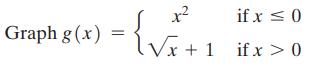
Problems 59–68 are based on material learned earlier in the course. The purpose of these problems is to keep the material fresh in your mind so that you are better prepared for the final exam. Graph g(x) x² if x ≤ 0 ifx>0 √x+1
In Problems 65–72, determine, without graphing, whether the given quadratic function has a maximum value or a minimum value, and then find the value. f(x) = 3x² + 24x
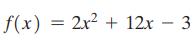
In Problems 65–72, determine, without graphing, whether the given quadratic function has a maximum value or a minimum value, and then find the value. f(x) = 2x² + 12x
In Problems 65–72, determine, without graphing, whether the given quadratic function has a maximum value or a minimum value, and then find the value. f(x) = 2x² + 12x - 3
Problems 110–119 are based on material learned earlier in the course. The purpose of these problems is to keep the material fresh in your mind so that you are better prepared for the final exam.Solve the inequality 27 - x ≥ 5x + 3. Write the solution in both set notation and interval notation.
Problems 110–119 are based on material learned earlier in the course. The purpose of these problems is to keep the material fresh in your mind so that you are better prepared for the final exam.Determine whether x2 + 4y2 = 16 is symmetric respect to the x-axis, the y-axis, and/or the origin.
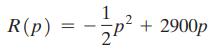
A lawn mower manufacturer has found that the revenue, in dollars, from sales of zero-turn mowers is a function of the unit price p, in dollars, that it charges. If the revenue R isWhat unit price p should be charged to maximize revenue? What is the maximum revenue? R(p) 1.2 2 + 2900p
In Problems 65–72, determine, without graphing, whether the given quadratic function has a maximum value or a minimum value, and then find the value. f(x) = -5x² + 20x + 3
The function f(x) = x2 is decreasing on the interval __________.
Problems 110–119 are based on material learned earlier in the course. The purpose of these problems is to keep the material fresh in your mind so that you are better prepared for the final exam.State the domain and range of the relation given below. Is the relation a function? {(5,-3), (4,-4),
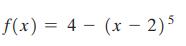
In Problems 27–40, use transformations of the graph of y = x4 or y = x5 to graph each function. f(x) = 4(x - 2) 5
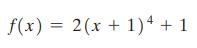
In Problems 27–40, use transformations of the graph of y = x4 or y = x5 to graph each function. f(x) = 2(x + 1)4 + 1
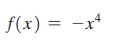
In Problems 27–40, use transformations of the graph of y = x4 or y = x5 to graph each function. f(x) = -x² 4
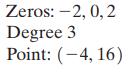
In Problems 49–58, find a polynomial function with the given real zeros whose graph contains the given point. Zeros: -2,0, 2 Degree 3 Point: (-4, 16)
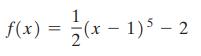
In Problems 27–40, use transformations of the graph of y = x4 or y = x5 to graph each function. 1 f(x) = (x - 1)³-2
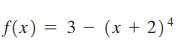
In Problems 27–40, use transformations of the graph of y = x4 or y = x5 to graph each function. f(x) = 3 = (x + 2) 4
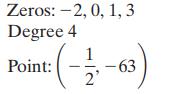
In Problems 49–58, find a polynomial function with the given real zeros whose graph contains the given point. Zeros: 2, 0, 1, 3 Degree 4 :( - 12/2-63 2² Point:
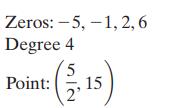
In Problems 49–58, find a polynomial function with the given real zeros whose graph contains the given point. Zeros: -5, -1, 2,6 Degree 4 Point: 2,15
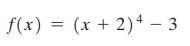
In Problems 27–40, use transformations of the graph of y = x4 or y = x5 to graph each function. f(x) = (x + 2)4 - 3
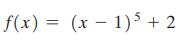
In Problems 27–40, use transformations of the graph of y = x4 or y = x5 to graph each function. f(x) = (x - 1)³ + 2 5
Problems 110–119 are based on material learned earlier in the course. The purpose of these problems is to keep the material fresh in your mind so that you are better prepared for the final exam. Write 4x² (3x + 5)2/3 with positive exponents. + 8x (3x + 5)¹/3 as a single quotient
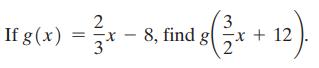
Problems 110–119 are based on material learned earlier in the course. The purpose of these problems is to keep the material fresh in your mind so that you are better prepared for the final exam. 2 3 ) = ਤੂੰ - ਸ + 12). 8, find g 3 If g(x)
Showing 6600 - 6700
of 16373
First
60
61
62
63
64
65
66
67
68
69
70
71
72
73
74
Last
Step by Step Answers

 Get 50% OFF
Claim Now
Get 50% OFF
Claim Now