New Semester
Started
Get
50% OFF
Study Help!
--h --m --s
Claim Now
Question Answers
Textbooks
Find textbooks, questions and answers
Oops, something went wrong!
Change your search query and then try again
S
Books
FREE
Study Help
Expert Questions
Accounting
General Management
Mathematics
Finance
Organizational Behaviour
Law
Physics
Operating System
Management Leadership
Sociology
Programming
Marketing
Database
Computer Network
Economics
Textbooks Solutions
Accounting
Managerial Accounting
Management Leadership
Cost Accounting
Statistics
Business Law
Corporate Finance
Finance
Economics
Auditing
Tutors
Online Tutors
Find a Tutor
Hire a Tutor
Become a Tutor
AI Tutor
AI Study Planner
NEW
Sell Books
Search
Search
Sign In
Register
study help
mathematics
contemporary mathematics
Contemporary Mathematics 1st Edition OpenStax - Solutions
If possible, add the following irrational numbers without using a calculator. If this is not possible, state why. \(4.1 \pi+3.2 \pi\)
If possible, subtract the following irrational numbers without using a calculator. If this is not possible, state why. \(2.1 \sqrt{45}-3.7 \sqrt{5}\)
Perform the following operations without a calculator. Simplify if possible.1. \(84 \sqrt{132} \div(14 \sqrt{11})\)2. \(57 \sqrt{792} \div(25 \sqrt{2})\)
Perform the following operations without a calculator. Simplify if possible.1. \((1.2 \sqrt{21}) \times(4.5 \sqrt{14})\)2. \(38 \pi \div(2 \pi)\)
Rationalize the denominator of the following:1. \(\frac{24}{\sqrt{15}}\)2. \(\frac{11 \sqrt{14}}{6 \sqrt{21}}\)
Rationalize the denominator of \(\frac{15}{5-\sqrt{13}}\).
Determine if each of the following are real numbers:1. \(\frac{8}{15}\)2. \(4+17 i\)3. \(-17 \sqrt{46}\)
Identify all subsets of the real numbers to which the following real numbers belong:1. \(14 \sqrt{3}\)2. -147 3. \(\frac{37}{150}\)
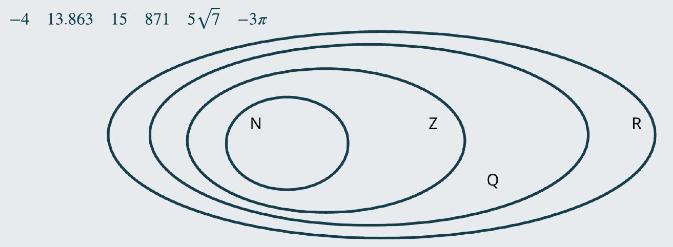
Place the following numbers correctly into the Venn diagram. -4 13.863 15 871 57 -3 N N R
In each of the following, identify which property of the real numbers is being applied.1. \(5 \times(6+19)=5 \times 6+5 \times 19\)2. \(41.7+(-41.7)=0\)
Use properties of real numbers and mental math to calculate the following:\(9 \times 8 \times 11\)
Find the value of the following numbers modulo 12.1. 93 2. 387
If it is \(9: 00\) now, what time will it be in 43 hours?
If it is \(7: 00\) now, what time was it 34 hours ago?
What is the product of 4 and 19 modulo 12 ?
You have agreed to text your friend every 3 hours while driving across the country. You began your trip at 8 AM. What time will it be when you text your friend the 15 th time?
Your family shares the cooking duties in the home. You've agreed to prepare the meal every 5 days. The last time you prepared dinner was a Tuesday. What day of the week will it be after you've prepared the meals 20 more times?
If possible, use the product rule to simplify the following:1. \(12^{13} \times 12^{8}\)2. \(3^{6} \times 4^{10}\)
Use the product rule to simplify \(b^{6} \times b^{3}\).
Use the quotient rule to simplify \(\frac{b^{6}}{b^{4}}\).
Use the exponent distributive rule to expand \((2 \times 19)^{14}\).
Use the exponent distributive rule to expand \((a \times b)^{6}\).
Use the exponent distributive rule to expand the following:1. \(\left(\frac{14}{5}\right)^{9}\)2. \(\left(\frac{a}{18}\right)^{5}\)
Expand the following:1. \(\left(11^{4}\right)^{12}\)2. \(\left(a^{7}\right)^{6}\)
Convert the following to expressions with no negative exponent:1. \(12^{-3} \times 7^{5}\)2. \(c^{-7} \times 5^{3}\)
Use negative exponents to rewrite the following expressions with no denominator:1. \(\frac{6^{3}}{13^{8}}\)2. \(\frac{c^{5}}{2^{9}}\)
Simplify the following:1. \(\left(\frac{7^{9}}{10^{5} \times 6^{3}}\right)^{8}\)2. \(\left(\frac{4}{a^{9} b^{6}}\right)^{2}\)
Which of the following numbers are in scientific notation? If the number is not in scientific notation, explain why it is not.1. \(42.67 \times 10^{13}\)2. \(7.113 \times 10^{-2}\)3. -80.91
Write the following numbers in scientific notation form:1. -38300 2. 0.0045 3. 1
Change \(46.113 \times 10^{8}\) by moving the decimal four places to the left.
Change \(149.11 \times 10^{-4}\) by moving the decimal two places to the right.
Convert the following into standard form:1. \(1.02 \times 10^{6}\)2. \(4.09 \times 10^{-5}\)
Calculate the following:1. \(7.57 \times 10^{13}+2.031 \times 10^{13}\)2. \(3.03 \times 10^{-6}-1.5 \times 10^{-6}\)
Calculate the following:1. \(5.08 \times 10^{3}+6.9 \times 10^{3}\)2. \(8.968 \times 10^{-38}-8.761 \times 10^{-38}\)
Calculate the following:\(1.14 \times 10^{-43}+2.56 \times 10^{-46}\)
Calculate the following:\(9.15 \times 10^{28}-7.23 \times 10^{26}\)
Calculate the following:1. \(\left(2.29 \times 10^{3}\right) \times\left(3 \times 10^{4}\right)\)2. \(\left(6.91 \times 10^{-3}\right) \times\left(9.1 \times 10^{5}\right)\)
Calculate the following:1. \(\left(3.6 \times 10^{-2}\right) /\left(1.5 \times 10^{3}\right)\)2. \(\left(1.8 \times 10^{4}\right) /\left(4.8 \times 10^{3}\right)\)
Earlier we saw that a single transistor in a computer chip 0.000000014 meters, or \(1.4 \times 10^{-8} \mathrm{~m}\), in size, and that the diameter of an atom could be 0.2 nanometers, or \(2 \times 10^{-10} \mathrm{~m}\) in size. How much larger is the transistor than the atom?
Mercury is about \(3.114 \times 10^{7}\) miles from the sun. Neptune is about \(2.781 \times 10^{9}\) miles from the sun. How many times further is Neptune from the sun than Mercury?
There are approximately \(1 \times 10^{12}\) grains of sand in a cubic meter. If the number of grains of sand on the Australian coastline is roughly \(7.5 \times 10^{21}\) grains, roughly how many cubic meters of sand is there on the Australian coastline?
Humans collectively exhale approximately \(6.4235 \times 10^{12}\) pounds of carbon dioxide per year. There are approximately \(7.647 \times 10^{9}\) humans currently living on Earth. How many pounds of carbon dioxide does a single human, on average, exhale per year?
Determine if the following sequences are arithmetic sequences. Explain your reasoning.1. \(\{7.6,5.4,3.2,1.0,-1.2,-3.4,-5.6,-7.8,-10.0\}\)2. \(\{14,16,18,22,28,40,32,0\}\)
Identify \(a_{1}\) and \(d\) for the following arithmetic sequence. Use this information to determine the 86th term.\[ \{4.5,8.1,11.7,15.3,18.9,22.5,26.1, \ldots\} \]
A sequence is known to be arithmetic. Two of the terms are \(a_{14}=41\) and \(a_{38}=161\). Use that information to find the constant difference and the first term. Then determine the 151 st term of the sequence.
What is the sum of the first 101 terms of an arithmetic sequence with \(a_{1}=13\) and \(d=2.25\) ?
Christina decides to save money for after graduation. Christina starts by setting aside \(\$ 10\). Each week, Christina increases the amount she saves by \(\$ 5\). How much money will Christina save in week 52?
In a theater, the first row has 24 seats. Each row after that has 2 more seats. How many total seats are there if there are 40 rows of seat in the theater?
For each sequence, determine if the sequence is a geometric sequence. If so, identify the common ratio.1. \(\{-1,-5,-25,-125,-625,-3125, \ldots\}\)2. \(\{-3,6,-12,24,11,33\}\)3. \(\left\{-500,50,-5, \frac{1}{2},-\frac{1}{20}, \ldots\right\}\)
In the following geometric sequences, determine the indicated term of the geometric sequence with a given first term and common ratio.1. Determine the 12 th term of the geometric sequence with \(a_{1}=3072\) and \(r=\frac{1}{2}\).2. Determine the 5 th term of the geometric sequence with
1. What is the sum of the first 10 terms of the geometric sequence with first term \(a_{1}=7\) and common ratio \(r=6 ?\)2. What is the sum of the first 6 terms of the geometric sequence with first term \(a_{1}=27\) and common ratio \(r=\frac{1}{3}\) ?
Sophia deposited \(\$ 4,000\) in an account that earns \(5.5 \%\) interest compounded yearly. After 20 years, Sophia withdrew all the money in the account to pay for her child's college. How much money was in the account when Sophia withdrew the money?
When Streptococcus lactis (S. lactis) is in a milk culture at \(37^{\circ} \mathrm{C}\), the population of \(S\). lactis doubles in number every 30 minutes. If the culture began with 15 organisms, how many S. lactis bacteria are present in the culture after 20 hours?
You have a square 1 meter on each side. You begin by coloring one half of the square blue. Then you color half the remaining area blue. Then you color half the remaining area blue once more. At each step, you color half the remaining area. What is the total area you have colored blue after
\(4^{5} \times 4^{2}\)Simplify the expression.
\(3^{3} \times 3^{6}\)Simplify the expression.
\(a^{2} \times a^{7}\)Simplify the expression.
\(b^{7} \times b^{12}\)Simplify the expression.
\(\frac{4^{6}}{4^{2}}\)Simplify the expression.
\(\frac{15^{14}}{15^{11}}\)Simplify the expression.
\(\frac{c^{9}}{c^{4}}\)Simplify the expression.
\(\frac{a^{14}}{a^{5}}\)Simplify the expression.
\(\frac{11^{3}}{11^{7}}\)Simplify the expression.
\(\frac{7^{14}}{7^{23}}\)Simplify the expression.
\(\frac{b^{6}}{b^{19}}\)Simplify the expression.
\(\frac{d^{8}}{d^{17}}\)Simplify the expression.
\((4 \times 3)^{4}\)Simplify the expression.
\((5 \times 8)^{7}\)Simplify the expression.
\((3 c)^{6}\)Simplify the expression.
\((n \times m)^{9}\)Simplify the expression.
\(\left(\frac{7}{2}\right)^{8}\)Simplify the expression.
\(\left(\frac{a}{6}\right)^{11}\)Simplify the expression.
\(\left(\frac{4}{c}\right)^{9}\)Simplify the expression.
\(\left(6^{4}\right)^{8}\)Simplify the expression.
\(\left(12^{5}\right)^{3}\)Simplify the expression.
\(\left(x^{6}\right)^{2}\)Simplify the expression.
\(\left(b^{6}\right)^{11}\)Simplify the expression.
\(\left(\frac{3 b}{5}\right)^{4}\)Simplify the expression.
\(\left(\frac{a}{2 b}\right)^{5}\)Simplify the expression.
\(\left(\frac{3 a^{4}}{7}\right)^{3}\)Simplify the expression.
\(\left(\frac{6 x^{7}}{11}\right)^{8}\)Simplify the expression.
\(\left(\frac{2 x^{4}}{b^{7}}\right)^{3}\)Simplify the expression.
\(\left(\frac{7 r^{9}}{a^{4}}\right)^{12}\)Simplify the expression.
\(\frac{3}{a^{4}}\)Rewrite the expression without a denominator.
\(\frac{5}{b^{6}}\)Rewrite the expression without a denominator.
\(\frac{4}{b^{2} c^{3}}\)Rewrite the expression without a denominator.
\(\frac{9}{x^{4} y^{5}}\)Rewrite the expression without a denominator.
\(12^{4} \times 5^{-3}\)Rewrite the expression without negative exponents.
\(3 b^{-12}\)Rewrite the expression without negative exponents.
\(\frac{15}{a^{-10}}\)Rewrite the expression without negative exponents.
\(\frac{6 x^{-5}}{y^{-7}}\)Rewrite the expression without negative exponents.
Explain what modulo 12 means.
Explain what modulo 7 means.
What is 75 modulo 12 ?
What is 139 modulo 12 ?
What is 38 modulo 7 ?
What is 83 modulo 7 ?
\(7+13\)Use clock arithmetic \((\bmod 12)\), to perform the indicated calculation.
\(8+19\)Use clock arithmetic \((\bmod 12)\), to perform the indicated calculation.
\(4+27\)Use clock arithmetic \((\bmod 12)\), to perform the indicated calculation.
Showing 5500 - 5600
of 6887
First
49
50
51
52
53
54
55
56
57
58
59
60
61
62
63
Last
Step by Step Answers

 Get 50% OFF
Claim Now
Get 50% OFF
Claim Now