New Semester
Started
Get
50% OFF
Study Help!
--h --m --s
Claim Now
Question Answers
Textbooks
Find textbooks, questions and answers
Oops, something went wrong!
Change your search query and then try again
S
Books
FREE
Study Help
Expert Questions
Accounting
General Management
Mathematics
Finance
Organizational Behaviour
Law
Physics
Operating System
Management Leadership
Sociology
Programming
Marketing
Database
Computer Network
Economics
Textbooks Solutions
Accounting
Managerial Accounting
Management Leadership
Cost Accounting
Statistics
Business Law
Corporate Finance
Finance
Economics
Auditing
Tutors
Online Tutors
Find a Tutor
Hire a Tutor
Become a Tutor
AI Tutor
AI Study Planner
NEW
Sell Books
Search
Search
Sign In
Register
study help
mathematics
contemporary mathematics
Contemporary Mathematics 1st Edition OpenStax - Solutions
\(\sim(p \rightarrow q \wedge r)\)Write each statement as a conjunction or disjunction in symbolic form by applying the property for the negation of a conditional.
If a student scores an 85 on the final exam, then they will receive an \(A\) in the class.Write the negation of each conditional in words by applying the property for the negation of a conditional.
If a person does not pass their road test, then they will not receive their driver's license.Write the negation of each conditional in words by applying the property for the negation of a conditional.
If a student does not do their homework, then they will not play video games.Write the negation of each conditional in words by applying the property for the negation of a conditional.
If a commuter misses the bus, then they will not go to work today.Write the negation of each conditional in words by applying the property for the negation of a conditional.
If a racecar driver gets pulled over for speeding, then they will not make it to the track on time for the race.Write the negation of each conditional in words by applying the property for the negation of a conditional.
If Rene Descartes was a philosopher, then he was not a mathematician.Write the negation of each conditional in words by applying the property for the negation of a conditional.
If George Boole invented Boolean algebra and Thomas Edison invented the light bulb, then Pacman is not the best video game ever.Write the negation of each conditional in words by applying the property for the negation of a conditional.
If Jonas Salk created the polio vaccine, then his child received the vaccine or his child had polio.Write the negation of each conditional in words by applying the property for the negation of a conditional.
If Billie Holiday sang the blues or Cindy Lauper sang about true colors, then John Lennon was not a Beatle.Write the negation of each conditional in words by applying the property for the negation of a conditional.
If Percy Jackson is the lightning thief and Artemis Fowl is a detective, then Artemis Fowl will catch Percy Jackson.Write the negation of each conditional in words by applying the property for the negation of a conditional.
If all rock stars are men, then Pat Benatar is not a rock star.Write the negation of each conditional in words by applying the property for the negation of a conditional.
If Lady Gaga is a rock star, then some rock stars are women.Write the negation of each conditional in words by applying the property for the negation of a conditional.
If yellow combined with blue makes green, then all colors are beautiful.Write the negation of each conditional in words by applying the property for the negation of a conditional.
If leopards have spots and zebras have stripes, then some animals are not monotone in color.Write the negation of each conditional in words by applying the property for the negation of a conditional.
\(p \rightarrow q \equiv \sim p \vee q\)Construct a truth table to verify that the logical property is valid.
\(p \rightarrow \sim q \equiv \sim p \vee \sim q\)Construct a truth table to verify that the logical property is valid.
\(\sim p \rightarrow q \equiv p \vee q\)Construct a truth table to verify that the logical property is valid.
\(\sim(p \rightarrow \sim q \vee \sim r) \equiv p \wedge q \wedge r\)Construct a truth table to verify that the logical property is valid.
A ________ __________ is a complete sentence that makes a claim that may be either true or false.
The __________ of a logical statement has the opposite truth value of the original statement.
If \(p\) represents the logical statement, "Marigolds are yellow flowers," then __________ represents the statement, "Marigolds are not yellow flowers."
The statement \(\sim(\sim p)\) has the same truth value as the statement __________ .
The logical statements used to support the conclusion of an argument are called __________.
__________ arguments attempt to draw a general conclusion from specific premises.
All, some, and none are examples of __________ words that assign a numerical relationship between two or more groups.
The negation of the statement, "All giraffes are tall," is __________ .
A __________ __________ is a logical statement formed by combining two or more statements with connecting words, such as and, or, but, not, and if ..., then.
A __________ is a word or symbol used to join two or more logical statements together to form a compound statement.
The most dominant connective is the __________.
__________ are used to specify which logical connective should be evaluated first when evaluating a compound statement.
Both __________ and __________ have equal dominance and are evaluated from left to right when no parentheses are present in a compound logical statement.
A logical argument is __________ if its conclusion follows from its premises.
A logical statement is valid if it is always __________ .
A __________ is a tool used to analyze all the possible outcomes for a logical statement.
The truth table for the conjunction, \(p \wedge q\), has __________ rows of truth values.
The truth table for the negation of a logical statement, \(\sim p\), has __________ rows of truth values
In logic, a conditional statement can be thought of as a __________.
If the hypothesis, \(p\), of a conditional statement is true, the __________, \(q\), must also be true for the conditional statement \(p \rightarrow q\) to be true.
If the __________ of a conditional statement is false, the conditional statement is true.
The symbolic form of the __________ statement is \(p \leftrightarrow q\).
The __________ statement is equivalent to the statement \((p \rightarrow q) \wedge(q \rightarrow p)\)
\(p\) if and only if \(q\) is__________ whenever the truth value of \(p\) matches the truth value of \(q\), otherwise it is false.
Two statements \(p\) and \(q\) are logically equivalent to each other if the biconditional statement, \(p \leftrightarrow q\) is __________.
The __________ statement has the form, " \(p\) then \(q . "\)
The contrapositive is __________ to the conditional statement, and has the form, "if \(\sim q\), then \(\sim p . "\)
The __________ of the conditional statement has the form, "if \(\sim p\), then \(\sim q . "\)
The __________of the conditional statement is logically equivalent to the __________ and has the form, "if \(q\) then \(p . "\)
De Morgan's Law for the negation of a conjunction states that \(\sim(p \wedge q)\) is logically equivalent to__________.
De Morgan's Law for the negation of a disjunction states that \(\sim(p \vee q)\) is logically equivalent to __________.
The negation of the conditional statement, \(\sim(p \rightarrow q)\), is logically equivalent to . __________.
\(\sim(\sim(p \rightarrow q)) \equiv p \rightarrow q\), which means the conditional statement is logically equivalent to \(\sim(p \wedge \sim q)\). Apply __________ to the statement \(\sim(p \wedge \sim q)\) to show that the conditional statement \(p \rightarrow q \equiv \sim p \vee q\).
A __________ is a logical statement used as a fact to support the conclusion of an argument.
A logical argument is ____________ if its conclusion follows from the premises.
A logical argument that attempts to draw a more general conclusion from a pattern of specific premises is called an ____________ argument.
A ____________ argument draws specific conclusions from more general premises.
Not all arguments are true. A false or deceptive argument is called a ____________.
If an argument is valid and all of its premises are true, then it is considered ____________.
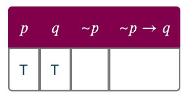
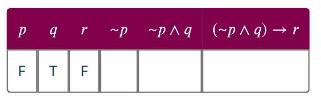
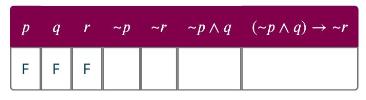
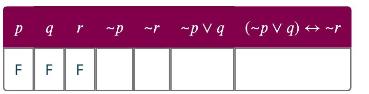
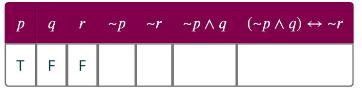
Complete the truth table to determine the truth value of the proposition in the last column. p q TT
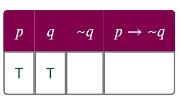
Complete the truth table to determine the truth value of the proposition in the last column. | T T bd b~ bd
Complete the truth table to determine the truth value of the proposition in the last column. bd- d- P 9 -P FT
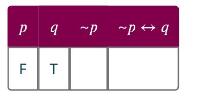
Complete the truth table to determine the truth value of the proposition in the last column. b~d b- bd F T
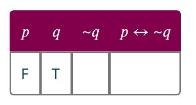
Complete the truth table to determine the truth value of the proposition in the last column. 1(byd~) bvd~ FT F
Complete the truth table to determine the truth value of the proposition in the last column. p q r -p LL F LL F FL 1~ (bv d~)
Complete the truth table to determine the truth value of the proposition in the last column. Pqr-p FF F pvq (~pvq) r
Complete the truth table to determine the truth value of the proposition in the last column. TF FF
Complete the truth table to determine the truth value of the proposition in the last column. p q r FFF -P -p pvr pr (pvr) (pr)
Complete the truth table to determine the truth value of the proposition in the last column. TT T p q r d- (d~d) (bv d~) dd bvd-
If Giacomo works with Faheem, then Faheem is not a software engineer.Assume these statements are true: \(p\) : Faheem is a software engineer, \(q\) : Ann is a project manager, \(r\) : Giacomo works with Faheem, and \(s\) : The software application was completed on time. Translate each of the
If the software application was not completed on time, then Ann is not a project manager.Assume these statements are true: \(p\) : Faheem is a software engineer, \(q\) : Ann is a project manager, \(r\) : Giacomo works with Faheem, and \(s\) : The software application was completed on time.
The software application was completed on time if and only if Giacomo worked with Faheem.Assume these statements are true: \(p\) : Faheem is a software engineer, \(q\) : Ann is a project manager, \(r\) : Giacomo works with Faheem, and \(s\) : The software application was completed on time.
Ann is not a project manager if and only if Faheem is a software engineer.Assume these statements are true: \(p\) : Faheem is a software engineer, \(q\) : Ann is a project manager, \(r\) : Giacomo works with Faheem, and \(s\) : The software application was completed on time. Translate each of the
If the software application was completed on time, then Ann is a project manager, but Faheem is not a software engineer.Assume these statements are true: \(p\) : Faheem is a software engineer, \(q\) : Ann is a project manager, \(r\) : Giacomo works with Faheem, and \(s\) : The software application
If Giacomo works with Faheem and Ann is a project manager, then the software application was completed on time.Assume these statements are true: \(p\) : Faheem is a software engineer, \(q\) : Ann is a project manager, \(r\) : Giacomo works with Faheem, and \(s\) : The software application was
The software application was not completed on time if and only if Faheem is a software engineer or Giacomo did not work with Faheem.Assume these statements are true: \(p\) : Faheem is a software engineer, \(q\) : Ann is a project manager, \(r\) : Giacomo works with Faheem, and \(s\) : The software
Faheem is a software engineer or Ann is not a project manager if and only if Giacomo did not work with Faheem and the software application was completed on time.Assume these statements are true: \(p\) : Faheem is a software engineer, \(q\) : Ann is a project manager, \(r\) : Giacomo works with
Ann is a project manager implies Faheem is a software engineer if and only if the software application was completed on time implies Giacomo worked with Faheem.Assume these statements are true: \(p\) : Faheem is a software engineer, \(q\) : Ann is a project manager, \(r\) : Giacomo works with
If Giacomo did not work with Faheem implies that the software application was not completed on time, then Ann was not the project manager.Assume these statements are true: \(p\) : Faheem is a software engineer, \(q\) : Ann is a project manager, \(r\) : Giacomo works with Faheem, and \(s\) : The
\(p \vee \sim q \rightarrow q\)Construct a truth table to analyze all the possible outcomes and determine the validity of each argument.
\(\sim q \rightarrow p \wedge \sim q\)Construct a truth table to analyze all the possible outcomes and determine the validity of each argument.
\((p \rightarrow q) \leftrightarrow q\)Construct a truth table to analyze all the possible outcomes and determine the validity of each argument.
\((p \rightarrow q) \leftrightarrow p\)Construct a truth table to analyze all the possible outcomes and determine the validity of each argument.
\(\sim(p \vee q) \leftrightarrow(\sim p \wedge \sim q)\)Construct a truth table to analyze all the possible outcomes and determine the validity of each argument.
\((p \rightarrow q) \wedge p \rightarrow q\)Construct a truth table to analyze all the possible outcomes and determine the validity of each argument.
\(p \rightarrow q \rightarrow r\)Construct a truth table to analyze all the possible outcomes and determine the validity of each argument.
\((p \rightarrow q) \wedge(q \rightarrow r) \leftrightarrow(p \rightarrow r)\)Construct a truth table to analyze all the possible outcomes and determine the validity of each argument.
\(p \vee(q \wedge r) \leftrightarrow(p \vee q) \wedge(p \vee r)\)Construct a truth table to analyze all the possible outcomes and determine the validity of each argument.
\(p \vee(q \vee r) \leftrightarrow(p \vee q) \vee r\)Construct a truth table to analyze all the possible outcomes and determine the validity of each argument.
Converse: \(q \rightarrow p\) and inverse: \(\sim p \rightarrow \sim q\)Determine whether the pair of compound statements are logically equivalent by constructing a truth table.
Conditional: \(p \rightarrow q\) and contrapositive: \(\sim q \rightarrow \sim p\)Determine whether the pair of compound statements are logically equivalent by constructing a truth table.
Inverse: \(\sim p \rightarrow \sim q\) and contrapositive: \(\sim q \rightarrow \sim p\)Determine whether the pair of compound statements are logically equivalent by constructing a truth table.
Conditional: \(p \rightarrow q\) and converse: \(q \rightarrow p\)Determine whether the pair of compound statements are logically equivalent by constructing a truth table.
\(\sim p \rightarrow q\) and \(p \vee \sim q\)Determine whether the pair of compound statements are logically equivalent by constructing a truth table.
\(\sim p \rightarrow q\) and \(p \vee q\)Determine whether the pair of compound statements are logically equivalent by constructing a truth table.
\(\sim(p \wedge q)\) and \(\sim p \wedge \sim q\)Determine whether the pair of compound statements are logically equivalent by constructing a truth table.
\(\sim(p \wedge q)\) and \(\sim p \vee \sim q\)Determine whether the pair of compound statements are logically equivalent by constructing a truth table.
\(p \wedge(q \vee r)\) and \((p \wedge q) \vee(p \wedge r)\)Determine whether the pair of compound statements are logically equivalent by constructing a truth table.
\(p \wedge(q \vee r)\) and \((p \wedge q) \vee r\)Determine whether the pair of compound statements are logically equivalent by constructing a truth table.
\(p\) : Six is afraid of Seven and \(q\) : Seven ate Nine.Answer the following:a. Write the conditional statement \(p \rightarrow q\) in words.b. Write the converse statement \(q \rightarrow p\) in words.c. Write the inverse statement \(\sim p \rightarrow \sim q\) in words.d. Write the
\(p\) : Hope is eternal and \(q\) : Despair is temporary.Answer the following:a. Write the conditional statement \(p \rightarrow q\) in words.b. Write the converse statement \(q \rightarrow p\) in words.c. Write the inverse statement \(\sim p \rightarrow \sim q\) in words.d. Write the
Showing 6200 - 6300
of 6887
First
55
56
57
58
59
60
61
62
63
64
65
66
67
68
69
Step by Step Answers

 Get 50% OFF
Claim Now
Get 50% OFF
Claim Now