New Semester
Started
Get
50% OFF
Study Help!
--h --m --s
Claim Now
Question Answers
Textbooks
Find textbooks, questions and answers
Oops, something went wrong!
Change your search query and then try again
S
Books
FREE
Study Help
Expert Questions
Accounting
General Management
Mathematics
Finance
Organizational Behaviour
Law
Physics
Operating System
Management Leadership
Sociology
Programming
Marketing
Database
Computer Network
Economics
Textbooks Solutions
Accounting
Managerial Accounting
Management Leadership
Cost Accounting
Statistics
Business Law
Corporate Finance
Finance
Economics
Auditing
Tutors
Online Tutors
Find a Tutor
Hire a Tutor
Become a Tutor
AI Tutor
AI Study Planner
NEW
Sell Books
Search
Search
Sign In
Register
study help
mathematics
contemporary mathematics
Contemporary Mathematics 1st Edition OpenStax - Solutions
Affirming the consequent: \(p \rightarrow q\) and \(q\). Therefore, \(p\).Use a truth table or construct a Venn diagram to prove whether the following arguments are valid.
\(\sim p \vee q\) and \(p\). Therefore, \(q\).Use a truth table or construct a Venn diagram to prove whether the following arguments are valid.
\(p \wedge q \rightarrow r\) and \(\sim r\). Therefore, \(\sim p \vee \sim q\).Use a truth table or construct a Venn diagram to prove whether the following arguments are valid.
The ____________ of a logical statement has the opposite truth value of the original statement.Fill in the blank to complete the following sentence.
____________ are logical statements presented as the facts used to support the conclusion of a logical argument.Fill in the blank to complete the following sentence.
Where is the restroom?Determine whether each of the following sentence represents a logical statement, also called a proposition. If it is a logical statement, determine whether it is true or false.
No even numbers are odd numbers.Determine whether each of the following sentence represents a logical statement, also called a proposition. If it is a logical statement, determine whether it is true or false.
\(4+3=8\).Determine whether each of the following sentence represents a logical statement, also called a proposition. If it is a logical statement, determine whether it is true or false.
\(\sim p\) : Pink Floyd's album The Wall is not a rock opera.Write the negation of each following statement symbolically and in words.
\(q\) : Some dogs are Labrador retrievers.Write the negation of each following statement symbolically and in words.
\(\sim r\) : Some universities are not expensive.Write the negation of each following statement symbolically and in words.
Spaghetti noodles are made with wheat, ramen noodles are made with wheat, and to mein noodles are made with wheat.Draw a logical conclusion to the following arguments, and include in both one of the following quantifiers: all, some, or none.
A Porsche Boxster does not have four doors, a Volkswagen Beetle does not have four doors, and a Mazda Miata does not have four doors.Draw a logical conclusion to the following arguments, and include in both one of the following quantifiers: all, some, or none.
____________ are words or symbols used to join two or more logical statement together to from a compound statement.Fill in the blank to complete the following sentence.
____________ and ____________ have equal dominance and are evaluated from left to right when no parentheses are present in a compound logical statement.Fill in the blank to complete the following sentence.
If Tweety Bird is a bird, then Sylvester will not chase him.Translate each compound statement below into symbolic form.Given: \(p\) : “Tweety Bird is a bird," \(q\) : "Bugs is a bunny," \(r\) : "Bugs says, 'What's up, Doc?'," \(s\) : "Sylvester is a cat," and \(t\) : "Sylvester chases Tweety
Tweety Bird is a bird and Sylvester chases him if and only if Bugs says, "What's up Doc?"Translate each compound statement below into symbolic form.Given: \(p\) : “Tweety Bird is a bird," \(q\) : "Bugs is a bunny," \(r\) : "Bugs says, 'What's up, Doc?'," \(s\) : "Sylvester is a cat," and \(t\) :
\(\sim q \vee p \rightarrow \sim s\)Translate the symbolic form of each compound logical statement below into words.Given: p: "Tweety Bird is a bird," \(q\) : "Bugs is a bunny," \(r\) : "Bugs says, 'What's up, Doc?'," \(s\) : "Sylvester is a cat," and \(t\) "Sylvester chases Tweety Bird."
\(\sim(p \wedge \sim s) \leftrightarrow q \rightarrow r\)Translate the symbolic form of each compound logical statement below into words.Given: p: "Tweety Bird is a bird," \(q\) : "Bugs is a bunny," \(r\) : "Bugs says, 'What's up, Doc?'," \(s\) : "Sylvester is a cat," and \(t\) "Sylvester chases
\(p \vee q \wedge r \rightarrow \sim s \wedge t\)For each of the following compound logical statements, apply the proper dominance of connectives by adding parentheses to indicate the order to evaluate the statement.
\(\sim p \rightarrow q \vee r \leftrightarrow p \wedge s \rightarrow \sim t\)For each of the following compound logical statements, apply the proper dominance of connectives by adding parentheses to indicate the order to evaluate the statement.
A ____________ is true if at least one of its component statements is true.Fill in the blank to complete the sentence.
For a ____________ to be true, all of its component statements must be true.Fill in the blank to complete the sentence.
\(p \wedge \sim r\)Given the statements, p: "No fish are mammals," \(q\) : "All lions are cats," and \(\sim r\) : "Some birds do not lay eggs," construct a truth table to determine the truth value of each compound statement below.
\(\sim(p \vee \sim r)\)Given the statements, p: "No fish are mammals," \(q\) : "All lions are cats," and \(\sim r\) : "Some birds do not lay eggs," construct a truth table to determine the truth value of each compound statement below.
\(\sim p \vee q \wedge \sim(\sim r)\)Given the statements, p: "No fish are mammals," \(q\) : "All lions are cats," and \(\sim r\) : "Some birds do not lay eggs," construct a truth table to determine the truth value of each compound statement below.
\(\sim p \vee q \wedge p\)Construct a truth table to analyze all the possible outcomes of the following statements, and determine whether the statements are valid.
\(\sim p \vee q \vee \sim q\)Construct a truth table to analyze all the possible outcomes of the following statements, and determine whether the statements are valid.
If the ____________, p, of a conditional statement is true, then the conclusion, \(q\), must also be true for the conditional statement \(p \rightarrow q\) to be true.Fill in the blank to complete the following sentence.
The biconditional statement \(p \leftrightarrow q\) is ____________ whenever the truth value of \(p\) matches the truth value of \(q\), otherwise it is ____________.Fill in the blank to complete the following sentence.
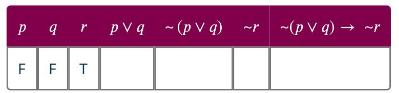
Complete the truth tables below to determine the truth value of the proposition in the last column. pqrpvq ~(pvq) -r FF T ~(pvq) ~r
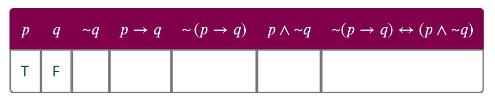
Complete the truth tables below to determine the truth value of the proposition in the last column. T (b-vd) (bd)~ b~vd (bd) bd b- bd LL F
If Timmy Turner is 10 years old and Poof is not a baby fairy, then Timmy Turner has fairly odd parents.Assume the following statements are true. \(p\) : "Poof is a baby fairy," \(q\) : "Timmy Turner has fairly odd parents," \(r\) : "Cosmo and Wanda will grant Timmy's wishes," and \(t\) : "Timmy
Cosmos and Wanda will not grant Timmy's wishes if and only if Timmy Turner is 10 years old or he does not have fairly odd parents.Assume the following statements are true. \(p\) : "Poof is a baby fairy," \(q\) : "Timmy Turner has fairly odd parents," \(r\) : "Cosmo and Wanda will grant Timmy's
Construct a truth table to analyze all the possible outcomes and determine the validity of the following argument. \(\sim p \vee q \leftrightarrow \sim q \rightarrow \sim p\)Assume the following statements are true. \(p\) : "Poof is a baby fairy," \(q\) : "Timmy Turner has fairly odd parents,"
The ____________ is logically equivalent to the inverse \(\sim p \rightarrow \sim q\).Fill in the blank to complete the sentence above.
The ___________ is logically equivalent to the conditional \(p \rightarrow q\).Fill in the blank to complete the sentence above.
Write the conclusion of the conditional statement in words and label it appropriately.Use the conditional statement, \(p \rightarrow q\) : "If Novak makes the basket, then Novak's team will win the game," to answer the following questions.
Write the hypothesis of the conditional statement in words and label it appropriately.Use the conditional statement, \(p \rightarrow q\) : "If Novak makes the basket, then Novak's team will win the game," to answer the following questions.
Identify the following statement as the converse, inverse, or contrapositive: "If Novak does not make the basket, then his team will not win the game."Use the conditional statement, \(p \rightarrow q\) : "If Novak makes the basket, then Novak's team will win the game," to answer the following
Identify the following statement as the converse, inverse, or contrapositive: "If Novak's team wins the game, then he made the basket."Use the conditional statement, \(p \rightarrow q\) : "If Novak makes the basket, then Novak's team will win the game," to answer the following questions.
De Morgan's Law for the negation of a disjunction states that \(\sim(p \vee q) \equiv\) _________Fill in the blank to complete the sentence.
De Morgan's Law for the negation of a conjunctions states that ___________ \(\equiv \sim p \vee \sim q\).Fill in the blank to complete the sentence.
Apply De Morgan's Law to write the statement without parentheses: \(\sim(\sim p \wedge q)\).
Apply the property for the negation of a conditional to write the statement as a conjunction or disjunction: \(\sim(\sim p \wedge q \rightarrow \sim r)\).
Write the negation of the conditional statement in words: If Thomas Edison invented the phonograph, then albums are made of vinyl, or the transistor radio was the first portable music device.
Construct a truth table to verify that the logical property is valid: \(\sim(\sim p \rightarrow \sim q) \equiv \sim p \wedge q\).
The _________________ is a valid logical argument with premises, \(p \rightarrow q\) and \(p\), used to support the conclusion, \(q\).Fill in the blank to complete the sentence.
The chain rule for conditional arguments states that the ____________ property applies to conditional arguments, so that: \((p \rightarrow q) \wedge(q \rightarrow r) \rightarrow(p \rightarrow r)\).Fill in the blank to complete the sentence.
If the Tampa Bay Buccaneers did not win Super Bowl LV, then Tom Brady was not their quarterback. Tom Brady was the Tampa Bay Buccaneers quarterback.Assume each pair of statements represents true premises in a logical argument. Based on these premises, state a valid conclusion that is consistent
If \(\sim q\), then \(p\) and if \(r\), then \(\sim q\).Assume each pair of statements represents true premises in a logical argument. Based on these premises, state a valid conclusion that is consistent with the form of the argument.
If Kamala Harris is the vice president of the United States, then Kamala Harris is the president of the U.S. Senate. Kamala Harris is the vice president of the United States.Assume each pair of statements represents true premises in a logical argument. Based on these premises, state a valid
Construct a truth table or Venn diagram to prove whether the following argument is valid. If the argument is valid, determine whether it is sound.If all frogs are brown, then Kermit is not a frog. Kermit is a frog. Therefore, some frogs are not brown.
Determine whether each of the following sentences represents a logical statement. If it is a logical statement, determine whether it is true or false.1. The Buffalo Bills defeated the New York Giants in Super Bowl XXV.2. Michael Jackson's album Thriller was released in 1982.3. Would you like some
Write each of the following logical statements in symbolic form.1. The movie Gandhi won the Academy Award for Best Picture in 1982.2. Soccer is the most popular sport in the world.3. All oranges are citrus fruits.
Write the negation of each logical statement in words.1. Ted Cruz was not born in Texas.2. Adele has a beautiful singing voice.3. Leaves convert carbon dioxide to oxygen during the process of photosynthesis.
Write the negation of each logical statement symbolically.1. \(\sim p\) : Ted Cruz was not born in Texas.2. \(q\) : Adele has a beautiful voice.3. \(r\) : Leaves convert carbon dioxide to oxygen during the process of photosynthesis.
Given the statements:\(r\) : Woody and Buzz Lightyear are best friends.\(\sim p\) : Wonder Woman is not stronger than Captain Marvel.1. Write the symbolic form of the statement, "Wonder Woman is stronger than Captain Marvel."2. Translate the statement \(\sim r\) into words.
For each series of premises, draw a logical conclusion to the argument that includes one of the following quantifiers: all, some, or none.1. \(1+2=3,5+6=11\), and \(14+15=29\). Of these, 1 and 2 are consecutive integers, 5 and 6 are consecutive integers, and 14 and 15 are consecutive integers.
Given the statements:\(\sim p\) : Some apples are not sweet. \(r\) : No triangles are squares.\(s\) : Some vegetables are green. Write each of the following symbolic statements in words.1. \(p\)2. \(\sim r\)3. \(\sim S\)
For each connective write its name and associated symbol.1. not 2. and 3. if and only if
Let \(p\) represent the statement, "Last night it snowed," and let \(q\) represent the statement, "Today we will go skiing." Write the symbolic form of each of the following compound statements:1. Today we will go skiing, but last night it did not snow.2. Today we will go skiing if and only if it
Let \(p\) represent the statement, "My roommates ordered pizza," let \(q\) represent the statement, "I ordered wings," and let \(r\) be the statement, "Our friends came over to watch the game." Translate the following statements into words.1. \(\sim r \rightarrow(p \vee q)\)2. \((p \wedge q)
For each logical statement, determine the truth value of its negation.1. \(\sim p: 3 \times 5=14\).2. \(\sim q\) : Some houses are built with bricks.3. \(r\) : Abuja is the capital of Nigeria.
Given \(p\) : Yellow is a primary color, \(q\) : Blue is a primary color, and \(r\) : Green is a primary color, determine the truth value of each conjunction.1. \(p \wedge q\)2. \(q \wedge r\)3. \(\sim r \wedge p\)
Given \(p\) : Yellow is a primary color, \(q\) : Blue is a primary color, and \(r\) : Green is a primary color, determine the truth value of each disjunction.1. \(p \vee q\)2. \(\sim p \vee r\)3. \(q \vee r\)
Given \(p\) : Yellow is a primary color, \(q\) : Blue is a primary color, and \(r\) : Green is a primary color, determine the truth value of each compound statement, by constructing a truth table.1. \(\sim q \wedge p \vee r\)2. \(p \vee q \wedge \sim r\)3. \(\sim(p \wedge r) \wedge q\)
Construct a truth table to determine the validity of each of the following statements.1. \(p \vee \sim p\)2. \(\sim p \vee \sim q\)
Assume \(p\) is true and \(q\) is false. \(p\) : Kevin vacuumed the living room, and \(q\) : Kevin's parents did not let him borrow the car. Create a truth table to determine the truth value of each of the following conditional statements.1. \(p \rightarrow q\)2. \(p \rightarrow \sim q\)3. \(\sim p
Construct a truth table to analyze all possible outcomes for each of the following statements, then determine whether they are valid.1. \(q \rightarrow \sim p \vee q\)2. \(\sim p \rightarrow q \wedge p\)
Assume \(p\) is true and \(q\) is false: \(p\) : The contractor fixed the broken window, and \(q\) : The homeowner paid the contractor \(\$ 200\). Create a truth table to determine the truth value of each of the following biconditional statements.1. \(p \leftrightarrow q\)2. \(p \leftrightarrow
Construct a truth table to analyze all possible outcomes for each of the following statements, then determine whether they are valid.1. \(\sim(p \wedge q) \leftrightarrow(\sim p \vee \sim q)\)2. \(\sim p \leftrightarrow q \wedge p\)3. \(p \rightarrow q \leftrightarrow \sim p \vee q\)4. \(p \wedge q
Create a truth table to determine whether the following compound statements are logically equivalent.1. \(p \rightarrow q ; q \rightarrow \sim p\)2. \(p \rightarrow q ; p \vee \sim q\)
Use the statements, \(p\) : Elvis Presley wore capes and \(q\) : Some superheroes wear capes, to write the following statements:1. Write the conditional statement, \(p \rightarrow q\), in words.2. Write the converse statement, \(q \rightarrow p\), in words.3. Write the inverse statement, \(\sim p
Use the conditional statement, "If Dora is an explorer, then Boots is a monkey," to identify the following:1. Write the hypothesis of the conditional statement and label it with a \(p\).2. Write the conclusion of the conditional statement and label it with a \(q\).3. Identify the following
Assume the conditional statement \(p \rightarrow q\) : "If my friend lives in San Francisco, then my friend does not live in California" is false, and use it to answer the following questions.1. Write the converse of the statement in words and determine its truth value.2. Write the inverse of the
Write the negation of each statement in words without using the phrase, it is not the case that.1. Jackie played softball or she ran track.2. Brandon studied for his certification exam, and he passed his exam.
Write the negation of each conditional statement.1. If Edna Mode makes a new superhero costume, then it will not include a cape.2. If I had pancakes for breakfast, then I used maple syrup.
Write the negation of each conditional statement.1. If some people like ice cream, then ice cream makers will make a profit.2. If Raquel cannot play video games, then nobody will play video games.
Write the negation of each conditional statement applying De Morgan's Law.1. If Eric needs to replace the light bulb, then Marcus left the light on all night or Dan broke the bulb.2. If Trenton went to school and Regina went to work, then Merika cleaned the house.
Each pair of statements represents the premises in a logical argument. Based on these premises, apply the law of detachment to determine a valid conclusion.1. If my classmate likes history, then some people like history. My classmate likes history.2. If you do not like to read, then some people do
Each pair of statements represents the premises in a logical argument. Based on these premises, apply the law of denying the consequent to determine a valid conclusion.1. If my classmate likes history, then some people like history. Nobody likes history.2. If Homer does not like to read, then some
Each pair of statements represent true premises in a logical argument. Based on these premises, apply the chain rule for conditional arguments to determine a valid and sound conclusion.1. If my roommate does not go to work, then my roommate will not get paid. If my roommate does not get paid, then
\(\sim(\sim p \vee q)\)Use De Morgan's Laws to write each statement without parentheses.
\(\sim(\sim p \wedge \sim q)\)Use De Morgan's Laws to write each statement without parentheses.
\(\sim(p \wedge \sim q)\)Use De Morgan's Laws to write each statement without parentheses.
\(\sim(\sim p \vee \sim q)\)Use De Morgan's Laws to write each statement without parentheses.
Sergei plays right wing and Patrick plays goalie.Use De Morgan's Laws to write the negation of each statement in words without using the phrase, "It is not the case that, ..."
Mario is a carpenter, or he is a plumber.Use De Morgan's Laws to write the negation of each statement in words without using the phrase, "It is not the case that, ..."
Luigi is a plumber, or he is not a video game character.Use De Morgan's Laws to write the negation of each statement in words without using the phrase, "It is not the case that, ..."
Ralph Macchio was the original Karate Kid, and karate is not for defense only.Use De Morgan's Laws to write the negation of each statement in words without using the phrase, "It is not the case that, ..."
Some people like broccoli, but my siblings did not like broccoli.Use De Morgan's Laws to write the negation of each statement in words without using the phrase, "It is not the case that, ..."
Some people do not like chocolate or all people like pizza.Use De Morgan's Laws to write the negation of each statement in words without using the phrase, "It is not the case that, ..."
\(\sim(p \rightarrow q)\)Write each statement as a conjunction or disjunction in symbolic form by applying the property for the negation of a conditional.
\(\sim(p \rightarrow \sim q)\)Write each statement as a conjunction or disjunction in symbolic form by applying the property for the negation of a conditional.
\(\sim(\sim p \rightarrow q)\)Write each statement as a conjunction or disjunction in symbolic form by applying the property for the negation of a conditional.
\(\sim(\sim p \rightarrow \sim q)\)Write each statement as a conjunction or disjunction in symbolic form by applying the property for the negation of a conditional.
\(\sim(p \wedge q \rightarrow \sim r)\)Write each statement as a conjunction or disjunction in symbolic form by applying the property for the negation of a conditional.
\(\sim(p \rightarrow q \vee r)\)Write each statement as a conjunction or disjunction in symbolic form by applying the property for the negation of a conditional.
\(\sim(p \vee q \rightarrow \sim r)\)Write each statement as a conjunction or disjunction in symbolic form by applying the property for the negation of a conditional.
Showing 6100 - 6200
of 6887
First
55
56
57
58
59
60
61
62
63
64
65
66
67
68
69
Step by Step Answers

 Get 50% OFF
Claim Now
Get 50% OFF
Claim Now