New Semester
Started
Get
50% OFF
Study Help!
--h --m --s
Claim Now
Question Answers
Textbooks
Find textbooks, questions and answers
Oops, something went wrong!
Change your search query and then try again
S
Books
FREE
Study Help
Expert Questions
Accounting
General Management
Mathematics
Finance
Organizational Behaviour
Law
Physics
Operating System
Management Leadership
Sociology
Programming
Marketing
Database
Computer Network
Economics
Textbooks Solutions
Accounting
Managerial Accounting
Management Leadership
Cost Accounting
Statistics
Business Law
Corporate Finance
Finance
Economics
Auditing
Tutors
Online Tutors
Find a Tutor
Hire a Tutor
Become a Tutor
AI Tutor
AI Study Planner
NEW
Sell Books
Search
Search
Sign In
Register
study help
mathematics
linear algebra
Linear Algebra A Modern Introduction 3rd edition David Poole - Solutions
Determine whether the angle between u and v is acute, obtuse, or a right angle.u = [1, 2, 3, 4], v = [5, 6, 7, 8]
Determine whether the angle between u and v is acute, obtuse, or a right angle.u = [1, 2, 3, 4], v = [-3, 1, 2, -2]
Determine whether the angle between u and v is acute, obtuse, or a right angle.u = [0.9, 2.1, 1.2], v = [-4.5, 2.6, -0.8]
Determine whether the angle between u and v is acute, obtuse, or a right angle.u = [5, 4, -3], v = [1, -2, -1]
Determine whether the angle between u and v is acute, obtuse, or a right angle. -3.
If u, v, and w are vectors in Rn, n ≥ 2, and c is a scalar, explain why the following expressions make no sense:(a)∥u · v∥(b)u · v + w(c)u · (v · w)(d)c · (u + w)
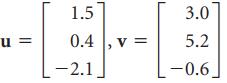
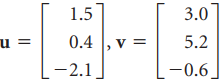
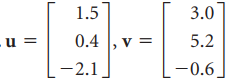
Find the distance d(u, v) between u and v in the given exercise.Data From Exercise 4 1.5 3.0 5.2 0.4 , v = -0.6 -2.1
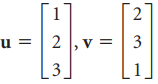
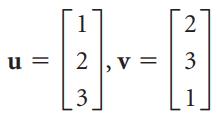
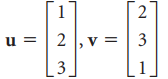
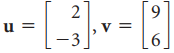
Find the distance d(u, v) between u and v in the given exercise.Data From Exercise 3 2 , v = | 3 3 2.
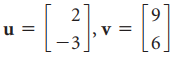
Find the distance d(u, v) between u and v in the given exercise.Data From Exercise 2 2 6.
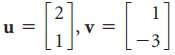
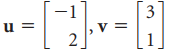
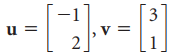
Find the distance d(u, v) between u and v in the given exercise.Data From Exercise 1 -1 3 2.
Find ∥u∥ for the given exercise, and give a unit vector in the direction of u.Data From Exercise 6u = [1.12, -3.25, 2.07, -1.83],v = [-2.29, 1.72, 4.33, -1.54]
Find ∥u∥ for the given exercise, and give a unit vector in the direction of u.Data From Exercise 5u = [1, √2, √3, 0], v = [4, -√2, 0, -5]
Find ˆ¥uˆ¥ for the given exercise, and give a unit vector in the direction of u.Data From Exercise 4 1.5 3.0 0.4 , v = 5.2 -2.1 -0.6
Find ¥u¥ for the given exercise, and give a unit vector in the direction of u.Data From Exercise 3 2 v = u = 2 , v = 3 3.
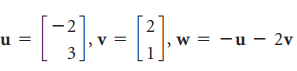
Draw the coordinate axes relative to u and v and locate w. w = -u - 2v 3 ||
Compute the indicated vectors.2c - 3b - dData From Exercise 3(a) a = [0, 2, 0] (b) b = [3, 2, 1](c) c = [1, -2, 1] (d) d = [-1, -1, -2]
Compute the indicated vectors.2a + 3cData From Exercise 3(a) a = [0, 2, 0] (b) b = [3, 2, 1](c) c = [1, -2, 1] (d) d = [-1, -1, -2]
Compute the indicated vectors and also show how the results can be obtained geometrically.a - dData From Exercise 1(a) (b) (c) (d) 3 a b = 3
Compute the indicated vectors and also show how the results can be obtained geometrically.d - cData From Exercise 1(a) (b) (c) (d) 3 a b = 3
Give the vector equation of the plane passing through P, Q, and R.P = (1, 0, 0), Q = (0, 1, 0), R = (0, 0, 1)
Give the vector equation of the line passing through P and Q.P = (4, -1, 3), Q = (2, 1, 3)
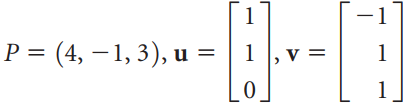
Write the equation of the plane passing through P with direction vectors u and v in (a) vector form and (b) parametric form. P = (4, – 1, 3), u = | 1
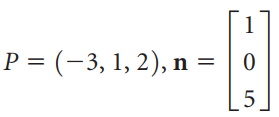
Write the equation of the plane passing through P with normal vector n in (a) normal form and (b) general form. P = (-3, 1, 2), n = 5.
Compute the indicated vectors and also show how the results can be obtained geometrically.b + cData From Exercise 1(a) (b) (c) (d) 3 a b = 3
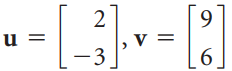
Find ˆ¥uˆ¥ for the given exercise, and give a unit vector in the direction of u.Data From Exercise 2 9. u [6. -3
Compute the indicated vectors and also show how the results can be obtained geometrically.a + bData From Exercise 1(a) (b) (c) (d) 3 a b = 3
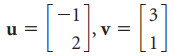
Find ??u?? for the given exercise, and give a unit vector in the direction of u. Data From Exercise 1 3 u = v = 2.
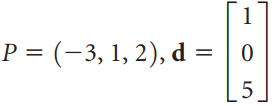
Write the equation of the line passing through P with direction vector d in(a) Vector form(b) Parametric form. P = (-3, 1, 2), d = 0 5
Find u · v.u = [1.12, -3.25, 2.07, -1.83],v = [-2.29, 1.72, 4.33, -1.54]
For each of the following pairs of points, draw the vector Then compute and redraw as a vector in standard position.(a) A = (1, -1), B = (4, 2)(b) A = (0, -2), B = (2, -1)(c) (d) A = (2, }), B = (;, 3) A = (55), B = (3) %3D
Find u · v.u = [1, √2, √3, 0], v = [4, -√2, 0, -5]
Find u · v. 1.5 3.0 0.4 , v = 5.2 -0.6 -2.1
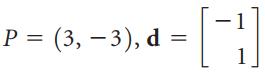
Write the equation of the line passing through P with direction vector d in(a) Vector form(b) Parametric form. - 1 P = (3, – 3), d
Let A, B, C, and D be the vertices of a square centered at the origin O, labeled in clockwise order. If a = O̅A̅ and b = O̅B̅, find B̅C̅ in terms of a and b.
If the vectors in Exercise 3 are translated so that their heads are at the point (1, 2, 3), find the points that correspond to their tails.Data From Exercise 3(a) a = [0, 2, 0] (b) b = [3, 2, 1](c) c = [1, -2, 1] (d) d = [-1, -1, -2]
Find u · v. 2 ,v = | 3 u 2. 3.
Find u · v. -3
Draw the vectors in Exercise 1 with their tails at the point (1, -3). Data From Exercise 1(a) (b) (c) (d) 3 a b = 3
Find u · v. 3 2
Determine whether the given set, together with the specified operations of addition and scalar multiplication, is a vector space. If it is not, list all of the axioms that fail to hold.The set of all vectorsin R2 with x ‰¥ 0, y ‰¥ 0 (i.e., the first quadrant), with the usual
Determine whether the given set, together with the specified operations of addition and scalar multiplication, is a vector space. If it is not, list all of the axioms that fail to hold.The set of all vectorsin R2 with x ‰¥ y (i.e.,the union of the first and third quadrants), with the usual
Determine whether the given set, together with the specified operations of addition and scalar multiplication, is a vector space. If it is not, list all of the axioms that fail to hold.The set of all vectorsin R2 with x ‰¥ y, with the usual vector addition and scalar multiplication х -У.
Find the solution of the differential equation that satisfies the given boundary condition(s).y'' - k2y = 0, k ≠ 0, y(0) = y'(0) = 1
Determine whether the given set, together with the specified operations of addition and scalar multiplication, is a complex vector space. If it is not, list all of the axioms that fail to hold.Rn, with the usual vector addition and scalar multiplication
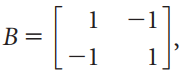
Determine whether the linear transformation T is invertible by considering its matrix with respect to the standard bases. If T is invertible, use Theorem 6.28 and the method of Example 6.82 to find T-1.T in Exercise 11Data From Exercise 11T : M22 †’ M22 defined by T(A) = AB - BA,
Which of the codes are linear codes?The even parity code En
Prove Theorem 6.17.
Find the dimension of the vector space V and give a basis for V.V = {A in M22 : A is upper triangular}
Prove Theorem 6.10(f).
Prove Theorem 7.1(b).
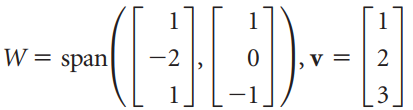
Find the standard matrix of the orthogonal projection onto the subspace W. Then use this matrix to find the orthogonal projection of v onto W. W = span| -2 3 -1
Prove Theorem 7.7(b).
Show that if A is an invertible matrix, then cond (A) ≥ 1 with respect to any matrix norm.
Prove Theorem 7.12(b).
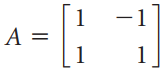
Find a polar decomposition of the matrices in A in Exercise 14Data From Exercise 14 -1 A = 1
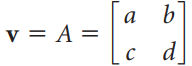
Determine whether T is a linear transformation.T : M22 †’ M22 defined by w + x х y – z] I|
Determine whether W is a subspace of V. V = f, W = {f in f : f (x + π) = f (x) for all x}
Find the matrix [T] C†Bof the linear transformation T : V †’ W with respect to the bases B and C of V and W, respectively. Verify Theorem 6.26 for the vector v by computing T(v) directly and using the theorem.T : P2 †’ R2 defined by T(P(x) ) B = {1, x, x2},
Find the solution of the differential equation that satisfies the given boundary condition(s).f '' - f ' - f = 0, f(0) = 0, f(1) = 1
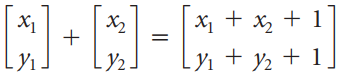
Determine whether the given set, together with the specified operations of addition and scalar multiplication, is a vector space. If it is not, list all of the axioms that fail to hold.R2, with the usual scalar multiplication but addition defined by A-A-A ху + x, + 1 Lyi + y½ + 1 X2
Determine whether T is a linear transformation. T : Mnn → R defined by T(A) = a11a22 ··· ann
Determine whether the given set, together with the specified operations of addition and scalar multiplication, is a vector space. If it is not, list all of the axioms that fail to hold.The set of all positive real numbers, with addition ⊕ defined by x ⊕ y = xy and scalar multiplication ʘ
Determine whether T is a linear transformation. T : Mnn → R defined by T(A) = rank (A)
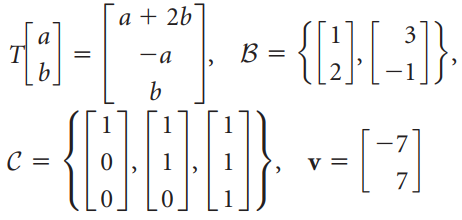
Find the matrix [T]C†Bof the linear transformation T : V †’ W with respect to the bases B and C of V and W, respectively. Verify Theorem 6.26 for the vector v by computing T(v) directly and using the theorem. T : R2 †’ R2 defined by a + 2b в-(B4) 3 -a э
Find the solution of the differential equation that satisfies the given boundary condition(s).y'' - 2y' + y = 0, y(0) = y(1) = 1
Determine whether T is a linear transformation. T : P2 → P2 defined by T(a + bx + cx2) = (a + 1) + (b + 1) x + (c + 1)x2
Determine whether the given set, together with the specified operations of addition and scalar multiplication, is a vector space. If it is not, list all of the axioms that fail to hold.The set of all rational numbers, with the usual addition and multiplication
Follow the instructions for Exercises 1–4 using p(x) instead of x.p(x) = 2 - x, + 3x2, B = {1 + x, 1 + x2, x + x2}, C = {1, x, 1 + x + x2} in P2 Instructions From Exercise 1(a) Find the coordinate vectors [x]B and [x]B of x with respect to the bases B and C, respectively.(b) Find the
Find the matrix [T]C†Bof the linear transformation T : V †’ W with respect to the bases B and C of V and W, respectively. Verify Theorem 6.26 for the vector v by computing T(v) directly and using the theorem. Repeat Exercise 7 withData From Exercise 7T : R2 †’ R2
Test the sets of polynomials for linear independence. For those that are linearly dependent, express one of the polynomials as a linear combination of the others.{2x, 1 - x3, x2 - x3, 1 - 2x + x2} in P3
Find the solution of the differential equation that satisfies the given boundary condition(s).x'' + 4x' + 4x = 0, x(0) = 1, x'(0) = 1
Test the sets of polynomials for linear independence. For those that are linearly dependent, express one of the polynomials as a linear combination of the others.{1 - 2x, 3x + x2 - x3, 1 + x2 + 2x3, 3 + 2x + 3x3} in P3
Determine whether T is a linear transformation. T : P2 → P2 defined by T(a + bx + cx2) = (a + 1) = a + b(x + 1) + b(x + 1)2
Determine whether the given set, together with the specified operations of addition and scalar multiplication, is a vector space. If it is not, list all of the axioms that fail to hold.The set of all upper triangular 2 × 2 matrices, with the usual matrix addition and scalar multiplication
Determine whether T is a linear transformation. T : F → F defined by T(f) = f(x2)
Determine whether the given set, together with the specified operations of addition and scalar multiplication, is a vector space. If it is not, list all of the axioms that fail to hold. The set of all 2 × 2 matrices of the form where ad = 0, with the usual matrix addition and
Determine whether the given set, together with the specified operations of addition and scalar multiplication, is a vector space. If it is not, list all of the axioms that fail to hold. The set of all skew-symmetric n × n matrices, with the usual matrix addition and scalar multiplication.
Determine whether T is a linear transformation. T : F → R defined by T(f) = f(c), where c is a fixed scalar
Find either the nullity or the rank of T and then use the Rank Theorem to find the other.T : M33 → M33 defined by T(A) = A - AT
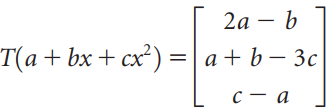
Determine whether the linear transformation T is (a) one-to-one and (b) onto.T : P2 †’ R3 defined by 2a – b T(a + bx + cx²) =| a + b – 3c
Determine whether the linear transformation T is (a) one-to-one and (b) onto.T : P2 †’ R2 defined by p(0) ] T(p(x)) Lp(1).
T : U → V and S : V → W are linear transformations and B, C, and D are bases for U, V, and W, respectively. Compute [S ͦ T]D←B in two ways: (a) by finding S ͦ T directly and then computing its matrix and (b) by finding the matrices of S and T separately and using Theorem 6.27.T :
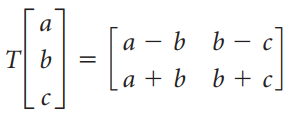
Determine whether the linear transformation T is (a) one-to-one and (b) onto.T : R3 †’ M22 defined by a – b b– TЬ La + b b + c_ ||
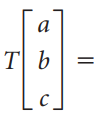
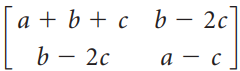
Determine whether the linear transformation T is (a) one-to-one and (b) onto.T : †’ R3 W defined by where W is the vector space of all symmetric 2 × 2 matrices T b a + b + c b – 2c b – 2c
Determine whether the linear transformation T is invertible by considering its matrix with respect to the standard bases. If T is invertible, use Theorem 6.28 and the method of Example 6.82 to find T-1.T in Exercise 5Data From Exercise 5T : P2 †’ R2 defined by T(P(x) ) B = {1,
Express p(x) = x3 as a Taylor polynomial about a = 1 / 2.
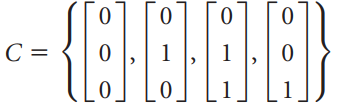
Which of the codes are linear codes? 1
Determine whether the set B is a basis for the vector space V.V = P2, B = {1, 2 - x, 3 - x2, x + 2x2}
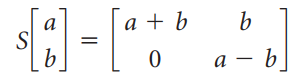
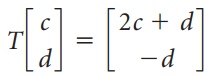
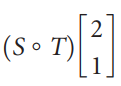
Define linear transformations S : R2†’ M22and T : R2†’R2byand ComputeandCan you compute If so, compute it. a + b a – b 2c + d d
Determine whether V and W are isomorphic. If they are, give an explicit isomorphism T : V → W. V = C, W = R2
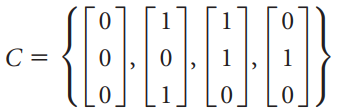
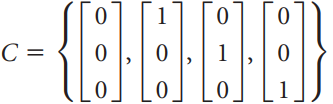
Which of the codes are linear codes? 1 C = 1 1
Determine whether V and W are isomorphic. If they are, give an explicit isomorphism T : V → W. V = {A in M22 : tr(A) = 0}, W = R2
Determine whether the linear transformation T is invertible by considering its matrix with respect to the standard bases. If T is invertible, use Theorem 6.28 and the method of Example 6.82 to find T-1.T in Exercise 12Data From Exercise 12T : M22 †’ M22 defined by T(A) = A - AT, B =
Which of the codes are linear codes? |C = 0_
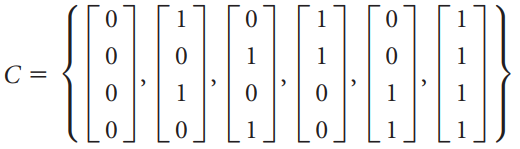
Which of the codes are linear codes? ПEEBBBB |C =
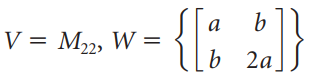
Use Theorem 6.2 to determine whether W is a subspace of V. {: :} a V = M2, W = b 2a
Use Theorem 6.2 to determine whether W is a subspace of V. a b {l: : ad > bc V = M, W = 22
Use the method of Example 6.83 to evaluate the given integral.∫ ( e2x cos x - 2e2x sin x)dx. (See Exercise 15.)Data From Exercise 15Consider the subspace W of D, given by W = span (e2x, e2x cos x, e2x sin x).(a) Find the matrix of D with respect to B = {e2x, e2x cos x, e2x sin x}.(b)
Use the method of Example 6.83 to evaluate the given integral.∫ (x cos x + x sin x) dx. (See Exercise 16.)Data From Exercise 16Consider the subspace W of D, given by W = span(cos x, sin x, x cos x, x sin x).(a) Find the matrix of D with respect to B = {cos x, sin x, x cos x, x sin
Which of the codes are linear codes?The odd parity code On consisting of all vectors in Zn2 with odd weight.
Showing 700 - 800
of 1025
1
2
3
4
5
6
7
8
9
10
11
Step by Step Answers

 Get 50% OFF
Claim Now
Get 50% OFF
Claim Now







![Ly]](https://dsd5zvtm8ll6.cloudfront.net/si.question.images/images/question_images/1536/0/7/5/2295b8ea5ddb189c1536057551857.jpg)

![w + x х y – z] I|](https://dsd5zvtm8ll6.cloudfront.net/si.question.images/images/question_images/1536/1/5/9/3155b8fee53d2abe1536141638739.jpg)
![[p(0)° Lp(1)] ||](https://dsd5zvtm8ll6.cloudfront.net/si.question.images/images/question_images/1536/2/2/8/3125b90fbd8ebb931536210645393.jpg)
![Find the matrix [T] C←B of the linear transformation T](https://dsd5zvtm8ll6.cloudfront.net/si.question.images/images/question_images/1536/2/2/8/8095b90fdc95d8cf1536211141768.jpg)

![p(0) ] T(p(x)) Lp(1).](https://dsd5zvtm8ll6.cloudfront.net/si.question.images/images/question_images/1536/1/6/7/1665b900cfe435271536149488546.jpg)